
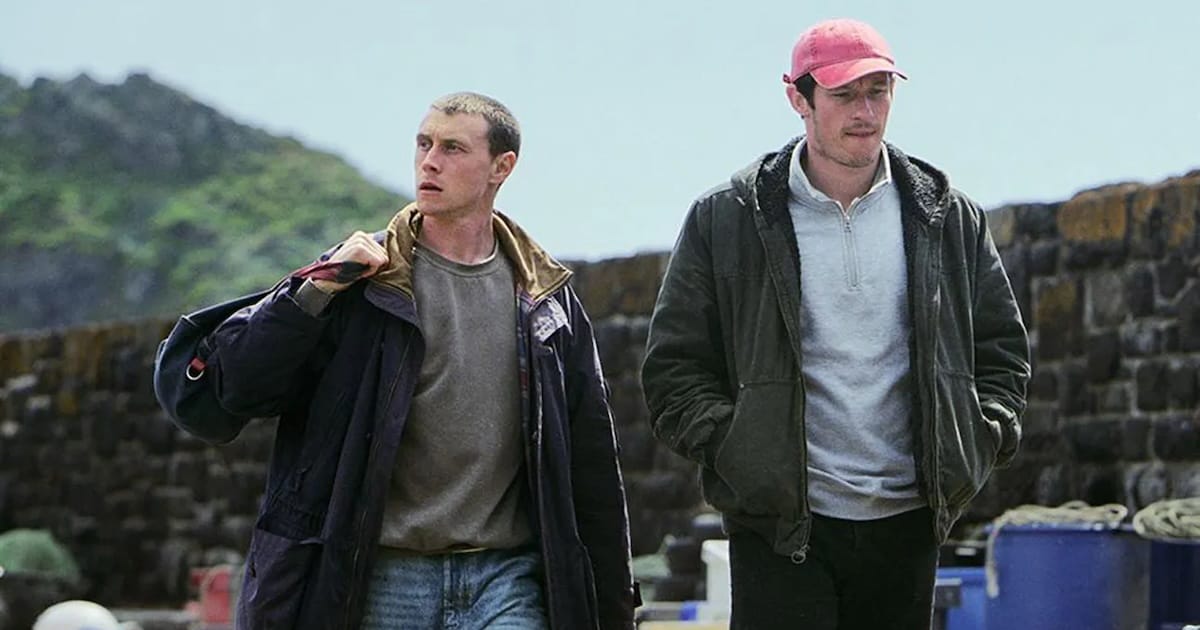
Mark Jenkin’s moody tale follows fishermen aboard a mysteriously returned trawler who find themselves trapped 30 years in the past.
Rose of Nevada, Mark Jenkin’s haunting time-travel movie, does an excellent job at building dread with its use of tight shots and other oppressive camerawork and subtle acting. But the pacing that works to achieve that effect can also cause it to drag at points.
The film, which premiered Nov. 2 at the Denver Film Festival, opens on a shot of the titular ship, Rose of Nevada, returning to the docks of a small fishing village after going missing 30 years along with its two-man crew. As the vessel approaches, the film shows close-ups of the rusty, old mechanisms of the once proud vessel as it creaks ominously.
The crewless trawler is first seen by an older local fisherman (Edward Rowe) who utters the words “She’s back.” He shares the fact that it’s returned to the widow of one of the crew, telling her it should be put back to work.
The film then follows Nick (George MacKay) and Liam (Callum Turner), residents of the dismal fishing village long past its prime, as they accept jobs aboard the Rose of Nevada.
Nick is a family man with a wife and young daughter who takes the job to pay to fix his roof that has recently caved in. Liam is a broke, sleazy drifter who flirts with the daughter of the widow.
The pair is joined by the newly hired boat captain (Francis Magee), a mysterious, almost otherworldly man who seems to know more than he lets on. As they embark on their first fishing trip, things go fairly smoothly. But as they return to the village, they discover they’ve been transported 30 years into the past and take the place of the two original crew members who went missing.
While Nick is horrified at potentially never seeing his family again, Liam is more than content with sliding into the role of husband and father to the original crewmate’s widow and daughter — which sickens Nick and puts the two into conflict.
Jenkin makes impressive use of camerawork and cinematography, giving the fishing village a dreary and oppressive feel with his use of tight angles shot on 16 mm film. The effect is to make everything feel claustrophobic. While on the fishing vessel, the camera lingers on shots of the decaying walls and rusty mechanisms, underscoring how ancient and decrepit the vessel is. The ambient sound design adds a lot to the creepy feeling, with the boat creaking and moaning ghoulishly over the sounds of the ocean.
The two leads give convincing performances, particularly Mackay as he subtly conveys the state of stress and dread Nick is in. Using just his haunted eyes, he depicts the anxiety of potentially never getting to see his family. Turner does well at portraying a slightly douchey, albeit endearing guy who shifts from a similar dread as Nick to contentment with his situation.
The story is not one for big climaxes or satisfying payoffs, making for a slow burn of character study and environment. After the initial reveal of the time travel, Rose of Nevada becomes more of a mood piece, where we slowly watch the two protagonists come to terms with their disturbing new situation.
Ultimately, Jenkin succeeds in creating a bleak and enigmatic film that comes to feel like a modern folktale. The haunting premise, measured pace, strong performances and captivating cinematography make the film a quiet study making an audience uneasy.



Andy Miller is an avid theatre-goer who lives and writes in Highlands Ranch.

Leave A Comment