

A beautifully sung South Pacific at Lakewood Cultural Center proves this Rodgers and Hammerstein classic still hits home in 2026.
One of the first major musicals to open in 2026 in Colorado at the Lakewood Cultural Center is also one of Broadway’s oldest: Rodgers and Hammerstein’s South Pacific, which first premiered in 1949. But in Performance Now Theatre Company’s glowing production, directed and choreographed by Kelly Van Oosbree, the show’s blend of romance, wartime drama and pointed social commentary feels anything but dusty.
The musical, based on James Michener’s Tales of the South Pacific, follows Navy nurse Nellie Forbush on an island in the South Pacific during WWII as she falls in love with French planter Emile de Becque and is forced to confront the racism she was taught back home in Little Rock when she discovers his late wife was Polynesian and his children are mixed-race. Rather than sanding down the show’s harder edges, this production leans into its emotional truth, allowing Nellie’s journey from love to fear to acceptance to play out with real weight.
Van Oosbree’s assured direction is an exquisitely executed reminder of why South Pacific remains a relevant and powerful musical from the Golden Age.
A fluid, dynamic island
Much of what makes this production hum is the work of technical director and scenic designer Andrew Bates, whose multi-use set keeps the show moving through its many island locations with remarkable speed and clarity. Platforms, rolling units and hand-carried furniture allow scenes to glide from military bases to tropical beaches to Emile’s plantation home, all choreographed seamlessly by the cast themselves.
Upstage, projections and lighting transform a simple backdrop into a living horizon that glows with sunlight, clouds, moonlight or stars as the emotional temperature of each scene shifts. Two arches flank the stage, filled with textured scenic elements that help fill the large Lakewood Cultural Center space without cluttering it. The result is a design that feels lush and dimensional, even when it is doing a great deal with very little.

Lighting designer Brett Maughan enhances that sense of atmosphere with warm tropical hues, crisp isolation for intimate solos, and darker, moodier tones when the story turns tense or tragic. Together, the design team creates a visual world that feels expansive and cinematic, even as it remains highly theatrical and efficient.
Costumes by Susan Rahmsdorff-Terry further enrich that visual world, grounding the production in period detail while clearly tracking the story’s temporal shifts. The sailors and military officers are dressed sharply in a rotating parade of uniforms, while Nellie’s wardrobe, which ranges from her bright blue two-piece work outfit to her party dresses and work uniform, subtly reflects her changing sense of self. Frequent costume changes across the ensemble give the evening a feeling of motion and time passing, helping the sprawling narrative feel coherent.
Just as impressive is the music. Music director Heather Iris Holt leads a full live orchestra that plays Rodgers’ sweeping score with power, precision and heart. With nearly 30 musical numbers (not counting the overture, entr’acte and exit music!), South Pacific lives or dies on its sound, and here it soars.
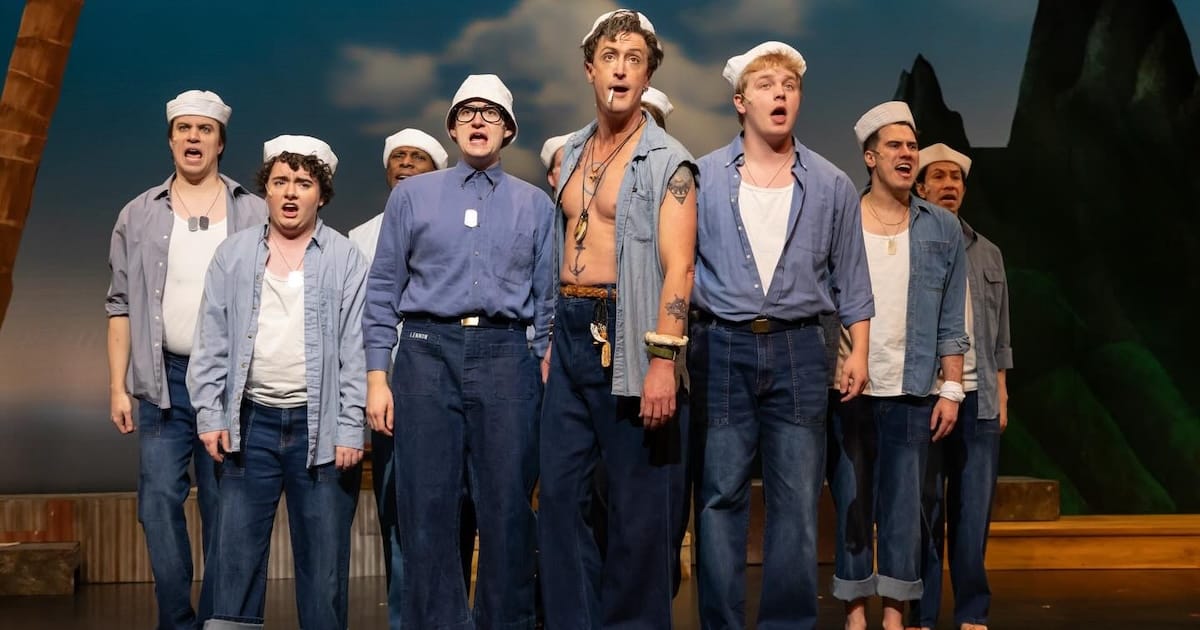
Photo: RDGPhotography
An ensemble that sells every note
Van Oosbree has assembled a large, uniformly strong ensemble, and the production benefits enormously from having so many confident performers animating every corner of the stage. Even in quieter book scenes, the sailors, nurses and islanders are constantly reacting, listening and building the social world around the principals. That attention to acting detail makes the big moments hit harder because the community around them always feels alive.
At the center is Sarah Kit Farrell as Nellie, a performance that captures both the character’s fizzy charm and her painful moral reckoning. Farrell is effervescent and funny in her early scenes, but she never plays Nellie as shallow, which makes the character’s later fear and shame feel more human.
Vocally, her bright, expressive soprano makes “A Cockeyed Optimist” and “I’m in Love with a Wonderful Guy” pop with joy, while “I’m Gonna Wash That Man Right Outa My Hair,” staged with a fully working shower, is pure Golden Age musical comedy bliss. When the story turns darker, her reprise of “Some Enchanted Evening” carries genuine heartbreak.
Opposite her, Jeremy Rill’s Emile de Becque has both warmth and quiet authority. His believable French accent and commanding physical presence make Emile feel grounded, especially in the book scenes where his patience and vulnerability are most exposed. Rill’s “Some Enchanted Evening” is one of the evening’s great highlights, and his “This Nearly Was Mine” in Act Two, sung after Nellie rejects him over his children, lands as a devastating emotional peak.
Joyce Yuriko Cole brings wit, grit and sly humanity to Bloody Mary, turning her into far more than comic relief. Cole finds the survival instinct and weary pragmatism beneath the humor, making “Happy Talk” and “Bali Ha’i” stand out. Jeffrey Parker’s Luther Billis, meanwhile, is a riot as the fast-talking schemer who steals scenes in “There Is Nothing Like a Dame” and the drag-infused “Honey Bun,” while also snapping sharply into disciplined soldier mode when his superiors arrive.
Burke Walton’s Lt. Cable provides the show’s moral counterpoint, his stiffness contrasting effectively with the more freewheeling sailors around him. Walton sings “You’ve Got to Be Carefully Taught” with controlled intensity, giving the show one of its most sobering moments. Tiffany Sieu Gruman’s Liat, though mostly silent, brings quiet emotional gravity to their forbidden romance, making their scenes together feel intimate, vulnerable and tragically brief.
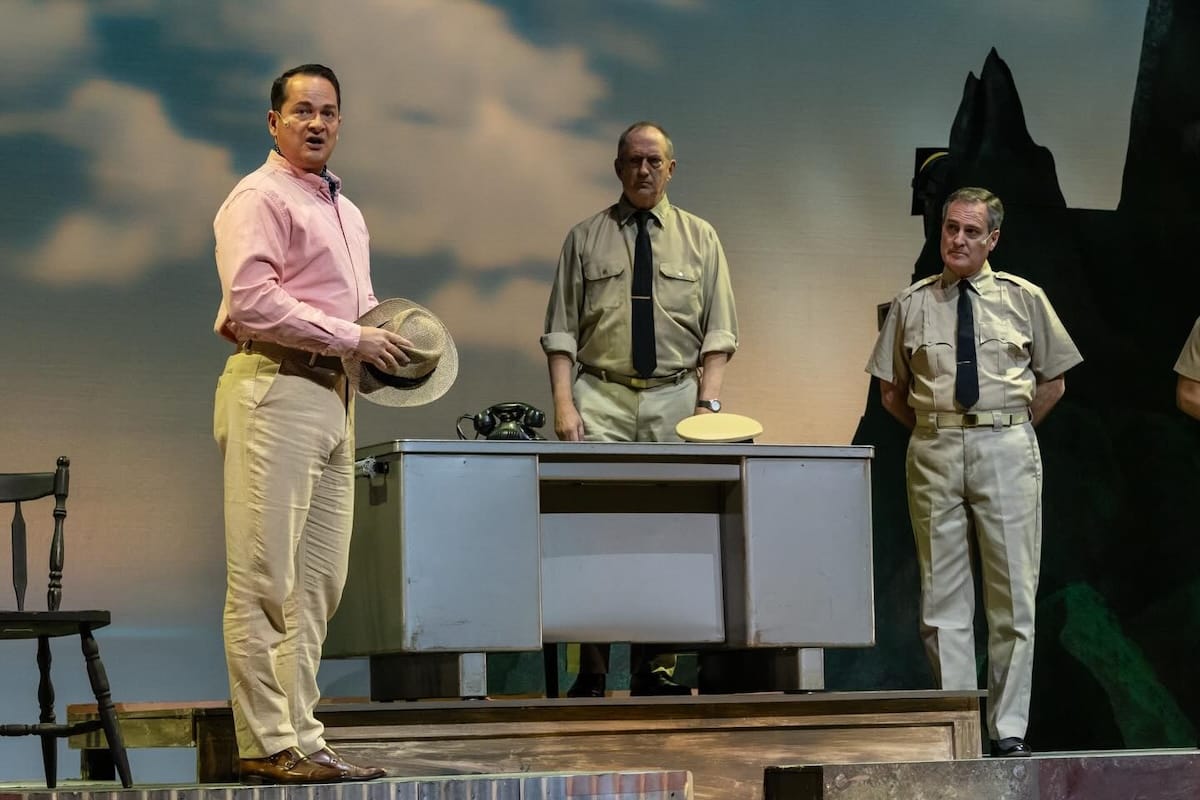
Photo: RDGPhotography
A golden age musical that still hits
If there is a weakness in South Pacific, it is the book, which bogs down in Act Two with off-stage military attack scenes and exposition that is dwarfed by the music. But when Rodgers and Hammerstein are firing on all cylinders, few shows can compete. From “There Is Nothing Like a Dame” to “Younger Than Springtime,” the score is jam-packed with hits, all expertly staged by Van Oosbree.
More importantly, the show’s message about learned prejudice, which was revolutionary in 1949, remains relevant in 2026. This production does not try to update or sanitize the material; instead, it trusts audiences to engage with its discomfort and growth. That honesty makes the final reconciliation between Nellie and Emile feel earned and deeply moving.
Performance Now’s South Pacific is a well-sung reminder that even the oldest musicals can still speak directly to the present when staged with intelligence, care and emotional sensitivity.


A Colorado-based arts reporter originally from Mineola, Texas, who writes about the changing world of theater and culture, with a focus on the financial realities of art production, emerging forms and arts leadership. He’s the Managing Editor of Bucket List Community News, a contributor to Denver Westword and Estes Valley Voice, resident storyteller for the Bonfils-Stanton Foundation and co-host of the OnStage Colorado Podcast. A member of the American Association of Theatre Critics, he holds an MBA and an MA in Theatre & Performance Studies from CU Boulder.

Price?