

Miners Alley’s regional premiere of My Mother and the Michigan/Ohio War uses a historic border dispute to explore the funny, messy dynamics of family life.
There are few historical conflicts more perfectly suited to comedy than the Toledo War.
Fought between Michigan and Ohio from 1835 to 1836 over a narrow strip of land near present-day Toledo, the dispute was largely bloodless. The only reported injury was a non-fatal stabbing, and the single shot fired allegedly struck a horse or mule. It was, by most accounts, a deeply unserious clash inflated by pride, stubbornness and regional loyalty.
That same cocktail of pettiness and passion fuels Paul Stroili’s My Mother and the Michigan/Ohio War, now receiving its regional premiere at Miners Alley Performing Arts Center in Golden. Directed by Len Matheo, who also helmed Miners Alley’s 2024 production of Stroili’s A Jukebox for the Algonquin, this brisk 90-minute three-hander uses that obscure 19th-century border dispute as a lens through which to examine something far more volatile: family dynamics.
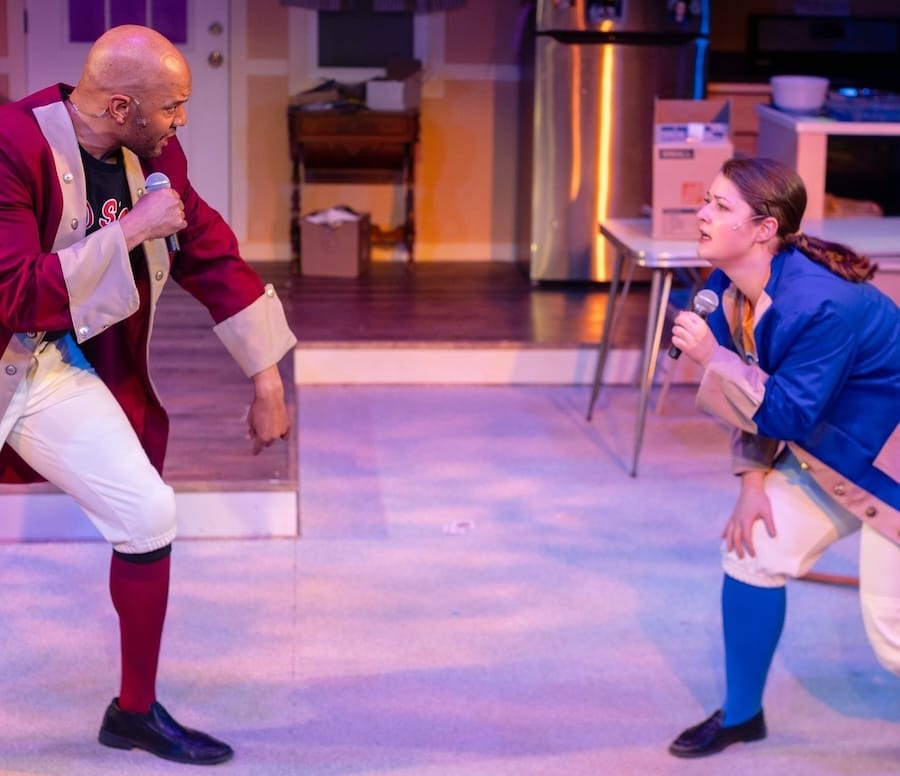
Orion Carrington and Kate Poling are the warring children in the comedy. | Photo: Sarah Roshan Photography
Mourning in blue and scarlet
The play opens at the funeral of Freddy, a history buff whose lifelong dream was to stage a full-scale reenactment of the Michigan-Ohio War. His widow, Izzy (Cindy Laudadio Hill), is left to grieve while navigating a forced downsizing and the return of her fiercely competitive adult children.

Carey (Kate Poling), a proud Wolverine, and Josh (Orion Carrington), a Buckeye loyalist, arrive dressed in their respective team colors and secretly listening to the Michigan-Ohio State football game during the service. When Josh cheers too loudly and must leave, the production quickly establishes its central tension: This is a family whose rivalries run deep enough to intrude even on mourning.
Hill drives the production’s emotional and comic elements. Izzy frequently breaks the fourth wall to confide in the audience about her frustrations with her children, her uncertainty about changing social norms and the emotional labor she’s quietly performed to keep the family connected. Hill’s improvisational background comes in handy in these moments, allowing her to interact playfully with audience members in a recurring gag centered on a list of offensive terms that builds comic momentum throughout the evening, as well as other interactive segments.
Poling and Carrington bring believable sibling friction to their roles, capturing the particular ease with which adult children can slip back into adolescent antagonism.
Poling’s Carey is a tightly wound ball of competence and worry. She’s stressed, yes, and the production leans into that anxious energy for laughs. Still, Poling never allows Carey to become preachy or self-righteous. Even when she’s lecturing Izzy about logistics or trying to police the tone of the room, you can sense the well-meaning impulse underneath: She wants this family to function, and she’s terrified she’s the only one trying.
Carrington’s Josh arrives with a different kind of intensity. His performance makes the character’s OCD tendencies legible without turning them into a punchline. For example, when he enters the room, he begins sorting what’s on the table with an almost reflexive precision, aligning objects as if the room can be stabilized through symmetry alone. Around his family, Carrington lets the character’s tightness soften, especially as the sibling sparring gets more ridiculous.
Packing up the past
Much of the play unfolds as the trio packs up Izzy’s home, a process that reveals not only knickknacks and memories but also long-simmering resentments. Freddy’s unproduced 200-page manuscript about the Toledo War becomes a point of contention when Izzy proposes completing his reenactment as a tribute.
Her children resist until she challenges them to a board game their father designed about American border disputes. A high-energy montage set to “Eye of the Tiger” raises the stakes before a cheating scandal involving the siblings exposes deeper emotional fault lines in the family, allowing Izzy to express her previously unspoken emotions directly to her children.
The show’s most pointed critique of the family is also its most emotionally recognizable one: Izzy has been the connective tissue, the one who keeps showing up, the one who makes the household workable, and she still feels like she’s on the outside of the bond between father and children.
Stroili doesn’t try to turn Izzy into a saint, and Hill is too canny an actor to play her that way. Izzy can be petty and harsh to the point of cruelty, but the play’s emotional argument is that those traits are frequently the defenses of someone who has done the invisible work for years and is tired of being treated as background noise.
If the play has a weakness, it’s that its tidy resolution arrives a bit too cleanly for characters this sharp-tongued. The pivot after the big blow-up moves quickly, and the piece relies on the charm of its final musical theatre-inspired number to smooth over the lingering mess. Yet that speed is also part of the show’s appeal. There’s no intermission or sense that the play is going to over-explain itself. It gets in, builds its comic language and then dares to end on joy.
A modest but effective design
Jonathan Scott-McKean’s scenic design keeps the house grounded and playable. The space reads immediately as a home being dismantled: boxes scattered around the thrust configuration, a central table that becomes the arena for games and arguments, a kitchen area stage right, door and windows that give the blocking clean entrances and exits. It’s simple, but that simplicity helps the actors. This is a talky three-hander that thrives on rhythm, and the set never traps it.
Crystal McKenzie’s costumes do similar work. Funeral attire gives way to lived-in domestic clothes that suggest people who arrived planning to “help” and then realized they were walking into a long day with emotional consequences. Samantha Piel’s props and set dressing add texture and specificity: The house feels crowded with memory, full of knickknacks that can become surprise joke fuel the moment a box opens.
Vance McKenzie’s lighting design uses subtle tonal shifts to distinguish Izzy’s direct-address monologues from the play’s more naturalistic scenes, bathing her asides in cool blue hues while warmer tones define the shared family space. John Hauser’s sound design contributes a series of recurring ringtone gags, though some cues are occasionally too soft to register fully.
The final sequence, in which the siblings transform the reenactment into a ridiculously moving musical theater tribute for their mother, becomes the production’s emotional payoff. Stroili smartly chooses pastiche the audience can recognize without needing Broadway-level execution: a wink toward “Don’t Cry for Me Argentina” becomes “Don’t Cry for Me, Toledo,” and the Hamilton riff pays off a running thread about Izzy’s love of the show.
My Mother and the Michigan/Ohio War is not the most technically ambitious work, but it delivers on what Miners Alley audiences have come to expect from regional premieres: a funny, heartfelt story with strong performances and clear emotional stakes. Like the historical conflict that inspired it, the play reminds us that the battles we fight with those closest to us are rarely about territory and almost always about attention, recognition and finally seeing the person who kept the family together while everyone else was busy picking a side.

An award-winning Colorado arts and culture reporter originally from Mineola, Texas. Tresca is the chief theatre critic for OnStage Colorado and managing editor of OnScreen Colorado. He’s the editor of Bucket List Community News, a contributor to Denver Westword and Estes Valley Voice, a resident storyteller for the Bonfils-Stanton Foundation and the co-host of the OnStage Colorado Podcast.

Leave A Comment