
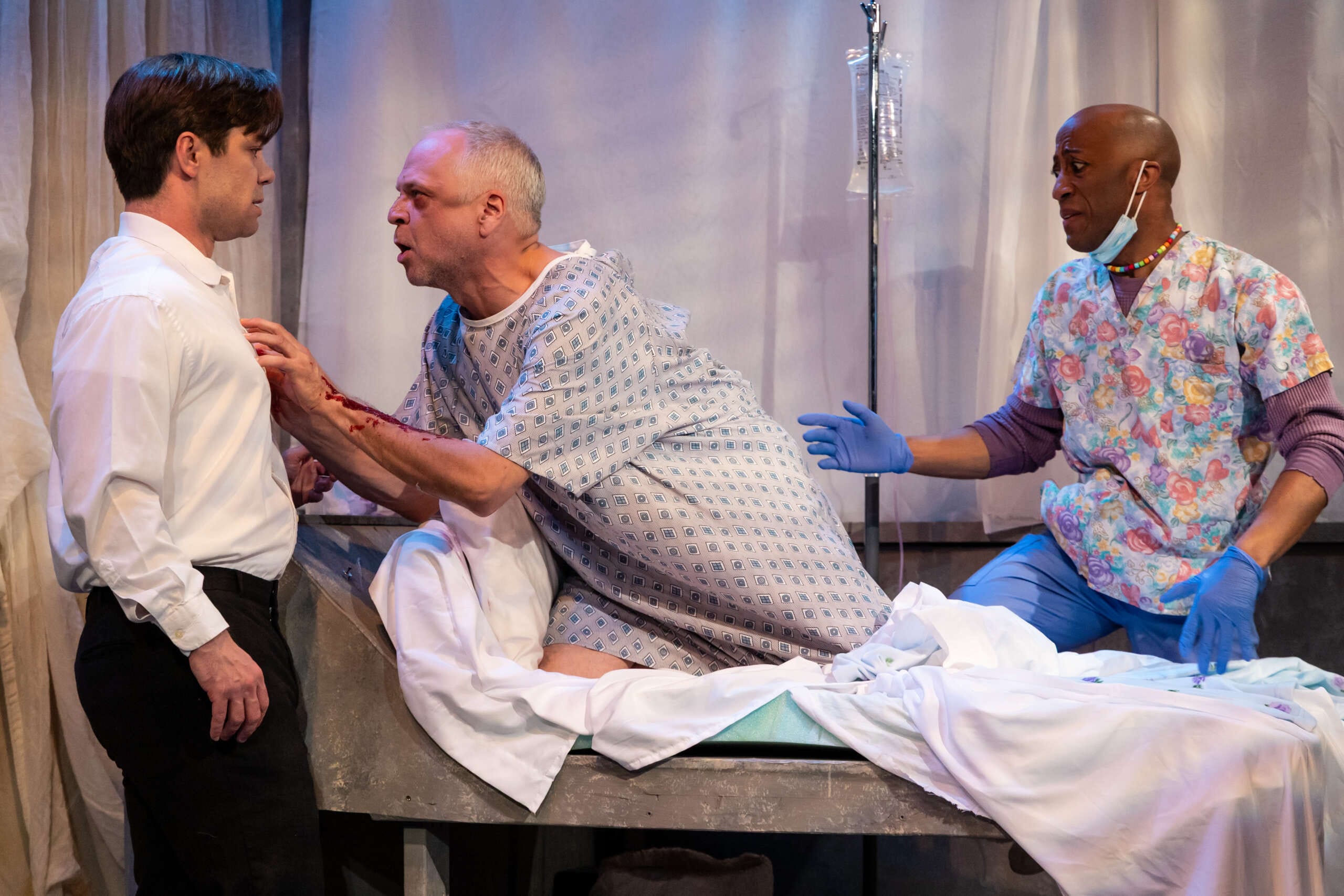
Angels in America Part Two deepens the story begun in Part One, culminating in a gripping conclusion.
Tony Kushner’s Angels in America: Perestroika asks for more patience than Millennium Approaches. Despite being longer, denser and more openly cerebral, Vintage Theatre’s production, directed by Troy Lakey, meets the challenge with clarity and conviction.
This section of the play is subtitled “Perestroika,” a Russian term meaning “restructuring,” and Kushner builds the second half around that concept from every angle. Relationships break down, power shifts, belief systems crack open and even heaven appears to be reorganizing. In 1986, when most of this play takes place, those pressures were bound up in the AIDS crisis, Reaganism and fear around change.
Watching that theme unfold now, four decades after the story’s setting, creates an unavoidable political echo. The play wrestles repeatedly with migration and the fear it provokes in those who want the world to stay fixed in place. In Kushner’s imagined cosmology, angels demand that humanity stop moving entirely. Migration, they argue, angered God and fractured heaven.
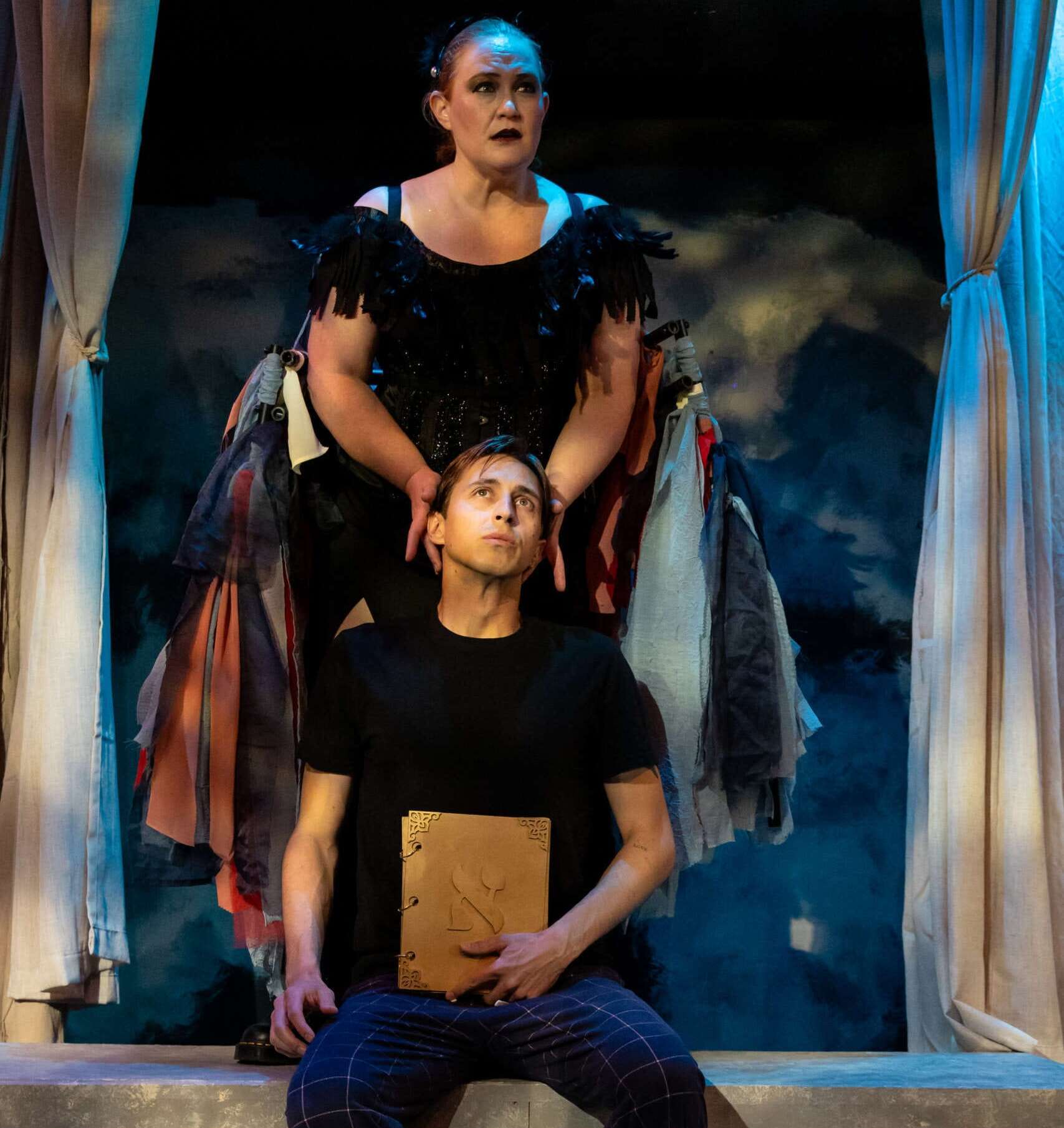
Kelly Uhlenhopp and Casey Board in Angels in America Part Two. | Photo: RDGPhotography
That argument sounds less abstract today than it might have once, as immigration battles continue to dominate American politics during the second Trump administration. Calls to halt movement, restrict borders and restore a mythic past circulate loudly in public life. When the angels insist that change itself must end, the demand reads like a cosmic version of those political anxieties.
Vintage Theatre’s staging does not treat those ideas as distant philosophical puzzles. In the Bond-Trimble Theatre’s tight quarters, the play’s big arguments stay tethered to bodies in pain, fraying relationships and people trying to imagine a future while the world around them hardens.
Lakey inherits the same eight-person cast and design framework as Vintage’s current production of Part One, directed by Bernie Cardell. The handoff works smoothly. Even at nearly four hours with two intermissions, the production holds attention through clean staging, strong performances and the force of Kushner’s ideas colliding in real time.
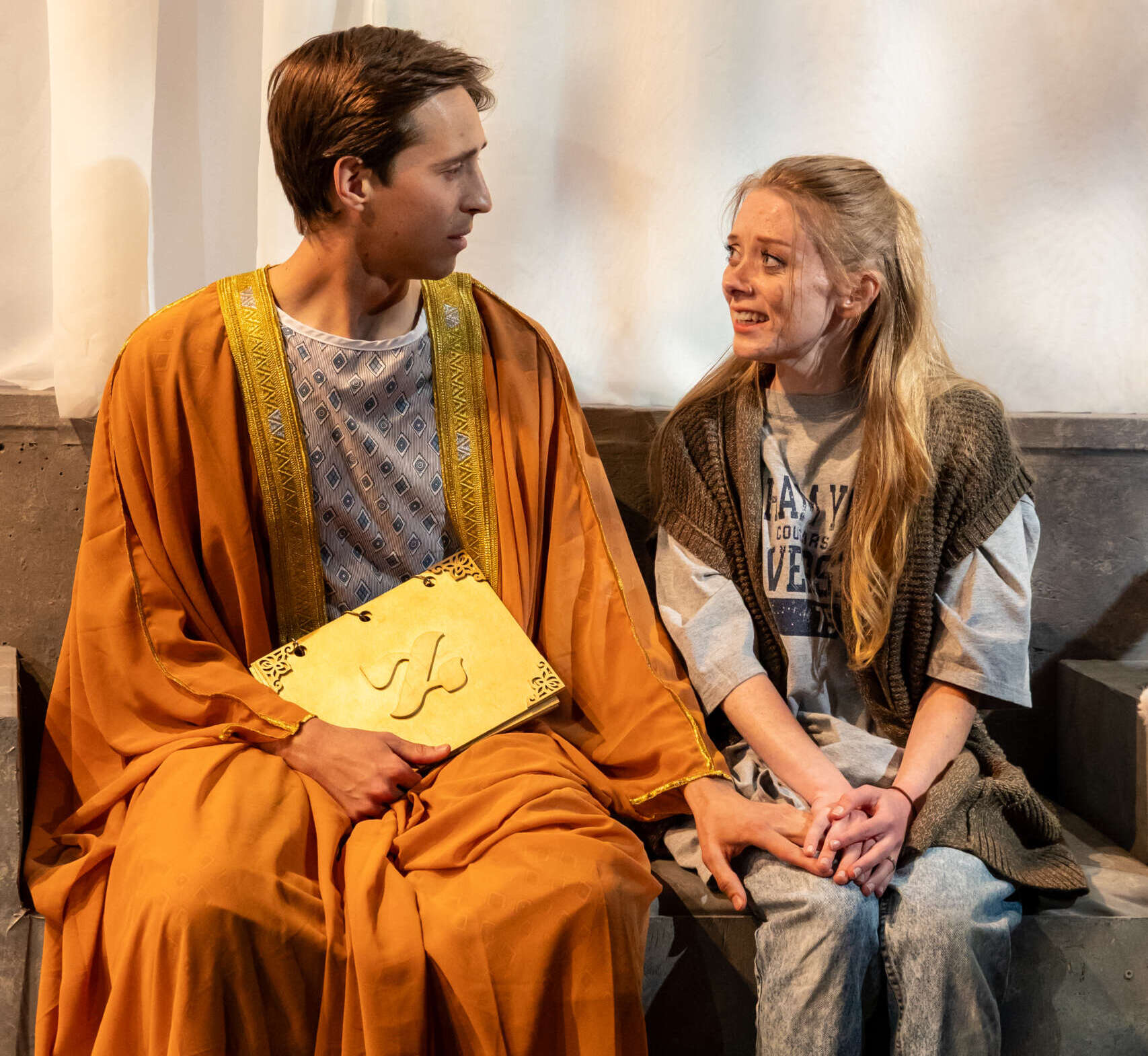
Casey Board as Prior Walter with Nicole Kaiser as Harper Pii. | Photo: RDGPhotography
Prior’s prophecy, Roy’s collapse
Having ended Millennium Approaches with the Angel’s thunderous declaration that “the great work begins,” Perestroika follows Prior (Casey Board) as he tries to understand what it means to be cast as a prophet while also living inside the daily terror and physical deterioration of AIDS. Prior is still funny, a little vain and more than capable of deflecting terror with wit, but Board gives him new stability. The character’s journey in Part Two is about deciding whether to accept the meaning others ascribe to his suffering, and Board navigates that exploration with zeal.
One of the most powerful scenes is when Prior describes his encounter with the Angel (Kelly Uhlenhopp) to Belize (Johnathan Underwood). The scene has comedy, fear and exhaustion braided together, and Board handles all of it without straining for effect.
Kelly’s Angel is visually simple, with stylized wings and a handmade aesthetic, but she portrays the character with enough swagger to make the apparition count. In a room this small, that is the right choice. Lakey does not try to fake epic spectacle he cannot deliver. He instead leans into the strangeness of the encounter and lets the actors carry it.
Belize, played with dry intelligence and growing compassion by Underwood, refuses to indulge Prior’s fantasies without question. Underwood is once again crucial to the show’s moral balance. As Belize, he grounds the play’s flights of mysticism in his personal experience as a nurse who has witnessed the brutality of the AIDS epidemic and believes Prior is desperately grasping at straws to make sense of his illness.
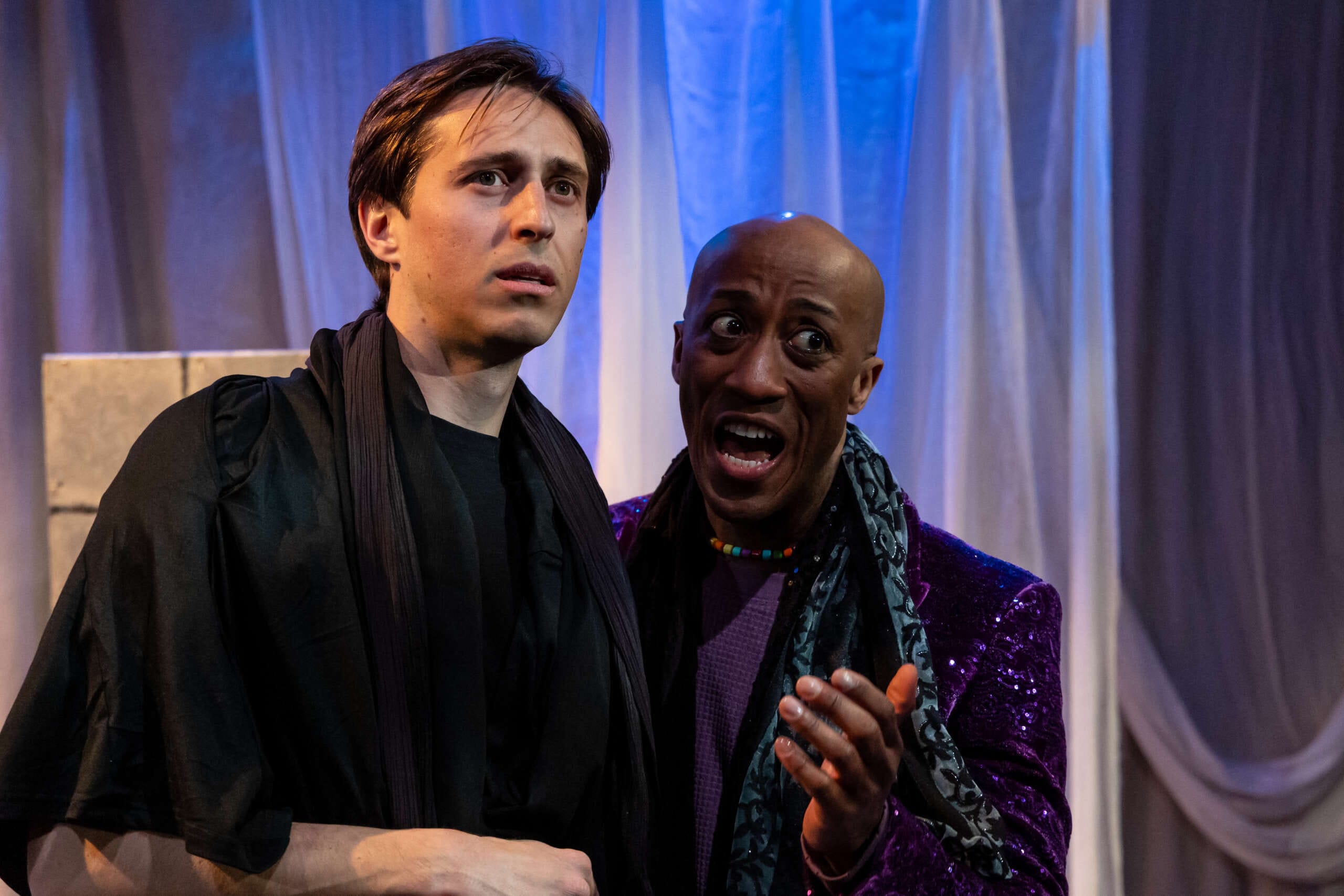
Casey Board as Prior Walter and Johnathan Underwood as Belize. | Photo: RDGPhotography
Andrew Uhlenhopp, meanwhile, gives the production its fiercest performance as Roy Cohn. In Part One, his Cohn was all speed, venom and bluster. Here, illness has stripped him down. He is weaker, frightened and cornered, yet still clawing for control. Andrew’s performance depicts the humiliation of a powerful man realizing his limitations. His scenes land with particular force once Roy is disbarred and he’s truly forced to accept that neither the law nor his body will obey him anymore.
His scenes with Underwood’s Belize as his nurse are especially interesting because they allow for contradiction rather than simple redemption. Roy dislikes Belize because he is an openly queer Black man who is authentically living his truth, but he needs his help as AIDS makes life more difficult. Belize despises Roy because Roy, a closeted gay man, spent years advancing anti-LGBTQ+ policies, but he can’t help but feel compassion for the suffering body in front of him. Andrew and Underwood make that tension painfully believable.
Roy’s increasing hallucinations of Ethel Rosenberg (Haley Johnson), a woman whose death sentence he helped push for in the Rosenberg espionage case, leave an indelible impression. She is not there to offer comfort. She is there as a reminder that history keeps score. Johnson gives Ethel a biting, unsentimental presence that sharpens Roy’s unraveling.
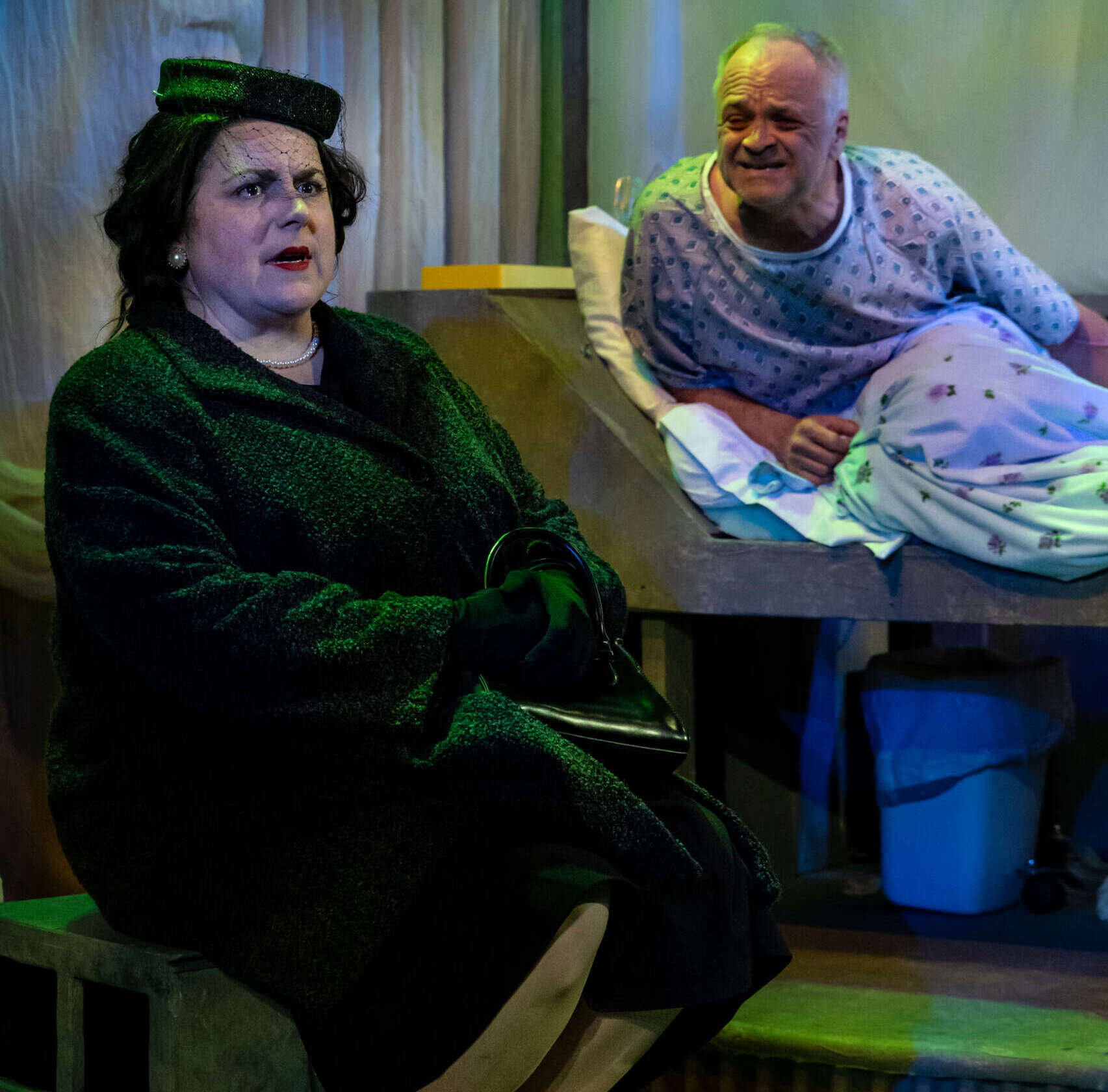
Haley Johnson as Ethel Rosenberg and Andrew Uhlenhopp as Roy Cohn. | Photo: RDGPhotography
Lovers, ghosts and escape routes
The other major thread of Perestroika tracks the continued fallout around Joe (Chad Hewitt), Harper (Nicole Kaiser) and Louis (Dakota Hill). Hewitt and Hill effectively convey the unstable attraction between Joe and Louis, two men drawn together physically yet divided by temperament and politics. Their relationship has an argumentative, restless energy that suits Kushner’s writing. These are not lovers being swept into romantic destiny; they are two people circling each other through guilt, desire and self-justification.
Hill continues to excel at making Louis both exasperating and recognizable. His gift is not in making Louis likable, but in making his evasions feel horribly human. Hewitt, by contrast, plays Joe with a tightly controlled uncertainty that serves the role well. Joe remains difficult to read by design, a man whose legal and religious language has become a shield against self-knowledge.
Nicole Kaiser’s Harper remains harder to pin down. She spends much of the play in a medicated fog, drifting through visions and emotional aftershocks. There are places where the performance could use a few more gears, especially as Harper moves toward the decision to leave Joe for good. Even so, Kaiser is effective in showing a woman whose disorientation is also a form of insight. Harper often understands the emotional truth of a situation before anyone else can say it plainly.
That becomes especially clear in the Mormon Visitors’ Center scene, one of the play’s finest passages and one of Lakey’s best-handled sequences. Harper and Prior meet there amid museum dioramas after previously encountering each other only in dreams. The scene is funny, eerie and sad all at once. It captures what Perestroika does best, which is to let hallucination and reality overlap until the distinction barely matters.
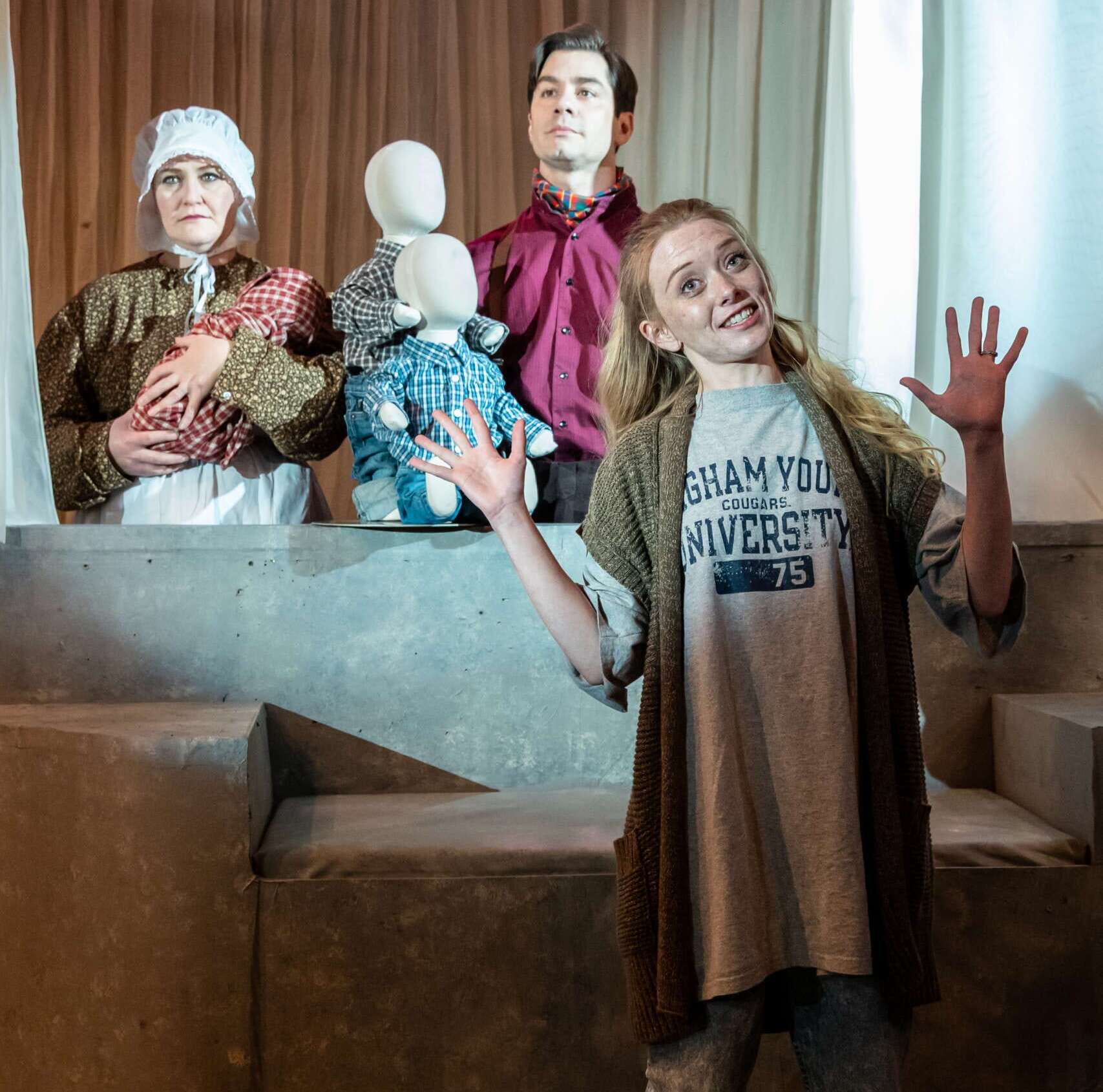
Kelly Uhlenhopp, Chad Hewitt and Nicole Kaiser in Angels in America Part Two. | Photo: RDGPhotography
The world only spins forward
Because Perestroika is the more conceptual half of Angels in America, it can also be the more daunting one to stage. Lakey’s achievement is that he never lets the production become inert or overburdened by significance.
The design remains largely the same as in Part One, with Brendan T. Cochran’s stripped-down set relying on suggestion rather than literal transformation. But the mechanics feel smoother here. The rotating piece that was somewhat distracting in Millennium Approaches is handled more cleanly in Perestroika, often shifted in darkness and with less interruption to the momentum. That matters in a play this long, where cluttered transitions can quickly drain energy.
Emily Maddox’s lighting and Patrice Mondragon’s sound design (which has a much more pronounced ’80s new-wave feel than Part One) help to differentiate between the play’s earthly and visionary planes without overcomplicating the space. That simplicity becomes an advantage in Part Two. Kushner’s writing grows more discursive here, and a production can easily bog down trying to illustrate every idea. Lakey avoids that trap. He trusts the text, keeps things moving and lets the audience sit close enough to see the toll this world takes on the people inside it.
And yet Perestroika refuses despair as its final word. Prior’s closing address remains one of the great endings in modern American drama because it rejects the fantasy of a single chosen savior. The “great work” does not belong to prophecy alone. It belongs to everyone. In Vintage’s production, that final turn comes through clearly and movingly. The call is not for passive admiration but for civic imagination, collective responsibility and “more life.”
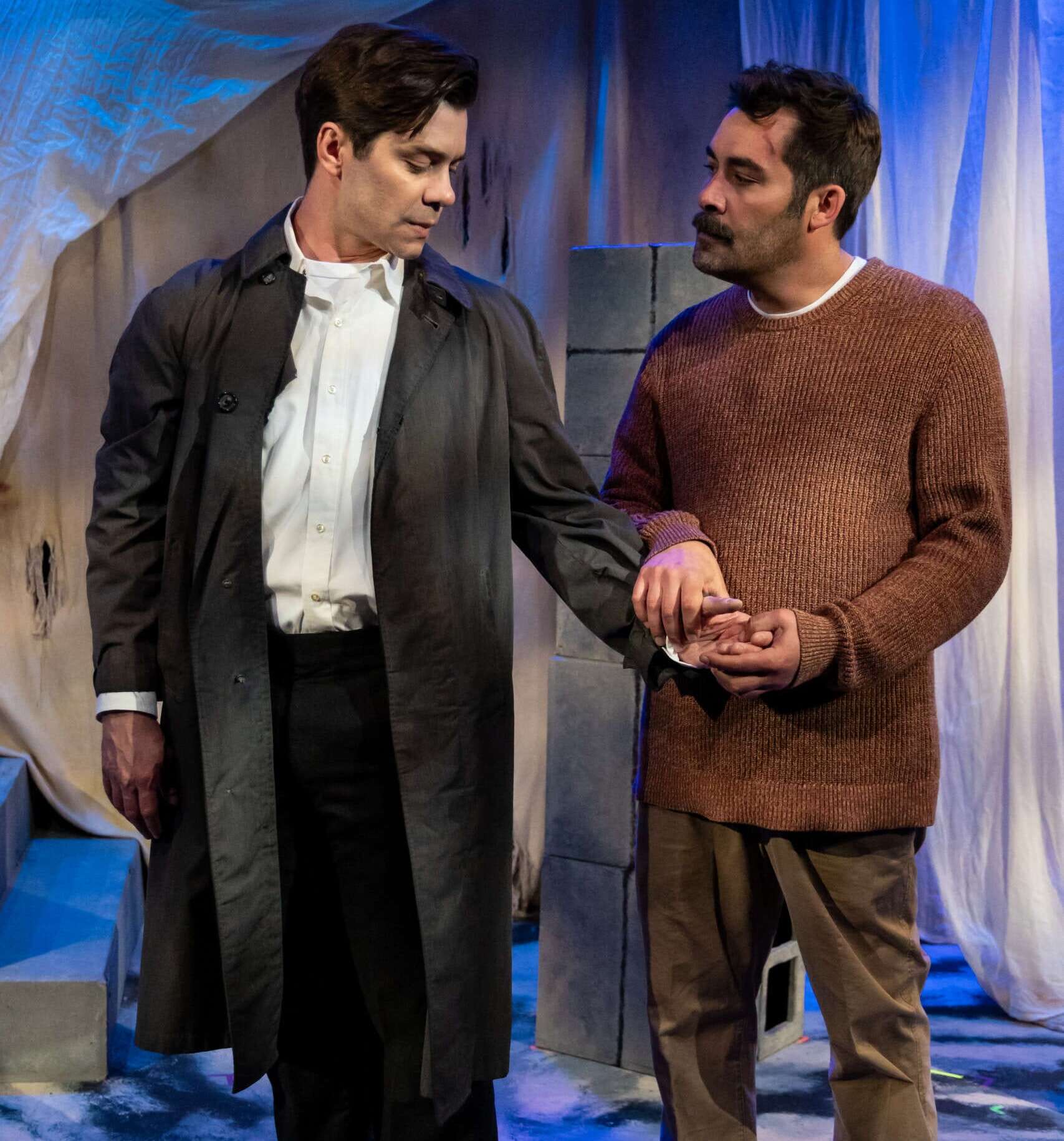
Chad Hewitt as Joe Pitt with Dakota Hill as Louis Ironson. | Photo: RDGPhotography
Vintage deserves real credit for taking on a play this unwieldy and this difficult. This is not the most lavish Angels in America you could see, nor does it try to be. It is a concentrated, actor-driven staging that keeps the human stakes in the foreground and understands why Kushner’s themes still cut.
One problem remains from Part One: the heat. Opening night was again uncomfortably warm, even with some air conditioning apparently running. In a packed house, over nearly four hours, that becomes more than a minor annoyance. I saw multiple audience members arrive with battery-powered fans, which turned out to be a smart move. Vintage should solve that issue if it can, because physical discomfort is one of the few things that muddles an otherwise strong production.
Seen across both halves, this Angels in America is a substantial achievement. For newcomers, it offers a lucid path through a famously knotty text. For those returning to Kushner, it offers a bracing reminder that the questions animating this play were never settled. They have simply been restructured.

An award-winning Colorado arts and culture reporter originally from Mineola, Texas. Tresca is the chief theatre critic for OnStage Colorado and managing editor of OnScreen Colorado. He’s the editor of Bucket List Community News, a contributor to Denver Westword and Estes Valley Voice, a resident storyteller for the Bonfils-Stanton Foundation and the co-host of the OnStage Colorado Podcast.

Leave A Comment