
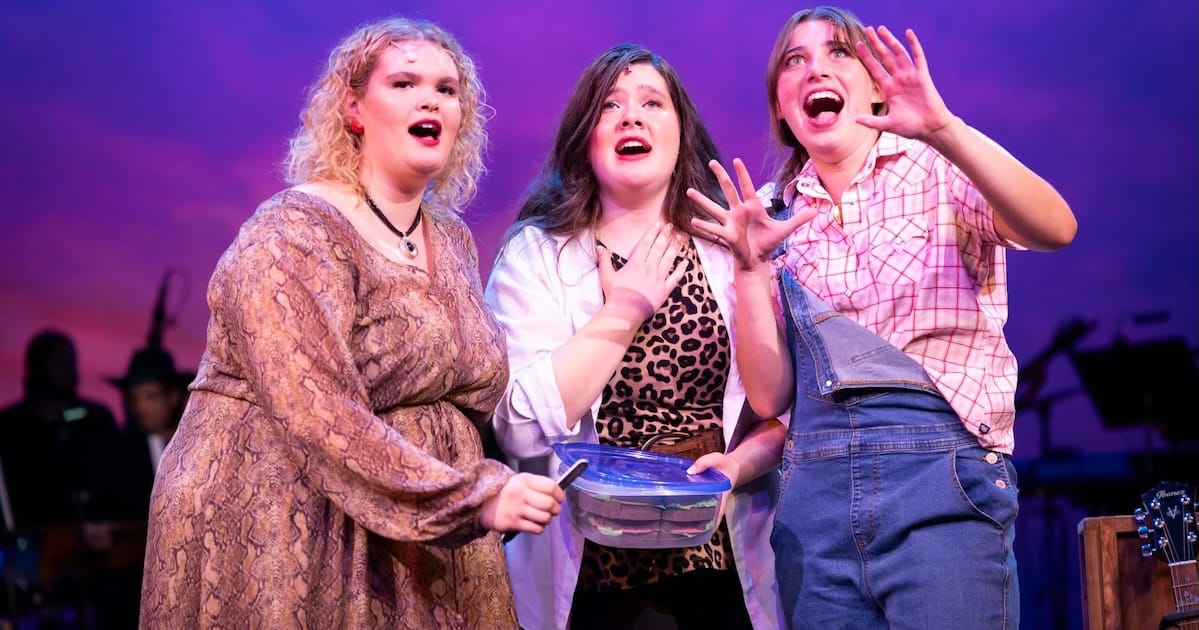
Jessica Hindsley’s sparse staging puts the focus on the young performers powering this country jukebox musical.
In the opening scene of Little Theatre of the Rockies’ Honky Tonk Angels, three women appear in silhouette. Then Parker Cropp, Ainsley Haggin and Emily Johnson join in close harmony, and the production makes its strongest argument before the story has even begun: These performers may be appealing alone, but they become irresistible together.
All three performers are current students at the University of Northern Colorado, and their chemistry carries director Jessica Hindsley’s buoyant staging of Ted Swindley’s country jukebox musical. Swindley, best known for Always…Patsy Cline, sends a trio of dissatisfied strangers toward Nashville — Angela, a neglected Texas housewife; Darlene, a young woman grieving a devastating loss; and Sue Ellen, a hardened Los Angeles office worker. Their lives converge on a bus, where country standards turn a chance meeting into friendship and, eventually, a singing group.
The book supplies only the thinnest connective tissue. Its characters are drawn in familiar strokes, and the second act largely abandons dramatic development for a concert by the newly successful Honky Tonk Angels. Yet Hindsley understands the assignment. Rather than overburdening the material with sentiment or scenic realism, she keeps the evening moving and lets the songs do the emotional work.
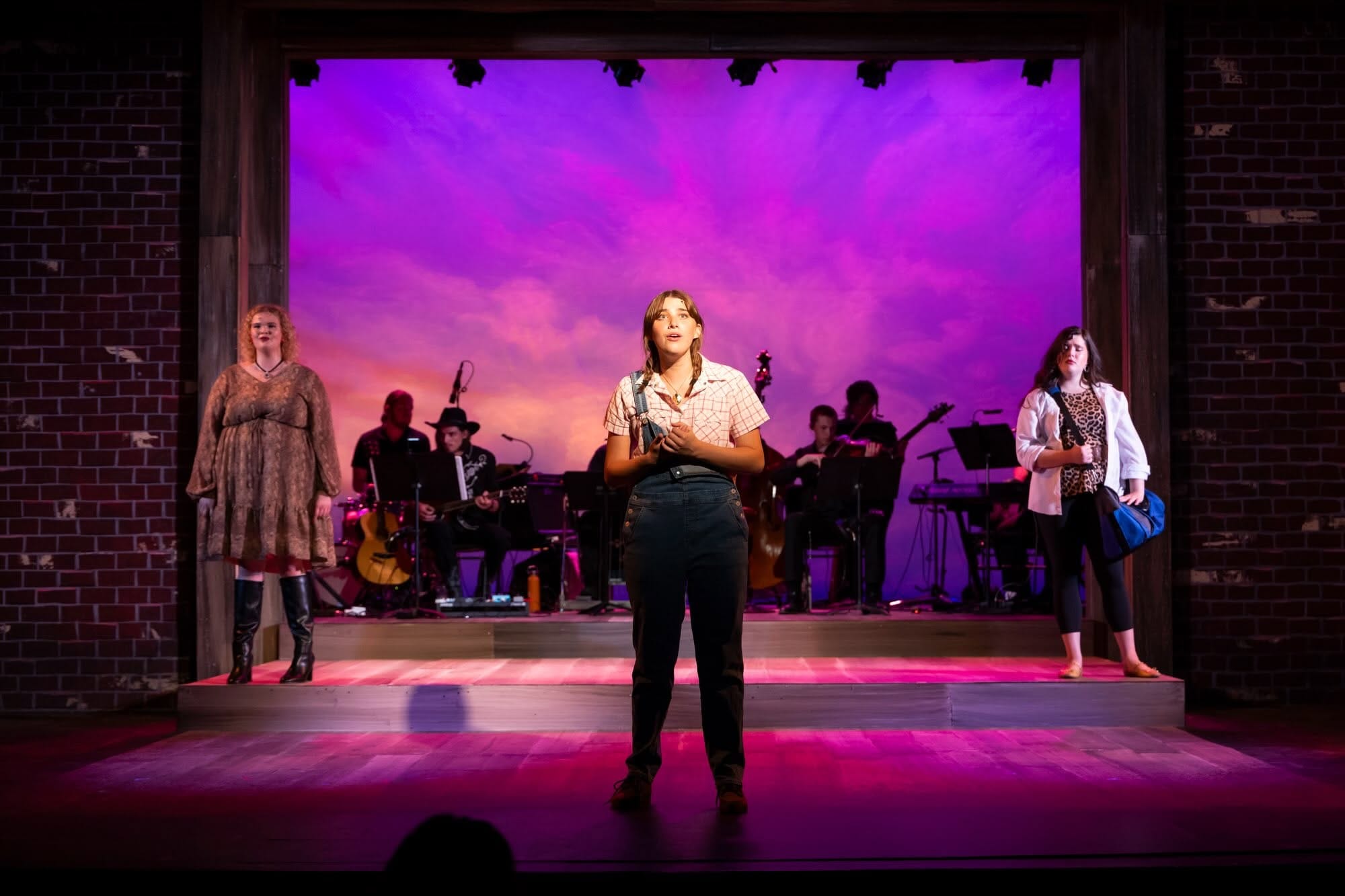
Honky Tonk Angels at Little Theatre of the Rockies. | Photo: Woody Myers
An empty stage by design
The script calls for the women’s separate worlds to be clearly established: Angela’s double wide trailer, Sue Ellen’s Los Angeles workplace and Darlene’s rural coal-country surroundings. Hindsley and scenic designer DJ Pike deliberately resist that invitation.
Instead, the live band, led by music director Victor Walters, sits on an elevated platform framed by a brick wall and wooden arch that form an inner proscenium. Behind the band, a translucent backdrop shifts colors to match the mood of each scene. Steps provide levels, while a few quickly deployed props suggest homes, offices and the bus to Nashville. At stage left, performers who are outside a scene create telephone rings, ironing noises and other effects at a visible Foley station.
The approach makes the women responsible for constructing one another’s stories. During Angela’s “Stand by Your Man,” Cropp and Johnson play her children, supply domestic noises and help conjure the overwhelming household she is preparing to leave. The theatrical game keeps the exposition lively while establishing that these women will eventually become one another’s support system.
Hindsley’s economy also prevents the two-hour production from becoming bogged down in transitions. Scenes snap into place, songs arrive quickly and the performers remain the evening’s primary visual attraction. The choice suits a musical whose physical journey matters less than the pleasure of watching three voices find one another.
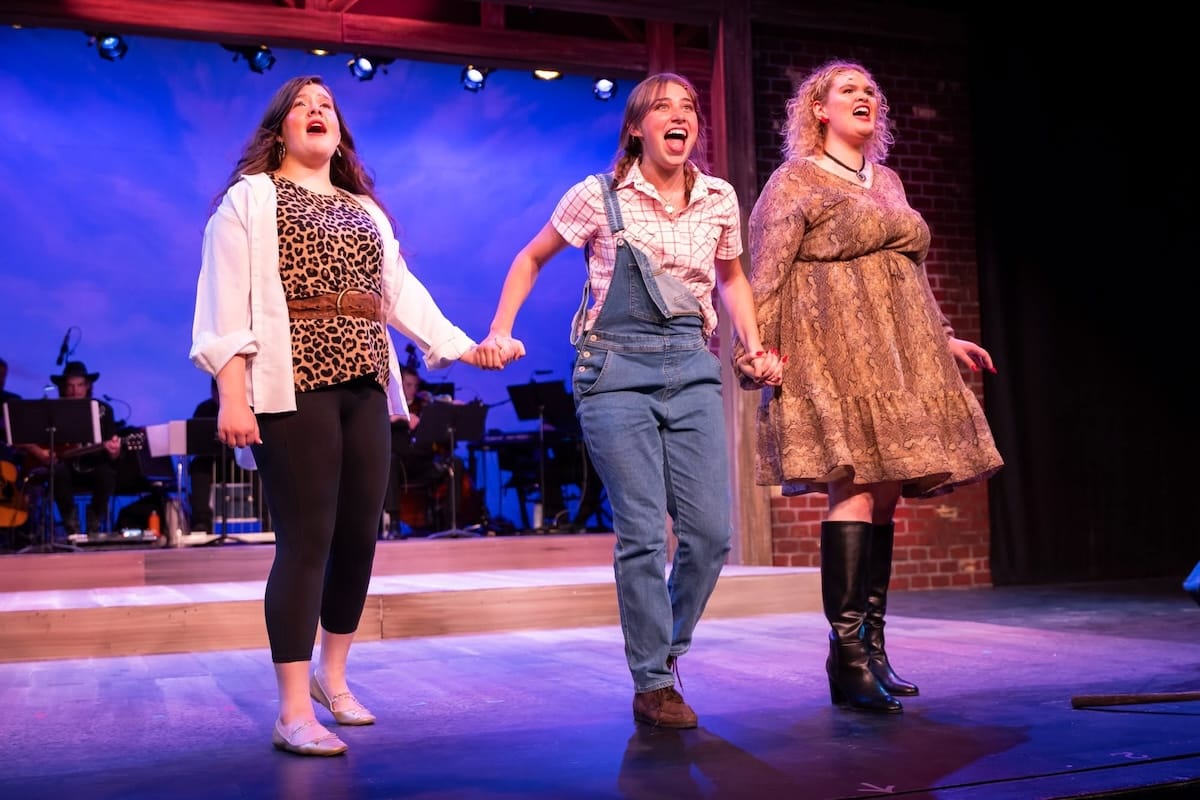
Ainsley Haggin, Parker Cropp and Emily Johnson in Honky Tonk Angels. | Photo: Woody Myers
Stronger together
Haggin gives Angela an openhearted warmth without making her naïve. As the trio’s informal narrator, she guides the audience through their journey with an easy conversational confidence that makes Angela feel like a trusted companion. She brings bologna sandwiches for the bus ride, offers them around and gradually discovers that generosity does not require surrendering her own desires.
Johnson’s Sue Ellen provides the necessary counterweight. Her sharp edges soften but do not disappear as she connects with the other women. Johnson attacks “9 to 5” with a relatable frustration that builds into exuberant glee as the others join her in bemoaning the working world. Later, as she prepares to leave her dead-end job, she steps into the audience during “These Boots Are Made for Walkin'” and wakes them up with a gleeful dance break.
Cropp possesses a strong voice and natural stage presence, but Hindsley directs Darlene more broadly than her companions. The character’s grief rarely has time to settle before another comic flourish arrives. A bit involving a bird during “Coal Miner’s Daughter” pushes her toward Disney-princess parody, while an opening-night ad-lib about her dead boyfriend undercuts the anguish that should anchor the character. Cropp then laughed through the joke, briefly exposing the machinery of a production that otherwise feels assured.
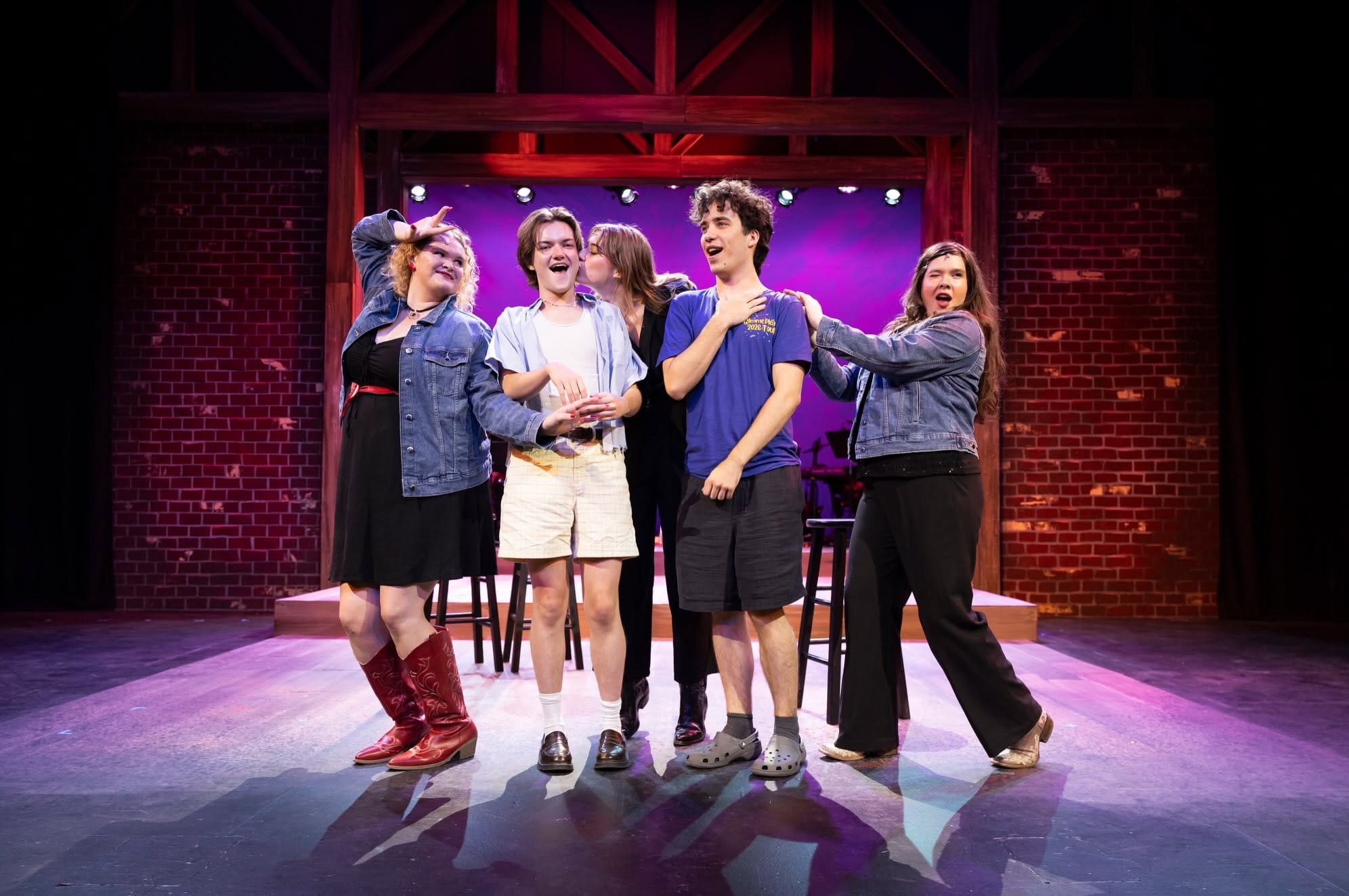
A scene with crowd participation in Honky Tonk Angels at Little Theatre of the Rockies. | Photo: Woody Myers
Even with that imbalance, the performers remain persuasive whenever Swindley gets out of their way. “Delta Dawn” turns their first impromptu bus performance into exhilarating proof of what the three voices can accomplish together. The second act then skips over their rise in Nashville and becomes a loose concert built around a threadbare disagreement over what kind of music the Angels should sing. By then, Haggin, Johnson and Cropp have generated enough affection for the trio that the fluff hardly matters.
Honky Tonk Angels asks for little more than affection for country standards and pleasure in watching these performers combine their talents. Little Theatre of the Rockies supplies both. Anyone seeking a substantial story will leave hungry, but country fans can pull on their boots with confidence: Hindsley’s spare, swift production gives these rising performers all the room they need to make familiar songs feel freshly shared.

An award-winning Colorado arts and culture reporter originally from Mineola, Texas. Tresca is the chief theatre critic for OnStage Colorado and managing editor of OnScreen Colorado. He’s the editor of Bucket List Community News, a contributor to Denver Westword and Estes Valley Voice, a resident storyteller for the Bonfils-Stanton Foundation and the co-host of the OnStage Colorado Podcast.

Leave A Comment