
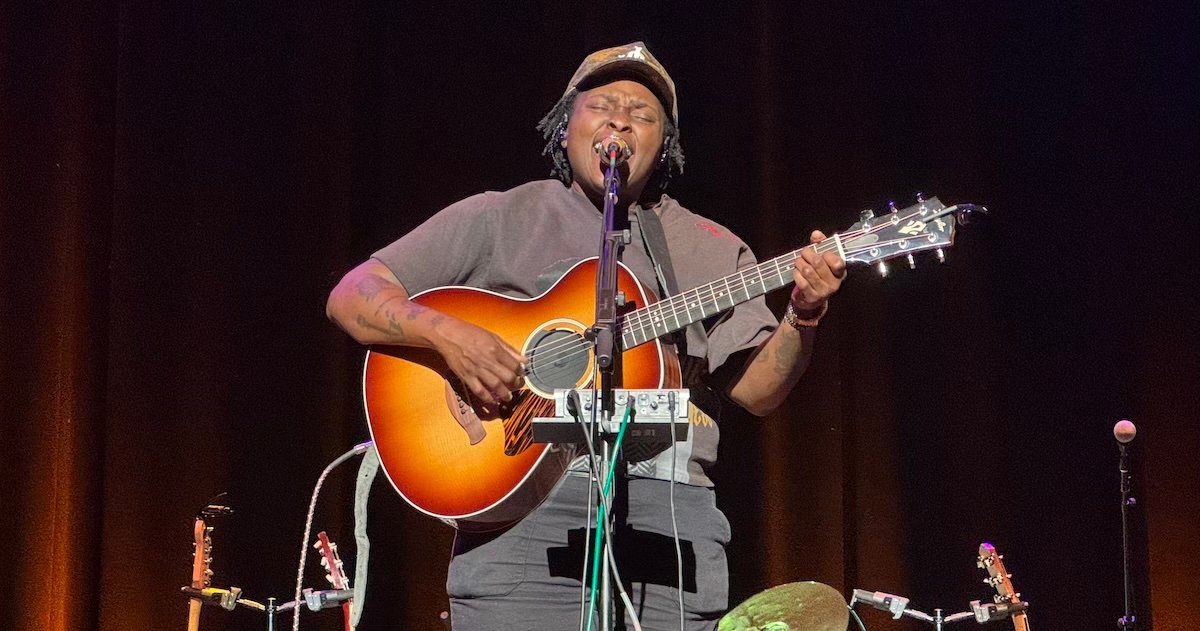
The queer singer-songwriter brought her Heavy Things Tour to Denver on Nov. 4.
I have been fantasizing about air conditioning school, and I could do it. I could be great,” Joy Oladokun joked.
The 34-year-old singer-songwriter said she loves her job, but sometimes it becomes overwhelming. Oladokun blends folk, R&B, rock and pop as she explores what it means to be human, face her demons and fight for change.
As a first-generation Nigerian American and queer Black woman, Oladokun understands what it feels like to be marginalized and refuses to turn a blind eye to injustice. She brought her Heavy Things Tour to the Paramount Theatre in Denver on Nov. 4.
“Thank you for being here tonight. I hope you have a good time at the show,” she said softly into the microphone with a little grin.
Lovable awkwardness
On “Easy Company,” her raspy alto rang out over syncopated drums. She closed her eyes, relishing the moment and perhaps calming her nerves as a socially anxious person.

“I wrote a few songs about the end of the world, and we’re going to play them tonight,” she said, giggling. An “ICE OUT” pin sat on the strap of her red acoustic guitar as she performed “The End of the World.” Pink lights shone from above with deep blue backlighting as she sang the angsty rock song.
Her bassist, Gray Schweers, headbanged and exhibited bright, playful expressions. Audience members zoomed in on their phones to take videos and photos of the band’s engaging performance.
A fan shouted, “We love you, Joy!” Oladokun responded, “I love you. That’s why I came to work today.”
She took a sip of her tea, radiating introvert energy. Oladokun reminded me of Ayo Edebiri’s character in Bottoms — awkward but in a funny and endearing way. For example, she noted that this was the first show where she wore real shoes — sneakers — instead of Crocs.
Gold and purple lights cascaded across Oladokun and her band as they performed “DRUGS.” Audience members clapped and swayed to the soulful song.
“It will slow down at some point,” she said. “We are on an emotional arc here.”
Societal epiphanies
Oladokun explained that she had a dark epiphany while watching a documentary about Woodstock ’99. She realized that “the revolution will not be televised” and that many people do good deeds simply for recognition and money.
“I’m supposed to do that but I smoke too much weed and read too many books,” she added as the crowd cheered.
Oladokun brought up “Mark the record guy” a few times during the show. In a lighthearted manner, she joked that she and Mark have butted heads over her creative process and wishes versus his focus on streams and monetization.
To avoid another potential fight with Mark, she titled one song on her latest album, Hope Is a Heavy Thing, “TOGIAIM.” She told the audience that it’s an acronym for the real title, “The Only God in America Is Money.” It’s a song about how past counterculture movements inevitably spiraled into capitalism.
Her voice echoed over the keys on “Changes” as she immersed herself in emotive fingerpicking. Oladokun spoke about how she used to hold a lot of anger and recently reached a place where she discovered the sadness lurking underneath. While she isn’t “healed,” she is hopeful she can recognize her true feelings.
On “Nothing Comes Easy,” she explored wanting to let go of the things that make her “intense and bitter.” She played the song with just her acoustic guitar, opening the door for emotional clarity and peace.
“We’re at the religious trauma section of the show,” she said. “We never strayed too far.”
Oladokun realized she had to let go of other people’s descriptions of God to discover her own understanding of a higher power. She performed “sunday,” a song about her quest for acceptance.
She sang her own track “Zombie” into “Zombie” by the Cranberries in a powerful mashup before launching into “Die Young,” her sweet song yearning for a simple life with someone.
Oladokun kept repeating, “I hope this has been okay,” as if she wasn’t changing lives with her beautiful alto and dedication to uplifting humanity. Throughout her performance, her guitar felt like an extension of her body. She moved through complicated chord progressions in a meditative state.
A stunning acoustic ending
She ended the night with a solo acoustic encore, the most moving part of her set. Oladokun spoke about the sadness of Propositions 134 and 135 passing in Colorado. The measures bar transgender girls and women from female school and college sports teams and prohibit surgery on minors intended to alter sex characteristics. She dedicated “I’D MISS THE BIRDS” to queer, trans and Black kids who “feel like the world has no place for them.”
The song reflects on the bittersweet realization that the place that should be home doesn’t feel safe and comforting. Oladokun wrote the track about the friction of living in Nashville as a queer Black person. She sings, “I wouldn’t miss the traffic or the runaway trains/And the Proud Boys and their women just make me feel out of place/Oh, but I’d miss the birds and the music that they make/But even they know when to fly away/I think it’s time to fly away.”
Oladokun said we cannot sacrifice important groups of people in the name of small wins. “I hope every day the world gets a little kinder for all the people who inhabit it,” she said.

Maddie Browning is a freelance arts and culture reporter who covers music, theatre, visual arts, books, food, and fashion. She has more than five years of culture writing experience, and her byline has appeared in NPR, the Los Angeles Times, Marie Claire, The Boston Globe, Business Insider, Denverite, Westword, Boston.com, WBUR, and Colorado Public Radio, among others. She earned her bachelor’s degree in journalism from Emerson College. On a day off, she enjoys checking out new local coffee shops and thrifting with friends.

Leave A Comment