

An inventive ensemble, graceful transitions and imaginative design bring Jane Austen’s world to life in this entertaining holiday production.
The pastel salmon lighting softens the stark white set pieces, which are simple and elegant. From the moment the audience enters for Vintage Theatre’s production of Sense and Sensibility, Scenic Designer Brian Watson and Scenic Artist Bernie Richard establish a garden atmosphere with trellises and arches covered in flowers. The set pieces are practical and elegant, effortlessly transforming into multiple locations throughout the production. Lighting designer Logan Foy uses gobos to evoke a garden on a sunny day, adding to the production’s storybook quality.
Not every choice is as successful. The positioning of the wing curtains allows the audience to see backstage and the costumes. When the lights go out, backstage blue light floods the stage, weakening the effect of the blackout. These distractions aside, the design team creates a visually appealing world that supports the production’s playful approach to Jane Austen.
Director Dana Hart Wright choreographs the scene transitions as a graceful dance, shifting the scenery while expertly suggesting the passage of time. The cast uses rhythm and movement to evoke clockwork, Sound Designer Luke Rahmsdorff-Terry adds the appropriate ticking effects and Foy provides the lighting equivalent of clock symbolism across the floor. The collaboration among the design team and performers suggests particularly effective communication.
No opportunity is wasted during the transitions. Actors use these moments to foreshadow events and develop their characters’ relationships through a glance or movement toward another character. Some of the transition work feels unnecessarily long, but the overall effect is engaging enough that the extra moments of light and music never become particularly irritating.
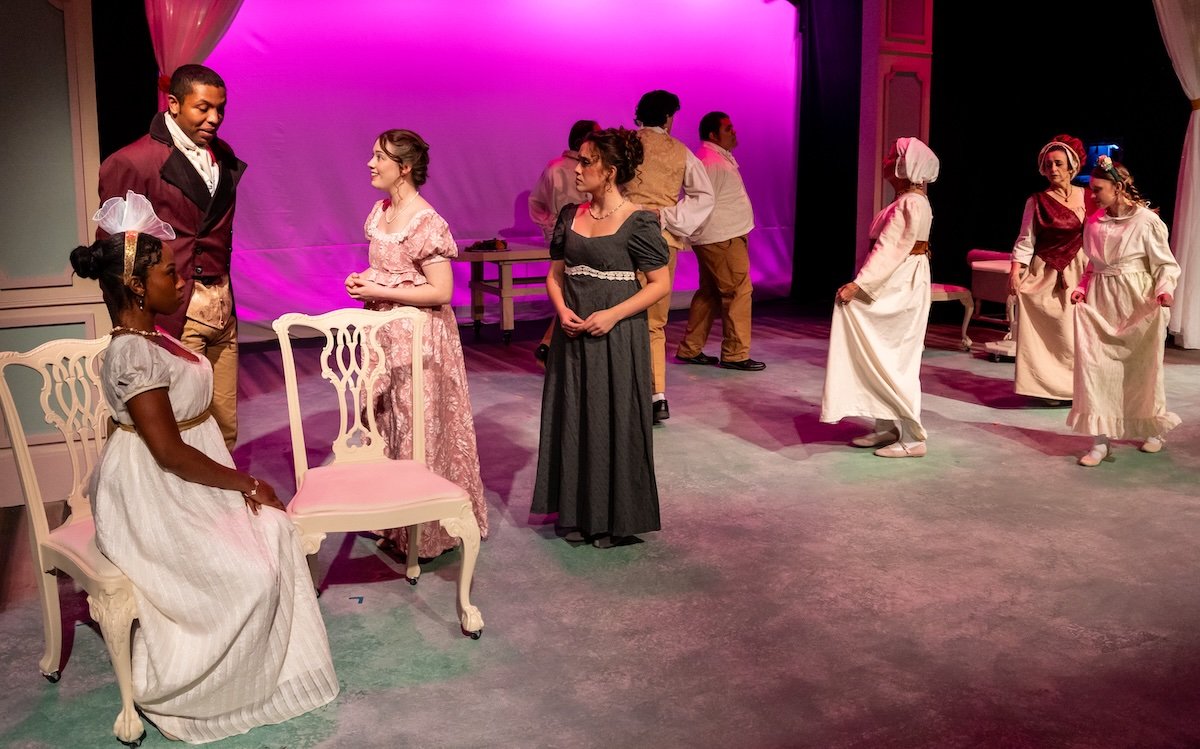
The cast of ‘Sense and Sensibility’ at Vintage Theatre. | Photo: RDGPhotography

Adorned in the finest fashion
Rahmsdorff-Terry establishes a feeling of timelessness with a score of modern popular songs performed in the style of a classical orchestra. At first, the instrumentation evokes late 18th-century England. Then the listener recognizes “Time After Time” by Cyndi Lauper, “September” by Earth, Wind & Fire or “Dancing in the Moonlight” by Sherman Kelly. The music is both perfectly suited to the period and surprisingly modern at the same time.
Costume designer Susan Rahmsdorff-Terry’s choices are pragmatic and exquisite. Through distinct styles and color themes, she helps the audience identify which character each performer embodies at any given moment. Director Wright assembles an ensemble that moves effortlessly from one character to another, creating a complex story of drama and gossip with a relatively small cast.
Kate Hamill’s adaptation of Jane Austen’s novel gives Wright plenty to work with. The script’s comic sensibility makes the production endearing, funny and wildly entertaining. The performers take sharp ownership of each character through their physicality and voices, making even the most rapid changes in persona remarkably clear.
The use of lighting, sound and performers to create a rainstorm around Marianne (Cate Rounds) is breathtaking. Rounds’ facial expressions are superb, and her movement is vibrant. However, much of Marianne’s dialogue is delivered at a near-shout, which limits the vocal range of the performance and makes moments of genuine emotional intensity more difficult to distinguish. A little more variation in volume would give those emotional moments greater impact.
Ashley Somers plays Margaret with enormous innocence and joy. Her energy is contagious, and her portrayal of a 13-year-old is entirely believable. She is a delight to watch. Jennifer Burnett dazzles as Mrs. Jennings, commanding the stage whenever she appears. The Gossips, portrayed by most of the cast, are another highlight. Each performer creates a rich and distinct individual, making the audience feel as though the entire town has gathered to weigh in on the families’ affairs. The Gossips are easily distinguishable from the central characters each actor also portrays. They help condense the novel and move the action along while remaining true to the source material. The performers handle these roles masterfully.
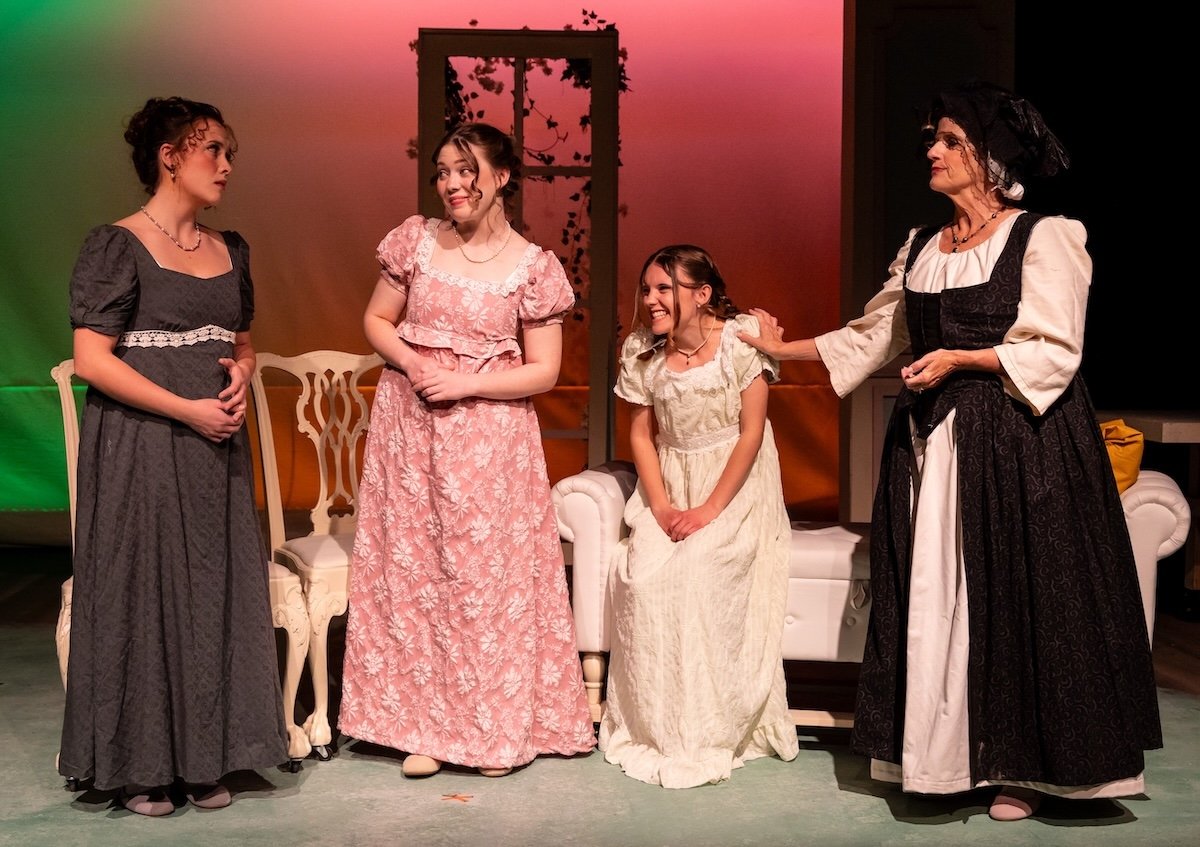
Photo: RDGPhotography
Know your own happiness
Kelsey McKercher’s portrayal of Elinor embodies sense, precisely as Jane Austen intends. McKercher displays a demeanor worthy of the character through her physicality, voice and expression. Her performance stands in sharp contrast to those of the other characters, allowing Elinor to emerge as a quiet example of restraint.
Daja McLeod and Suzanne Nepi’s portrayals of Lucy and Anne Steele, respectively, are delightfully ridiculous and draw laughter from the audience. Their transformations into Fanny (McLeod) and Mrs. Dashwood (Nepi) are so distinct that they instantly demonstrate both actors’ impressive ranges.
The chemistry among the ensemble is strong. Elinor (McKercher) and Marianne (Rounds) maintain the elegant and refined manner expected of young ladies of the period while retaining the playful attitudes that remind us Elinor is 19 and Marianne is 16. Creative touches, including stick-puppet actors and the interpretation of the carriage, are unexpected treats.
Colorado theatregoers with a taste for comedy, refinement, romance and art deserve this holiday delicacy. With its inventive staging, playful performances and imaginative approach to Austen, this production makes a strong case for bringing a familiar classic to the stage. It is both a fun and sensible choice.
* Selena A. Naumoff has performed at Vintage Theatre previously. Her last performance there was in 2019 in The Language Archive, directed by Margaret Norwood.


Selena A. Naumoff holds a BA in Theatre Arts and two master's degrees. She teaches theatre, stage-manages, directs, writes plays and performs in theatre and film. She is active in all aspects of theatre, including lighting, properties and sound design. She reviews for the Jewish Book Council and has published both nonfiction and young adult fiction under her pen name.

Leave A Comment