
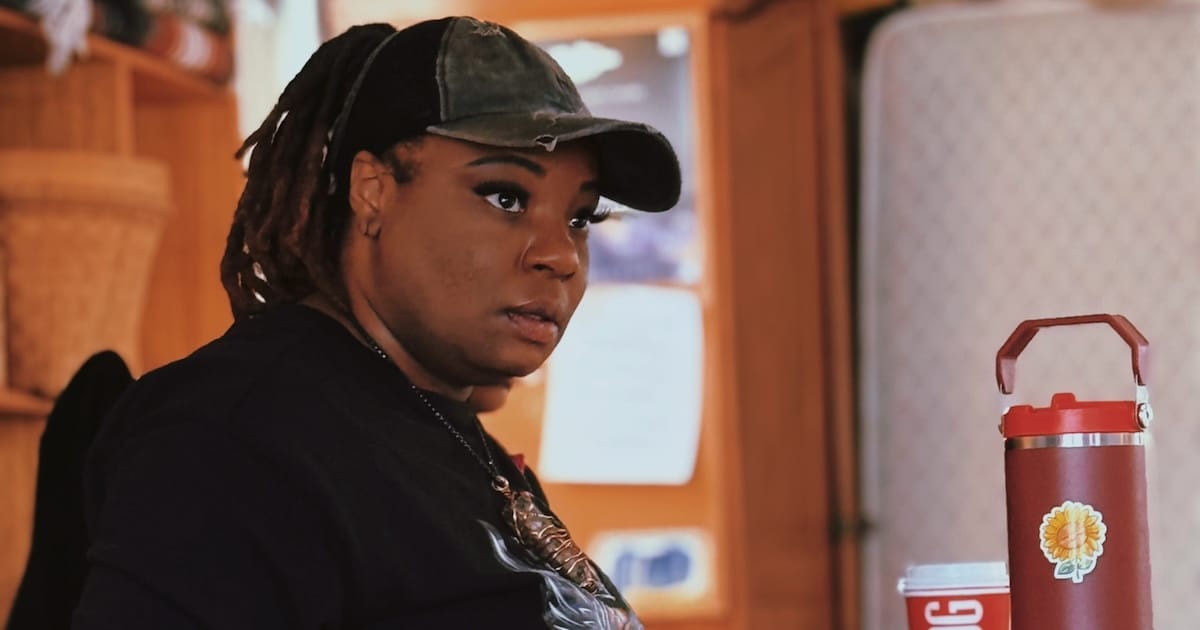
Inspired by her daughter’s experience, playwright creates intergenerational theatrical journey through Black hair history.
Kenya Mahogany didn’t set out to write a play. She just wanted her young daughter to love her natural hair.
When her daughter came home from school wanting straight hair instead of her Afro puffs, Mahogany bought her a children’s book — Happy to Be Nappy by bell hooks — to help build confidence. That simple act of parental encouragement sparked what would become a years-long creative journey, culminating in Happy 2B Nappy: Our Hair Story, premiering Feb. 14-March 1 at Manos Sagrados in Aurora.

Kenya Mahogany
“I thought it would be amazing to tell the story of how Black hair evolved over the years and the struggles and the triumphs and the celebrations,” Mahogany says. “I created Happy 2B Nappy in 2019, and since then I’ve been tightening up the script as I go along.”
The production blends storytelling, spoken word, dance and music into what Mahogany describes as a celebration rather than a trauma narrative. Produced through Control Group Productions’ Guest Artist Producing initiative, the play features nine cast members led by Artie Thompson, Brianna Winkfield and Kaitlyn Kendrick.
OnStage Colorado: Can you take us back to that moment with your daughter when you realized this needed to be told on stage?
Kenya Mahogany: My daughter was about 5 or 6 at the time, going to a pretty diverse school with a lot of other ethnicities. I would put her hair styled in Afro puffs or big Afros with headbands, and I remember her coming home from school telling me that she wanted her hair to “move” or she wanted her hair straightened. I could tell that she wanted to fit in with others around her, the students around her. So I bought her the book to help encourage her own natural hair in the way that it is. She loved the book and I enjoyed being able to offer that education and that celebration of her hair. It kind of sparked to me that there’s probably a lot of other young Black girls that are having issues with their identity and with their hair and just that representation.
OSC: You’ve been developing this since 2019. What changed or evolved in the piece?
KM: The piece started off just as kind of a storytelling type of a play, told from a grandmother’s eyes to her granddaughter. But I felt that it would be great to bring these stories to life — when it’s live theatre, you don’t want to just talk about it, but you want the action. So I began developing ensemble groups and different pockets of stories throughout history. I did a lot of research. I bought a book called Hair Story, which gives all the historical hairstyles and just the backgrounds and context of these hairstyles and where they came from. Just really studying hair and studying the history is how I definitely got my creative juices running and was able to dive into writing it very easily.
OSC: You said this story is a celebration because we’re dealing with so much trauma and negative narratives about the Black community. What does it mean for you to center joy and celebration?
KM: I feel that Black joy and representation is often dismissed or not talked about enough. I don’t like to deal in telling stories about trauma. I don’t like to deal with telling stories about even slavery because that is a trauma. But I want to talk more about the celebrations and the joys that center Black people as human and not a stereotypical role or related to some type of downfall. This is just a celebration of being able to be happy and joyful of your culture and proud of your hair, but not in a traumatic way. We can touch on traumatic issues, but in all in all, it’s about celebrating.
OSC: This is described as intergenerational. How has hair evolved in your own family?
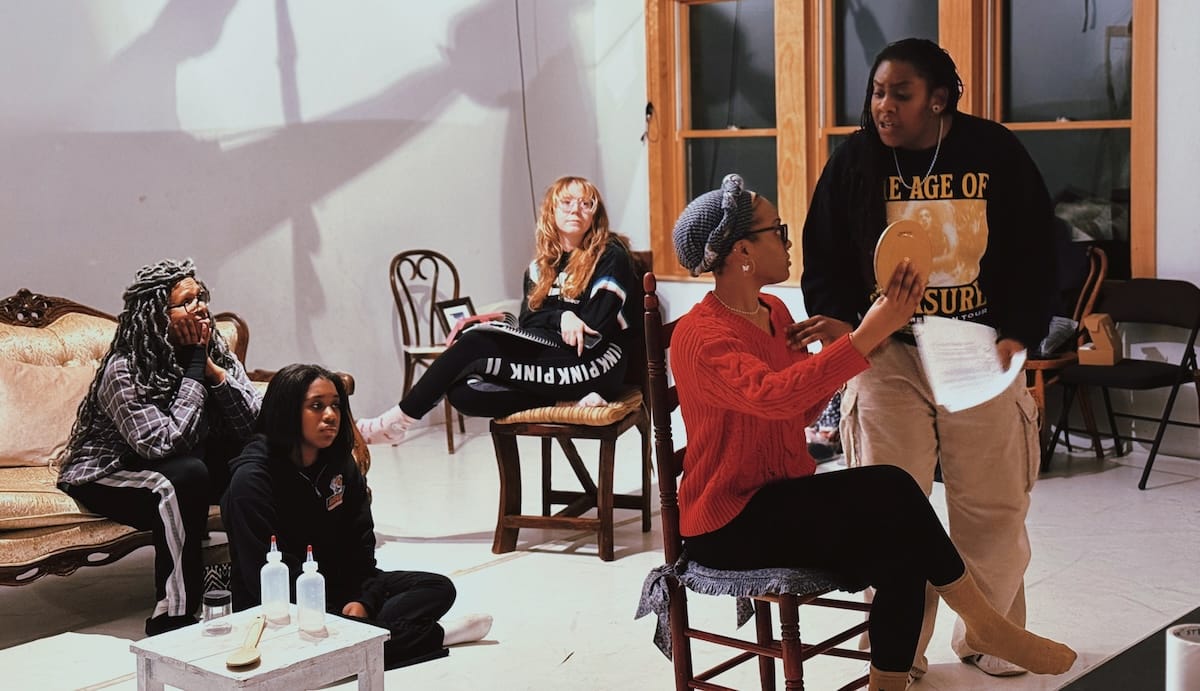
The cast rehearses ‘Happy 2B Nappy.’ | Photo courtesy Control Group Productions
KM: It has evolved so much, especially the stories. When you have those generations of women that come in — my mom, my grandmother, my aunties — all of them have great hair stories that they could share and pass down. I feel that just experiencing the stories has brought education and awareness about where we’ve come from with our hair, because we repeat these stories. Grandma told it to mom and mom’s telling it to me, so I’m going to tell it to my grandbaby. So it’s going to keep kind of having that ripple effect as far as continuing these stories. With my family, those stories really stuck out to me and made me the writer that I am.
OSC: Can you give an example of one of those stories from the play?
KM: This is actually a personal story of mine. Every Easter Sunday when I was young, we had a program for the kids. The tradition for Easter is that you had to get your hair straightened by a hot comb. The hot comb was very tricky because it was dangerous when it came to the edges of your head — it would sizzle or burn your skin. So it was very traumatic in that fact because I just remember sitting in the kitchen with my mother and she would have a hot comb on the stove. When it was time to put it on my hair to get it pressed out, you could hear the sizzle, but you could feel the heat from the hot comb burning and you were so nervous and so scared every time that it would touch your head. I have one of those little stories in there that kind of brings nostalgic feelings, because I feel like a lot of young Black women grew up in the same predicament with having a hot comb burn their forehead. So that’s like a universal story that I feel like everybody relates to.
OSC: Why are Black women so focused on their hair? Why is it so important?
KM: There’s a question that I actually ask in the beginning of the play, and that’s “What is your relationship with your hair?” A lot of people would say that they have a love affair relationship with their hair. So it’s so important to highlight those moments because there have been some moments of trauma — the hot comb or getting your hair braided so tightly that your scalp is red and flaky, or going through relaxers where the relaxer would burn your scalp. So many of those different hairstyles were kind of in the past, but they evolved now because a lot more Black people are accepting their natural hair, versus when it was back in the ’50s or the ’40s when a lot of Black women and men wanted their hair straight. Then it wasn’t until the ’60s, ’70s when Afros and natural hair started to become a thing. And then the ’80s, we have Jheri curls. So there’s different types of eras. The evolving of Black hair is significant because it has a story or a context of why. It’s not just “this is why we want to wear our hair,” but “this is because we have to.” Or “this is because society is deeming it unnatural or not suitable or not professional.” Certain things that we had to kind of dodge in order to wear our natural hair.
OSC: Can you describe what the play actually is? It’s got storytelling, spoken word, dance, music.
KM: It is a straight play, but there is a great storyline. Those stories that Grandma tells brings that creative aspect of dance, brings spoken word. So some of these stories are told in that way — they’re told as a spoken word poem or they’re told in a choreographed dance. I think it’s just different pockets of how the story is being told and how it’s presented, so you’ll experience some music, some dance and some poetry.
OSC: This obviously has a lot of appeal to Black audiences, but what about people who aren’t Black, white folks — what would you say to them that they could learn?
KM: I think it’s definitely for everyone. I feel that the aspect that I would like for others to learn is empathy and being able to understand. There’s going to be some moments — it’s a universal story. So there’s some moments that I feel like everyone can relate to, especially when it comes to family. So it has a very strong family aspect in it. I think all people will take something away when they come out. Either it’s being educated on something that you didn’t know about, or just being aware of something that you should be aware of, or just having empathy towards that and being able to understand another culture or another culture’s experiences.
OSC: Tell us about how this came together with the support of Control Group Productions?
KM: It’s been an amazing collaboration with Control Group Productions coming in. They offered a guest artist position and I applied for it, and I was able to get in with them. They have been helping me for the last year, getting funding and all that to make this opportunity a reality. They have been such vital pieces to this. It’s going to be an amazing play. Manos is a very intimate venue, but very beautiful. I know that we have some sponsors that are going to be giving away some hair products on opening night, so it’s going to be just a whole full event. If anything else, it’s just a little bit of everything that you will get in this play that hopefully will create some tears, some laughter and some joy.

Alex Miller is editor and publisher of OnStage Colorado. He has a long background in journalism, including stints as the top editor at the Vail Daily, Summit Daily News, Summit County Journal, Vail Trail and others. He’s also been an actor, director, playwright, artistic director and theatre board member and has been covering theatre in Colorado since 1995.

I recently attended the play Happy to Be Nappy, and it was truly heartfelt, relatable, and wonderfully funny. The production offered more than entertainment—it wove in a meaningful history lesson that felt natural and reflective of real-life family conversations around the dinner table.
Each actor fully embodied their role, and every character felt familiar, as if you could connect them to someone in your own life. The story felt like a walk back in time, honoring culture, identity, and shared experiences with authenticity and care. The kindred spirit of the cast brought an energy that made the entire performance vibrant and engaging.
Bold, beautiful, and flawless—this production was a celebration of heritage, family, and self-love. Five out of five.