
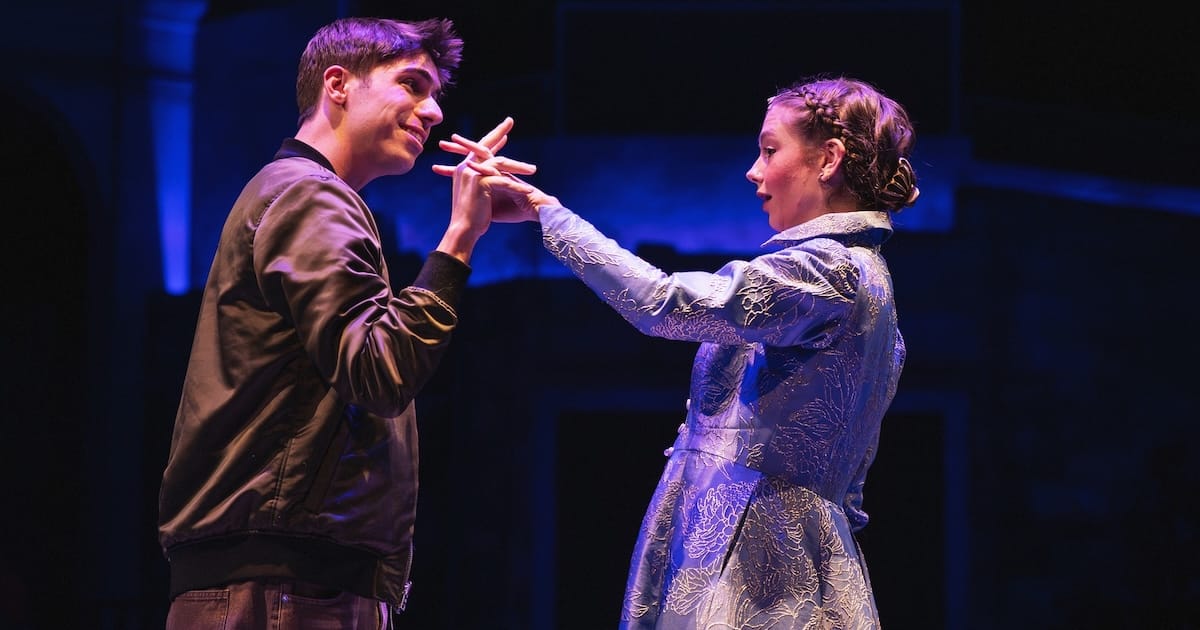
A lean, modern staging sharpens Shakespeare’s tragedy, though its bold cuts may challenge newcomers.
With two productions of Romeo and Juliet running in the Denver metro area this month and another set to open at Theatreworks in Colorado Springs in April, Shakespeare’s tale of star-crossed lovers is having a regional moment. At the Arvada Center’s Black Box Theatre, director Lynne Collins offers a contemporary, in-the-round staging that leans into the immediacy of the violence rather than its romance.
For those who need a refresher, the tragedy follows two teenagers from rival families who fall in love at first sight and secretly marry in hopes of ending their households’ long-standing feud. When a street fight leaves Romeo banished for killing Juliet’s cousin Tybalt, the lovers attempt to outmaneuver their circumstances through a risky plan involving a faked death, but a missed message leads Romeo to believe Juliet has truly died, prompting him to take his own life and Juliet to follow suit when she awakens beside his body.
In Collins’ staging, that familiar arc feels more like the byproduct of a community trapped in an endless cycle of retaliation. By foregrounding the speed with which disputes escalate into violence, this adaptation shifts focus from the lovers’ doomed passion to the social systems that make their deaths possible in the first place.
Running roughly 110 minutes without intermission, this eight-actor adaptation strips the play down to its emotional essentials. Collins’ production focuses less on pageantry and more on the rhythms of conflict and reconciliation that have kept this story alive for over four centuries, though some of her more aggressive textual cuts reshape its thematic contours in ways that may divide audiences.
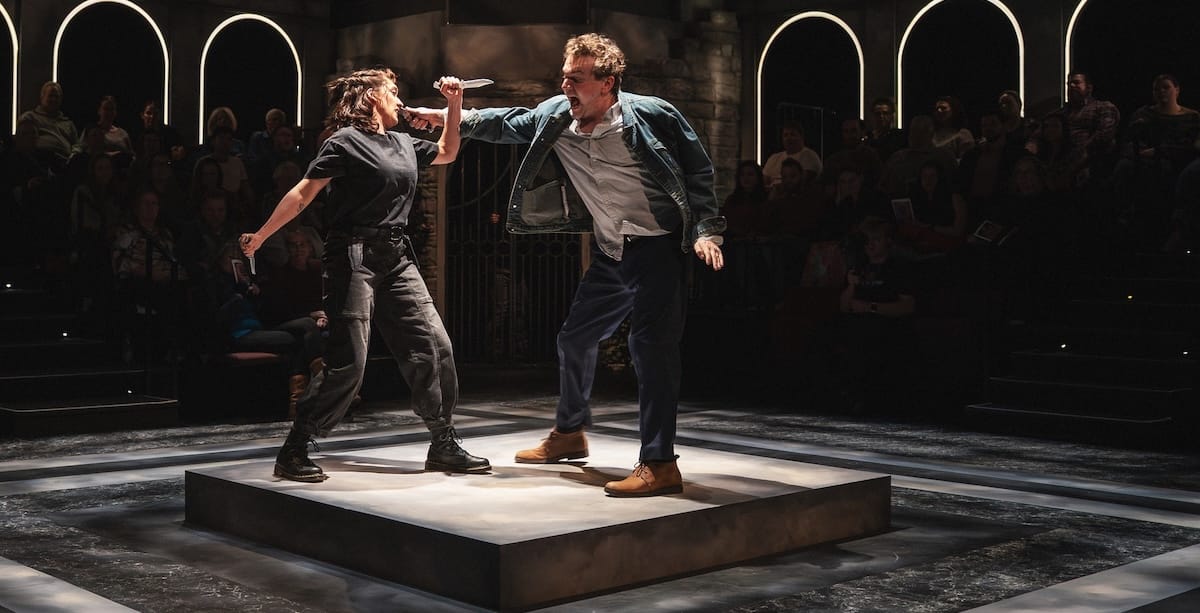
Chrys Duran and Jacob Dresch | Photo: Amanda Tipton Photography
R&J in present day
From the outset, Collins makes her directorial lens clear. The prologue is delivered collectively by the six performers not playing Romeo and Juliet — Jacob Dresch, Chrys Duran, Kenny Fedorko, Jenna Moll Reyes, Anne Penner and Cameron Varner — who speak Shakespeare’s opening lines in overlapping fragments before erupting into physical combat.
Rather than segueing into the familiar “bite your thumb” exchange that typically introduces the feud, the production moves almost immediately into the Prince’s intervention. Positioned above the action on one of the Black Box’s twin balconies, Varner halts the fighting as red-and-blue lighting ignites around the perimeter of the space, evoking the flash of modern police sirens.
Though the production is set in a loosely contemporary present, that choice is uneven in execution. Collins wisely resists mapping the Montague–Capulet divide onto specific political or social factions. Instead, the staging uses contemporary costuming and movement to highlight the speed with which tensions escalate when violence becomes the default mode of communication.
However, even though the characters are dressed and portrayed as modern-day Americans, the world they inhabit appears strangely devoid of modern technology. For example, there are no cellphones to complicate Friar Lawrence’s undeliverable message, and all acts of violence are carried out with knives rather than guns. The play’s refusal to engage with these modern-day elements strains credibility and undermines its “contemporary” billing.
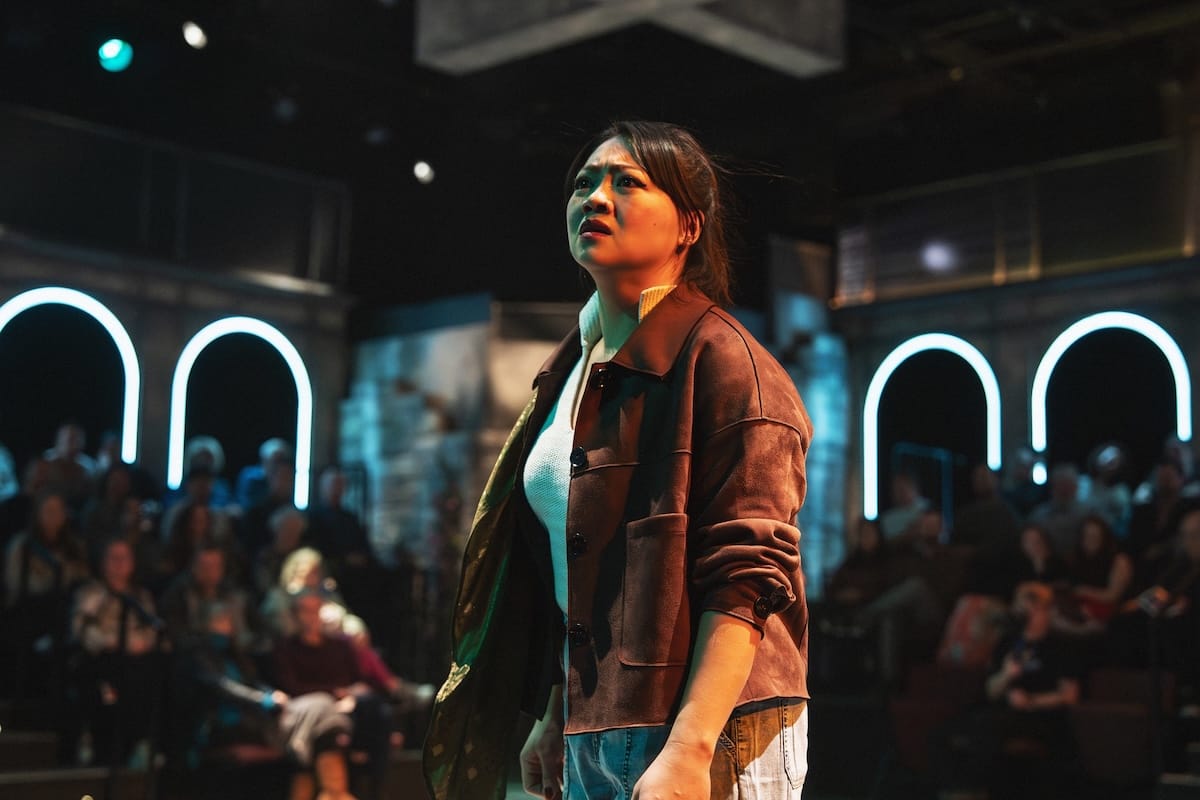
Jenna Moll Reyes as Benvolio | Photo: Amanda Tipton Photography
Lovers in close quarters
Even with these inconsistencies in its framing, the production’s emphasis on proximity and immediacy ultimately serves its central relationship well. Henry Hawes’ Romeo is charmingly playful in his early flirtations with Julia McGowan’s Juliet, grounding the character’s sudden infatuation in genuine curiosity rather than petulance. When tragedy strikes, Hawes allows that openness to collapse inward, revealing a young man who genuinely cannot imagine life beyond this connection.
McGowan’s Juliet is similarly affecting, her wide-eyed earnestness complemented by a keen attention to physical detail. She frequently holds her composure in conversation only to let it dissolve in fleeting private reactions, a subtle touch that lends weight to her eventual defiance of her family. Together, the couple has believable chemistry, making their secret marriage feel less impulsive and more inevitable.
Around them, the ensemble navigates multiple roles with varying degrees of distinction. Jacob Dresch proves especially versatile as both Lord Capulet and Friar Lawrence, balancing the former’s blustering authority with the latter’s measured empathy. Anne Penner’s Nurse avoids simple comic caricature in favor of a grounded portrayal that emphasizes the character’s genuine concern for Juliet’s well-being, whereas her Lady Capulet clearly means well but suffers the consequences of her refusal to truly listen to her daughter.
Design that moves with the action
Matthew S. Crane’s scenic design makes efficient use of the in-the-round space, anchoring the action around a central square platform that shifts fluidly from party seating to Juliet’s bed to the lovers’ tomb. Overhead framing elements mirror its geometry, while opposing balconies — one floral and garden-like, the other more domestic — provide visual shorthand for Friar Lawrence’s cell and the Capulet household.
Sarah Zinn’s contemporary costume design is similarly effective in delineating class and social roles, though it occasionally muddies character distinctions. Friar Lawrence, for example, is dressed less like a religious figure and more like a modern academic, and because Dresch also plays Lord Capulet, the overlap can be confusing, especially since both men are referred to as “father” in the script.
Carrie Colton’s fight choreography is a standout, particularly in the Act 3 duels between Tybalt (Kenny Fedorko), Mercutio (Cameron Varner) and Romeo. The knife combat is visceral and impressively escalates in tension, lending emotional weight to Mercutio’s death and the chain reaction that follows.
Max Silverman’s original music and sound design complement these shifts in tone, moving from club-like textures at the Capulet party to mournful underscoring as the tragedy tightens its grip. Kate Bashore’s lighting similarly delineates mood through bold color contrasts that keep the playing space visually dynamic.
Adaptation as a double-edged sword
Where Collins’ vision becomes more complicated is in its handling of Shakespeare’s text. This version eliminates Lord Montague (Romeo’s father), Lady Montague (Romeo’s mother) and Paris, Juliet’s would-be suitor. These choices streamline the narrative but diminish the sense of two fully realized households locked in mutual hostility.
More strikingly, the production concludes immediately after Romeo and Juliet’s deaths, excising the final reconciliation between their families. In doing so, Collins shifts the play’s emphasis from the possibility of communal healing to the permanence of loss.
The decision to end with the deaths is intellectually sound and reflects contemporary skepticism about whether entrenched divisions can ever be truly resolved. However, the removal of Shakespeare’s gesture of hope makes this a more cynical adaptation of the play than the original, which may irritate any purists in attendance.
A thoughtful, if not always accessible, retelling
For longtime Shakespeare devotees, Collins’ emphasis on lyrical passages often trimmed in modern productions may feel like a welcome restoration of the play’s poetic texture. For newcomers, however, the combination of dense language and narrative compression could prove challenging.
Even so, the Arvada Center’s Romeo and Juliet remains a compelling reexamination of a familiar tragedy. Collins’ staging finds renewed urgency in the ways cycles of violence persist when no one pauses to imagine an alternative. Its boldest choices may not appeal to every viewer, but they ensure that this latest return to Verona is more than a rehash of the same Romeo and Juliet you have seen a hundred times before.

A Colorado-based arts reporter originally from Mineola, Texas, who writes about the changing world of theater and culture, with a focus on the financial realities of art production, emerging forms and arts leadership. He’s the Managing Editor of Bucket List Community Cafe, a contributor to Denver Westword and Estes Valley Voice, resident storyteller for the Bonfils-Stanton Foundation and co-host of the OnStage Colorado Podcast. He holds an MBA and an MA in Theatre & Performance Studies from CU Boulder, and his reporting and reviews combine business and artistic expertise.

Leave A Comment