
A pair of clowns navigate identity, distraction, and physical comedy in this inventive Fringe-style piece.
There’s a headless dummy sitting in the corner facing away from us, but I’m more focused on the tiny chair sitting in the middle of the stage next to a much taller bar chair. A few books and newspapers are stacked on an end table. Off to the side, there’s a simple counter setup with a bell, clipboards and a few containers sitting on top. The dummy in the back is sitting next to a door with some coat hooks installed next to it.
This is a waiting room, I soon realize, but for what type of service is yet unclear. As typical waiting-room muzak plays, the male clown (who is unnamed in the show and program, played by Buba Basishvili) enters through the door and tiptoes around the room, timidly poking at things, humorously struggling to remove his coat and — finding no one after ringing the bell multiple times — eventually settling into a seat.
But the tall chair is tall. He can’t seem to land on it, no matter how hard he tries. And he does try hard … but always seems to awkwardly slide off. So he goes for the tiny chair instead. Ever so slowly, he carefully aims and lowers his rear end, pausing for a few moments before finally landing on it.
When he does, the stage lights go out and a single clear white bulb drops from the ceiling and hangs over the clown. Screeching violins fill the air. Shocked, he jumps to his feet, the light bulb recedes into the ceiling, and the muzak resumes.
All throughout the show, we watch on as absurd things like this happen, but the humor is not so much in the absurdity of the events as it is in the clown’s reactions to them. In this instance, the clown looks at the audience — slightly embarrassed and definitely confused — the emotions only conveyed by his sheepish facial expressions and gestures.
And then he does it again, squatting over the tiny chair and slowly lowering himself into it. Of course the same thing happens, but it’s the fact that he thought it wouldn’t that makes it so funny.
Buba Basishvili in ‘Shush, Now’ at Theatre Artibus. | Photo: Martha Wirth Photography
A surreal commentary takes shape
This is the essence of clowning: physical comedy with little (or no) dialogue. Thanks to Denver Fringe, I’ve seen a lot of it over the last several years, and it often comes with some kind of critique or statement on society and the issues that plague it.
Shush, Now is no exception, making clear and obvious nods to a dependence on phones and how that impacts our perception of the world around us. This subtext is accomplished through projections as well as narrative.
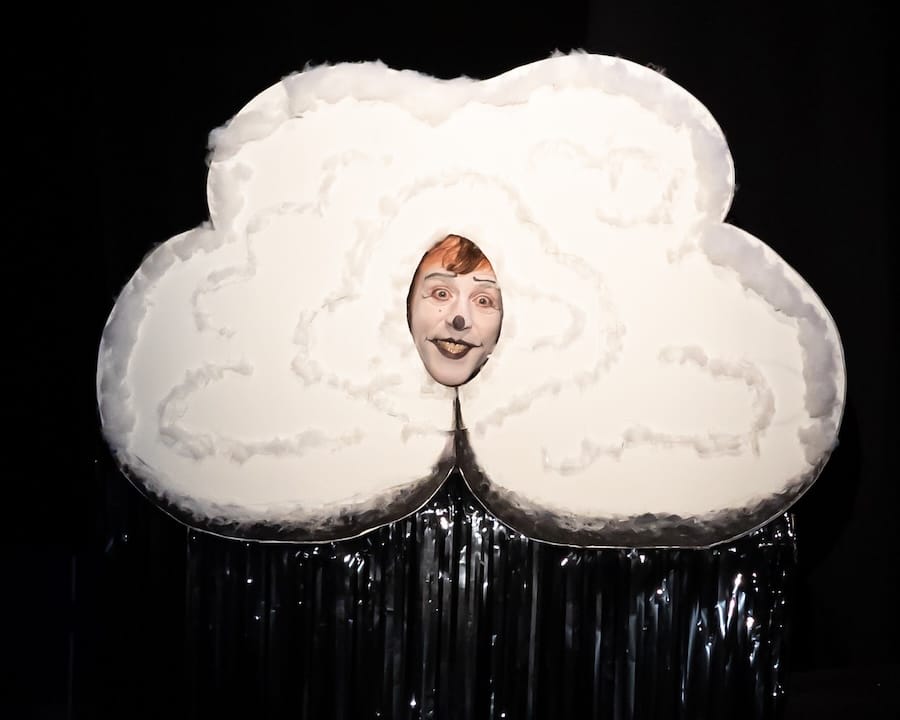
Off to the far right of the stage, in front of the counter with the bell, stands a giant white cloud with long black shiny streamers hanging from it. Sometimes visuals are projected on it, other times an oval-shaped flap is removed from the center and the resulting hole is filled with Basishvili’s face.
Here the stage lights go out and a spotlight shines as he speaks directly to the audience and delivers societal observations that meander and are hard to follow, but give enough context to get the gist of the message. This is where the title of the show comes from, as he frequently shushes us amidst these musings, as if to lull our juvenile desires for digital stimulation over authentic connection.
A pamphlet in the clown’s pocket reveals early on that he is in this waiting room to get a new head — literally. The first half of the show takes us inside his current head, perhaps to understand why he wants a new one. What results is a series of vignettes that cycle back and forth between Basishvili’s genius physical comedy and his bizarre cloud character.
One of the best of those scenes is backed by the theme from the movie Rocky with the clown chasing after a cloud that has dropped from the sky. Lit by a solid yellow background, Basishvili runs and runs after the cloud, staying in the same spot while appearing to be running on a conveyor belt at the same time grabbing at the cloud, which is always just out of reach. Operated by costar Meghan Frank, the cloud comes alive for an amusing dance with the clown that keeps it bouncing and darting around his hands as he desperately tries to capture it.
Meghan Frank in ‘Shush, Now.’ | Photo: Martha Wirth Photography
A scene-stealing second act
At the end of the first half, when the male clown is finally woken from his waiting room slumber and called to get his new head, it’s time for Meghan Frank’s gut-busting performance as the unnamed female clown who enters the waiting room just after the male clown has left it.
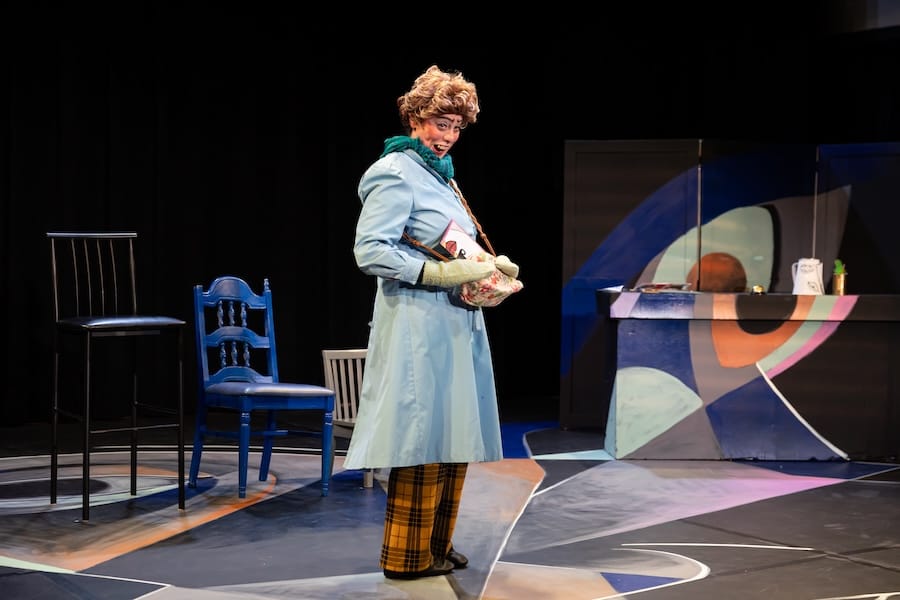
She, too, has trouble sitting on the tall chair, but perseveres and develops her own amusing system of finagling her torso and legs onto the chair. While Basishvili wears a more traditional clown costume — solid color clothing, a clown ruff around his neck and a classic painted-on face — Frank’s costume was far funker. She wears black and yellow plaid pants with a patterned top and a powder blue, knee-length jacket tied around the waist.
Most striking is the combination of wildly painted eyebrows and obnoxious false teeth that intensifies every facial expression in the most utterly comical way. Her character is more confident than Basishvili’s and features no sidebars as a cloud face; just hilarious physical comedy. Hers, too, is a sort of trip away from reality while she waits for her number to be called in the waiting room.
Compared to the excursion through the male clown’s head, the trip we take with the female clown is much more of a physical examination. There’s a bit where she’s filling out paperwork and taking measurements on her body, first struggling to find a writing utensil that works, then fudging the numbers on her waistline while admiring the tape measure readout on her bustline.
There’s another scene where she wears a brown paper bag over her head (that’s actually made of felt) and literally designs the features of her face, Mr. Potato Head-style, even allowing audience members to stick on an eye and a mouth. In another scene she swaps the bag for a more traditional half-mask that conceals her feminine facial features in ludicrous ways.
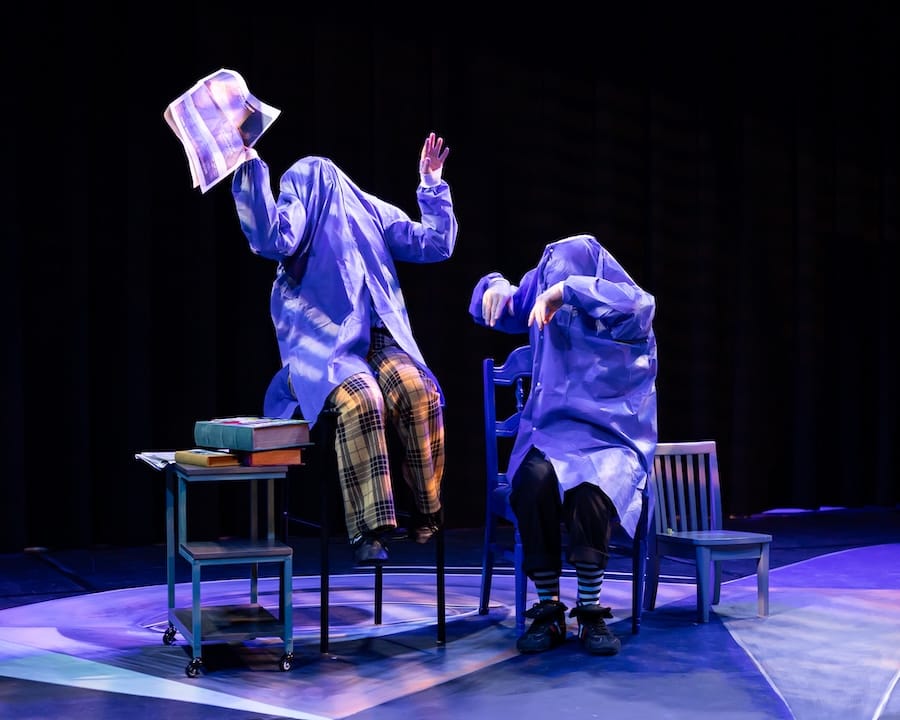
Photo: Martha Wirth Photography
A new dynamic in the waiting room
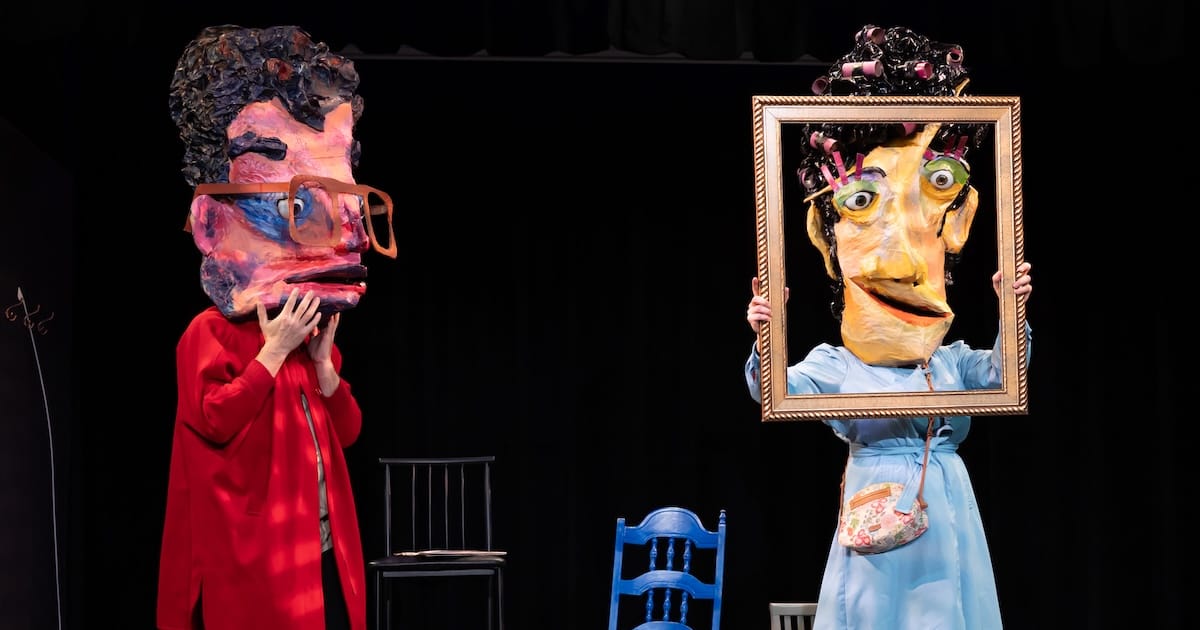
When we next see the two clowns, they are back in the waiting room, each wearing giant puppet heads over their own heads, easily adding three feet to their heights. All the features of a face are there, but they’re twisted and distorted … and yet, still kind of cute and endearing. We watch them bumble silently around the stage, struggling to do basic things like walk through a door with their giant heads, while they quickly develop a relationship relying on each other to navigate this new reality. Their challenges suggest that while the grass always seems greener on the other side, perhaps the change they were seeking should come from within, rather than without.
The program warns that “this is not a play with a tidy narrative,” and that’s what makes it so fun. There’s a throughline about escaping the weight of the world by replacing one’s own head, but it doesn’t lead to any obvious conclusions or revelations. It’s more of a light framework that holds together a delightfully dystopian collection of mostly solo skits. Through it, the powerful, silent humor of clowning shines brightly against the darkness of the world.


Danielle Riha is a digital marketer by trade and a lifelong writer. She is an active member of the Denver theatre community as a regular contributor for No Proscenium and a marketing volunteer with Immersive Denver. When she's not taking in local theatre, Danielle hikes and attends jam band concerts with her husband.

Leave A Comment