
Producing Artistic Director Jessica Robblee and Managing Director Mark Ragan talk through a six-play lineup that includes a Colorado premiere, an American premiere and a whole lot of trust in their audience.
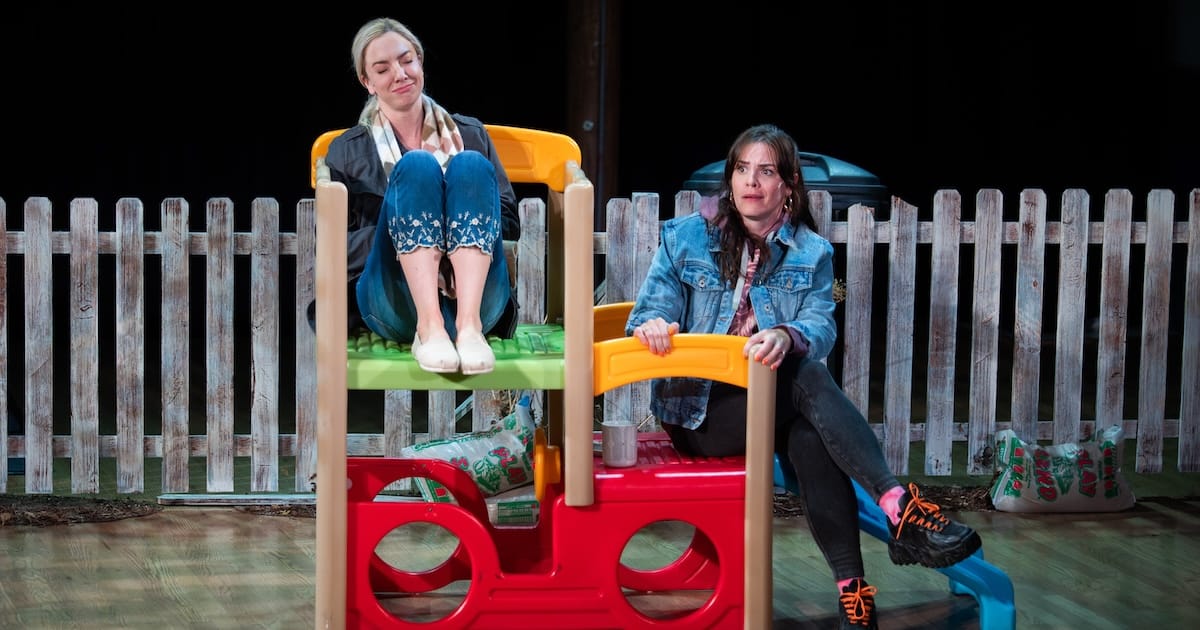
The Boulder Ensemble Theatre Company has announced its 2026-27 season, and it’s a bold one. Leading the lineup is the Colorado premiere of Liberation by Tony Award nominee Bess Wohl, directed by Kate Gleason. Set in 1970s Ohio, the play follows six women forming a consciousness-raising group in a basement gymnasium while a modern-day narrator uncovers her mother’s past.
The season also features the American premiere of Fair Maid of the West by Isobel McArthur, originally produced by the Royal Shakespeare Company; Witch by Jen Silverman; Once Upon a Bridge by Sonya Kelly; The Weir by Conor McPherson; and The Effect by Lucy Prebble. BETC will hold general auditions for the season on March 30-31 at the Savoy.
OnStage Colorado sat down with Robblee and Ragan to talk about what’s ahead.
How did what you saw in this past season inform what you picked for the next one?
Robblee: Some of these titles are ones that Mark and I have had on our list for a while — plays we’ve really liked. The Weir and Witch are plays we just appreciate the sensibility of, the language, the questions they ask and delve into.
I think what we learned from Every Brilliant Thing is that it’s about suicide and depression, but it really has a truly connective and warm feeling in the room. The Fair Maid of the West has that same sort of thing in a totally different flavor. It’s a musical comedy, it’s all about connecting with other people, and it’s doing it with a bit more of a Monty Python verve — this permission to be silly. It’s an interesting story of a woman navigating murder charges, of all things, that were foisted upon her. She finds friends along the way, and performers are just transforming in front of you.
Ragan: One of the reasons Jess was comparing Every Brilliant Thing to Fair Maid of the West is because they’re both what you’d otherwise call our holiday show. Jess and I decided a couple of years ago that we aren’t going to do holiday shows — no Christmas Carol, no Gift of the Magi, no The Christmas Story. At least not in the short term. Not to insult any other companies doing that, but the risk we took last year was to do a show that had nothing to do with Christmas but gave you a warm feeling, a feeling about hope and love and empathy — things we associate with the season.
Fair Maid was Jess’s unbelievable find. She was a dog on a bone with the licensing folks in England, and much to our surprise, she succeeded. As far as I know, this adaptation has only ever been produced by the Royal Shakespeare Company. When you Google it, you’ll see widespread acclaim from reviewers at The Guardian, The Times and other English publications.
Let’s talk about Liberation. What was it about this play that made you say, “We’ve got to have this”?
Ragan: I like to think there’s a signature BETC play. Brooklyn Laundry was one, Cry It Out was one, Coal Country. What does that mean? It means that it’s meaningful, that it’s at times funny, it’s very cathartic — you go through an emotional catharsis when you watch a BETC play. Liberation hits all of those points. It’s very funny at parts. It’s unbelievably poignant. It’s sad at times, inspiring at times, nostalgic at times.
I saw it twice in New York. When I stood up at curtain call and looked back at the audience, there wasn’t a dry eye in the place. There were women recognizing themselves, daughters with mothers, everybody dabbing their eyes — but in a good way, in a cathartic way. When I see that, I know that’s a BETC play.
Robblee: I agree — the catharsis element is really something we seek. But one thing I personally liked about this show is that it’s asking a really interesting question: Can you know your parents before they had you? The playwright is writing about her mom before she had kids. Who was she then? The play digs into that and lets you meet all the people she connected with during this important time when she was exploring what she thought of marriage and motherhood. She’s a feminist, at a time when marriage is being equated with servitude, and she ultimately chooses to marry and has the daughter who writes this play. That holds a lot, for women especially.
I was looking at imagery from the time and I just felt moved that these women were out there, being thought of as irritating or complainers or dangerous. But without their willingness to be that strong and out there, I’m not here right now. Looking at those pictures — the handwritten, mimeographed flyers on telephone poles — it really takes you back.
Why is Kate Gleason the right director for Liberation?
Robblee: She’s such a strong and nurturing person who’s also incredibly discerning on an artistic level. This play is really vulnerable. You need that strong core voice holding you together. She’s a bedrock sort of artist. The design team is going to be all women, and there are seven women in the show with one man. She’s a galvanizing force, an honest person who shoots you straight, and that breeds trust.
Ragan: It’s also a tricky play from one standpoint, which is the nudity. There’s a scene that involves it, and we have to be careful about how we approach that. Kate is the perfect director for that reason, too.
Robblee: We don’t want it to overtake the play. It’s not sensational, it’s not gratuitous — it’s part of her mother’s journey. It’s an honest effort to overcome insecurity and own your body. We’re being very clear about it in the character descriptions and sharing all of the intimacy protocols we’ll follow.
Tell us about Once Upon a Bridge.
Robblee: It’s another play I’ve been pursuing for a while and finally broke through. It’s a fascinating show inspired by a viral video of a jogger pushing a woman into traffic on Putney Bridge in London on May 5, 2017. It was on CCTV and it consumed Londoners — they were trying to figure out, who is this guy? Who does that and keeps jogging? The bus swerves, and it’s so dangerous. Sonya Kelly wrote this play during COVID imagining the paths that brought that moment about. Who is that man? Who is that woman? Who is that bus driver? The play has this beautiful momentum surging to their shared moment in time, then explores the repercussions. They never found the guy.
What about Witch?
Robblee: It’s a retelling of The Witch of Edmonton, a Jacobean drama, adapted by the very witty Jen Silverman. The irony is that the woman it’s named for is a regular person, but the town calls her a witch because she’s different and doesn’t fit the mold. Parallel to that, a father is struggling with his son not being the heir he wants. His son is gay, not interested in the farm, and the father is considering adopting another man who looks the part. Meanwhile, the devil is circulating through the town trying to buy people’s souls. He expects they’ll sell because the systems aren’t working for them, but the witch resists.
Ragan: And in the end, the devil himself is turned — he kind of falls in love with one of the women whose soul he’s seeking.
Robblee: Silverman has this great way of infusing contemporary humor into a piece set in a medieval village. The devil calls himself “up and coming” — he’s basically a salesperson trying to get people to buy in, but he’s not totally sold on it deep down.
And The Weir?
Robblee: Mark and Candace Orrino, one of our ensemble members, were both in love with this play. It’s an Olivier Award winner. It’s Irish storytelling at its best. What I love about it is that it really trusts you as the audience member to let yourself soak in the story. The simplest of nights in an Irish pub, listening to stories from different people and learning who they actually are, is among the most magical things you could experience.
Ragan: It’s not really plot-driven — there’s hardly a plot at all. Fundamentally, I think our culture is losing this practice we’ve had for millennia: to gather together in one place and tell each other stories. A bunch of bachelor men get together, slowly getting a buzz going, and in comes this woman who’s new to the countryside. Most of the stories are ghost stories. When done right, you can feel the wind coming through the crevices of the pub. The men tell their legendary ghost stories, and then the woman has the last word. And it’s a humdinger.
And The Effect?
Ragan: This is one of the coolest plays I’ve ever read. It’s probably the most cerebral play Jess and I have produced. Essentially, it’s asking: What makes us us? Is it the chemicals in our brain? When two people get together in a lab experiment and they’re being watched 24 hours a day by a doctor, do they naturally fall in love because they’re attractive, charismatic young people? Or is it the dopamine at the center of the trial that’s causing them to fall in love? And there are all these twists in the plot that are the kind that make an audience gasp.
Robblee: It really interrogates antidepressants and their value, even though they’re ubiquitous. It makes me think about what people call new relationship energy — is infatuation just chemicals? Are we making gigantic life decisions guided by chemicals in our bloodstream? Mark described it as an onion. You peel one question and there’s another.
You’ve been at this together for three years now. This lineup feels like BETC has really arrived with a clear identity.
Ragan: I’m so proud. Especially when we finally landed Liberation — it seemed like the culmination of a company that has gotten ever more serious and successful at what it does. Almost all of our shows have sold out. We just looked at the data, and since we took over, we’re at 97% capacity. I take pride in that because it shows that something we’re doing is resonating.
I often say to Jess that we can’t afford to not bat 100%, because theatre audiences today don’t have to be there. There are a million ways they can spend their time and money on safer bets. So we spend an inordinate amount of time on play selection, because if we make a mistake there, there’s no digging yourself out.
Robblee: I’m always wary of drinking one’s own Kool-Aid — it’s the death of art. I had a ballet teacher who would say, when you’re stretching, it’s like life: grow or die, always grow the stretch. That’s how it feels when I’m crafting a season with Mark. From the beginning, one of the images we talked about was following our noses, keeping our knees bent, being ready for a great story that gives us that opening of the heart. Each season is a product of us trying to do that all the time. It’s like a Russian doll of everyone trying to open and reach and find.
These aren’t household-name titles. How are you able to be successful with plays like these?
Robblee: They’re really good plays!
Ragan: Knock on every piece of wood around you, Jess. This season is going to cause the most worry on my part, because it’s my responsibility to put butts in the seats. But every time we do something audiences haven’t heard of — like Coal Country — and they’re pleased and satisfied, it builds trust so we can do it again. I like to think our patrons trust us. They may not know the plays, but we haven’t let them down.
We’re already 52% sold out on Mary Jane and we don’t open for six weeks. That’s a title nobody had heard of, about a woman taking care of a terminally ill child. So that’s a good sign.
Will you continue using the Boulder Dairy Center and Denver Savoy venues?
Ragan: We’re doing four plays at the Savoy this time instead of two — that’s a significant commitment to the Denver audience. One of the reasons we can do that is because over the past three years, we’ve been building. The first year, it was really hard to get people in the seats. Nobody knew us. Second year, a little easier. Third year, a lot easier. People are starting to come back.
Robblee: Liberation, because of the late arrival of its availability, will be at the Nomad Playhouse in Boulder. But yes, we’ll continue in both spaces.
Who else is directing this season?
Robblee: Allison Watrous is directing The Effect. Carolyn Howarth is directing Fair Maid of the West. Josh Hartwell is directing Witch. Candace Orrino is directing The Weir. And I’m directing Once Upon a Bridge.
BETC will hold auditions for the 2026-27 season on Monday, March 30 (noon-7 p.m.) and Tuesday, March 31 (10 a.m.-5 p.m.) at the Savoy (2700 Arapahoe St., Denver). For more information, visit betc.org.

Alex Miller is editor and publisher of OnStage Colorado. He has a long background in journalism, including stints as the top editor at the Vail Daily, Summit Daily News, Summit County Journal, Vail Trail and others. He’s also been an actor, director, playwright, artistic director and theatre board member and has been covering theatre in Colorado since 1995.

Leave A Comment