
Johnstown production embraces classic comedy and brassy Broadway style in an energetic, cartoon-like romp.
From the moment its brightly painted Yonkers storefronts come into view, Candlelight Dinner Theatre’s production of Hello, Dolly! makes its intentions clear. This is a big, bold, unapologetically cartoonish take on this classic show.
First produced on Broadway in 1964, Hello, Dolly! is a quintessential golden-age musical comedy, adapted from Thornton Wilder’s farce The Matchmaker (itself an expansion of his earlier play The Merchant of Yonkers). With a book by Michael Stewart and music and lyrics by Jerry Herman, the show became a defining hit of its era, celebrated for its splashy score, elaborate dance numbers and larger-than-life title character.
Set in the late 19th century, the musical follows Dolly Gallagher Levi, a widowed matchmaker who prides herself on arranging things for everyone around her while quietly engineering her own return to love and society. Hired to find a wife for Horace Vandergelder, the gruff Yonkers resident who owns a successful hay and feed store, Dolly instead unleashes a web of comic schemes, bringing young lovers together, sending clerks on a misadventure to New York City and eventually infiltrating Horace’s carefully guarded lifestyle.
Directed with brisk clarity by Carrie Colton, Candlelight’s Hello, Dolly! moves at a near-constant clip, an essential quality for a show with so many locations, entrances and overlapping plotlines. Colton embraces the musical’s archetypal characters and broad humor, framing the story as knowingly exaggerated rather than naturalistic, a choice that helps defang some of the show’s more dated attitudes by presenting them through caricature.
The result is a show that feels consistently lively, buoyed by a strong ensemble and a clear understanding of what makes this classic musical endure.
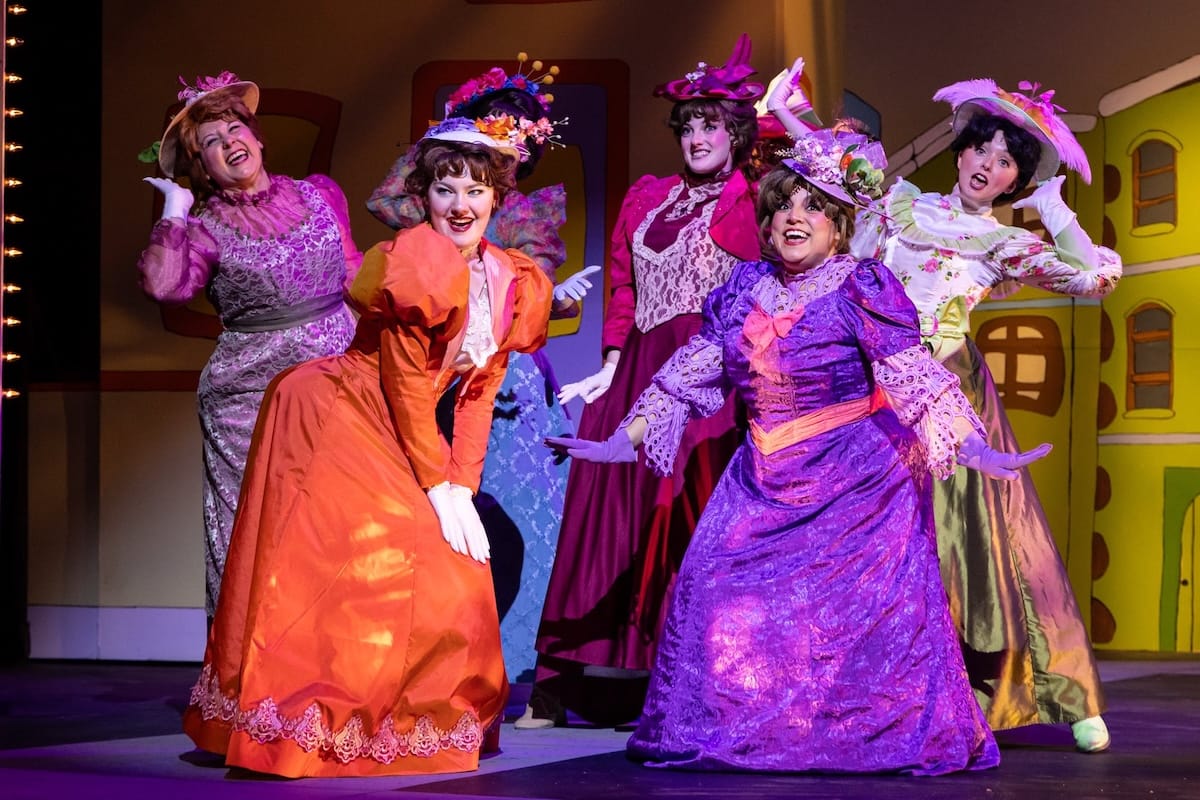
Photo: RDGPhotography
A world in ceaseless motion
Colton’s decision to treat Hello, Dolly! as a kind of living cartoon finds its strongest expression in the design. Scenic designer Michael Curtis Grittner anchors the show with a brightly colored, storybook Yonkers unit that flips to reveal different interiors, then gives way to a series of smaller, flexible set pieces for the New York scenes. This all keeps the stage busy and the storytelling fluid as the action moves from feed shop to city streets to Harmonia Gardens.
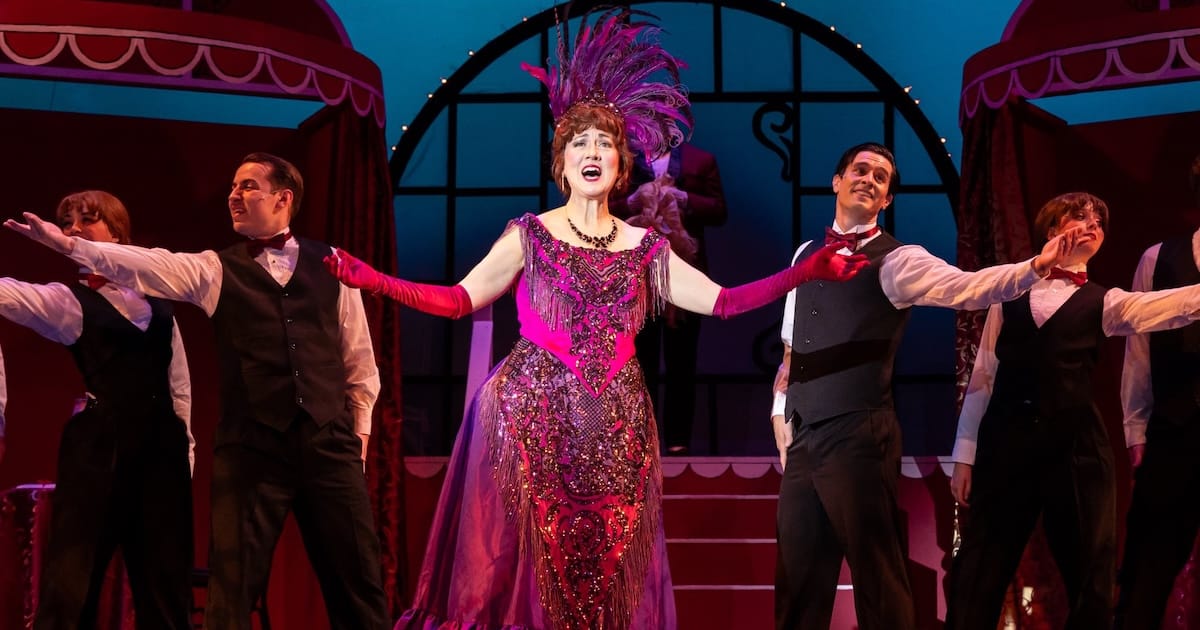
The heightened aesthetic extends to Charlotte Campbell’s vibrant costume design and Debbie Spaur’s sharp wig work. Dolly’s sequined purple gown for the titular number is the obvious showstopper, complete with a dramatic headpiece that announces her arrival. However, the production pays equal attention to ensemble detail, from the crisp, uniformed waiters to the parade costumes that fill the stage with cohesive and unapologetically theatrical garb.
At times, the cartoon impulse is pushed a step too far. Sound effects from the orchestra punctuate certain comic beats without a clear internal logic, occasionally drawing attention to themselves rather than sharpening the joke. It’s a minor inconsistency in an otherwise confident visual language, and one of the few moments where excess threatens to dilute clarity.
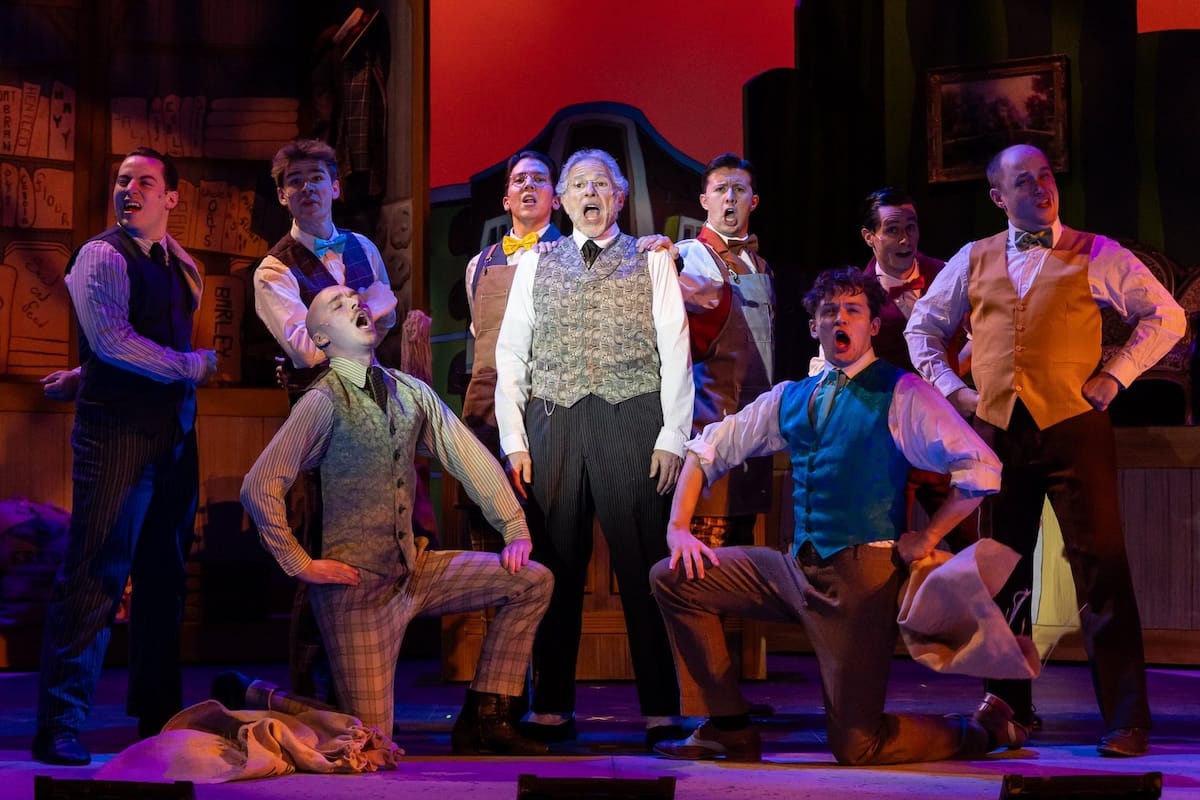
Photo: RDGPhotography
A company that sells the silliness
What really makes Colton’s approach work is the strength of the ensemble. Hello, Dolly! lives or dies on collective energy, and Candlelight’s 20-person cast commits fully to the show’s broad humor, physicality and persistent movement.
Melissa Williams leads the production as Dolly, playing her as brassy, self-assured and joyously manipulative, while allowing glimpses of vulnerability to surface in quieter moments. Williams finds a softer emotional register when Dolly reflects on her late husband and the years she spent shut out from society, grounding the character’s antics in genuine longing.
Roy Marcus is a sturdy foil as Horace Vandergelder, leaning into the character’s bluster and rigidity without pushing him into outright villainy. His swaggering sexism in “It Takes a Woman” lands less as endorsement than as character exposure, especially given the exaggerated, almost buffoonish way Marcus plays him.
The romantic subplotters bring plenty of charm. Jerod Mose and Ian Doyle are delightfully earnest as Cornelius Hackl and Barnaby Tucker, two overworked clerks determined to seize a day off and experience life and love in the city. Brooklyn Buhre’s Irene Molloy offers warmth and dignified charm as Cornelius’ romantic counterpart, while Taylor Baker leans into Minnie Fay’s kinetic comic energy, complete with a stylized laugh that earns hearty chuckles.
The ensemble’s cohesion is especially evident in group scenes, where ensemble performers snap cleanly between characters and physical vocabularies. Even small roles leave an impression, with Carter Edward Smith making a memorable meal of his part as Rudolph Reisenweber, the bombastic and very Prussian maître d’ of the Harmonia Gardens Restaurant, and Carrie Klofach hamming it up as the ridiculously uncouth Miss Money.
Across the board, the cast understands that Hello, Dolly! succeeds by fully embracing its silliness — a task they are more than capable of accomplishing.
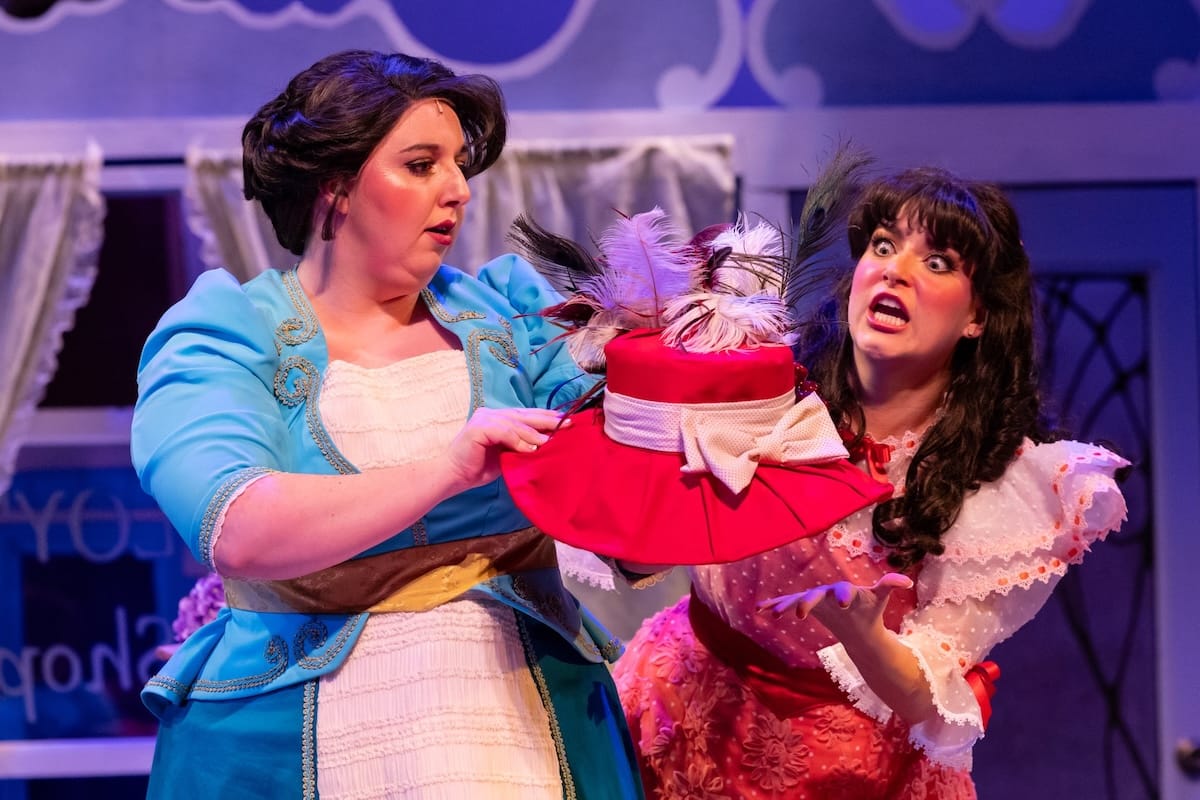
Photo: RDGPhotography
Expressive choreography and extraordinary golden-age sound
Christie Zimmerman’s choreography is one of the production’s strongest assets. This is a dance-heavy show, and Zimmerman fills it with playful specificity and visual variety. “Put On Your Sunday Clothes” unfolds as a joyful explosion of movement, complete with clever staging that turns flat scenic pieces and umbrellas into a rolling train.
Act 2 opens with “Elegance,” a slapstick-forward number that gives Irene, Minnie, Cornelius and Barnaby space to shine as a comic quartet. Zimmerman leans into rhythm and repetition, letting escalating physical gags do the work as the characters attempt and repeatedly fail to embody refinement. Shortly after, “The Waiters’ Gallop” is tightly controlled chaos, marrying ballet-inflected movement with farce inside the bustling Harmonia Gardens.
Musically, the production is in strong hands under Music Director Mason Siders, who conducts from the keyboard while leading a nine-piece orchestra. In an era dominated by pop-inflected musical theatre, there’s something deeply refreshing about hearing these classic melodies played full-throttle from the pit. The orchestra supports confident ensemble vocals and gives the evening a sonic richness that matches its visual scale.
A charming Candlelight experience
As with any Candlelight production, the dinner theatre experience itself is part of the appeal, and this Hello, Dolly! delivers on that front as well.
Service on opening night was attentive without being intrusive, with servers keeping the evening moving smoothly. The food itself was consistently solid, from savory courses to dessert, with the standout being the cheekily named Key (Lime) to Barnaby’s Heart, which was a bright, creamy key lime pie with a graham cracker crust and vanilla bean whipped cream.
Taken together, the exceptional customer service and the production’s theatrical exuberance reinforce what Hello, Dolly! does best: invite audiences to relax into pleasure. Candlelight’s approach doesn’t ask viewers to interrogate the material so much as to enjoy its rhythms, its color and its optimism.
Over-the-top and occasionally indulgent, Candlelight’s Hello, Dolly! nonetheless succeeds where it counts. It’s funny, generously performed and anchored by an understanding that beneath the matchmaking hijinks lies a story about grief, connection and choosing to rejoin the world. For audiences looking for a lively date night or a joyful reintroduction to a classic musical, this production delivers exactly what it promises — and then some.

A Colorado-based arts reporter originally from Mineola, Texas, who writes about the changing world of theater and culture, with a focus on the financial realities of art production, emerging forms and arts leadership. He’s the Managing Editor of Bucket List Community Cafe, a contributor to Denver Westword and Estes Valley Voice, resident storyteller for the Bonfils-Stanton Foundation and co-host of the OnStage Colorado Podcast. He holds an MBA and an MA in Theatre & Performance Studies from CU Boulder, and his reporting and reviews combine business and artistic expertise.

Leave A Comment