
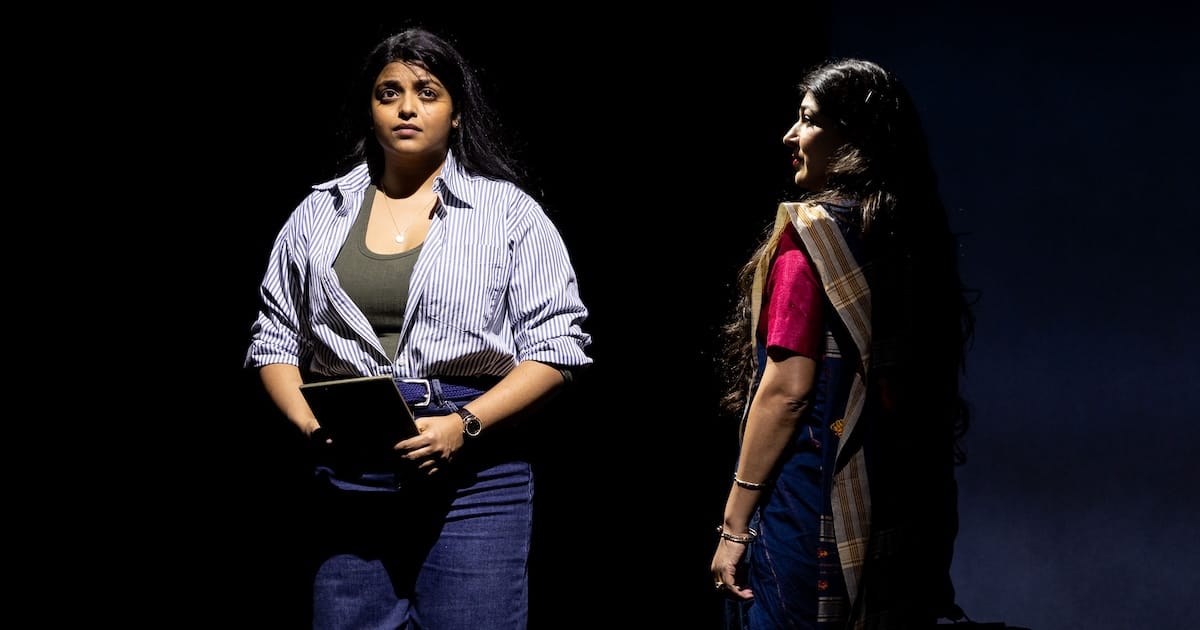
DCPA Theatre Company’s world premiere is a sharp, moving exploration of identity and grief in the rural West.
When Cowboys and East Indians first appeared as a reading at the Colorado New Play Summit in 2024, I remember talking with others in attendance about how it already felt unusually stage-ready. Now, in its world premiere at the DCPA Theatre Company, the play proves that the story works just as well fully staged as it did in a reading.
Adapted by Nina McConigley and Matthew Spangler from McConigley’s acclaimed short story collection and directed with confidence by Chris Coleman, this tight five-hander is emotionally rich, sharply paced and full of welcome surprises.
Set over the weekend of a wedding in rural Wyoming, the play centers on Lakshmi “Lucky” Sen (Sadithi De Zilva), who is determined to fulfill her late mother’s final wish: outfitting her sister’s wedding party in traditional saris. What sounds like a simple task quickly becomes a reckoning with the compromises Lucky has made while trying to fit into a place that never fully reflected her back to herself.
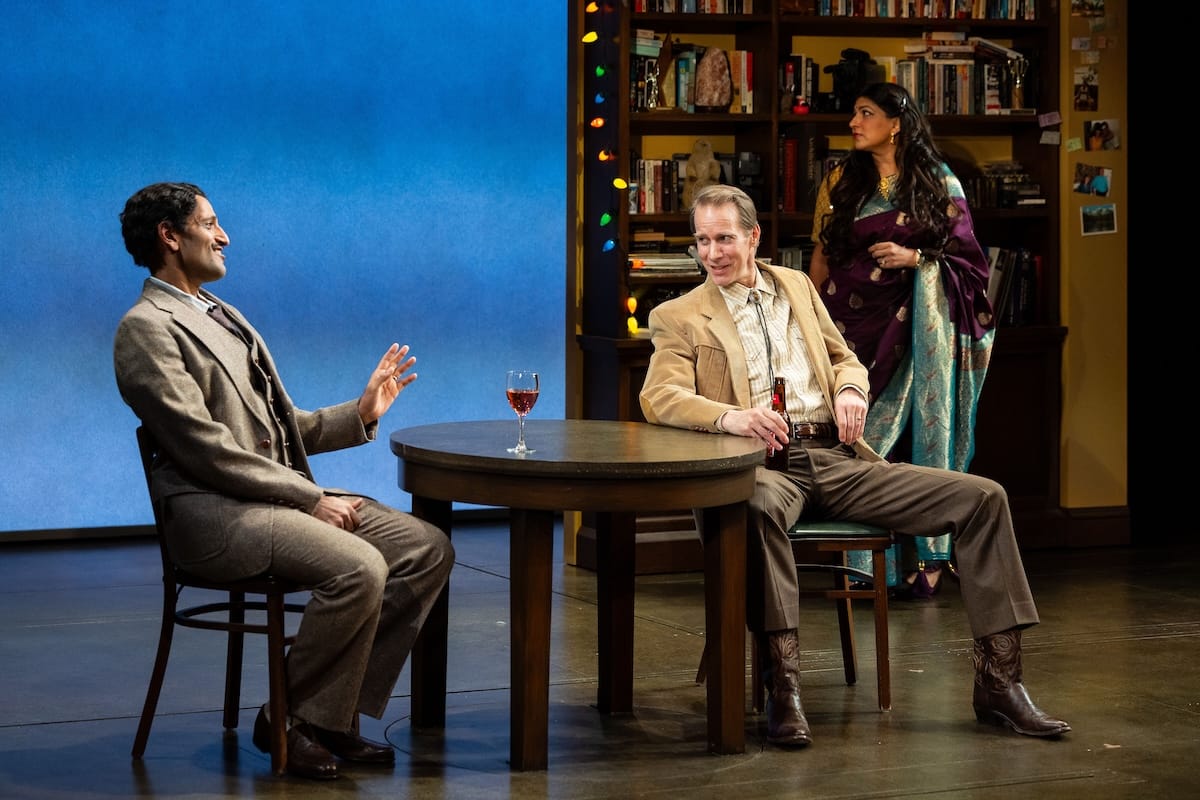
From left: Shawn K. Jain, Christopher Kelly and Minita Gandhi in ‘Cowboys and East Indians. | Photo: Jamie Kraus Photography
Superb ensemble
De Zilva’s portrayal of Lucky is witty, grounded and emotionally precise. Framed by monologues that open and close the play, Lucky serves as both narrator and participant. De Zilva’s performance excels in its restraint; even as the character unspools complicated feelings about her family and future, De Zilva’s performance never tips into melodrama.
Shawn K. Jain brings warmth and humor to Rajah Sen, Lucky’s father, particularly in scenes where he gently pushes Lucky toward graduate school and a life beyond Wyoming. His humor, often deployed in affectionate sparring with his daughter, balances the play’s heavier themes. In flashbacks, Jain’s chemistry with Minita Gandhi’s Chitra Sen is immediate and textured. Their marriage feels real not because it’s idealized, but because it’s prickly and playful.
Gandhi’s Chitra is a force: independent, outspoken and deeply yearning for community after years of moving. Her unexpected friendship with the Larsons becomes one of the play’s most compelling threads, especially as it reveals how connection can form in places that initially seem inhospitable.
As the Larsons, the white Wyoming family at the center of the play’s cultural collision, Christopher Kelly and Shannan Steele smartly avoid caricature. Kelly’s Richard initially reads as a blunt, domineering boss, but his performance steadily complicates that first impression. Steele’s Nancy, introduced with a kind of old-school geniality, gains depth as her friendship with Chitra grows. Together, the ensemble creates a believable web of relationships that feels lived in.
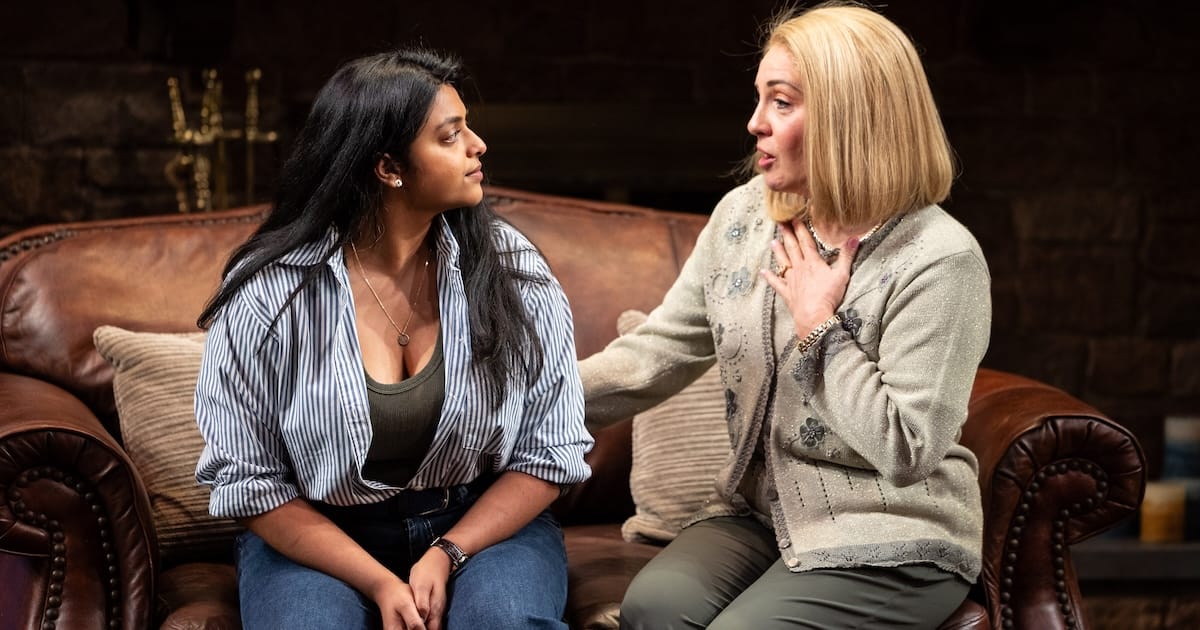
Sadithi De Zilva and Shannan Steele | Photo: Jamie Kraus Photography
Design that mirrors the play’s ideas
On the technical side, Chika Shimizu’s scenic design is surprisingly expansive. Starting from a bare stage with evocative horizon-like projections, the world fills in through seamlessly moving set pieces like cars, tables, couches, walls and even a hidden bed that emerges from behind the back wall. The effect underscores one of the play’s central ideas: What we see on the surface rarely tells the whole story.
Meghan Anderson Doyle’s costumes ground the characters in their environment while honoring cultural specificity, from cowboy-party attire to richly colored saris. Amith Chandrashaker’s lighting subtly shifts mood and focus, while Lindsay Jones’ original music and sound design supports the emotional arc without overpowering it. Particularly effective is the voice and dialect work by Pavithra Prasad, which keeps accents authentic yet always clear.
That commitment to suggestion over declaration becomes especially important as Cowboys and East Indians moves toward its most revelatory moment, which occurs slightly more than halfway through. Without giving anything away, the play takes a turn that reframes how we understand one of its central relationships and, by extension, what it really means to live between worlds in a place that demands clear categories. On opening night, it landed with an audible gasp from the audience.
What makes the moment so effective is not the surprise itself, but how carefully the groundwork has been laid. The twist does not contradict what came before; instead, it deepens it, bringing into focus the shared vulnerabilities that connect characters who initially seem worlds apart.
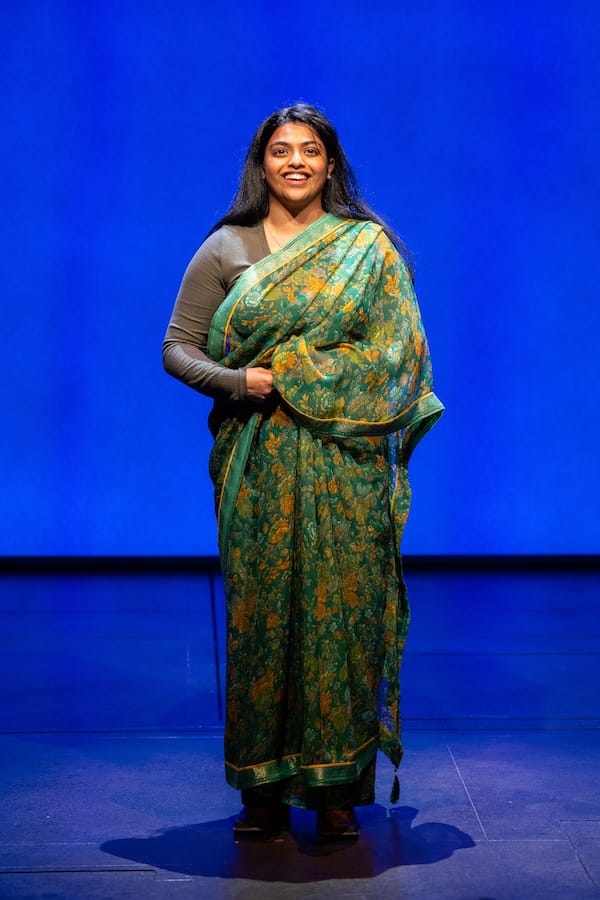
Sadithi De Zilva as Lucky in her sari. | Photo: Jamie Kraus Photography
A promising future beyond Denver
As a world premiere, Cowboys and East Indians is remarkably polished. The play’s compact cast and character-driven structure suggest a future well beyond the Denver Center, where it could easily be taken up by regional and smaller companies without losing its emotional clarity. Additionally, its focus on rural immigrant life fills a notable gap in contemporary American theatre. This is a story rooted in a very specific place, yet it speaks fluently to audiences far beyond Wyoming.
Cowboys and East Indians is a strong start to the year for the DCPA Theatre Company, as well as a compelling lead-in to this winter’s New Play Summit (Feb. 14-15), which continues the organization’s long-running commitment to developing new work from reading to full production. Surprising without being showy, it trusts its audience to sit with ambiguity and to recognize themselves in places they might not expect. In doing so, it quietly but firmly expands the theatrical map of the American West and reminds us how many stories are still waiting just beyond the horizon.

A Colorado-based arts reporter originally from Mineola, Texas, who writes about the changing world of theater and culture, with a focus on the financial realities of art production, emerging forms and arts leadership. He’s the Managing Editor of Bucket List Community Cafe, a contributor to Denver Westword and Estes Valley Voice, resident storyteller for the Bonfils-Stanton Foundation and co-host of the OnStage Colorado Podcast. He holds an MBA and an MA in Theatre & Performance Studies from CU Boulder, and his reporting and reviews combine business and artistic expertise.

Leave A Comment