
Nancy Keystone’s restless, busy staging has plenty to admire, but fans of the Pulitzer winner may find it gets in its own way.
DCPA Theatre Company’s Next to Normal is unlike any other production of the Pulitzer Prize-winning musical I’ve seen. The show is an emotional roller coaster — at times funny, at times devastating and always interesting. However, while I try to judge this production on its own terms, I simply did not connect with this version as directed by Nancy Keystone. This time, unlike when I have seen this show before, I did not cry.
It’s not that Keystone’s choices are wrong or not thought out. There is a consistency to her vision of this family in distress — each adrift and seeking a safe harbor but not knowing where to drop anchor. The show may be perfect for those unfamiliar with it. The opening night audience seemed enthralled and responsive. For those who have previously seen Next to Normal — including the version aired on PBS’s Great Performances — there are significant staging differences which distracted me from Keystone’s approach to the show.
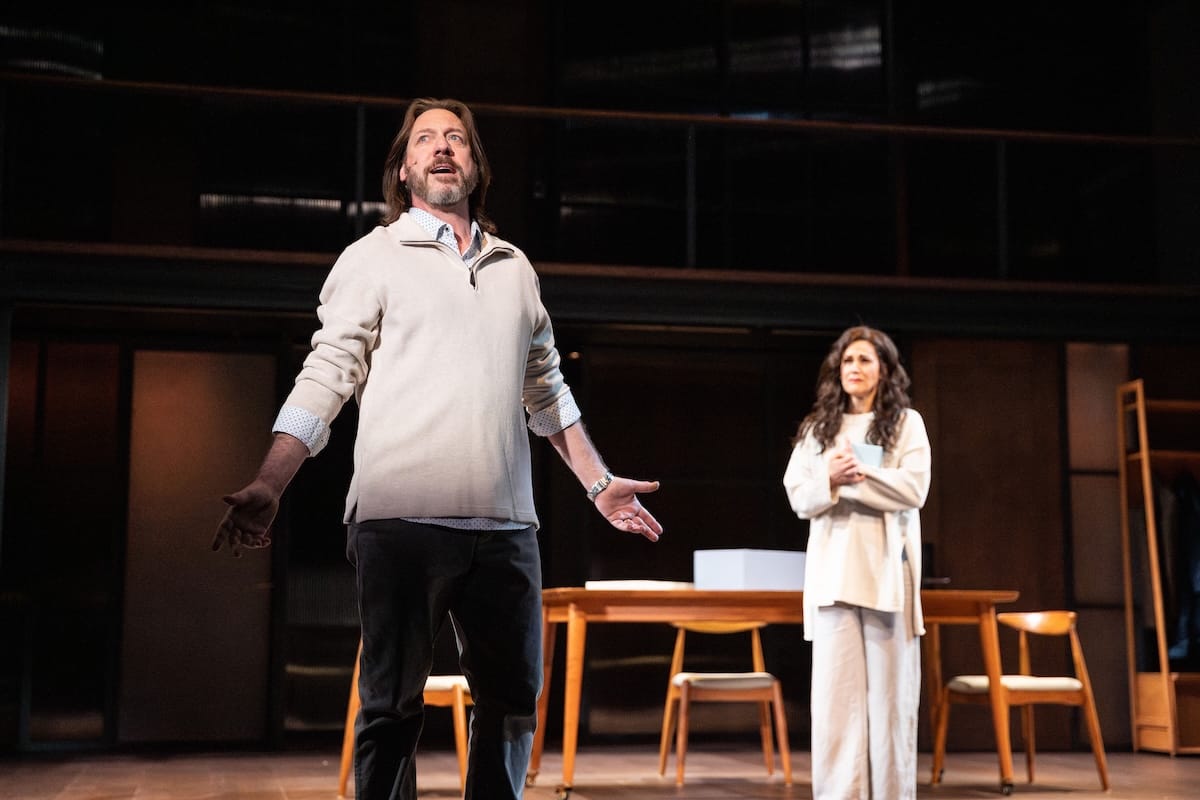
James D. Sasser and Aléna Watters as Dan and Diana. | Photo by Jamie Kraus Photography
One troubled family
Created by Tom Kitt and Brian Yorkey, Next to Normal is the story of the Goodman family of whom the mother, Diana (Aléna Watters), first sings of as a “perfect loving family, so adoring.” Yet, we quickly learn that Diana is mentally ill and the family has had to deal with it for at least 16 years.
Her husband, Dan (James D. Sasser), is confused and tired. Her daughter, Natalie (Angélica Concepción), is angry and can’t wait to leave home. And her son (Ethan Peterson) seems detached from the rest of the family. Drug therapy with two psychiatrists (both played by Randy Guiaya) works for a time until it is recommended Diana undergo electroconvulsive therapy (ECT), commonly known as “shock therapy,” which is where Act One ends. Act Two deals with the aftereffects of the treatment. Throughout, we watch Natalie in a push-pull romantic relationship with a classmate, Henry (Aidan Joyce).
Next to Normal started life as a short comedy entitled Feeling Electric before becoming a mostly sung rock musical and a dark family drama. There still is much humor to alleviate the dark drama at its core. Keystone elects to play up the humor while not diminishing the tension at the show’s core.
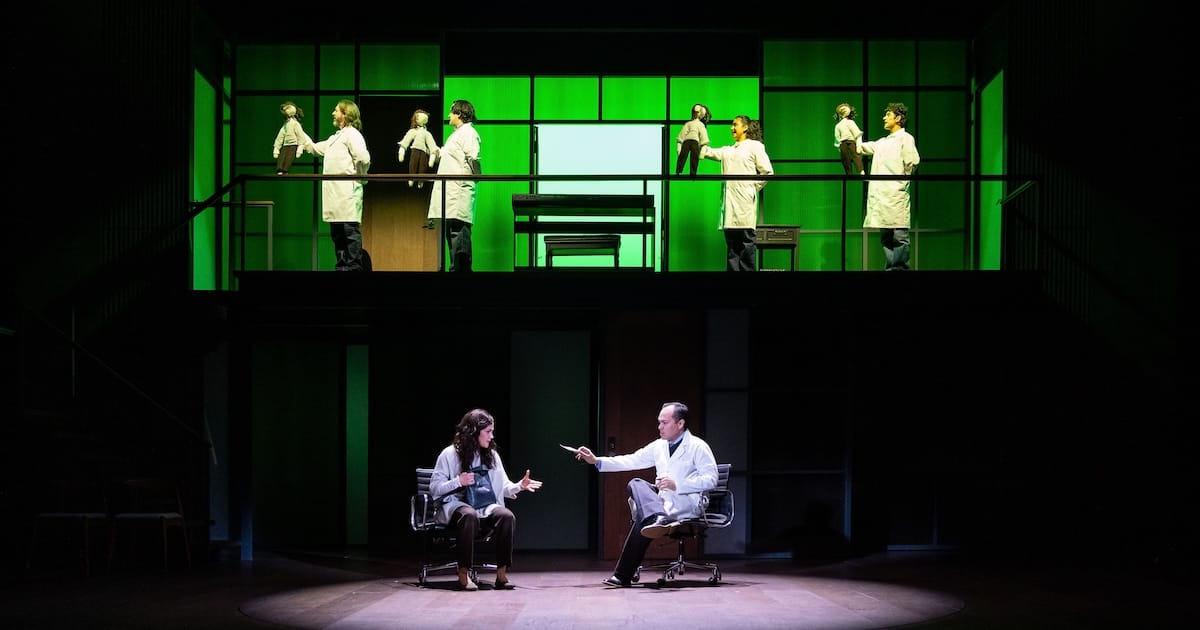
This show is much busier than other productions I’ve seen and more so than it needs to be. Even though the material is so strong (even where its internal timeline and logic fails), it seems like Keystone did not trust the material itself to carry the story. She has the cast in near constant action both direct to the audience but also visually commenting and reacting on the sides. She uses the action to amplify and emphasize the libretto and book. If you are not familiar with the show, the additions may be helpful, but I found myself looking at some of the side action and not focusing on the lyrics or dialog. For example, the cast uses puppets dressed as Diana in “My Psychopharmacologist and I,” which is cute and gets a laugh, but whose meaning was lost on me.
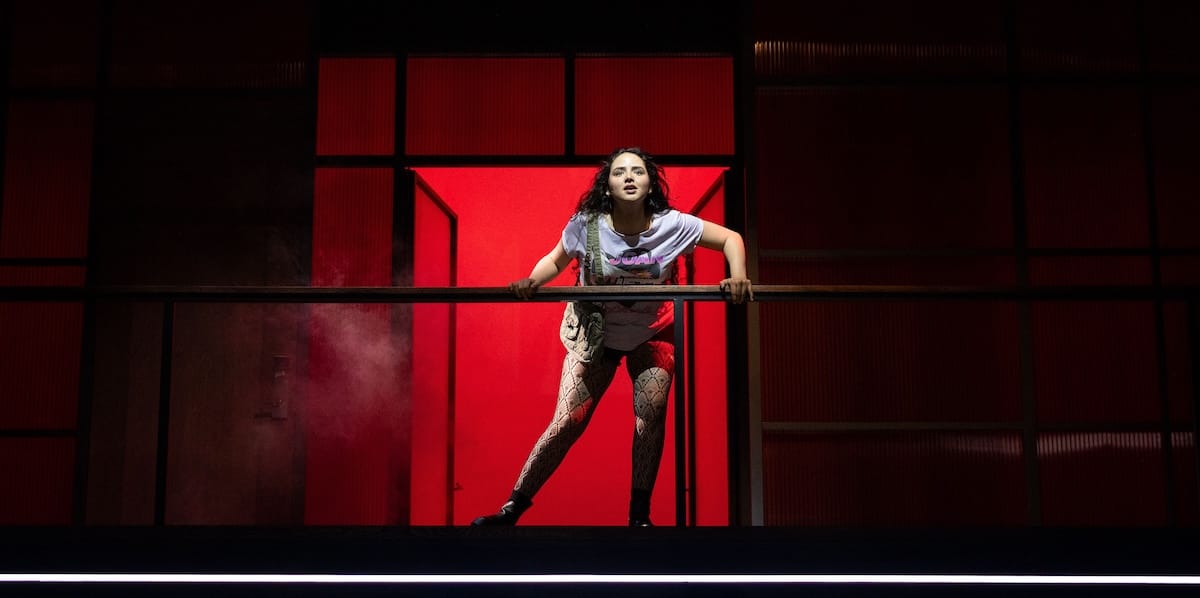
Angélica Concepción as Natalie. | Photo: Jamie Kraus Photography
The cast
Aléna Watters stars as Diana, often described as one of the most vocally challenging roles in modern musical theatre. At times, Watters seems to be holding back, pacing her voice to save it for the full run of the show. But when she lets loose in “I Miss the Mountains,” “Didn’t I See This Movie” and “Wish I Were Here,” she grabs hold of everyone in the audience and refuses to let go. In Act Two, her portrayal of Diana’s struggles produces gasps from the audience. Her emotions feel genuine as Diana navigates the effects of ECT, and she may bring you to tears with her “So Anyway.”
James D. Sasser’s Dan is more aloof than emotionally connected to Diana or Natalie. He is “living on a latte and a prayer,” more concerned with his own well-being than theirs. When he sings “Who’s Crazy,” it is truly him questioning himself. This makes his plea to Diana to undergo ECT seem awkward. It feels selfish. He wants Diana to be “normal” for his sake, not hers. I was unprepared for the choice Dan makes near the end of Act Two, although it is consistent with this self-focus. Sasser has a sweet singing voice that reflects Dan’s differing moods, yet it took me most of Act One to warm to his character.
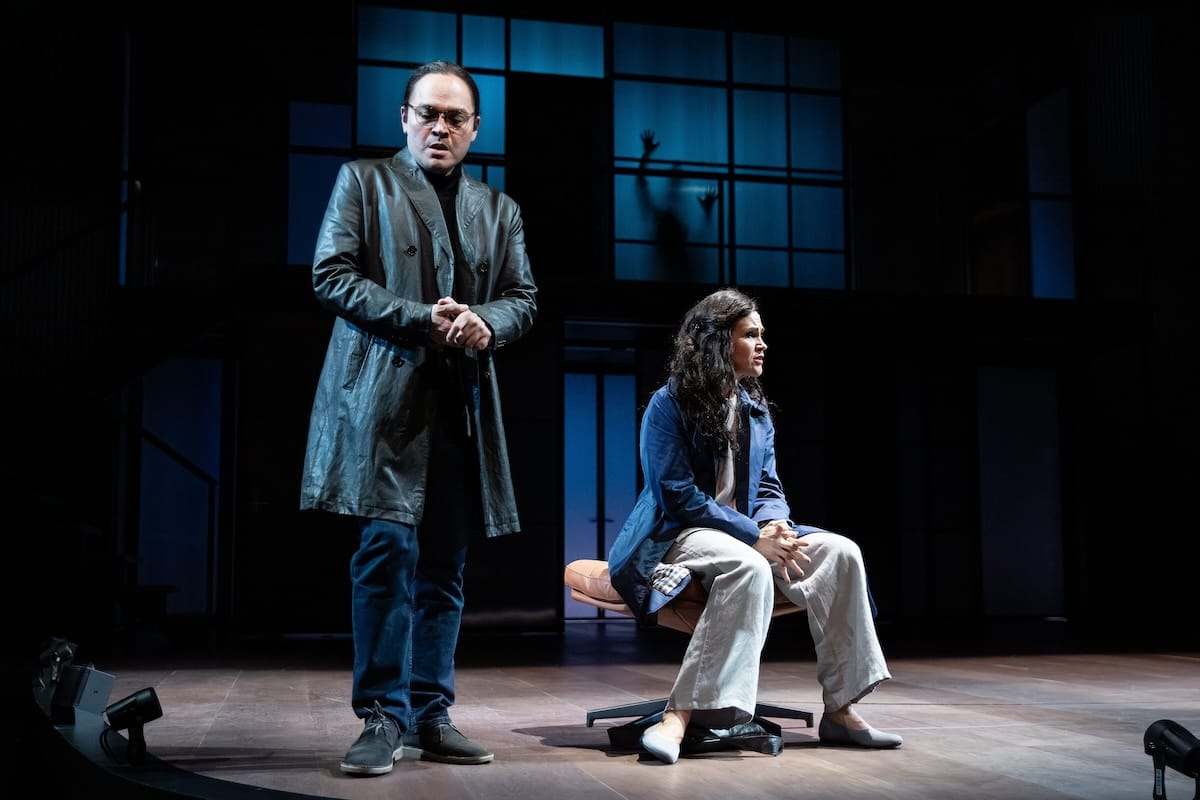
Randy Guiaya and Aléna Watters. | Photo by Jamie Kraus Photography
Two shrinks
Keystone’s direction emphasizes the weakness, uncertainty and dangers of psychiatry in treating mental illness. Randy Guiaya — who portrays Dr. Fine and Dr. Madden, the two psychiatrists who treat Diana — has a fine singing voice. But, as directed, he does not project the presence, authority and caring for Diana. Guiaya’s depiction is more of an indictment of psychiatry than any other element of the show.
Angélica Concepción’s Natalie is the emotional center of the show, and the actor does an excellent job navigating Natalie’s emotional swings. In Act One, she stunningly delivers the anguish of “Superboy and the Invisible Girl.” Her singing voice has a pure warm quality, following the music and letting it take her where Natalie needs to be. Concepción is particularly strong in Act Two during Natalie’s meltdown and when she finally allows herself to show her full anger at Diana, Dan and the doctors.
But she is hampered by Aidan Joyce’s Henry, who is played more straight — even normal — than his character is written. The bond between the two is slow to develop and never quite gets there. He just doesn’t yearn enough to earn Natalie’s affections.
Ethan Peterson tackles the difficult role of Diana’s son. It can be played on many different levels, reflecting or guiding Diana’s actions, charming, sinister, supportive or destructive. Peterson wanders through these levels leaving the son as more of a mystery. His big number “I’m Alive” should be more of an emotional shout, even a scream, than Peterson delivers.
Creative elements amplify Keystone’s vision
The lighting design by Paul Whitaker is fantastic. There are excellent effects throughout that perfectly capture mood and the emotional changes from moment to moment, while also focusing attention where Keystone wants it. The lighting is, in many ways, its own character.
The band, directed by Jacob Carll, is hidden, keeping the spotlight on the actors. Carll has the band following the actors rather than leading them, a welcome approach that lets Keystone’s direction shine.
For a mostly rock musical staged in the DCPA’s Wolf Theatre, Elisabeth Weidner has a daunting task with sound design. For the first 15 or 20 minutes, the sound mix is less than adequate, reminding me of sound issues I’ve been having with musicals in the larger Buell space. The music overwhelms the actors’ voices, lyrics become indecipherable and we lose some of the harmonies. Things do settle down after that, and I could appreciate the emotional moments sung and spoken and the work of vocal arranger AnnMarie Milazzo.
The two-story set by Klara Zieglerova features a number of sliding panels that are used well. However, the main floor is too sparse, with the actors having to bring on elements and props constantly drawing attention away from the story. There are also quite a few more costume changes than seem necessary. Costume Designer Meghan Anderson Doyle is up to the challenge even as I found the son’s costume in “There’s a World” out of place. Doyle, though, dresses Natalie in Act Two in a perfect representation of the character’s wildness.
Next to Normal‘s finale, “Light,” is an anthem of hope. Keystone’s direction and staging respond to that hope in a way I’ve not seen before. There is a clarity that may be perfect for those who’ve not yet seen the show. If you are familiar, you may enjoy seeing Keystone’s spin and appreciate how the same material can be presented so differently.
One last note: Next to Normal’s depiction of ECT and drug therapy are exaggerated and condensed for dramatic purposes. In addition to the numerous trigger warnings, DCPA should have had a note that the show is not representative of current psychiatric treatments.

Garth Gersten is an attorney and lifelong theatre lover. In Champaign, Illinois, he directed shows with Champaign-Urbana Theatre Company, Rantoul Theatre Company, Bright Lights Theatre Company and Twin City Theatre Company, which he founded. He now lives in Boulder with his wife who is a professor at CU.

Leave A Comment