
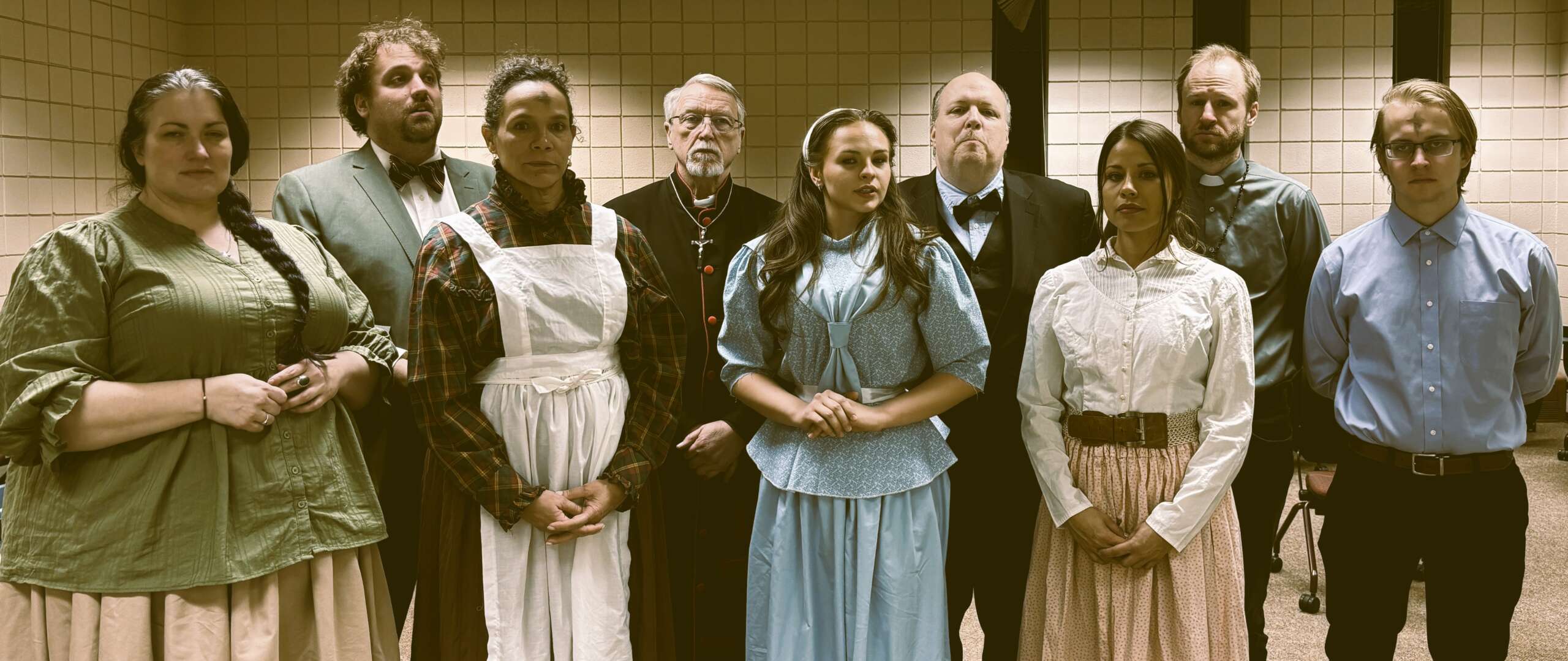
Elemental Theatre Company tackles Milan Stitt’s brooding drama, but staging issues dilute its impact.
Elemental Theatre Company’s production of The Runner Stumbles, now playing at The People’s Building in Aurora, is not the sort of show most emerging theatre companies choose for one of their early outings. Milan Stitt’s 1976 religious courtroom drama is dense, structurally complex and emotionally punishing, unfolding across interrogations, courtroom testimony and flashbacks that reconstruct the scandalous relationship between Father Rivard and Sister Rita after the young nun’s mysterious death.
That Elemental — the company formerly known as Wheat Ridge Theatre Company — has selected this material at all signals an admirable interest in tackling adult, idea-driven plays that can provoke conversation. In a Colorado theatre landscape where smaller companies often lean towards comedies and familiar titles, this is a serious swing toward something more dramaturgically demanding.
Under the direction of Sina Hirsch, Elemental approaches the play’s morally thorny material with admirable seriousness. However, staging choices, particularly frequent, time-consuming transitions in which cast members physically reconfigure the set for each new location, interrupt the steady accumulation of tension the play depends upon.
The cumulative effect is a production that understands the material’s thematic weight but struggles to maintain the narrative urgency required to fully deliver its devastating conclusion.

Calista Rain Masters as Sister Rita and Mark Caswell-Yee as Father Rivard.
Momentum lost in motion
The Runner Stumbles unfolds as a courtroom mystery filtered through memory. After the death of Sister Rita under suspicious circumstances in a remote northern Michigan parish in 1911, Father Rivard is charged with her murder.
The play alternates between Rivard’s current imprisonment and scenes set prior to Rita’s death, revealing their complicated relationship. As past and present collide, each retelling complicates our understanding of what happened between them, gradually revealing the emotional and institutional pressures that shape their actions, until the play’s final revelation reframes the entire tragedy.
The primary challenge of this staging is how the shifts in time and location are physically handled. Rather than designating specific playing areas for the prison cell, courtroom and flashback sequences, the nine-person cast repeatedly moves benches, blocks, tables and chairs on and offstage to reconfigure the environment for each scene.
These transitions are executed diligently, but they are also lengthy enough to interrupt the accumulating tension of the narrative. Because The Runner Stumbles hinges on the steady drip of new information in a variety of settings, any pause in forward momentum risks muddying the audience’s grasp of the plot. Unfortunately, over the course of the evening’s two hours and thirty minutes (with intermission), the drama feels more static than Stitt’s script likely intended.
A simpler staging vocabulary could allow the audience to track the timeline instantly and keep the focus on the play’s ethical stakes rather than the mechanics of scene changes. This could have been achieved by dividing the stage into three clearly defined areas that remain constant throughout the night. For example, if stage left is the jail cell, center stage is the “past” (the rectory/parish scenes), and stage right is the courtroom, the play can transition between testimony and memory without having to reposition furniture or reset the world.

Calista Rain Masters as Sister Rita.
Performances power the production
As Father Rivard, Mark Caswell-Yee commits fully to the role’s emotional demands, moving between stoic restraint and flashes of anger or grief as the character’s circumstances close in around him. There is a clear willingness to engage with the emotional weight of the role, but the connective tissue between those shifts can feel undeveloped at times.
Calista Rain Masters brings earnest sincerity to Sister Rita and demonstrates strong technical control in several of the production’s most heightened moments. Still, like her scene partner, she occasionally approaches the script’s biggest emotional beats at full intensity from the outset. When sadness immediately becomes tears or anger immediately becomes shouting in Caswell-Yee and Masters’ interactions, scenes can flatten into similar tonal registers instead of building to distinct climaxes.
Lisa Ann Collins fares especially well as Mrs. Shandig, the stern housekeeper whose loyalty to Rivard carries unsettling undertones. Collins finds gradations within the character’s rigidity, suggesting deeper motivations without overstating them.
Braden Nash provides welcome contrast as defense attorney Toby Felker, injecting occasional humor that helps maintain energy during exposition-heavy courtroom sequences. Melissa Taylor also makes a memorable impression as Erna Prindle during a key testimony scene, while James P. Hayes lends Monsignor Nicholson a quiet dignity that grounds several pivotal exchanges.

Mellisa Taylor as Erna Prindle.
An encouraging direction
Hirsch’s thoughtful visual approach is reflected in the production’s intentionally minimalist technical framework. Kati Oltyan’s costumes, while not strictly period-specific, clearly distinguish characters’ roles within the parish community and aid in audience orientation as the play shifts between timelines.
The scenic design makes similar use of The People’s Building’s intimate stage, relying on two painted walls that suggest a church interior before reversing to evoke a garden setting. When combined with Selena Naumoff’s subtle lighting and sound design, these elements create a functional storytelling environment.
For a company still defining its identity in this new chapter, The Runner Stumbles suggests an interest in grappling with morally complex material, and with continued attention to how space, performance and design guide an audience through that complexity, future Elemental efforts could land with even greater clarity and impact.

A Colorado-based arts reporter originally from Mineola, Texas, who writes about the changing world of theater and culture, with a focus on the financial realities of art production, emerging forms and arts leadership. He’s the Managing Editor of Bucket List Community Cafe, a contributor to Denver Westword and Estes Valley Voice, resident storyteller for the Bonfils-Stanton Foundation and co-host of the OnStage Colorado Podcast. He holds an MBA and an MA in Theatre & Performance Studies from CU Boulder, and his reporting and reviews combine business and artistic expertise.

Toni – I swear I didn’t read your review until after I had posted my own. And I laughed out loud when I saw that we had suggested exactly the same thing as solutions to the overpowering scene breaks and furniture moving waltz. Nice to know our minds work alike.