
Terence Anthony’s world premiere at the Denver Center is a gripping, if slightly disjointed, story about freedom in the uneasy aftermath of slavery.
Terence Anthony’s Godspeed doesn’t open with the sweep of Monument Valley or a massive conflict in the Wild West. It opens in the wreckage left behind when history moves on without fixing what it broke. Set in 1865, just after slavery has been abolished in Texas, the world premiere at Denver Center for the Performing Arts asks a harder question than most revenge tales dare: What happens when vengeance no longer promises justice?
Originally developed as part of the DCPA Theatre Company’s 2024 New Play Summit, the world premiere now shares the campus with Cowboys and East Indians, another 2024 Summit-born work that interrogates the Western from a radically different vantage point. Together, the two productions feel less like coincidence than a bold curatorial statement: The Western, long dominated by white mythmaking, is finally being reexamined from the margins.
Whereas Cowboys and East Indians depicts frontier life through a South Asian woman’s experience in modern-day Wyoming, Godspeed delves into Black American history and focuses on a Texas where slavery has technically ended but freedom remains violently provisional. The play follows a gunslinger returning from exile in Mexico with a single bullet and a carefully nurtured vendetta, only to discover that justice, like emancipation, rarely arrives in the form one expects.
That tension animates the opening scenes, as Godspeed confronts a Texas that has changed far less than she anticipated. Slavery may be abolished, but Black lives are still disposable, contracts are easily broken and power continues to tilt white and male. Anthony’s script is clearest and most unsettling when it exposes how little separates the old world from the new one and how survival still requires restraint and compromise.
Staging the play in the round at the Kilstrom Theatre heightens the sense of exposure but also complicates the epic scale implied by the script. Tanya Orellana’s tactile scenic design grounds the world in dirt, smoke and scarcity, yet the constant circling of the journey can blur the vastness of the terrain the characters are meant to be crossing. As directed by Delicia Turner Sonnenberg, the result is intimate, claustrophobic and occasionally repetitive, making it a slightly uneasy fit for a story about distance and movement.
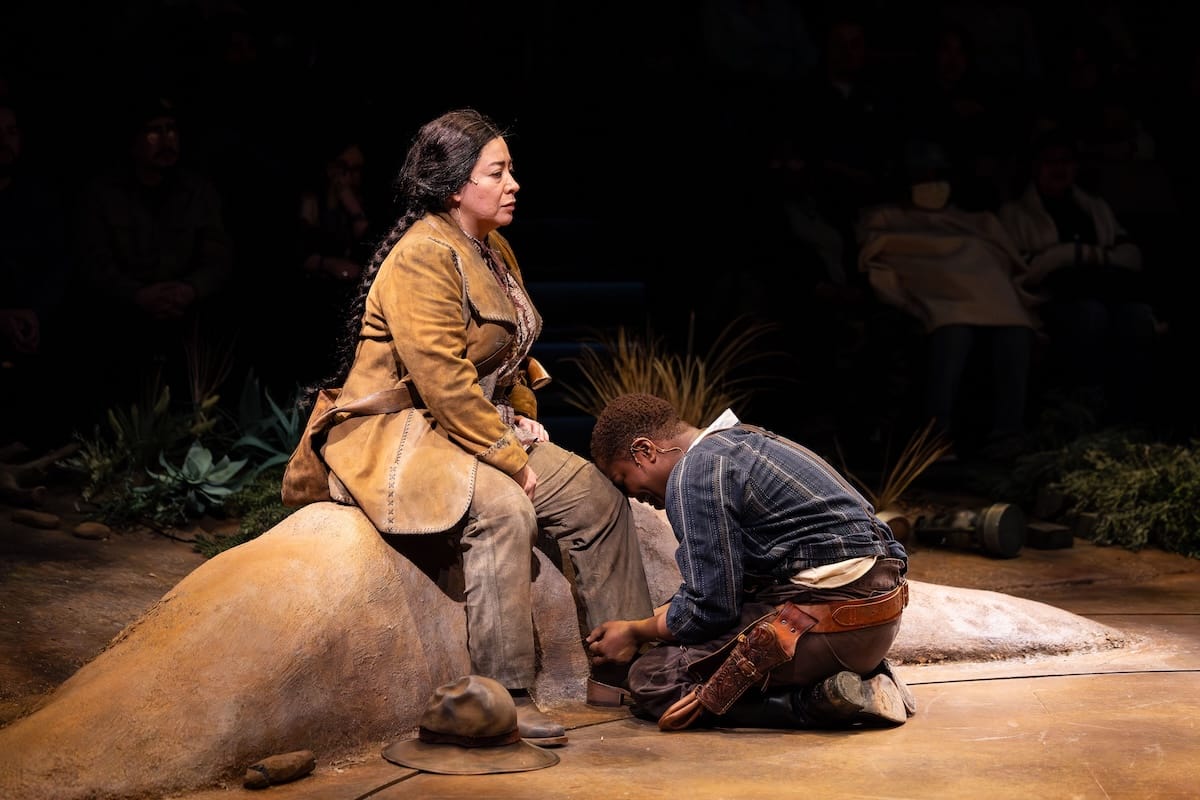
Erica Cruz Hernández and CG in ‘Godspeed.’ | Photo by Jamie Kraus Photography
Power, performance and survival on the road
As Godspeed, CG is the gravitational center of the production — a figure who radiates authority while constantly negotiating when and how to wield it. Godspeed, who was once enslaved as Anna, believes her child was murdered by her second-to-last master, and this belief has shaped her into something sharp-edged, guarded and perpetually ready to strike.
The role is played with commanding intensity by CG, whose performance captures the exhausting tension of a person who wants more than the world will allow them to have. CG’s Godspeed is domineering, volatile and often deeply uncomfortable to watch, especially as that cockiness repeatedly lands them in trouble.
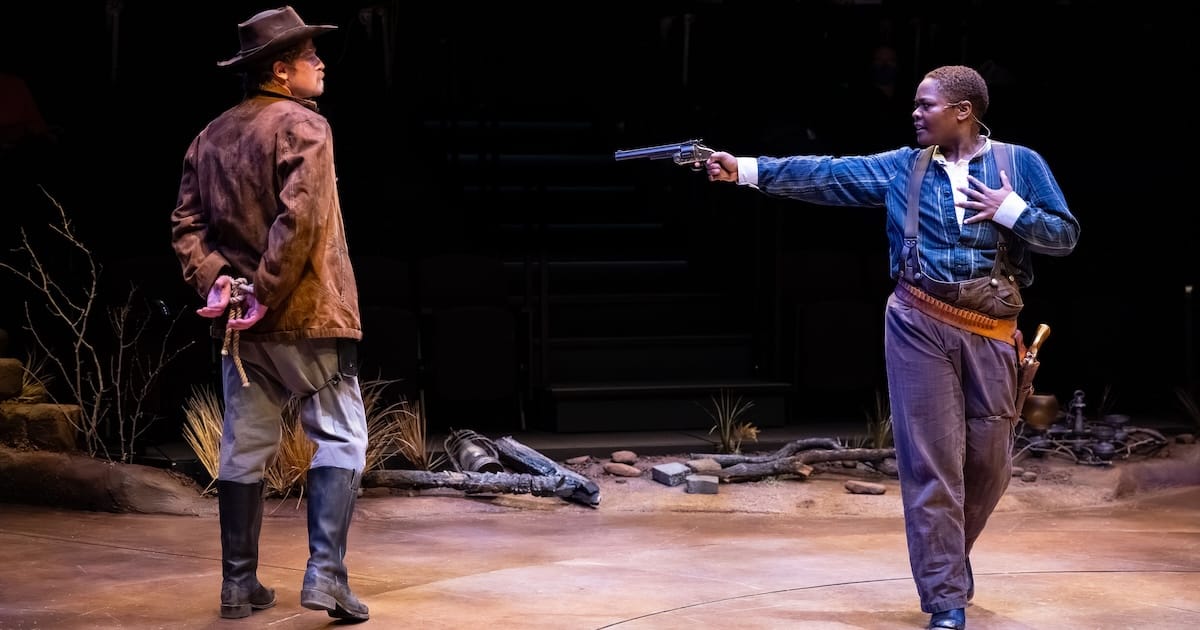
Nelson Bendy, played by Christopher Halladay, is Godspeed’s drunken former final enslaver and an unlikely foil. Halladay gives Nelson a pathetic, almost oily desperation that never quite settles into easy villainy. Their relationship is a fascinating inversion of the past: Godspeed pistol-whips Nelson into submission early on, establishing dominance without firing her single bullet, yet public spaces force them into old roles neither fully controls.
Nelson is genuinely uneasy with slavery and clearly cares for Godspeed, yet he is also a spineless coward with no practical skills and no vision for who he might become once the old order collapses. His refusal or inability to choose a moral direction culminates in Godspeed dressing him down and continuing alone, though the epilogue hints at a reconciliation the audience is never permitted to witness.
Erica Cruz Hernández brings warmth and steel to Peklai Cobos, a Mexican woman Godspeed befriended while hiding out during the Civil War. Hernández performs largely in Spanish, creating a multilingual dynamic that deepens the sense of cultural collision and mutual dependence. Peklai is no sidekick. Hernández plays her as perceptive, self-interested and deadly when crossed.
Zurin Villanueva plays two crucial roles. As Lucinda, a grieving Black woman encountered early in the journey, Villanueva delivers one of the production’s most devastating performances. Lucinda wears her heart on her sleeve, and while Godspeed initially underestimates her toughness, Villanueva makes it clear that Lucinda is far sharper and far more resilient than she appears.
Villanueva also appears as Mama Zo, Godspeed’s mother, in surreal, memory-driven sequences that blur the line between past and present. These scenes are visually striking, with trippy lighting and echoing vocal effects, but the performance leans toward melodrama. Mama Zo’s physicality and vocal choices feel more like a young actor signaling age than embodying it, which undercuts the emotional weight of revelations about how Godspeed’s past has been shaped by her manipulation.
Khiry Walker brings gravity to a variety of roles, most notably Felix, Godspeed’s long-lost relative. The play’s most devastating choice is to refuse a sentimental reunion scene. Instead, Anthony gives us a careful, oblique conversation in which identity is never named outright, but recognition hangs in every pause. Godspeed’s central reckoning hits hard: she realizes that the person she has become, hardened and consumed by vengeance, is not someone she would want her child to meet. It is the play’s emotional fulcrum, and Walker and CG handle it with remarkable restraint.
Colton Pratt and Gareth Saxe round out the antagonistic forces. Pratt’s Benjamin Mauck is an imposing presence, particularly when he reappears in the second act, his entitlement and violence barely contained. Saxe brings real menace to John Bendy, Nelson’s brother and a plantation owner scheming to escape his contractual obligations to freed Black workers. While Saxe’s authority is undeniable, his Southern accent is distractingly off, despite the cast’s otherwise strong voice and dialect training from Nathan C. Crocker.
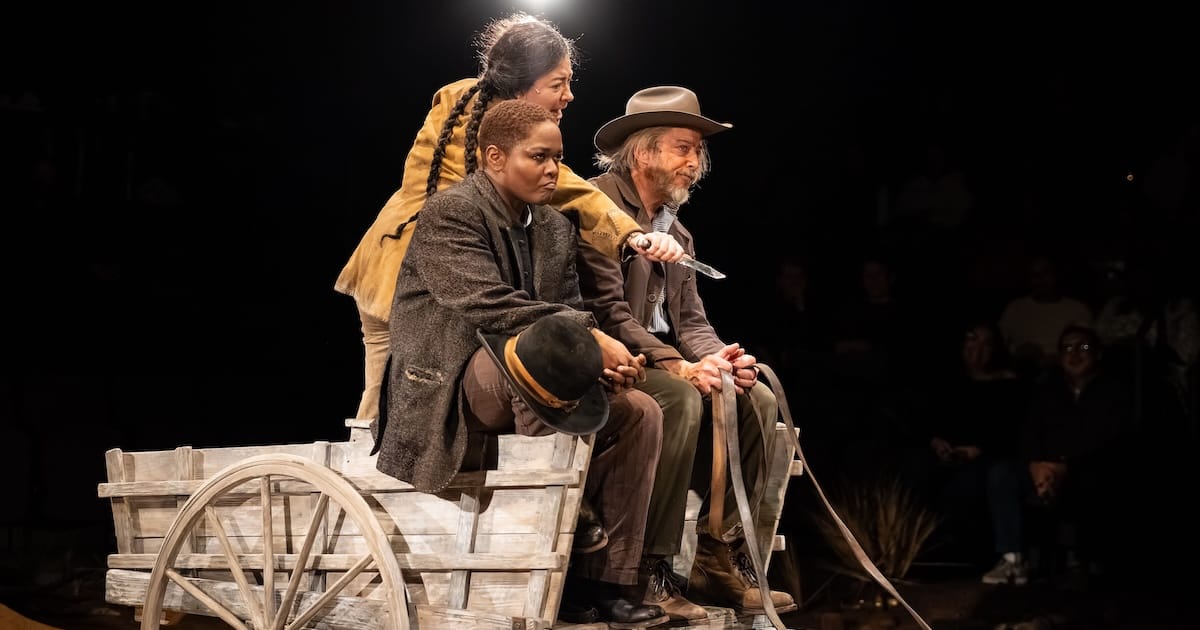
CG, Erica Cruz Hernández and Christopher Halladay in ‘Godspeed.’ | Photo by Jamie Kraus Photography
A Western in the round
Sonnenberg keeps the production moving at a strong clip, though the choice to stage the play in the round proves limiting. Orellana’s scenic design is tactile, with real dirt shoveled, smoke that literally rises from a campfire and two turntables: One to allow their cart to spin through space and the second to let them circle the perimeter of the stage. But the sense of vast distance never fully lands, and watching characters circle the audience becomes monotonous and even slightly disorienting.
Additionally, some staging moments, like Nelson awkwardly relieving himself against his cart, feel like compromises forced by the space rather than intentional choices. On a proscenium stage, that moment is clearly written for the actor to turn his back to the audience; however, because this is not possible in the round, the actor must clumsily piss on his property.
Where the design truly shines is in atmosphere. Charles R. MacLeod’s lighting is exceptional, particularly in dreamlike sequences and sharp isolations that carve emotional focus out of the open space. Noel Nichols and UptownWorks provide an eerie soundscape that hums with menace, while Samantha Egle’s fight choreography is consistently thrilling, with knife work, pistol-whipping and hand-to-hand combat all feeling dangerous and precise.
Revenge reimagined
What ultimately distinguishes Godspeed is its refusal to deliver the clean catharsis promised by its genre trappings. This is not a Western where vengeance restores order. Instead, the final confrontation reframes heroism as the ability to intervene in one moment, even if the larger system remains unchanged.
This is not a traditional Western, and it’s not a clean one. Godspeed may stumble at times, and the in-the-round staging can limit a story that craves cinematic sprawl, but the work has clearly evolved since its 2024 New Play Summit reading, emerging tighter and more thematically confident.
In Godspeed, Anthony and the DCPA offer a Western that looks past mythmaking to interrogate what freedom actually costs and who was left to pay it. It’s an ambitious, compelling world premiere that proves not all journeys end in gunfire. Some end in the harder work of choosing who you’ll protect when the dust finally settles.
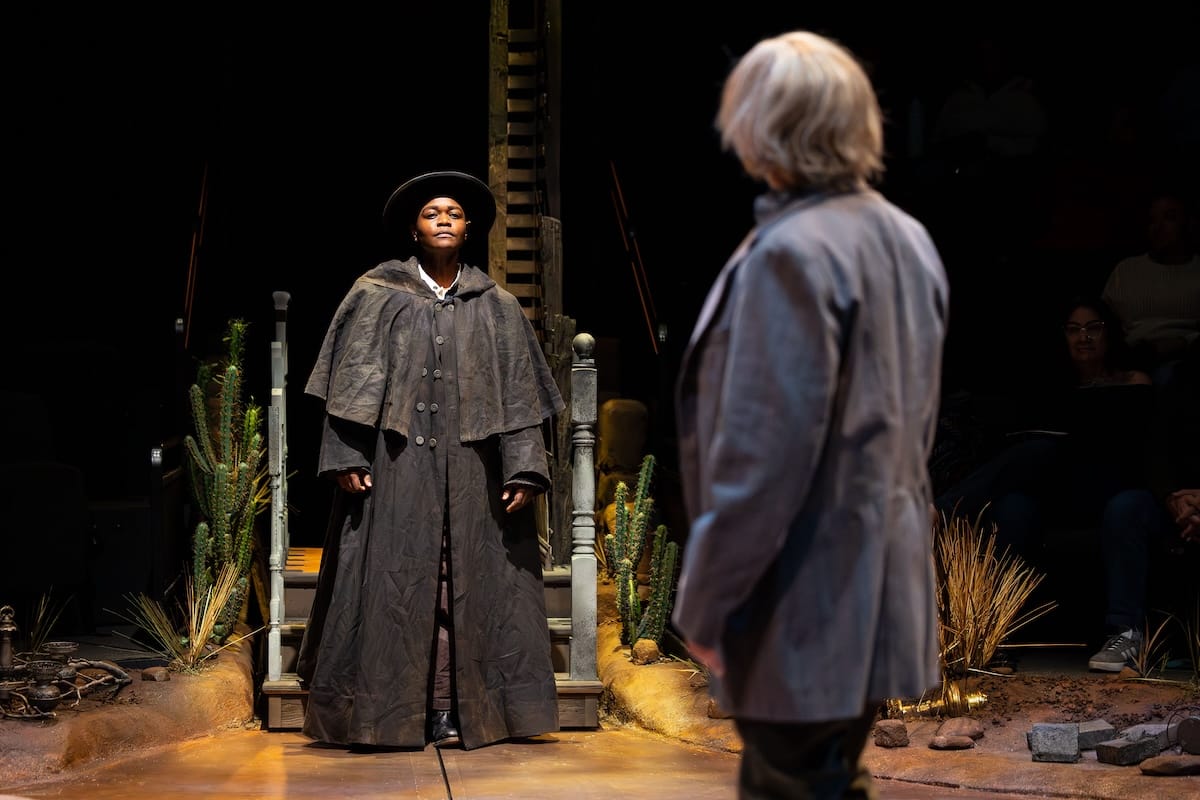
CG and Christopher Halladay in ‘Godspeed.’ | Photo by Jamie Kraus Photography


A Colorado-based arts reporter originally from Mineola, Texas, who writes about the changing world of theater and culture, with a focus on the financial realities of art production, emerging forms and arts leadership. He’s the Managing Editor of Bucket List Community Cafe, a contributor to Denver Westword and Estes Valley Voice, resident storyteller for the Bonfils-Stanton Foundation and co-host of the OnStage Colorado Podcast. He holds an MBA and an MA in Theatre & Performance Studies from CU Boulder, and his reporting and reviews combine business and artistic expertise.

Leave A Comment