
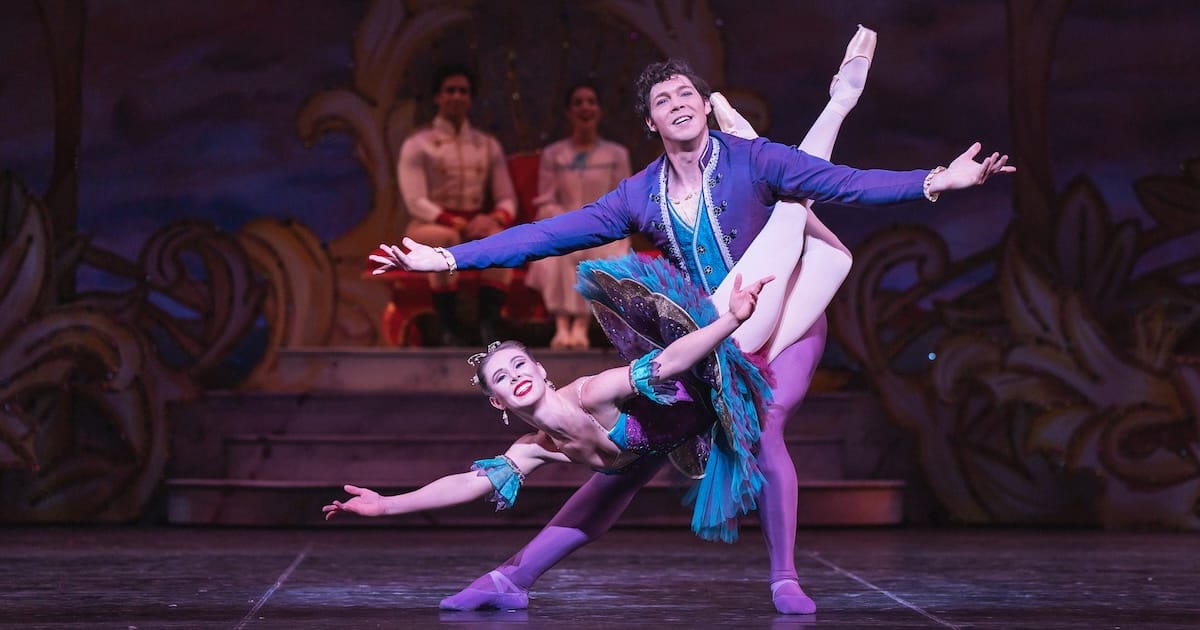
Fast-paced first act and stunning design elevate this traditional production at the Denver Center.
As anyone who read my review of Colorado Ballet’s Nutcracker last year knows, I reported that it was a dazzler. The company had premiered a new production with sets by Thomas Boyd and costumes by Holly Hines. Both are giants in the ballet world, having created designs for major ballet troupes around the world, and this Nutcracker showcases their talents magnificently.
I am happy to report that this is now Colorado Ballet’s annual production. A second viewing reinforces my view that it is one of the most engaging among the dozens of Nutcrackers I have seen over my many years as a dance critic.
The first act – a Christmas party in a Victorian German household – is lush and expansive while the second transports us to the glittering, magical kingdom of the Sugar Plum Fairy.
The choreography was created largely by former Artistic Director Martin Fredmann with additions by ballet master Sandra Brown. One of their most notable achievements is the fast-paced and thoroughly delightful first act. In many productions – even in the famous one by George Balanchine – this act often drags as the audience waits expectantly for the radiant second act’s ethnic variations and, especially, the Grand Pas de Deux of the Sugar Plum Fairy and her Cavalier.
Not so here. Fredmann and Brown have imbued the first act with a surfeit of glimmering steps, energy and humor and I was again surprised by how soon the intermission arrived. As Colorado Ballet’s company members continue to become more and more technically and artistically proficient, this year’s lead dancers and the corps in general look better than ever in Fredmann’s and Brown’s elegant choreography. Under the expert music direction of Adam Platt, the ballet orchestra assists in moving the action forward with energy and verve while at the same time allowing us time to enjoy the beauty of Tchaikovsky’s luminous score.
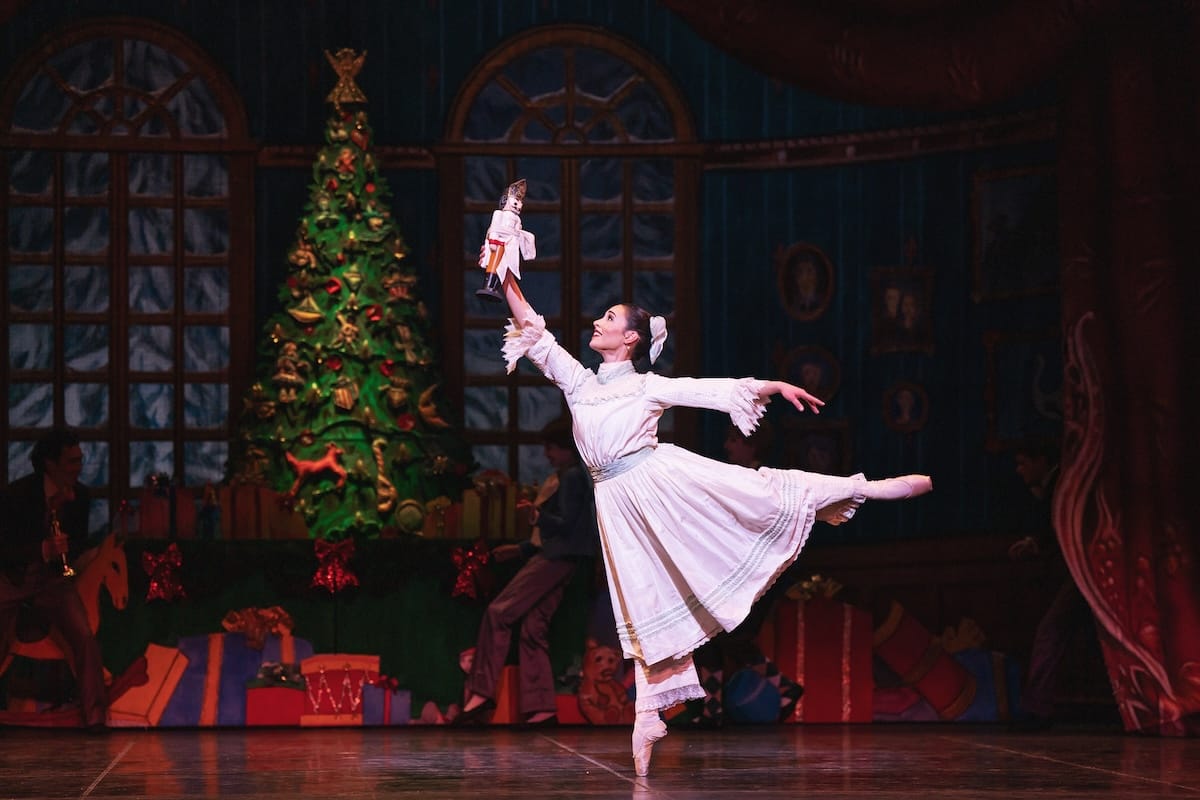
Leah McFadden as Clara | Photo: Amanda Tipton Photography
The basics
It’s worth repeating a few basic facts about Nutcracker before we get to Colorado Ballet’s version of this annual favorite. The first production was performed by the Imperial Ballet in St. Petersburg in 1892, with choreography by Marius Petipa and Lev Ivanov, to a sublime original score by Tchaikovsky. This is the version that George Balanchine danced in Russia and whose memory he brought with him when he co-founded New York City Ballet.
Balanchine’s Nutcracker, which premiered in 1954, was not the first American Nutcracker (that honor goes to William Christensen’s version for San Francisco Ballet in 1944), but it was the one that popularized the ballet in America.
Balanchine’s is the one performed by a number of ballet companies around the U.S., many of them directed today by alumni of New York City Ballet. But it is far from the only version and almost every student, pre-professional and professional ballet troupe in America now performs a Nutcracker. Some of them are weird if not wonderful, but the Colorado Ballet offers a lovely traditional one, the most elaborate with the greatest number of performances each holiday season in our state.
Among the greatest joys in this production is the beautiful dancing of the entire company, especially of the various lead dancers and soloists. There are five different casts for the lead roles and given the “deep bench” Colorado Ballet now has among its dancers, it’s a fair bet that whichever performance one attends before the run ends on December 28, you will be dutifully impressed by the dancing and the acting.
The most demanding role is that of Clara, the young girl who receives a nutcracker as a Christmas gift. At the performance I attended, Leah McFadden was the ideal Clara, deeply attuned to Tchaikovsky’s glorious music and technically perfect. She is an especially fluid dancer with gorgeous leg and arm extensions and an intrinsic grace even when she stands completely still. She and Kevin Gael Thomas as her Nutcracker Prince were extremely well matched, with the technically powerful Thomas radiating princely grandeur and confidence. Their pas de deux were some of the major highlights of the Nutcracker I attended.
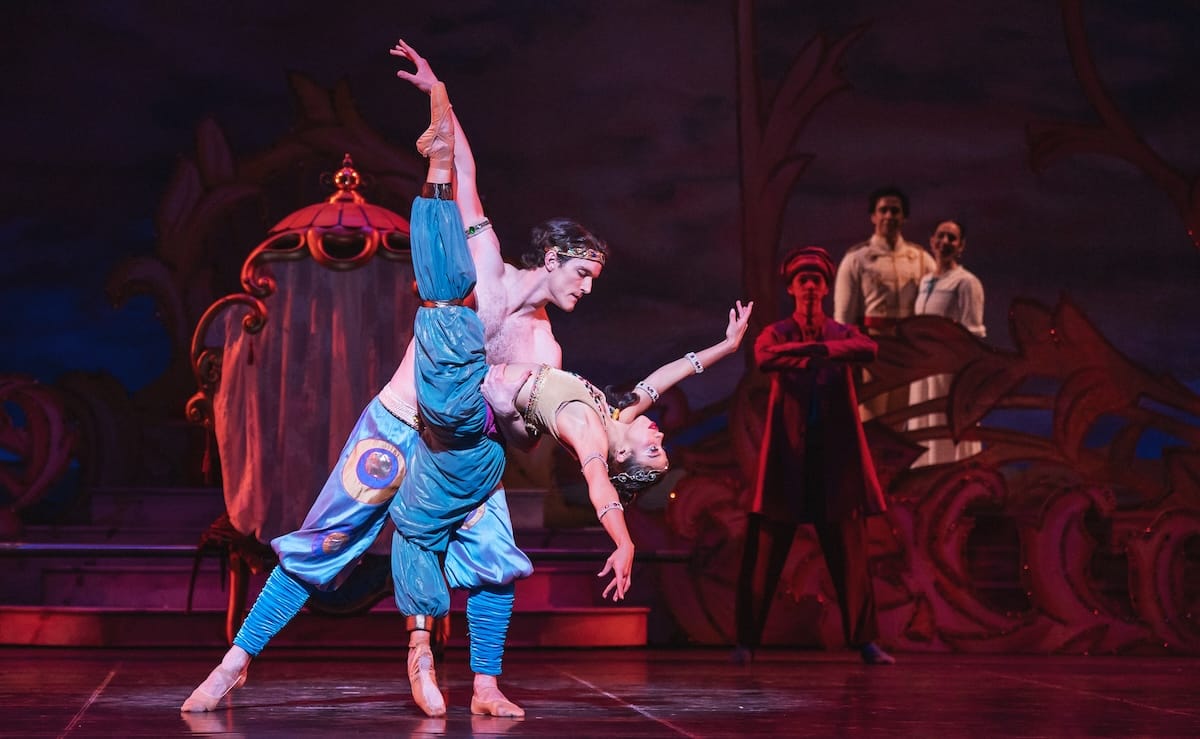
Patrick Mihm and Ariel McCarty in Arabian in the Colorodo Ballet’s ‘The Nutcracker.’ | Photo: Amanda Tipton Photography
Strong throughout
There are so many soloist roles in this Nutcracker that it could take half of this review to single them out with virtually all of the dancers in the various Act II ethnic variations throwing themselves completely into their respective dances. The men’s and women’s corps — fleshed out with company apprentices and a cadre of children — were appropriately funny, beautiful and adorable as an army of mice, toy soldiers or flowers and as eight little angels gliding across the stage as though propelled by invisible wheels.
As anyone who has ever seen a Nutcracker knows, there are standard visual elements in every traditional professional production, especially a huge growing Christmas tree, and Colorado Ballet’s version includes them all. More than anything, though, it radiates the joy of being a child (or a child at heart) at the holiday season and the pleasure at being transported to a magical place where dreams really do come true.

Jonathan Ramirez as the Nutcracker Prince | Photo: Amanda Tipton Photography




Alice Kaderlan is a long-time dance and theatre critic and general arts writer. She has written for newspapers and online news sites in Seattle, Washington D.C., Pittsburgh and other cities for more than 40 years. She has also appeared on various public radio stations including WAMU-FM in D.C. and KUOW in Seattle and covered arts for NPR. She currently lives and writes in Denver.

Another excellent, engaging and helpful review by Ms. Kaderlan. She always provides not only commentary but helpful background information that deepens one’s appreciation of the material.