
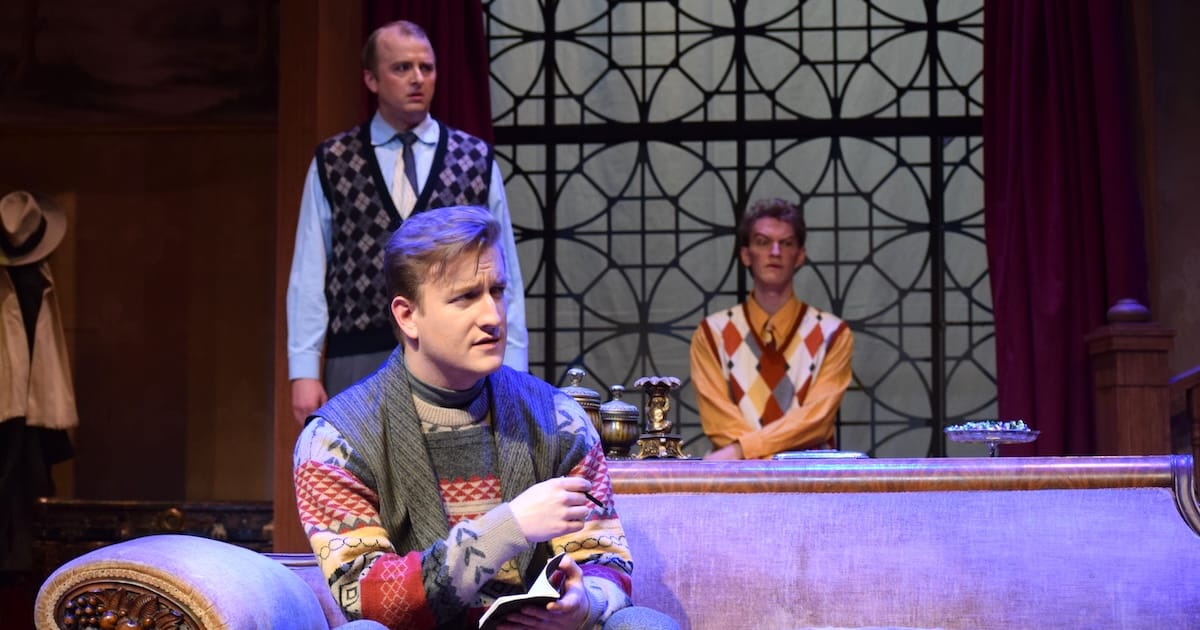
OpenStage Theatre & Company delivers a tense Mousetrap, with sharp performances and atmospheric design.
When the snow starts falling inside the Lincoln Center’s Magnolia Theatre early in the first act, you can feel the audience lean forward. Agatha Christie’s The Mousetrap may be the most well-known whodunit in theatre history, but OpenStage Theatre & Company’s new Fort Collins production demonstrates that a well-told mystery can still captivate and unsettle even the most seasoned sleuths.
First performed in London in 1952, The Mousetrap holds the distinction of being the longest-running play in theatrical history. The story is set in the aftermath of a child’s murder in London, as seven strangers arrive at the newly opened Monkswell Manor just as a blizzard cuts them off from the outside world.
When one of the guests is found dead, it becomes clear that the killer is still inside the house and that the past has followed someone into the snowbound inn. As a police detective races to uncover the truth, every guest comes under scrutiny, turning the cozy English guesthouse into a maze of secrets and suspicion.
Directed by Heather Ostberg Johnson, this staging leans hard into the script’s suspense, transforming Monkswell Manor into a pressure cooker of secrets, shifting alibis and barely concealed menace. With seven stranded guests and a killer hiding in plain sight, the show becomes a two-hour exercise in mounting paranoia that has audiences whispering theories at intermission and second-guessing every gesture onstage.
A blizzard of red herrings
Johnson’s greatest strength here is how thoroughly she weaponizes suspicion. Nearly everyone fits the killer’s initial description — “a dark overcoat, light scarf and soft felt hat” — and her direction encourages the cast to behave just suspiciously enough that no one ever feels safe. On opening night, the director took an informal straw poll at intermission, and the guesses were spread evenly across the suspects — proof that the misdirection was working.
That sense of unease is heightened by Ivan Andrade’s cozy but claustrophobic set: a warmly furnished manor with period portraits, patterned wallpaper, a glowing fireplace, a looming staircase and multiple doors that characters constantly slip through. A window framed by curtains opens to a flurry of falling snow, a simple but crowd-pleasing effect that makes the blizzard feel as isolating as the script demands.
Joshua Moore’s sound design adds another layer of tension. While there were a few technical hiccups early in the performance, including some feedback and a misfired sound cue, his eerie transition music and the insistent ticking of a clock in the second act steadily ratchet up the stakes, reminding us that another murder could be moments away.

Bryn Frisina and Katy White in the OpenStage production of ‘The Mousetrap.’ | Photo: Sarah J. Baker
A cast full of suspects
The production’s success ultimately rests on its ensemble, which is strong across the board, and opening night came with an extra twist of theatrical adrenaline. When Brian Wilcox (Giles Ralston) was injured in a bike accident just hours before curtain, OpenStage’s producing artistic director Jacob Offen stepped in, script in hand, with barely two hours of rehearsal.
The result was a small miracle of live theater: Offen hit his marks, kept the pace brisk and even managed a convincing British accent, while the rest of the cast seamlessly adjusted around him.
At the center of the storm is Katy White’s Mollie Ralston, the young co-owner of Monkswell Manor. White makes Mollie both capable and quietly haunted, a warm hostess whose confidence is constantly undercut by the secrets she’s hiding. Her tense exchanges with Giles crackle with unease, especially when their marriage begins to look less stable than it first appears.
Hugh Butterfield brings a manic, physical energy to Christopher Wren, the eccentric young lodger with a too-loud laugh and too many stories. Kari Armstrong’s costumes highlight his oddity with bold patterns and bright colors that make him stand out in every scene while also serving as a visual red flag that keeps the audience watching him closely.
Louise F. Thornton wrings dark humor out of the acid-tongued Mrs. Boyle, whose constant complaints and brittle reactions earn big laughs while never letting us forget she could be hiding something dangerous. David Austin-Gröen gives Major Metcalf a quiet authority that becomes increasingly suspicious as his access to the house and his military training come into focus.
Bryn Frisina’s Miss Casewell is a standout in the group scenes. With her low, deliberate voice and intensely expressive face, Frisina plays her cards close to the vest, making every small reaction feel like a potential clue.
Bas Meindertsma is deliciously strange as the mysterious Mr. Paravicini, dressed in heavy makeup and an expensive suit, his exaggerated age and accent making him both comical and deeply unsettling. And as Detective Sergeant Trotter, Bradley Calahan anchors the chaos with crisp authority, steadily corralling the suspects as the noose tightens.
James Burns’ fight choreography and moments of violence are staged cleanly and effectively, keeping the danger real without tipping into melodrama, while Mackenzie Lowe’s lighting keeps Andrade’s busy set readable even as Johnson sends characters darting through doors and up the stairs at a rapid clip.
Old-school suspense with fresh flare
One of Johnson’s more daring directorial flourishes is a nod to The Mousetrap’s origins as a 1947 radio play. The show opens with performers creating live sound effects at a microphone, shoes in hand, before slipping into the action, and closes with the Ralstons returning to that microphone for the final lines. It’s a small dramaturgical frame that quietly links Christie’s thriller to its broadcast roots, adding an extra layer of theatricality for those who know the play’s history, even if it risks being a touch opaque for first-timers.
What’s far clearer is Johnson’s commitment to suspense. Where the Arvada Center’s recent production leaned into the comedy baked into Christie’s script, OpenStage’s Mousetrap goes the other direction, tightening the screws after the first murder and rarely letting the tension slacken. The humor, including Mrs. Boyle’s prickly outbursts and Wren’s eccentricities, is still present, but it serves more as an uneasy release valve, providing brief moments of levity in an increasingly dangerous environment.
The result is a gripping, old-fashioned thriller that keeps Fort Collins audiences guessing until the final reveal. Whether you’re encountering Christie’s classic for the first time or you already know who did it, this is a version that makes the journey just as thrilling as the answer.

A Colorado-based arts reporter originally from Mineola, Texas, who writes about the changing world of theater and culture, with a focus on the financial realities of art production, emerging forms and arts leadership. He’s the Managing Editor of Bucket List Community Cafe, a contributor to Denver Westword and Estes Valley Voice, resident storyteller for the Bonfils-Stanton Foundation and co-host of the OnStage Colorado Podcast. He holds an MBA and an MA in Theatre & Performance Studies from CU Boulder, and his reporting and reviews combine business and artistic expertise.

Leave A Comment