

At Two Cent Lion, Olivia Buntaine’s new comedy imagines gender fluidity during the American Revolution and finds the past uncomfortably familiar.
What would happen if the concept of gender fluidity was introduced amidst the American Revolution in the 1700s?
That’s the question Colorado playwright and director Olivia Buntaine set out to answer with the debut of her original period comedy PUF: A Completely Factual and Objective History of The Publick Universal Friend. The answer turned out to be surprisingly predictable and quite similar to present day’s cultural reaction to the idea: enthusiastically divided.
Produced by Two Cent Lion, the website explains that, “PUF tells the story of a woman reborn as a nongendered heavenly messenger during the American Revolution, who attempts to prepare humanity for the end of the world.” It’s a lot to unpack, with themes of religion, sexuality, patriarchal oppression and centuries-old historical context all intertwined and layered into the narrative.
Perhaps it’s too much to unpack all at once, but it’s also possible that was Buntaine’s point: to overwhelm the viewer with the weight of that intersectionality. To imagine some of today’s most pressing cultural and societal issues in a time so vastly different than present day, and to realize that the more things change, the more they stay the same.
The parallels to immigrant and trans rights were clear and undeniable to me, a goal Buntaine makes clear in the play’s digital program. She writes, “Sometimes it feels like things are worse than ever before, but these are the politics our country was born from. In 1776, ‘all men are created equal’ was written down as an American creed [at a time] when the majority of people living on this soil were not considered as such.”
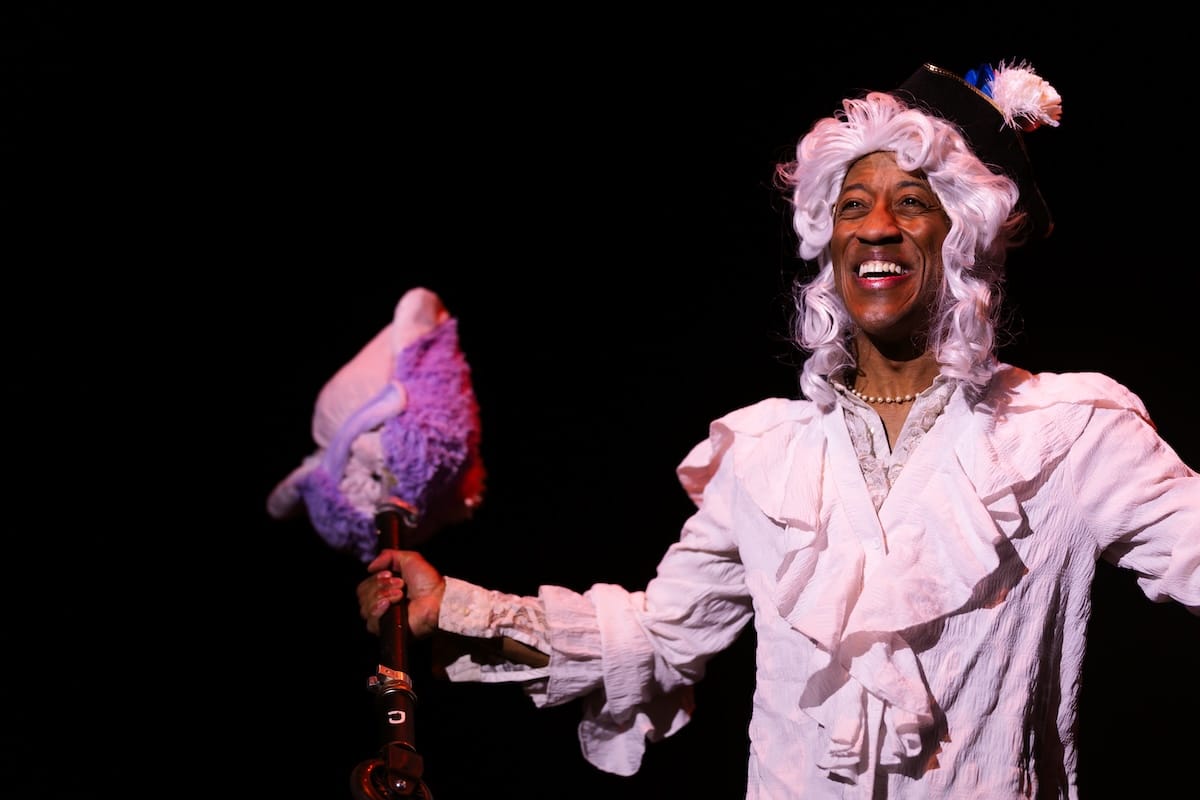
Johnathan Underwood in ‘PUF.’ | Photo: Kyla Fear Photography
Joy as resistance
Rather than take us down the bleak path of examining the injustices of past and present, Buntaine instead opted for the “joy as resistance” path. She made the idea of gender conformity as silly and ridiculous as it is by depicting how Quakers in the late 1700s might react if a woman in their community died and returned in a body dressed like a man — but who claimed to be neither male nor female, and insisted it was all sanctioned by God.
PUF is a comedy at its core, and the humor is never so highbrow or complex as to alienate. By that I mean, even if you aren’t queer, trans, an immigrant or part of any other marginalized group, you can still laugh at the absurdity of it all. Because the topic at hand is so inherently complex, the comedy couldn’t be; it was surface level, highly accessible, and consistently landed scene after scene.
For example, there’s a lot of really fun wordplay. The show begins with a cast full of Quakers discussing the community woman who has just passed away. “She was so obsessed with different sects and was always talking about a sect-change!” they exclaim, letting the “sex change” homophone set the tone for the religious gender-bending about to ensue. There is also a recurring joke where Patience (Johnathan Underwood) frequently misunderstands use of the common noun ‘patience’ as a call for their attention.
There’s also a hilarious throughline with Jameson (Emy McGuire) who is obsessed with his corn crop. It is most often in his side banter where we hear Jameson referencing his corn, but early in the play he solicited The Publick Universal Friend (PUF) for farming advice, and near the end, as another Quaker laid blame for failing crops on PUF’s meddling, Jameson pushed back, citing the bountiful harvest in his own fields as the audience erupted in laughter.
Speaking of side banter, I really enjoyed the ongoing interaction between characters on the periphery. Even when the spotlight wasn’t shining directly on them, the facial expressions and movements of every person on stage helped bring the story to life. Even when they weren’t the focus of the scene, I always caught myself watching them for context.
The eight actors and their characters’ dialog do all the lifting in this play, so Cole Mahlmeiste’s minimal set design works to its benefit. An arched doorway with lace curtains sits upon a riser at the back of the stage. Long benches flank both sides of the doorway. Tables, chairs and minimal props are brought in and out to establish different settings (like a church or a home) with quick and quiet transitions conducted in the brief, dark moments between scenes.
And for a dramatic close, Lighting Designer Maxwell O’Neill makes great use of the Samoiloff Effect by drenching the stage in rotating primary colors from different angles, giving the illusion of movement while a solitary, stationary PUF stands in front of those white lace curtains.
PUF: A Completely Factual and Objective History of The Publick Universal Friend is a daring romp through a historical saga that mocks the idea of gender conformity and centers queer love. It’s not for everyone, but it’s what Two Cent Lion does best, because they do it with care, compassion, and a vulnerable authenticity that sets their work apart.



Danielle Riha is a digital marketer by trade and a lifelong writer. She is an active member of the Denver theatre community as a regular contributor for No Proscenium and a marketing volunteer with Immersive Denver. When she's not taking in local theatre, Danielle hikes and attends jam band concerts with her husband.

I saw the show on opening night and Danielle wrote an accurate description of the whole thing. Kudos to Danielle for her piece and to Olivia for her generous take on gender politics.
Fantastic review!