

Bowls with the Bard’s take on R&J has flashes of innovation but lacks a clear vision to support its premise.
If you’re looking to spend time with Shakespeare’s most famous young lovers, the Denver metro area currently gives you more than one opportunity to do so.
Over at the Arvada Center, the company presents a contemporary staging of Romeo and Juliet. Meanwhile in RiNo, Bowls with the Bard is presenting something you’re far less likely to see anywhere else: a cannabis-lounge Romeo and Juliet where actors and audience members alike are invited to vape, smoke from bongs and pass joints to each other throughout the show.
The company’s latest production, directed by Natalie Edwards at Tetra Private Garden & Lounge, is an attempt to fuse Shakespearean tragedy with stoner comedy. It’s a concept that fits neatly with Bowls with the Bard’s mission of making Shakespeare more accessible for contemporary audiences. But while this adaptation retains the bones of Shakespeare’s story in a brisk 90-minute cut, its execution rarely matches the promise of its premise.
A few inspired moments cut through the haze
For anyone who slept through their high school English class or never got around to Baz Luhrmann’s film adaptation with Leonardo DiCaprio, Romeo and Juliet follows two teenagers from feuding families who fall in love at first sight, secretly marry and attempt to build a life together despite the Montague–Capulet rivalry. After a duel leaves Romeo banished, Juliet turns to a risky plan involving a fake death to avoid an arranged marriage, but when Romeo sees her dead before learning the truth, the lovers ultimately take their own lives.
To be clear, this version of Romeo and Juliet by Bowls with the Bard isn’t a total misfire. The adaptation itself is efficient, preserving the play’s essential plot points, from the lovers’ clandestine marriage to the fatal breakdown of Friar Lawrence’s plan, without ever feeling rushed. Even if you are unfamiliar with Romeo and Juliet, the story remains intact and understandable in this unconventional setting.
There are also scattered staging ideas that cleverly make use of Tetra’s limitations. For example, in the balcony scene, Juliet (Stephanie Saltis) is atop a ladder, using a handheld frame to switch between being seen and not. It’s a playful, low-tech solution that embraces the constraints of performing in a corner of a lounge rather than fighting them.
Alison Talvacchio delivers a notably varied turn as Tybalt and Friar Lawrence. Talvacchio is both fiery and confrontational as Juliet’s hot-headed cousin Tybalt and quietly contemplative as the well-intentioned Friar Lawrence. Bruce Robinson’s Nurse infuses the production with a sincere performance that capitalizes on the character’s warmth and verbal humor. In a production that often feels tonally adrift, these more earnest performances provide a welcome sense of emotional continuity.
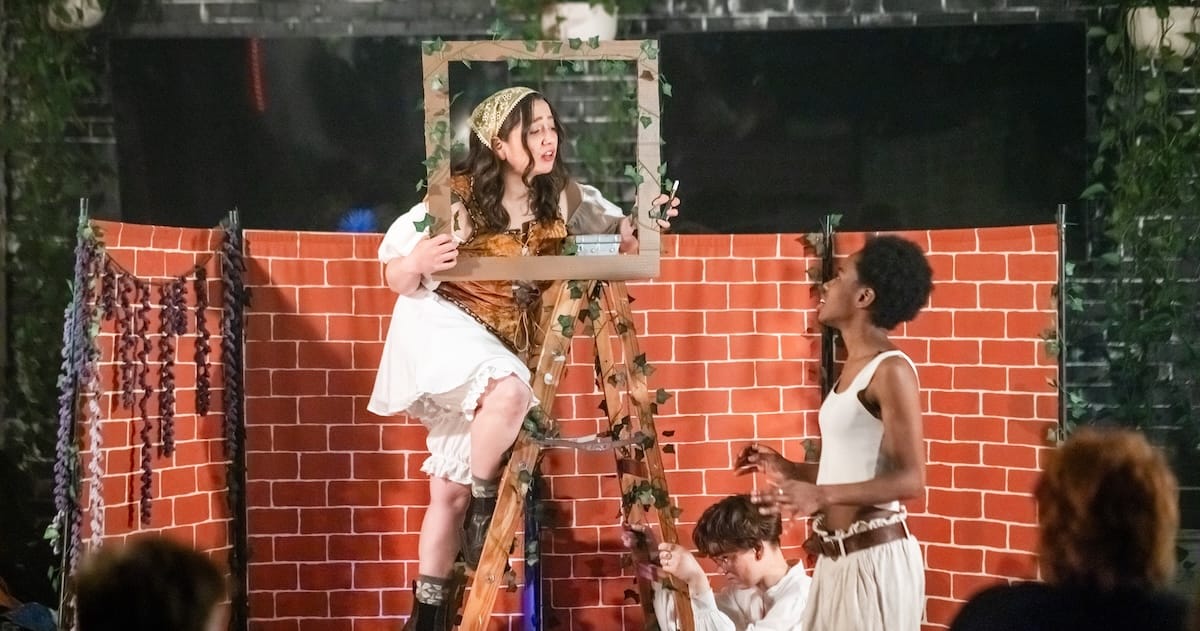
Photo: Jermaine Amado Photography
A concept in search of a perspective
The central issue with Bowls with the Bard’s Romeo and Juliet isn’t that it’s irreverent. It’s that the production never fully commits to what its irreverence means.
For much of the evening, actors play Shakespeare’s text relatively straight, delivering sincere renditions of familiar scenes while occasionally pausing to take a puff from a vape pen. But as the performance progresses, the tone shifts unpredictably into fourth-wall-breaking stoner comedy, with actors cracking jokes or acknowledging missed cues in real time. The result is a lurching oscillation between solid tragedy and middling sketch comedy that makes it difficult to settle into either mode.
Sophia Gulley’s Romeo leans toward emotional sincerity, while Saltis’ Juliet increasingly inhabits a more heightened comic register as the night goes on and she consumes a staggeringly impressive amount of cannabis onstage. Because the show never establishes a shared tonal vocabulary, scenes can feel like they belong to entirely different productions depending on who’s onstage.
The famous “blushing pilgrims” exchange at the Capulet ball, for example, plays as a largely traditional romantic meet-cute — albeit one enhanced by Renaissance-style covers of pop songs like “Bad Romance” — while later moments in the Juliet-led Act 4 veer towards loose, improvisatory parody. The tonal inconsistency of the two lead actors ultimately undermines the central romance, which never quite lands with the urgency that the tragedy requires.
Site-specific challenges that distract more than immerse
Performing inside an operating cannabis lounge presents logistical hurdles, and this production doesn’t entirely overcome them.
Although Tetra’s main seating area is closed for the show, patrons entering the venue to access the outdoor garden frequently open the front door in the middle of the scene, causing bursts of light and noise from conversations with workers as they check in, diverting attention away from the action. It is obviously not malicious because employees are simply doing their jobs, but the lack of a clear distinction between performance and business-as-usual traffic is distracting.
The sparse scenic setup in a corner of the lobby space of a brick-pattern flat, a ladder and a few actor boxes adds to the strain on blocking to keep the action moving within the playing area. Yet entrances and exits are largely limited to either side of the central flat, creating visible traffic jams backstage that frequently spill into view. At times, actors audibly acknowledge each other when they cross paths or assist one another with a stuck set piece, gestures that keep the show moving but chip away at immersion.
Even more disruptive is the presence of off-duty performers lingering around the edges of the space or, in several particularly frustrating instances, sitting in the audience and carrying on a conversation mid-scene. In a conventional theatre, such moments might go unnoticed; in a lounge already buzzing with ambient noise, they become difficult to ignore.
It’s worth noting that Bowls with the Bard will also perform this production at Three Leaches Theater in Lakewood later this month, which is a more conventional performance venue that may mitigate some of the ambient noise and traffic issues inherent to Tetra’s lounge environment. While audiences won’t be able to smoke alongside the cast in that setting, the added separation between performance space and offstage activity could help the production’s streamlined adaptation come into clearer focus without the same level of external distraction.
Not Bowls with the Bard’s sharpest high
Bowls with the Bard has built its reputation on concept-driven Shakespeare adaptations that illuminate the text through a distinct lens, like its disco-infused Twelfth Night, clown As You Like It or puppet Macbeth. By comparison, this Romeo and Juliet often feels defined less by an interpretive framework than by the novelty of its environment.
There’s a compelling production to be made about how intoxication reframes perception, impulsivity and youthful passion, which are all themes already embedded in Shakespeare’s tragedy. But here, the cannabis element reads more as a recurring gag than a dramaturgical throughline.
For audiences looking for a casual, communal spin on a familiar story, there’s still some fun to be found in Bowls with the Bard’s laid-back lounge setting. As a fully realized reimagining of Romeo and Juliet, however, this particular trip never quite finds its footing.

A Colorado-based arts reporter originally from Mineola, Texas, who writes about the changing world of theater and culture, with a focus on the financial realities of art production, emerging forms and arts leadership. He’s the Managing Editor of Bucket List Community Cafe, a contributor to Denver Westword and Estes Valley Voice, resident storyteller for the Bonfils-Stanton Foundation and co-host of the OnStage Colorado Podcast. He holds an MBA and an MA in Theatre & Performance Studies from CU Boulder, and his reporting and reviews combine business and artistic expertise.

Leave A Comment