
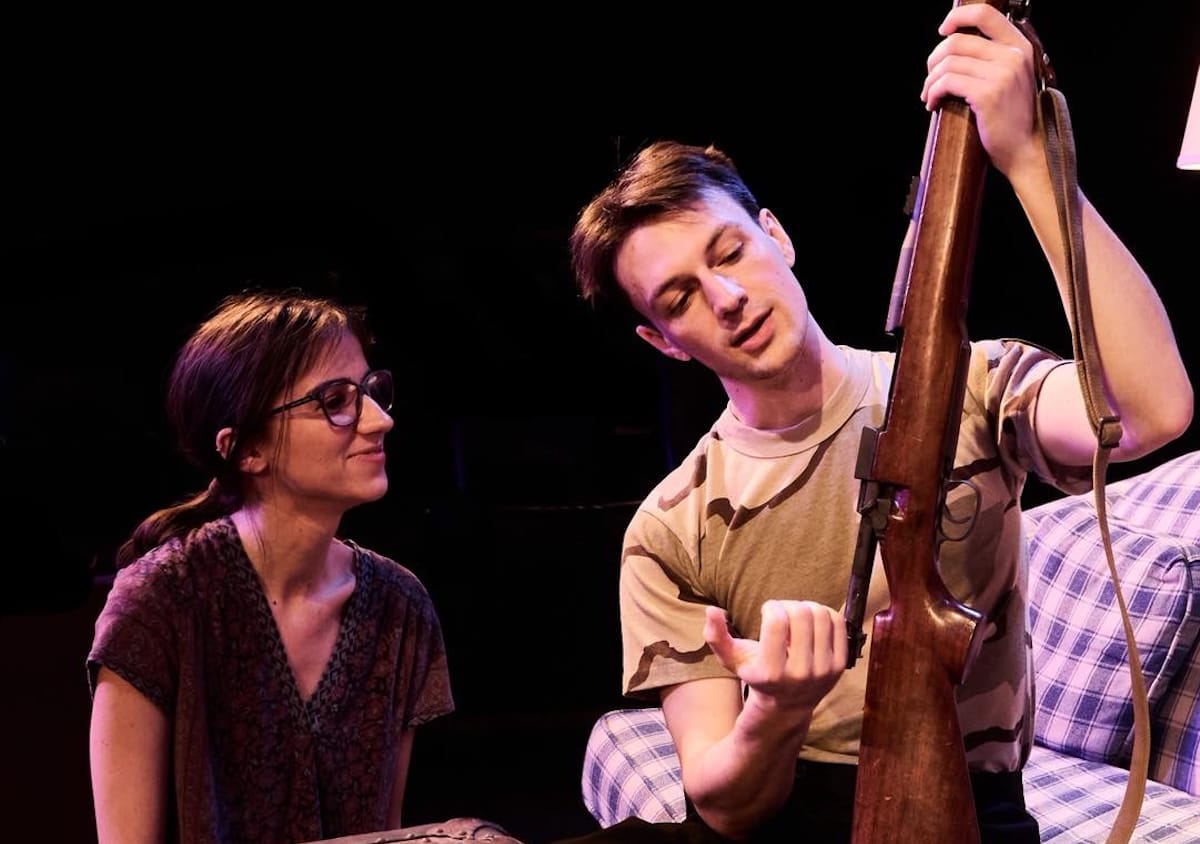
A tension-filled timely warning is a ‘don’t miss’ in Denver.
The Jewish Sage Hillel set out three questions for living your life:
If I am not for myself, who will be for me?
If I am only for myself, what am I?
And if not now, when?
The characters in Deborah Zoe Laufer’s award-winning play The Last Yiddish Speaker — making its Colorado premiere in a Theatre Or production at Denver’s Mizel Center — confront those questions of identity, community and action in this powerful, timely and universally relevant production.
It is 2029 in a United States where the January 6 insurrection succeeded. An overtly white right-wing Christian government now is in power, much like, if not yet to the extremes of, The Handmaid’s Tale. Paul and his 17-year-old daughter Sarah have moved from New York City to Granville, a small town in upstate New York, but must hide that they are Jewish. Sarah, now going by the name Mary, yearns to go to college, but girls are now forbidden to attend college and she dreams of escaping to Canada.
Sarah is in a relationship with a classmate, John, who also is a “watcher” conducting frequent surveys of their house and computers while armed to make sure that Paul and Sarah/Mary are the “right kind of people.”
One night, a car drops off an older woman with a note identifying her as Aunt Chava and the message “It’s your turn to hide her. Good luck.”
But, Paul and Sarah know of no such aunt. Chava speaks Yiddish, broken English, and claims to be 1,000 years old “give or take.” Paul and Sarah, after much discussion, decide to hide her in their house for the moment. As they interact, Chava causes Paul and Sarah to question who they are and who they are for. But, most importantly, she gets them to confront and decide whether to claim and continue their Jewish heritage while living in a town where being Jewish could be a death sentence.
It truly is their turn. At the same time, John’s interactions and infatuation with Sarah are making him confront who he is, who he is for, what he believes and what should he do.
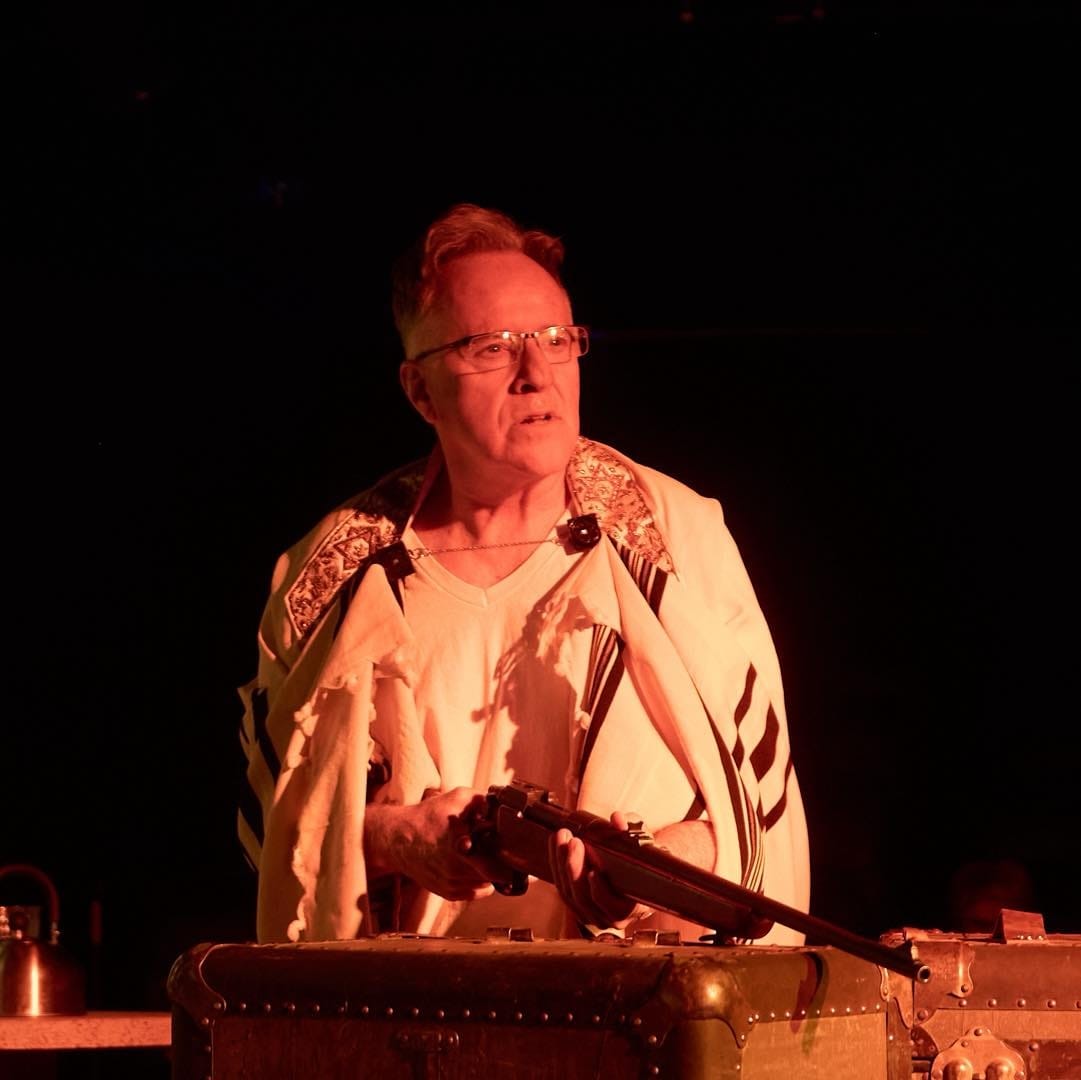
Kevin Hart in ‘The Last Yiddish Speaker.’ | Photo: Brian Miller
105 minutes of tension and honest portrayals
Laufer’s play is at differing times subtle and obvious, preachy and suggestive and, as directed by Amy Feinberg, filled with near-constant tension through its 105 minutes. There are some bits of humor, including a sequence with a language app on Sarah’s phone. Developments are natural but not predictable. While Paul and Sarah are Jewish, they represent any group that may be considered outsiders or “not the right kind of people” and which must decide who they are and whether they must abandon who they were to survive. The play is for anyone struggling with issues of identity in a world that, at best, may tolerate but not accept them.
Dia Kline expertly portrays Chava with mystery and pain. Every facial expression and gesture carries meaning. Director Feinberg often has her appear behind a scrim observing the other characters, not verbally commenting, but affecting how the audience sees the story. Chava has seen much suffering, and Kline lets us feel the weight she carries from it. You understand why Sarah is drawn to her even as Paul fears Chava threatens the new life he seeks.
Kevin Hart is an emotionally on-edge Paul. He has suffered pain and loss — his wife was taken and is presumed to have been killed — and now he lives only to protect Sarah. Hart expresses that goal in every moment. He is never strident but is emphatic even as he is emotionally torn, struggling to determine who he should be and desperate to survive no matter the cost. Through Hart, we see Paul’s inner turmoil at the choices he has to make.
Solomon Abell is beyond excellent in a difficult role. As played by Abell, John is not evil. John is naïve, trapped in a MAGA world he grew up in. Sarah even says she thinks he is a good person. Abell’s John is sincerely drawn to Sarah/Mary and listens to her “strange” ideas with surprising openness. If Chava represents pain, John represents hope. Abell’s depiction feels honest, and we can understand why Sarah is attracted to him, despite the dangers inherent in that relationship.
Maddy Wagner succeeds at portraying Sarah’s struggle to be allowed to be who she wants to be. She is, understandably, so angry at Paul and John throughout the show that some of her more tender moments do not feel as authentic. The changes in tone don’t necessarily match what we’ve seen of Sarah.
Her relationship with John runs so hot and cold where she is frustrated with him one moment, fearful of what he could do if he knew the truth. In the next moment, she is trying to seduce him. She visibly and vocally chafes at Paul’s efforts to protect her but then is tender with Chava. In short, Wagner accurately portrays a 17-year-old under immense stress.

Maddy Wagner and Dia Kline | Photo: Brian Miller
Creative staging
Matthew Crane’s set is simple with some inspired touches, such as the scrim, which, when transparent, reflects an American flag. Brian Miller’s lighting design amplifies mood, setting and the passage of time. Together with Crane, the moments with Chava behind the scrim are breathtaking. I want to call out the brilliant car sequence, but don’t know whether it was Crane, Miller or props master Maru Garcia who is responsible. Sam Morin’s sound design emphasizes the rural scene with natural bird and animal sounds, which makes the occasional gunfire much more gut-wrenching. The costume designs by Laura Love and Sloane Crazybear telegraph meaning, whether in John’s “watcher” attire or in Chava’s multiple dresses.
Albert Banker is credited as a Yiddish and Hebrew consultant. The cast’s pronunciations, to my ear, were accurate, natural and commendable. The program contains a glossary of some of the Yiddish used in the play, but not all the words. While the glossary is helpful, understanding Yiddish and the Hebrew prayers isn’t necessary to follow the story or connect with the characters. Laufer’s script and Feinberg’s direction provide all the context you need.
Staged in a three-sided audience configuration, there are moments where the characters are difficult to see, even from our center seats. I don’t know if the side seats miss some of the subtleties in the set and staging. Feinberg does her best in the space, but a standard proscenium staging would likely have been more fitting.
Early in the play, Sarah quotes Elie Wiesel: “Neutrality helps the oppressor, never the victim.” Seeing The Last Yiddish Speaker the same day as attending a “No Kings” rally exemplifies the call to act and to not shy away. The world of The Last Yiddish Speaker feels all too close. Coming out of the theatre, you can’t help but discuss what you would do when it’s your turn.



Garth Gersten is an attorney and lifelong theatre lover. In Champaign, Illinois, he directed shows with Champaign-Urbana Theatre Company, Rantoul Theatre Company, Bright Lights Theatre Company and Twin City Theatre Company, which he founded. He now lives in Boulder with his wife who is a professor at CU.

Leave A Comment