
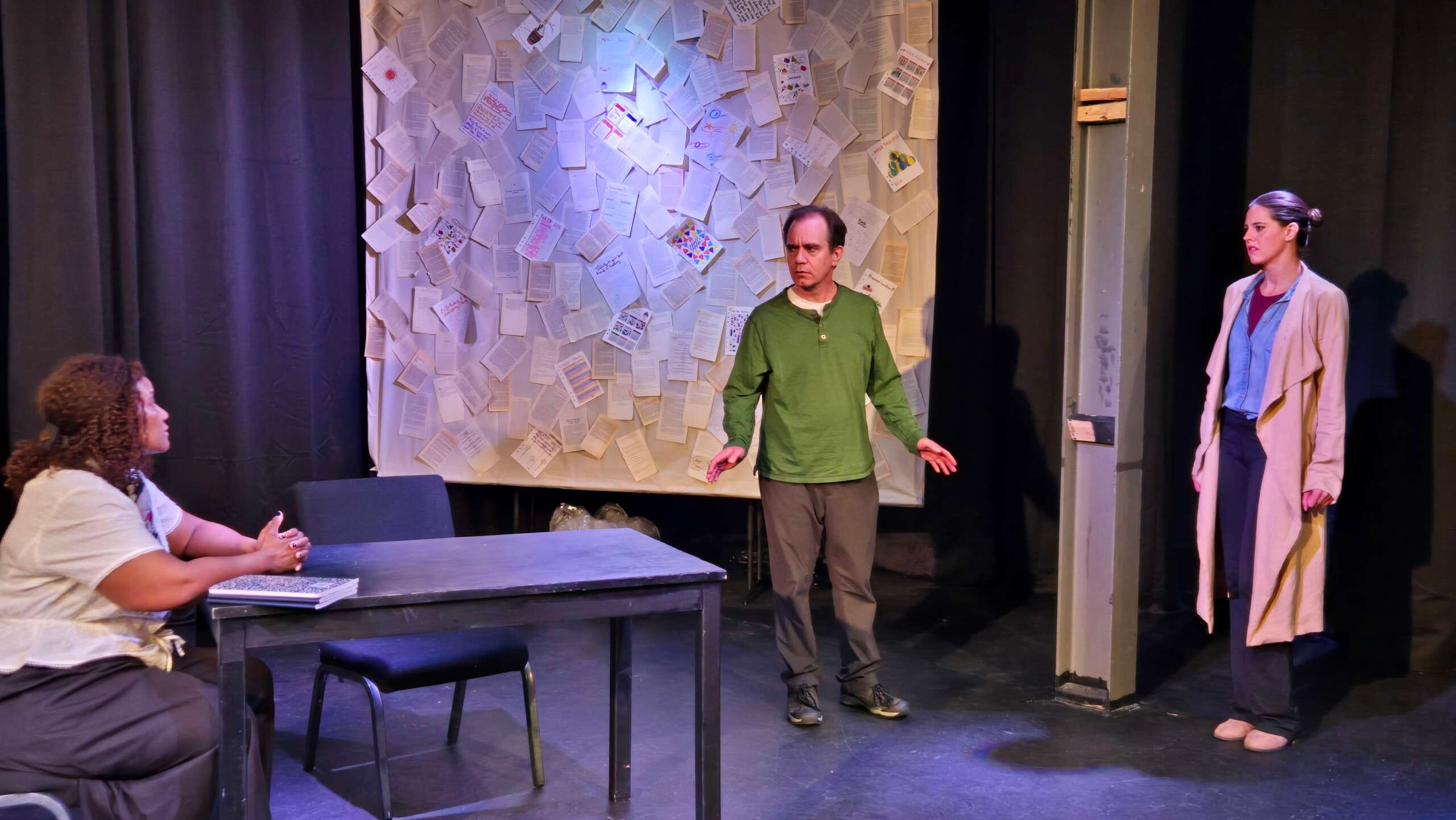
Three Leaches Theater tackles Steven Dietz’s rarely staged Fiction with wit and emotional heft.
At first glance, the marriage at the center of Steven Dietz’s Fiction seems enviably honest.
Linda (Laura Steele) and Michael Waterman (Paul Jaquith) are well-known novelists who take pride in their candor. They critique each other’s work, mock the world around them and revel in the intimacy of being married to someone who speaks the same literary language.
But Dietz’s sly, cerebral 2002 play, now mounted by The Three Leaches Theater in Lakewood, asks a wickedly destabilizing question: What happens when two writers, people professionally skilled at invention, begin reading each other’s private accounts? The answers found in their hidden accounts of their lives complicate the relationship they’ve built together to deliciously dramatic proportions.
That makes Fiction a smart choice for this scrappy company as it continues to settle into its Lakewood home (formerly Benchmark Theatre and, before that, The Edge Theatre Company). In this production, director Melissa Leach and a tightly focused three-person cast lean into the play’s literary gamesmanship and emotional volatility with largely successful results.
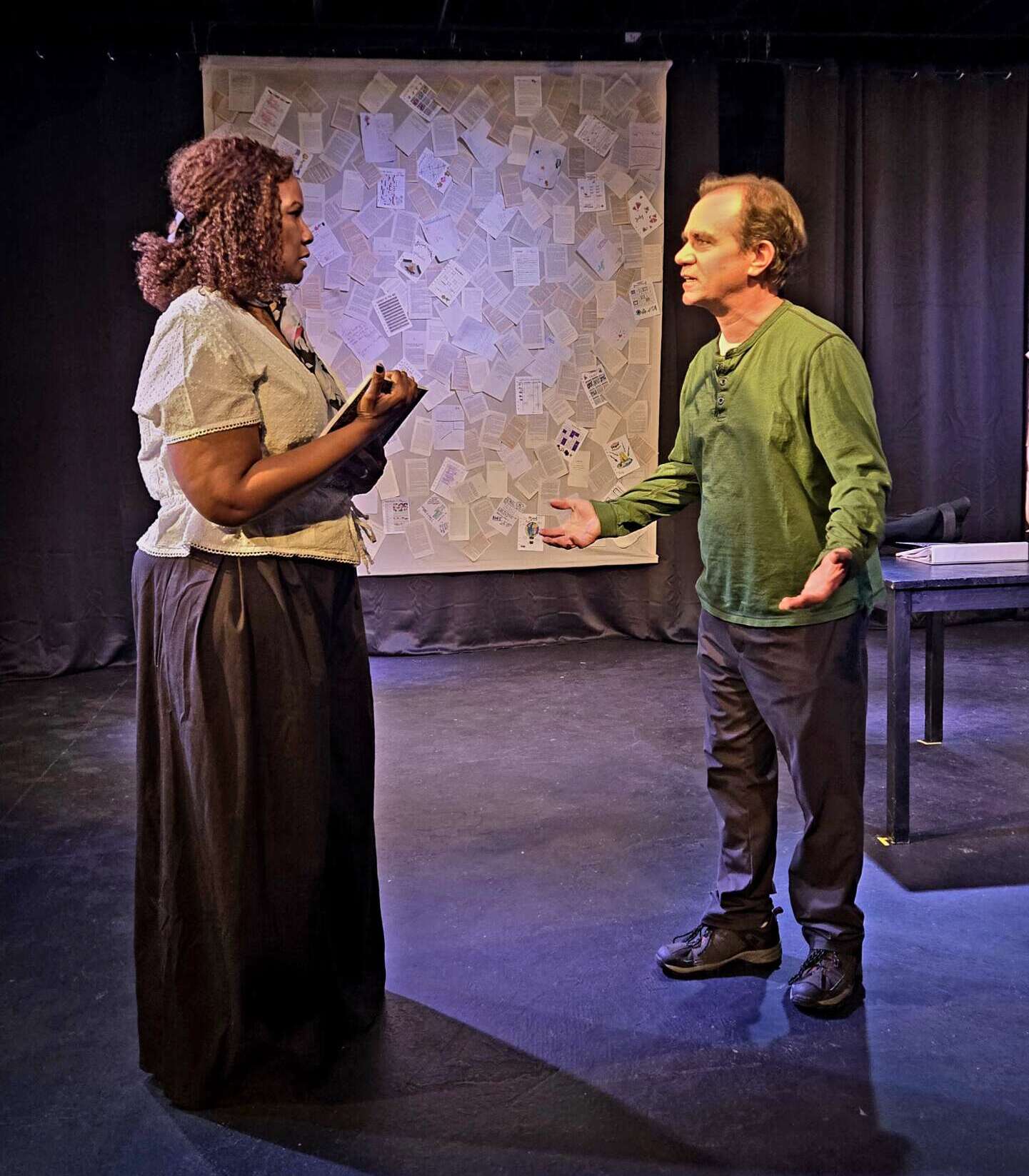
Laura Steele as Linda Waterman, and Paul Laquith as Michael Waterman.
A loving marriage cracked open
Although Dietz was born and raised in southwest Denver, and many of his shows are produced locally, this one is not. Fiction was last seen in the metro area in 2011, when it was produced by Miners Alley Playhouse, and before that, Curious Theatre Company staged its regional premiere in 2006, so this revival is a welcome chance to revisit one of Dietz’s most slippery and satisfying scripts.
The play opens with the charming meet-cute that launched the Watermans’ marriage. In a Paris café, the two argue about the greatest rock and roll vocal performance of all time (Linda prefers Janis Joplin’s “Piece of My Heart,” while Michael champions John Lennon’s “Twist and Shout”).
Laura Steele and Paul Jaquith quickly establish the couple’s prickly chemistry, making their mutual admiration believable even when their egos threaten to eclipse it. Despite their disagreements, the two bond over their dislike for the same cultural irritants, revealing themselves as intellectual snobs who enjoy mocking the world around them.
That playful foundation gives way to darker territory when Linda receives devastating news: she has a brain tumor and little time left. Steele handles this shift with quiet intensity, allowing grief and guilt to creep into Linda’s composure as she contemplates the void her death will leave behind.
The turning point arrives when Linda asks Michael to read his diaries before she dies. Jaquith’s reaction says everything. The actor lets Michael’s confidence collapse inward as the implications sink in. If Linda reads those journals now, the truth, or whatever version of truth Michael has written down, could destroy their final days together.
Michael later insists that much of what Linda may find in his journals is fiction. He is a novelist, after all. He makes things up. But Dietz’s whole point is that fiction is rarely “just fiction,” and this production understands that ambiguity. It lets the audience sit in the unnerving space between invention and confession.
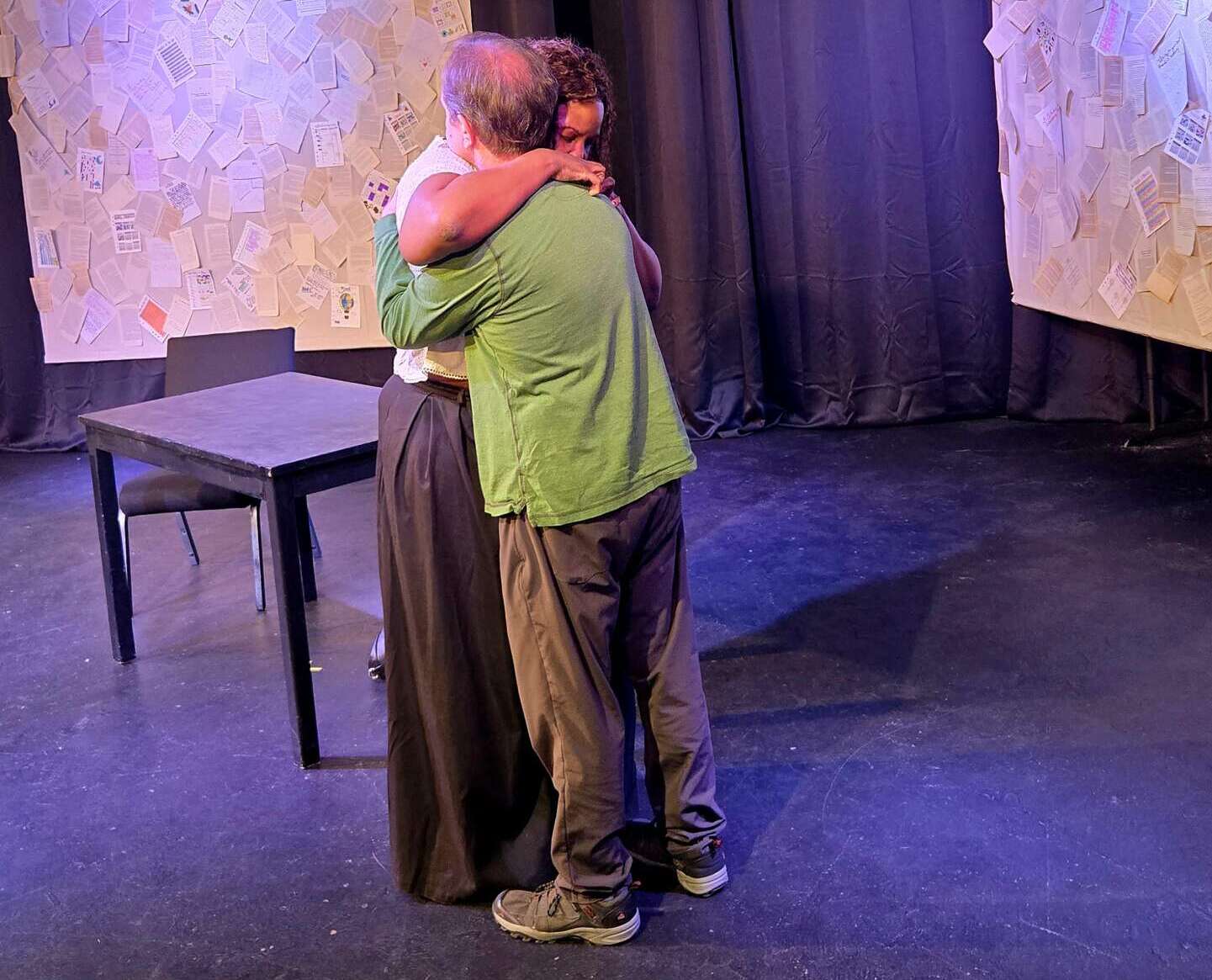
Laura Steele as Linda Waterman, and Paul Laquith as Michael Waterman.
Love triangle written in ink
Much of the play’s intrigue emerges through Michael’s memories of a writers’ retreat he attended after Linda’s breakout success. There, he meets Abby Drake, played by Nicole Caron, an administrator at The Drake Colony.
Caron gives Abby a captivating unpredictability. Abby first appears as someone unimpressed by Michael’s ego and in no mood to indulge his charm. Their early scenes bristle with a wary antagonism that gradually shades into flirtation.
But Caron never lets Abby become legible too quickly. Even when the character appears to be softening, there’s a sense she’s operating with a deeper agenda. That ambiguity becomes crucial when Abby later reappears in the Watermans’ home, revealing that her connection to Linda runs deeper than Michael ever suspected.
Jaquith makes Michael appropriately witty, self-deprecating and quietly pompous. He is the kind of man who performs humility while still expecting the room to orbit around him. Steele matches him beat for beat. Her Linda carries the bitterness of someone whose early literary success has curdled into disappointment, and Steele makes those flashes of academic authority and old resentment feel fully inhabited.
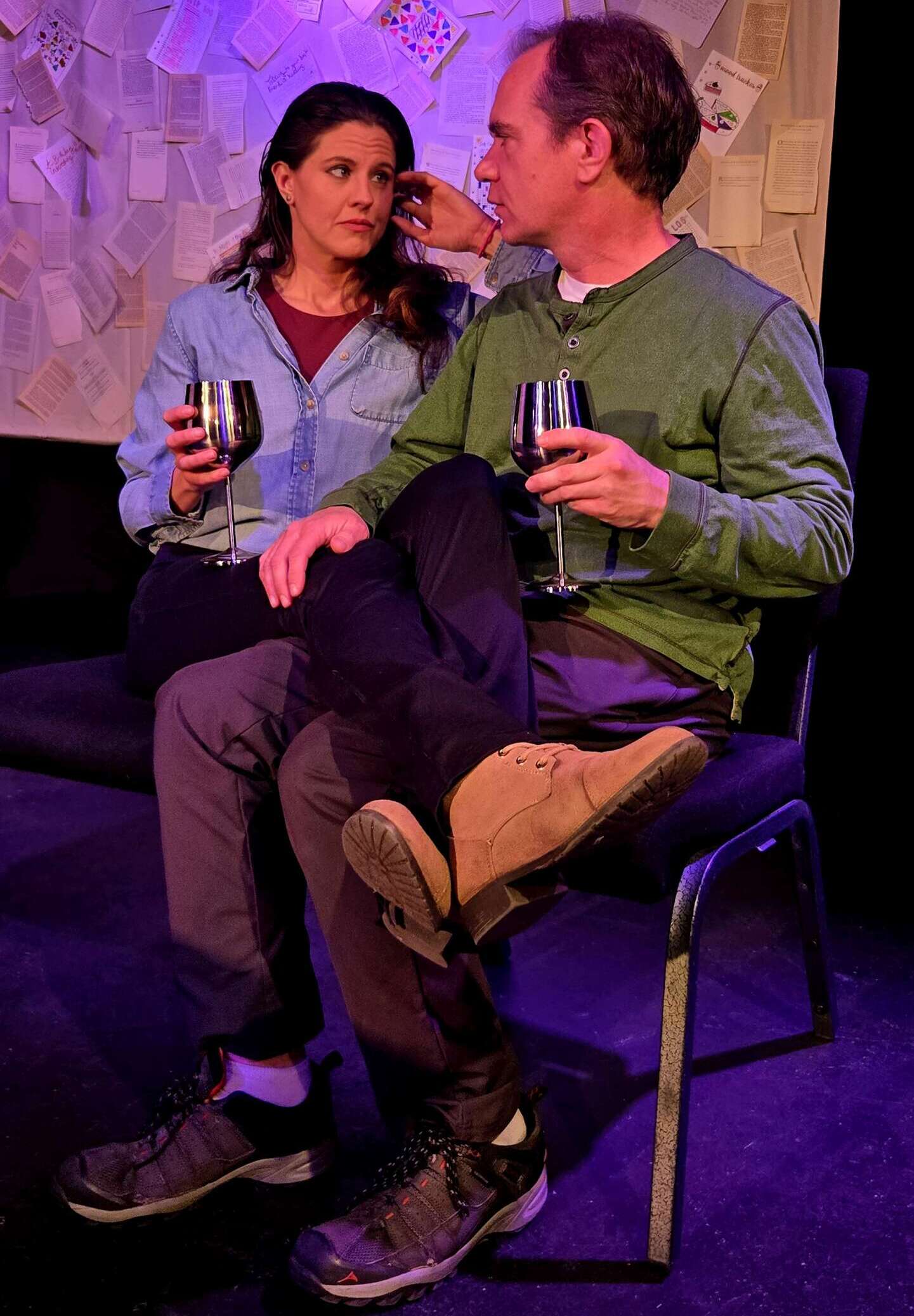
Nicole Caron as Abby Drake and Paul Jaquith as Michael Waterman.
A minimalist stage that lets the words shine
Three Leaches wisely avoids overcomplicating the design. The set is spare, anchored by a table and chairs and framed by two hanging walls filled with pages, lists and other fragments of writing. The hanging installation creates an appropriately writerly environment. From a distance, the collage looks chaotic and overwhelming; up close, individual fragments of thought emerge. It’s an apt visual metaphor for the characters’ tangled inner lives.
The staging moves fluidly through multiple time periods and imagined spaces. There are moments when the production leans into a slightly formal theatricality, especially when characters move into isolated pools of light for monologues, but the device mostly works. It gives shape to a script that is constantly toggling between memory, fantasy and immediate confrontation.
The intimacy of the venue also helps. In a play this emotionally intricate, proximity matters. You want to catch every flicker of recognition, panic, resentment and desire crossing these actors’ faces, and here you can. That closeness turns Dietz’s elegant mind game into something more immediate and bruising.
Leach’s staging keeps the two-hour runtime brisk. The first act runs just under an hour and establishes the emotional stakes quickly, while the second act tightens the screws as long-buried truths begin to surface. Opening-night jitters produced a handful of minor line stumbles, but the actors’ command of the material remained strong throughout.
Fiction ultimately works because Dietz refuses to offer easy answers about honesty in relationships. The play suggests that even the most transparent partnerships are built on carefully curated versions of ourselves. In the Watermans’ case, the line between storytelling and reality becomes so blurred that it is nearly impossible to tell whether the journals reveal betrayal or simply the imaginative impulses of two people who make their living inventing lives on the page.
For The Three Leaches, the production also signals a company growing confidently into its new home. With a small cast, sharp script and minimal design demands, Fiction proves an ideal vehicle for a troupe that thrives on intimacy and actor-driven storytelling. Dietz’s play deserves to appear on local stages more often, and this staging demonstrates how well it plays in a room where audiences can sit close enough to watch every carefully chosen word land.

A Colorado-based arts reporter originally from Mineola, Texas, who writes about the changing world of theater and culture, with a focus on the financial realities of art production, emerging forms and arts leadership. He’s the Managing Editor of Bucket List Community Cafe, a contributor to Denver Westword and Estes Valley Voice, resident storyteller for the Bonfils-Stanton Foundation and co-host of the OnStage Colorado Podcast. He holds an MBA and an MA in Theatre & Performance Studies from CU Boulder, and his reporting and reviews combine business and artistic expertise.

Leave A Comment