

At Vintage, an entertaining fish tale is weighed down by a sketchy script.
In the penultimate scene of The Shark is Broken, a play about the filming of Jaws, Graham Bryant as Richard Dreyfuss says that “everything is about something” and asks his castmates — Evan Marquez as Roy Scheider and Austin Terrell as Robert Shaw — to say what they think the film is about. Dreyfuss and Scheider provide interpretations. But, Shaw, the accomplished actor and playwright, says “It’s a movie about a shark.”
And therein lies the problem with The Shark is Broken making its Denver premiere at the Vintage Theatre (the Springs Ensemble Theatre also did it last year). It could have been about something. It teases being about something — fame, insecurity, value, what is “art.” But it never finishes those thoughts. After two hours of entertaining banter and bickering, I was left wondering what the play was about. I didn’t perceive even a “shark.”
Nominally, the play is about the three primary actors in Jaws — Shaw, Scheider and Dreyfuss — and how they spent hours and hours and hours on a boat waiting to film their scenes while the mechanical shark wasn’t working. Or the weather was bad. Or there were ships and boats on the horizon. When the shark is broken, the relationships of the actors also threaten to break. Repeatedly.
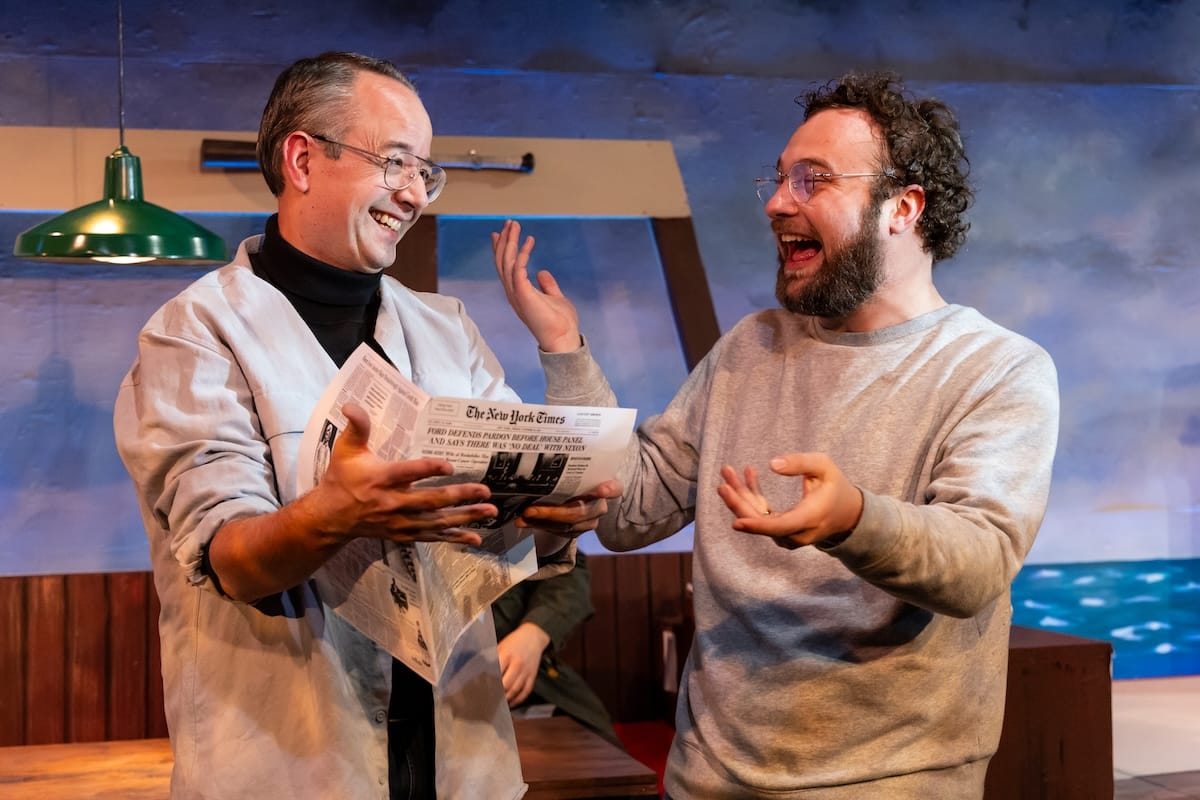
Evan Marquez, left, as Roy Scheider and Graham Bryant as Richard Dreyfuss in ‘The Shark is Broken’ at Vintage Theatre. | Photo: RDGPhotography
Solid production
When you arrive, you are immediately put into the world of the film. Audience members enter through a shark’s mouth and see the boat with ocean water and sky painted by Bernie Richard. I could almost taste the sea air. The set design and build by Lexi Renfro is a marvel of utility, affording the actors room to move and to play with all manner of seeming minutiae and props arranged by Kortney Hanson. The costumes by Susan Rahmsdorff-Terry match my memory of how the actors were dressed in the film to make an instant connection for me. The sounds and music by Russ Kirby also triggered memories of John Williams’ origianl score.

As directed by Luke Rahmsdorff-Terry, the two hours of the play (not counting intermission) zip along. Humor is prevalent, but never over the top. Most of the laughs come from believable situations.
Bryant, Marquez and Terrell all capture the essence of the actors they portray and their look. Bryant has Dreyfuss’ nervous tics, inflections, insecurities and bravado. Terrell makes for a fine Shaw — sophisticated and knowledgeable with an air of knowing superiority. He suggests Shaw’s accent more than duplicating it, until he nails it in the epilogue. The repartee between Terrell’s Shaw and Bryant’s Dreyfuss flows naturally even when it explodes into a confrontation choreographed by Brandon Billings. Marquez is a quiet introspective Scheider — trying to be a calm in the eyes of the storm and to divert Dreyfuss and Shaw from their clashing personas.
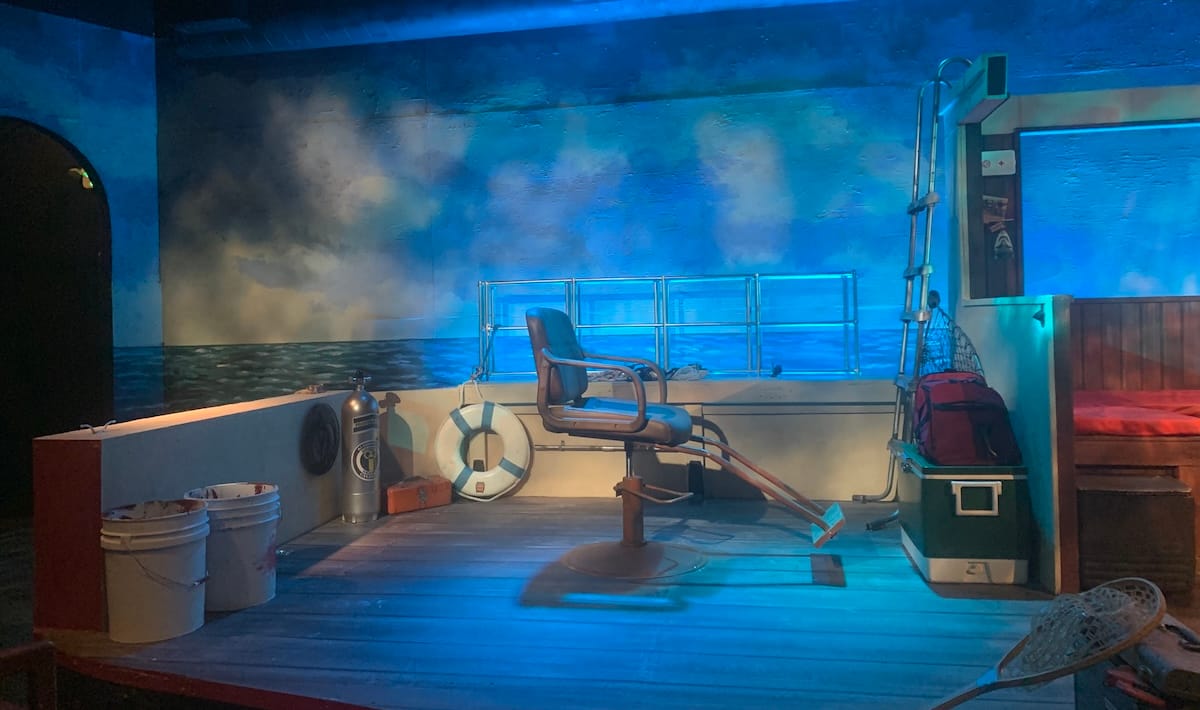
A look at Lexi Renfro’s impressive ocean set. | Photo: Garth Gersten
Wandering script
But the cast and crew are let down by the script. The play is written by Ian Shaw, Robert Shaw’s son, and Joseph Nixon, purportedly from notes Robert Shaw kept. And yet, the play wanders from event to event with little connection or growth between scenes. Some incidents seem included because they happened, rather than because they advance the story and characters.
Timeline shifts make things confusing. Early in the play, the actors say they have been filming for seven weeks. Later, they say it is four weeks, and, then, in the penultimate scene, it is the last day of filming. I found some of the conversations odd, as they likely would have happened earlier in the filming than they are set. We never know what scenes from the film are being filmed, nor do the actors comment on what they have filmed. I had no sense of the passage of time.
With all the time the Jaws actors had on their hands, they could have discussed many things, but the play centers mostly on the bickering between Dreyfuss and Shaw. There was an opportunity to explore the different approaches to acting: Shaw, the classically trained experienced actor and playwright who has seen a lot; Scheider, the hard working American actor for whom acting is just a job; and Dreyfuss, the new, hungry and insecure kid seeking fame and fortune.
Bryant, Marquez and Terrell convey the conflicts between the actors, but the play never grapples nor develops any themes from the conflicts. Instead, the play only skims the surface of topics and personalities in favor of a “behind the scenes” story that even concludes with some poor jokes about sequels and remakes. This might make a modern audience give a knowing laugh, but were unlikely to have been made by the actors.
That famous monologue
The one part of the film we do see discussed and enacted is the famous Indianapolis monologue given by Shaw as “Quint,” which many consider one of the greatest film monologues. The play delves slightly into the development of the monologue from the version that Shaw thinks is crap and too long. We see him scribbling and rewriting. Shaw attempts to deliver it as he has written it, but is too drunk (which actually happened).
Terrell does communicate some of Shaw’s struggles, including a poignant discussion of why he drinks to excess. But, instead of a thematic through-line where Shaw’s — and the film’s — struggles pay off with the monologue, the play just ends. Then there is an epilogue where the monologue is presented (excellently by Terrell). The audience I was with was confused because it seemed the play had ended and then there is this final out-of-context scene.
Other sequences — which may or may not have happened — are presented with even less context, including one with Scheider all alone trying to sun himself, albeit well-played by Marquez. There also are numerous references to then current events and popular culture as well as the first names of crew on the film which did not connect with any audience member who was not very familiar with the film nor 1974. One audience member commented at intermission that she wasn’t catching any of the references but was still enjoying the play. I did catch the references and enjoyed them.
The Vintage Theatre production manages to sail along even as it is weighted down by the script. As a piece of nostalgia, it can resonate with an audience. Familiarity with Jaws is not required, but it certainly helps.

Garth Gersten is an attorney and lifelong theatre lover. In Champaign, Illinois, he directed shows with Champaign-Urbana Theatre Company, Rantoul Theatre Company, Bright Lights Theatre Company and Twin City Theatre Company, which he founded. He now lives in Boulder with his wife who is a professor at CU.

I believe the actor playing Shaw is spelled Terrell
thanks, fixed