
Revised Neil Simon Play still works in Miners Alley production.
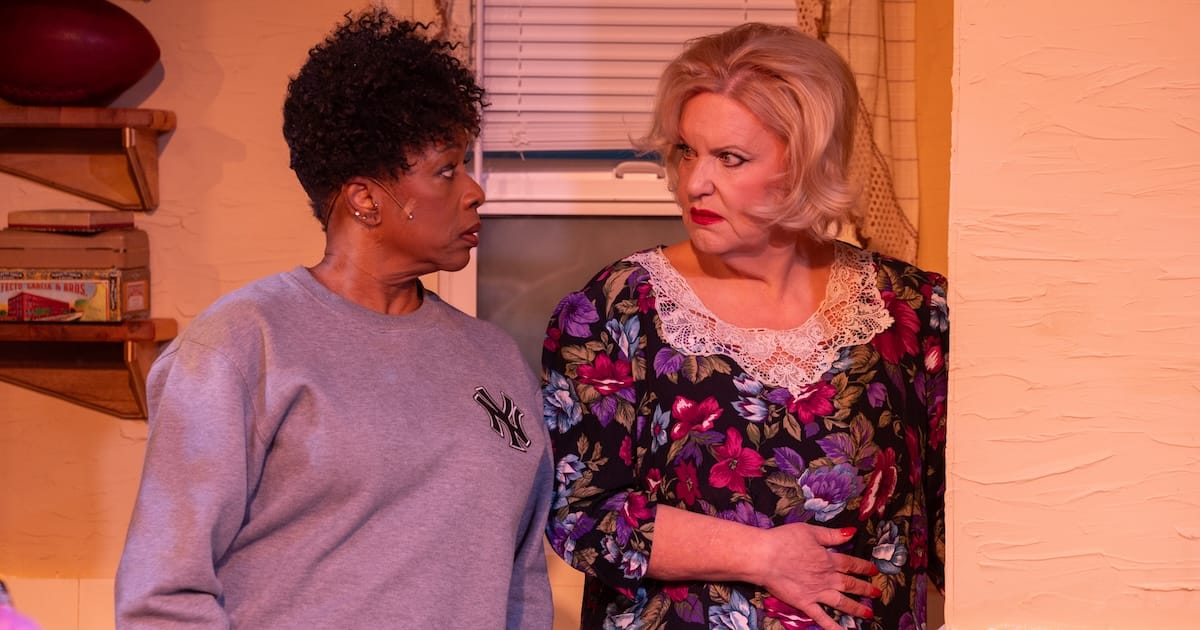
It’s not a retread. Neil Simon had a reason and purpose in reconceiving and rewriting his 1966 Tony wining play, The Odd Couple, in 1985. The Odd Couple (Female Version) now at Miners Alley Performing Arts Center through March 8, is not just a “gender bended” version (as for example, the recent all-female version of 1776). Simon’s rewrite explored how women react differently than men to similar situations. While some of the beats are familiar, The Odd Couple (Female Version), as directed crisply by Miners Alley’s Associate Artistic Director Warren Sherrill, is its own very funny, very entertaining, very thoughtful show that plays just as well in 2026 as it did in the 1980s and 1960s.
The set-up is simple and brilliant. Oscar in the original is now Olive Madison (a brilliant Sheryl McCallum), divorced for three years, and hosting an evening of Trivial Pursuit at her messy apartment with a non-functioning refrigerator and old non-edible snacks and sandwiches for her female friends. These include Mickey (Adrian Egolf), Renee (Annie Dwyer), Sylvie (Dana Hart Wright) and sweet, simple Vera (Candace Orrino). The last member of the group, Florence Unger (Emma Messenger), the revised Felix Unger, is uncharacteristically late. We hear concerns about Florence and also about her idiosyncrasies. A phone call reveals that Florence’s husband, Sydney, has thrown her out. She shows up at the gathering, disheveled, distraught, and confused. Having nowhere else to go, Olive offers to let Florence stay with her in the apartment.
Although friends for some time, Olive and Florence are opposites in how they approach life and cleanliness. Thus, they become an “odd couple.” The play really gets into high gear in Act Two when Olive invites two new neighbors, Manola (Josh Levy) and Jesus (Damon Guerrasio) — brothers from Spain who are each divorced — to the apartment. Emotions run high as Olive and Florence clash about nearly everything. But, by the end of the play, Olive and Florence have each grown more into themselves becoming happy to be self-sufficient and positive about where life will take them.
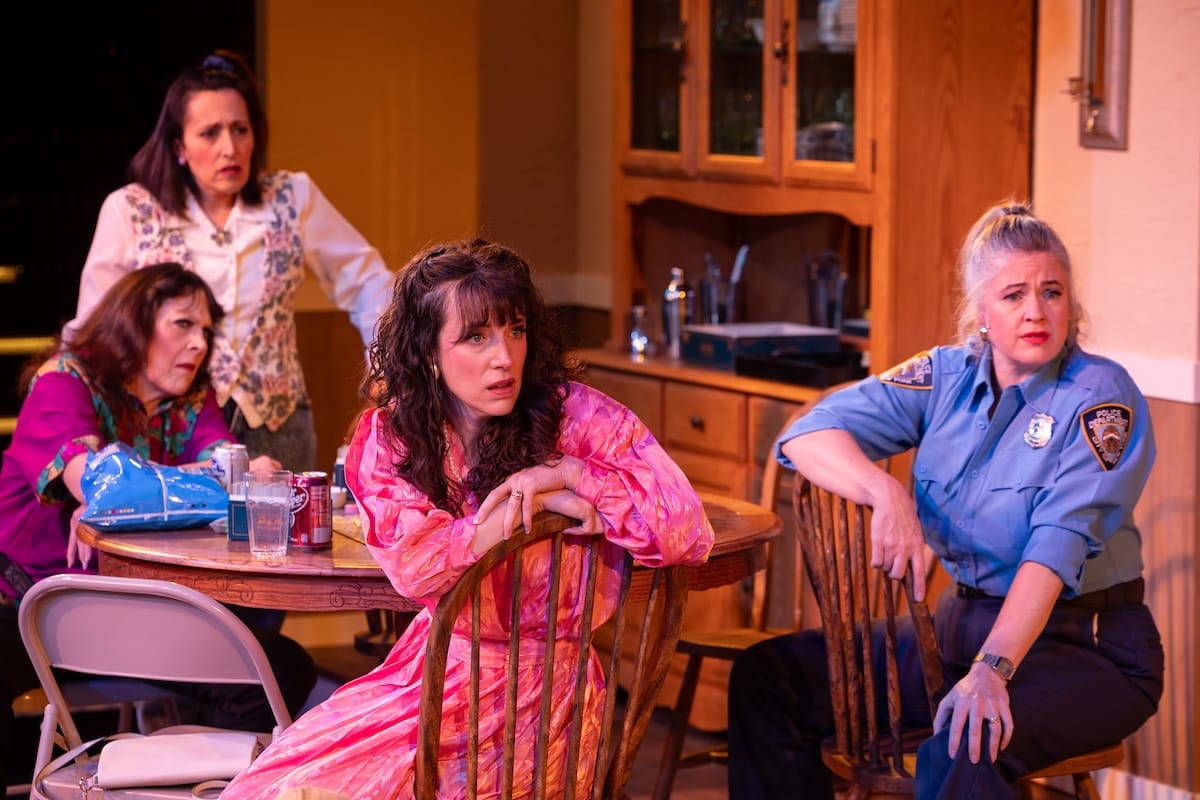
Photo: McLeod9 Creative
The female version feels new
The original Odd Couple struck a chord about the growing rate of divorce in the 1960s. It derived its humor by broad stereotypes about single men: Oscar, who can’t take care of himself without a spouse and Felix, considered annoying for wanting to cook and clean as a “traditional wife.” In contrast, divorced women in the 1970s and 1980s (and to a lesser extent today) were still struggling with their role in American society.
Olive and Florence and the other women would have been born in the early 1950s and raised with ideas of domesticity, classes about “home economics” and an expectation of an identity based on their future husbands. The women’s liberation movement of the 1960s and 1970s had changed society displacing the 1950s and 1960s ideas of women’s roles. The Odd Couple (Female Version) builds off that dichotomy of childhood anticipation with the reality of the 1980s and having to find your own and new way. Oscar and Felix didn’t face those issues. Olive and Florence do.
Even as the women grapple with their lives, they approach issues and friendships as women. The non-subtle switch from men playing poker – an aggressive game about winning and dominance – to women playing Trivial Pursuit — a game with teams and about knowledge — quickly establishes the difference between men and women. This Odd Couple is about female friendship and support.
As a result, this version strains to be about an “odd couple” as Olive and Florence are supportive friends in a way that Oscar and Felix were not. Olive does not so much get annoyed at Florence’s idiosyncrasies until Florence’s attitude and actions ruin Olive’s chances at romance with either of the Spanish brothers. The conflict is less about cleaning and cooking, and more about how to enjoy life. It feels like a completely new play, with new dialog, even as it hits and repeats some of the iconic moments and lines from the original.
Timeless themes
The program does not identify when the play is set. Musical interludes are mostly 1970s television show theme songs, but Trivial Pursuit is a game that became popular in the 1980s. There are other references in the script to people and places which would place the show in the 1970s or 1980s and might be missed by modern audiences. But the themes and humor ring true today regardless. The Odd Couple derives its humor less from gender roles and more from people trying to deal with a changing world.
Simon’s plays rarely take a breath, and this show is no exception. There are a lot of jokes, but most are from the situations and not just bon mots hurled by the characters. The audience at our Sunday matinee was generally an older crowd, but this is a show that younger audiences should connect to and enjoy whether they identify themselves as the characters or, perhaps, identify their parents as the characters!
McCallum dominates the stage from her first entrance. Her Olive is dynamic, charismatic, strong and, when appropriate, vulnerable. I’m not a fan of accents on stage as many actors have a difficult time maintaining an accent and acting through it. I’m not sure where Olive and Florence are from in New York, and Messenger’s accent did vary a bit. I was taken aback at first by Messenger coming across like a ditzy blonde – not by words, but by voice and inflection. But, she settled in as the show progressed and Florence became a stronger person. McCallum and Messenger play off each other well in that heightened reality of early Simon plays.
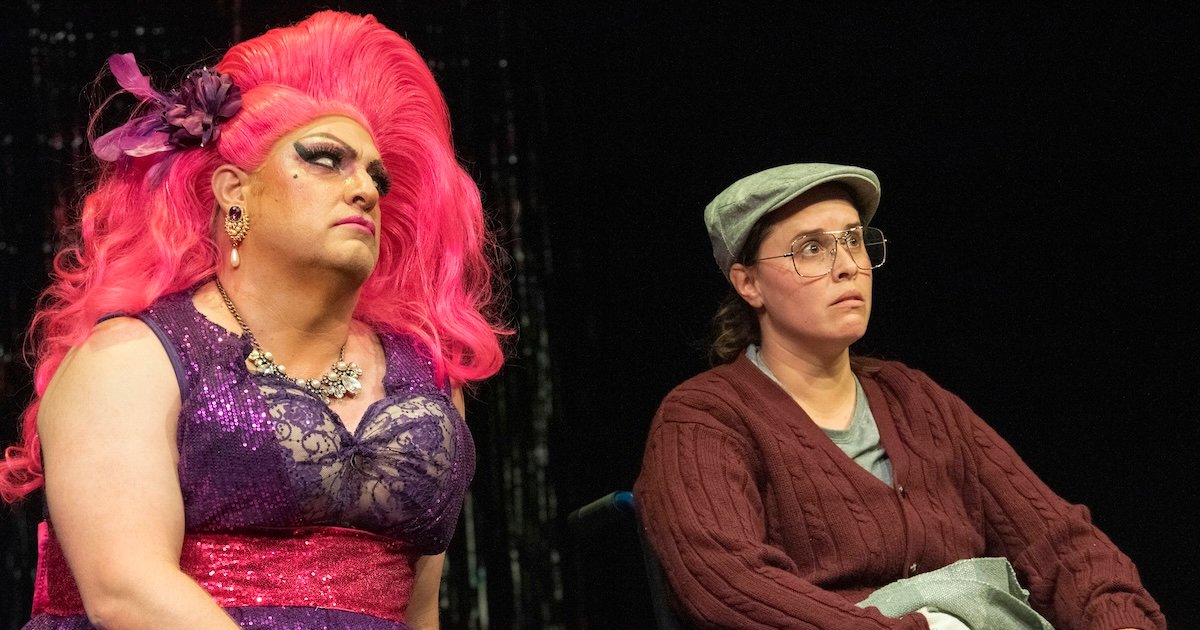
Josh Levy and Damon Guerasio play the male versions of the Pigeon Sisters from the original, here as the Spanish brothers. Dashing in their 1970s wild and crazy outfits, they delight in mangling the English language and misunderstanding American idioms. Levy plays Manolo as a manly man while Guerrasio’s Jesus was more of an Andy Kauffman “Latk” persona. Levy’s expressive face added to every punchline.
The group of women friends don’t have a lot to do, but they do it well. Their physical reactions and facial expressions are always on target. They truly support Olive and Florence while presenting a contrast to the outsized personalities of Olive and Florence.
Design elements
Olive’s apartment is one of those spaces that could never exist in real life, but Jonathan Scott-McKean’s design lays it out so that it feels natural and gives the actors room to move and react. The stage is in a thrust format, with the audience on three sides. We sat in the “south” section where we could see all of the action. I’m not certain that people sitting in the East and West sections got the same full experience, even as the actors try to play to all sides.
The costumes by Crystal McKenzie added to the humor with a blend of 1960s and 1970s dresses, pants and pastel open shirts. All that was missing were shoulder pads and scarves. Vance McKenzie kept the stage well lit with few lighting effects. Sound, designed by John Hauser, was excellent, even as I could see some head microphones having issues staying on. Samantha Piel had to dress the set for very different times, but every piece told the right story for the scenes.
Under Sherrill’s assured direction and anchored by McCallum’s magnetic performance, Miners Alley’s production honors Simon’s original while proving the female version has its own important story to tell, and, oh yes, giving the audience a very entertaining time.


Garth Gersten is an attorney and lifelong theatre lover. In Champaign, Illinois, he directed shows with Champaign-Urbana Theatre Company, Rantoul Theatre Company, Bright Lights Theatre Company and Twin City Theatre Company, which he founded. He now lives in Boulder with his wife who is a professor at CU.

I look forward to seeing this female rendition of The Odd Couple. I watched Felix and Oscar regularly. Sheryl McCallum is a seasoned actor that rises to what ever role she is given.