
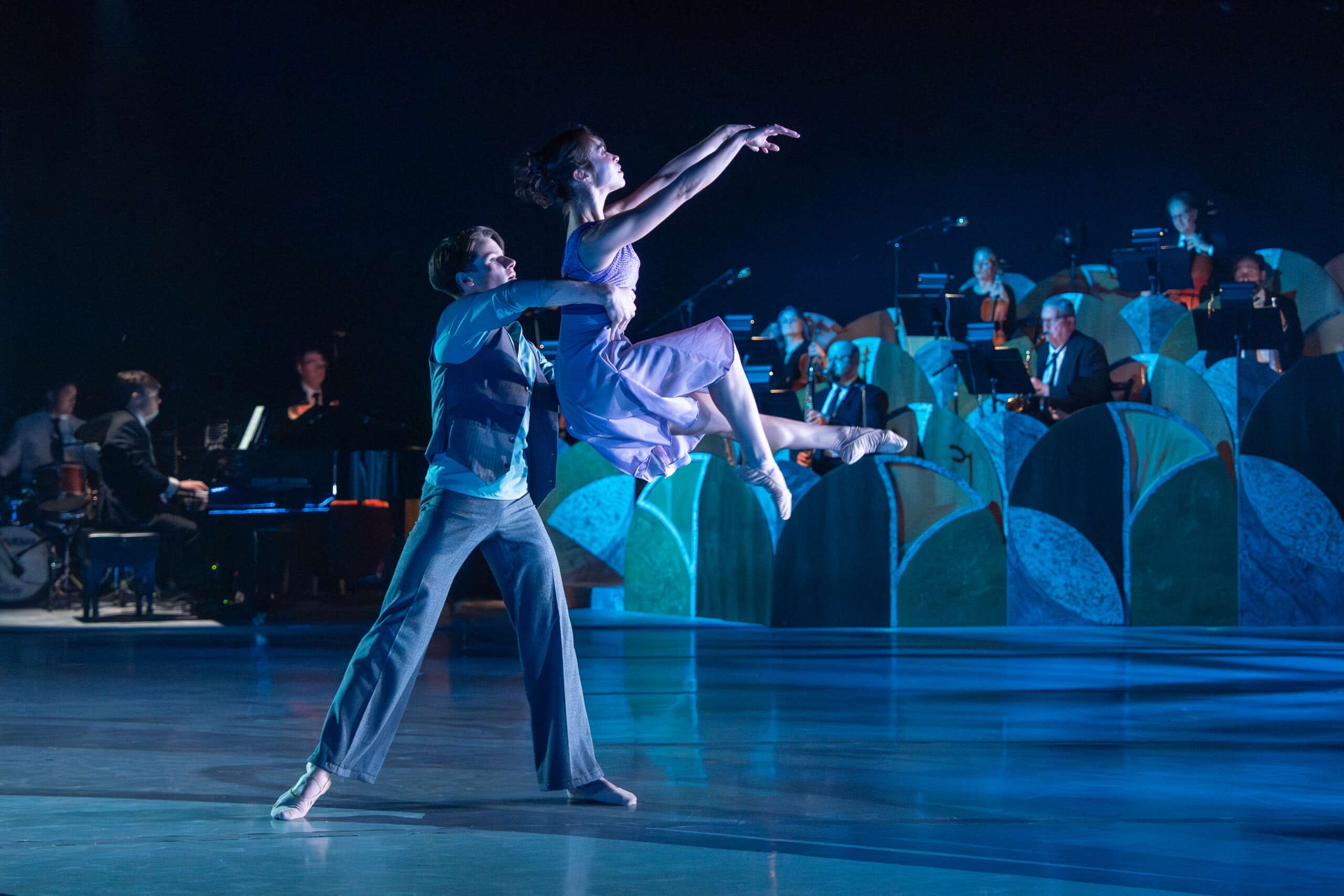
Wonderbound’s latest world premiere pairs Roaring ’20s glamour with emotional wreckage.
With Decadent Desires, Wonderbound once again proves that it has little interest in polite, decorative ballet. This world premiere, created by artistic director Garrett Ammon, plunges audiences into a smoky, glittering 1920s New York where pleasure is currency and love is transactional. Like the jazz age itself, the show pulses with excess and the sense that indulgence always carries a bill that will eventually come due.
Running through March 8 at Wonderbound’s Denver home, the two-hour work (with intermission) is both one of the company’s more narratively accessible productions and one of its most emotionally bruising. Inspired in part by Ursula Parrott’s 1929 novel Ex-Wife, Ammon’s ballet tracks the rise and unraveling of Desirée, a modern young woman navigating ambition, romance and betrayal in a world that celebrates male appetite while punishing female autonomy.
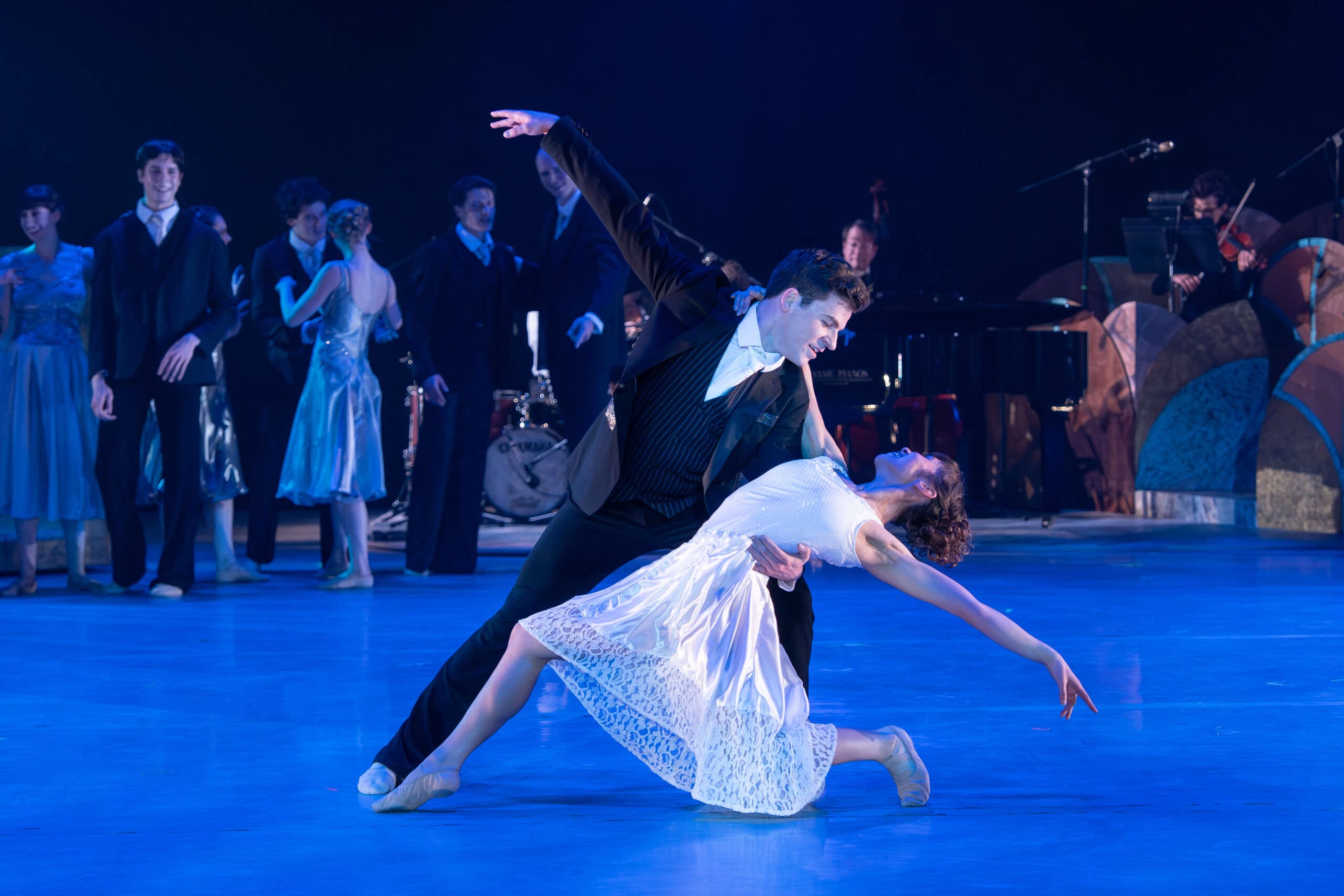
Henrique Neumann as Peter and Danielle Lieberman as Desirée | Photo by Amanda Tipton Photography

Live jazz as narrative engine
A major reason the production feels so alive is the onstage presence of the Colorado Jazz Repertory Orchestra, conducted by composer and arranger Drew Zaremba. Rather than relegating the 11-piece ensemble to a pit, the musicians are integrated into the visual architecture of the show. The stage evokes an Art Deco supper club: a grand piano and rhythm section at floor level, with brass and winds rising diagonally on tiered platforms that the dancers weave through and climb.
Zaremba’s arrangements reimagine music by George Gershwin, Frédéric Chopin, Claude Debussy, Erik Satie, Maurice Ravel, Sergei Rachmaninoff and Irving Berlin, refracting familiar melodies through a brassy, rhythmically charged jazz lens. The score moves seamlessly from lush, romantic swells to buoyant, champagne-splashing club numbers.
The synchronization between orchestra and choreography is, for most of the evening, razor sharp. There are moments, particularly in large ensemble partner sections, where the physical complexity slightly outruns the precision, but the sheer ambition of what’s being attempted makes minor slippages forgivable, especially in an early performance.
Women in a man’s world
Danielle Lieberman’s performance as Desirée is the emotional backbone of the show, and it is one of her most layered performances at Wonderbound to date. Her first-act solo bursts with optimism, a portrait of youthful ambition expressed through expansive lines and buoyant turns. By contrast, her second-act variation — delivered after her marriage implodes and her prospects narrow — collapses inward, trading openness for weighted, fractured movement that suggests a body carrying both shame and exhaustion.
A whirlwind courtship with Peter (Henrique Neumann) leads to marriage by the end of the first act. Neumann’s Peter is appropriately charismatic early on, with his flirtatious physicality foreshadowing the wandering eye that eventually destroys their marriage. Nonetheless, the two dancers’ chemistry is palpable, especially in their early pas de deux, which features swooping lifts and quick rhythmic movements that convey trust and surrender.
Morgan Sicklick pulls double duty as both an advertising executive and Charlotte, a woman who mentors Desirée into the morally ambiguous world of transactional survival. As Charlotte, she exudes weary authority. Her duets with Lieberman are charged with both intimacy and caution, suggesting a lineage of women who have learned to navigate a system stacked against them.
Marcelina Lancaster-Gaudini and Hailey Stinchcomb bring welcome levity as Desirée’s friends Patricia and Helen. A drunken stumble home in Act I, complete with physical comedy and messy camaraderie, is one of the evening’s most humanizing scenes. The choreography captures the wobble and unfiltered honesty of inebriation without tipping into caricature. These moments make the later unraveling all the more painful.
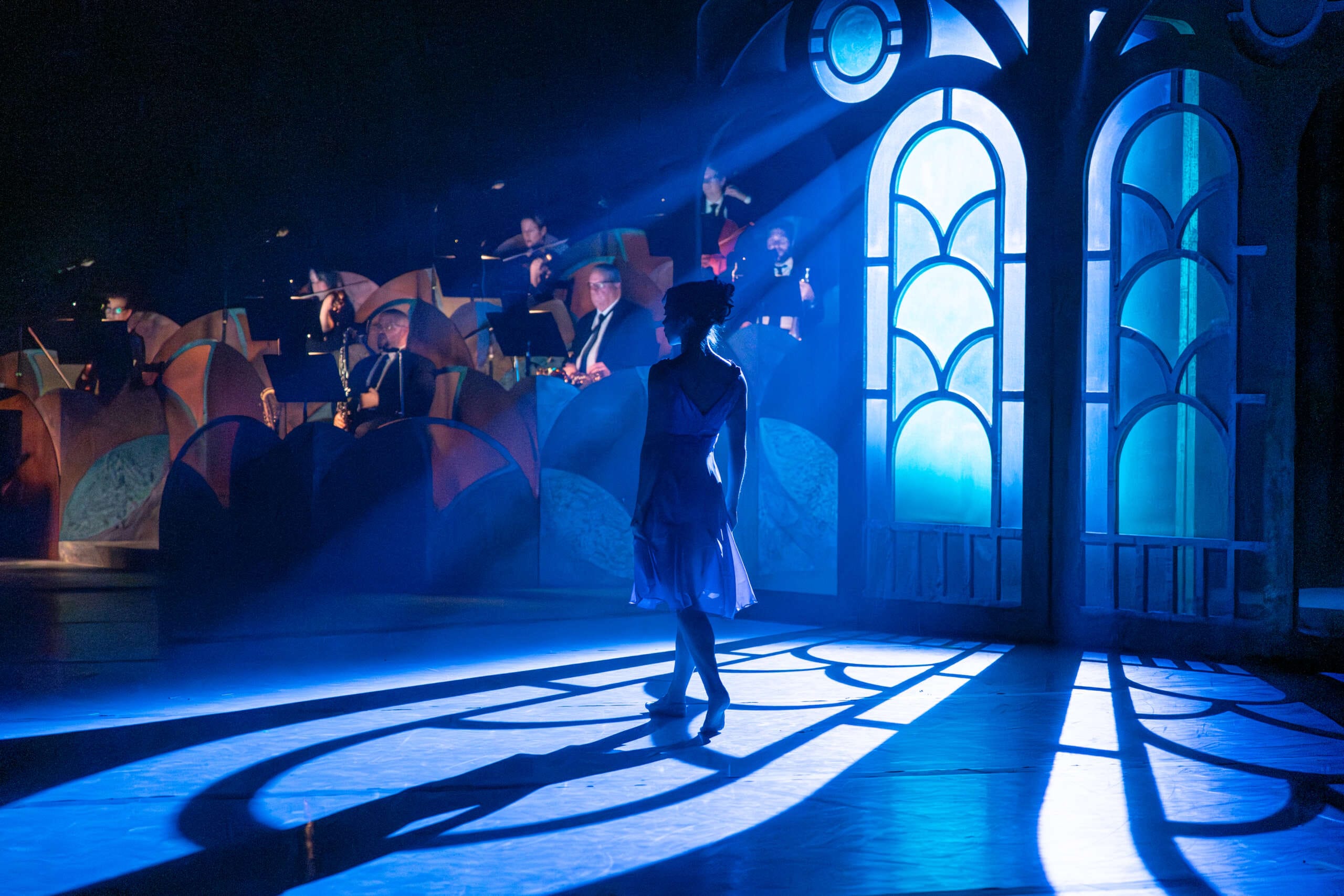
Danielle Lieberman as Desirée | Photo by Amanda Tipton Photography
Design that breathes and broods
Ammon’s five-piece rolling scenic units, with geometric cutouts that evoke stained glass and Deco latticework, are marvels of fluid storytelling. They rotate, separate and recombine to transform seamlessly from ad agency to nightclub to marital home to shadowed street. The transitions are choreographic in their own right, with dancers and crew manipulating the pieces in ways that feel seamlessly integrated into the show’s fast-paced world.
Lighting designer Joseph Naftal heightens the atmosphere with sculptural backlighting that throws elongated shadows across the stage. The effect is intoxicating: the space feels perpetually on the verge of smoke, even without a cigarette in sight.
Dawn Fay and Sloane Crazybear’s costumes subtly reinforce these shifting environments. Office wear appears restrained and structured, while party dresses introduce bursts of color that mirror the characters’ loosening inhibitions as the evening wears on. The visual clarity keeps the focus on the dancers’ bodies and the emotional architecture of the story.
A mature, accessible entry point
Longtime Wonderbound audiences know that Ammon gravitates toward moral complexity and psychological tension. Decadent Desires is squarely in that lineage, but unlike the time-bending complexity of recent works like Hideaway Hotel, it follows a relatively linear narrative path. There are no overlapping timelines or deliberately fragmented structures. The story unfolds chronologically, making it one of the company’s most approachable works for newcomers.
That accessibility does not dilute its thematic bite. The ballet interrogates gendered hypocrisy and the cost of ambition in a society intoxicated by consumption. If Desirée’s punishment feels disproportionate, that imbalance appears intentional, as a reflection of 1920s social codes that judged women more harshly than men.
Denver is fortunate to house a company willing to merge live jazz, narrative ballet and unapologetically adult themes at this scale. Decadent Desires may not satisfy viewers seeking escapism, but it offers something richer: a sophisticated, technically demanding work that invites audiences to sit with discomfort.
As the final notes fade and Desirée faces an uncertain future, the glitter of the jazz age dims into something more sobering. It is a reminder that in Wonderbound’s world, pleasure and consequence are inseparable partners.

An award-winning Colorado arts and culture reporter originally from Mineola, Texas. Tresca is the chief theatre critic for OnStage Colorado and managing editor of OnScreen Colorado. He’s the editor of Bucket List Community News, a contributor to Denver Westword and Estes Valley Voice, a resident storyteller for the Bonfils-Stanton Foundation and the co-host of the OnStage Colorado Podcast.

Leave A Comment