
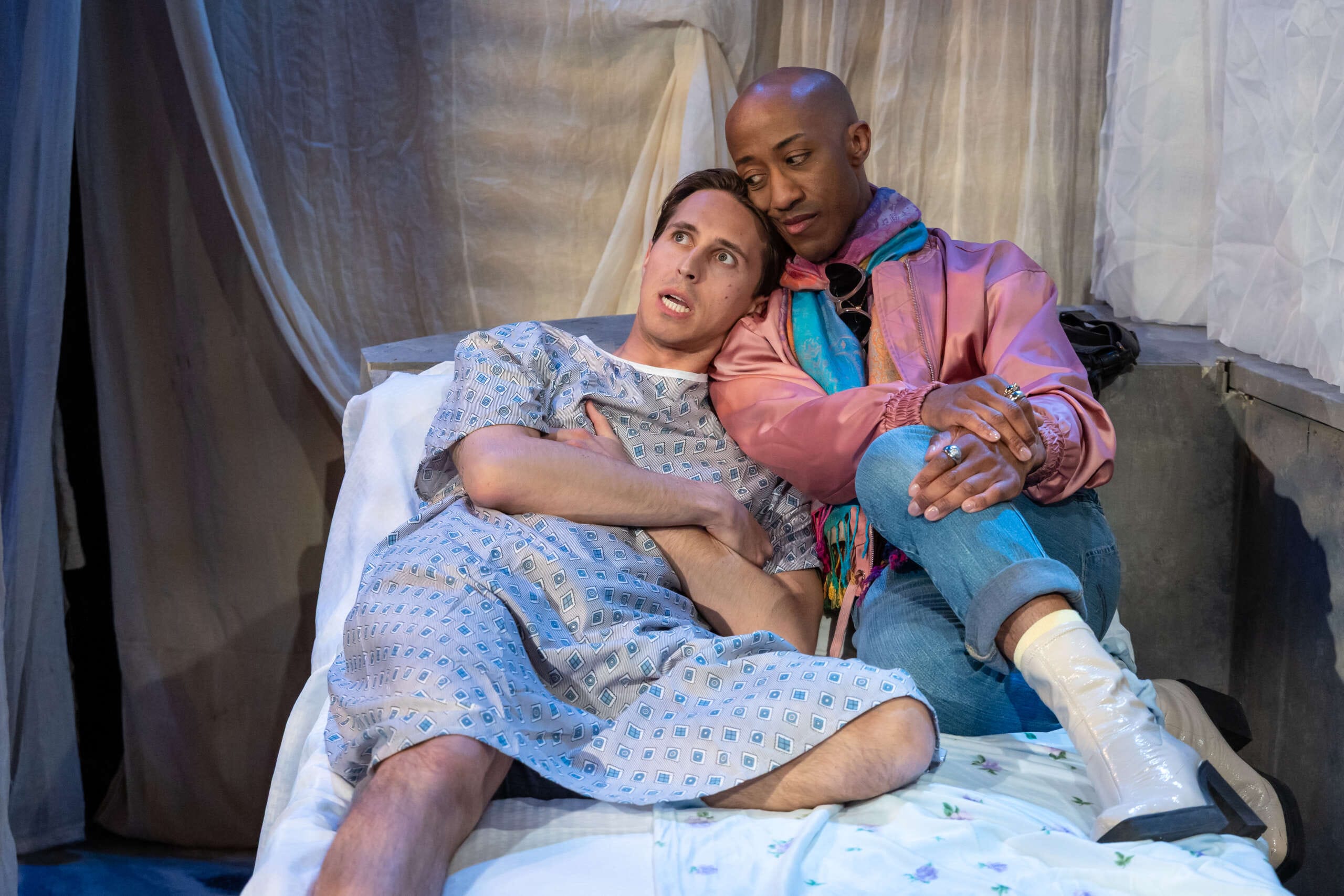
Tony Kushner’s epic AIDS-era drama hits hard in a sharply acted Aurora production of Millennium Approaches.
A three-hour play with two intermissions can sound intimidating. But, in Vintage Theatre’s production of Tony Kushner’s Angels in America: Millennium Approaches, the experience feels more like bingeing the first few episodes of a gripping prestige streaming series.
Under Bernie Cardell’s sturdy direction, the production moves at the pace of a serialized drama rather than a single marathon theatrical event. Each act lands like another chapter in an unfolding saga of illness, politics, faith and survival. By the time the final scene occurs, with a celestial visitor crashing dramatically into Prior Walter’s apartment, the hours have passed with surprising ease.
That pacing helps make Kushner’s monumental 1991 Pulitzer Prize-winning play approachable even for audiences encountering it for the first time. Set during the height of the AIDS epidemic in 1980s New York, Millennium Approaches traces the intersecting lives of two couples navigating love and identity against the backdrop of Ronald Reagan’s second administration.

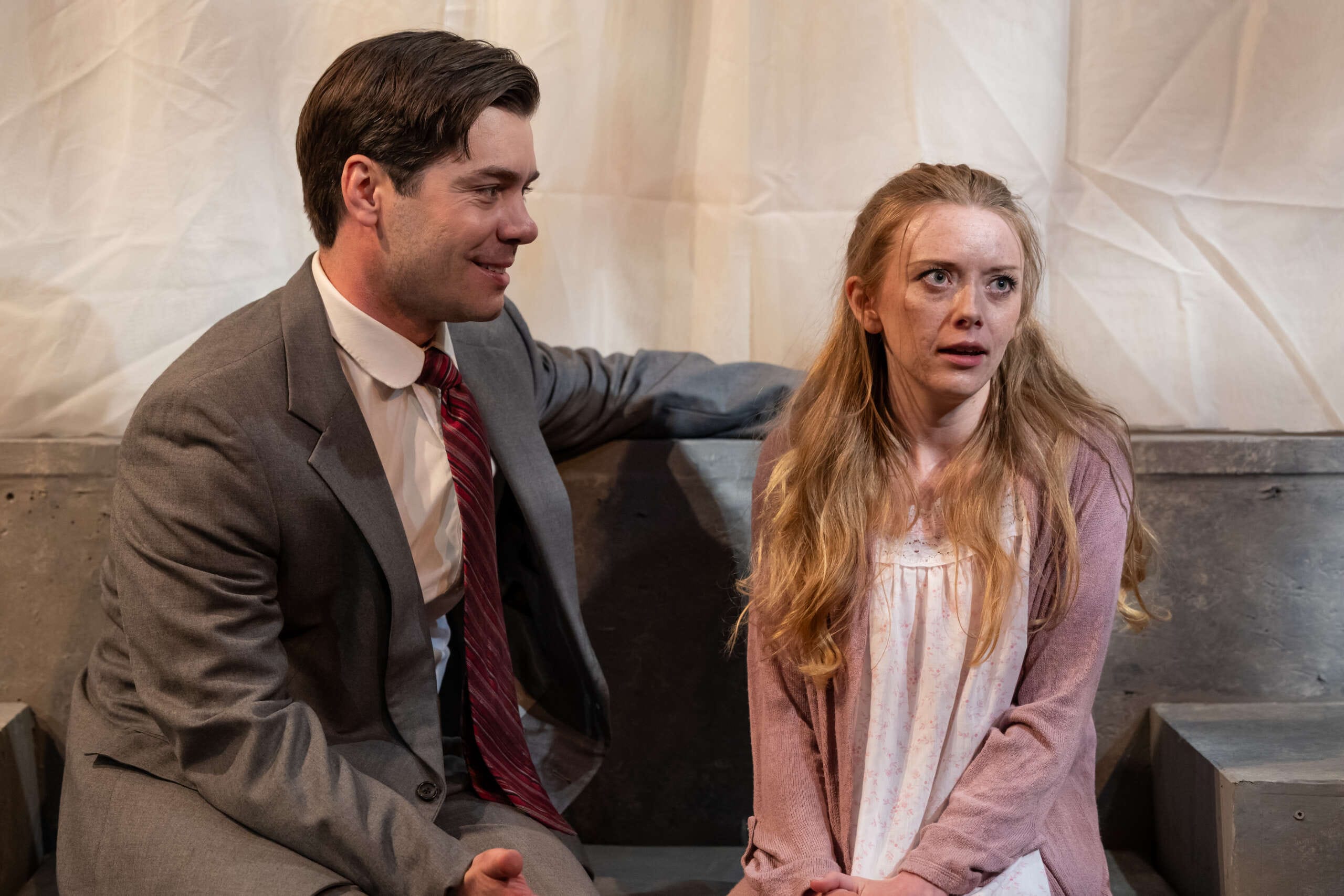
Chad Hewitt as Joe Pitt and Nicole Kaiser as Harper Pii. | Photo: RDG Photography
Vintage’s new staging marks a return to familiar territory for the company. Cardell first directed both parts of Angels in America for Vintage in 2010, when the theater operated out of its former 63-seat venue at 17th Avenue and Vine Street. Sixteen years later, the company revisits the work in its current home at 1468 Dayton, the 67-seat Bond-Trimble Theatre.
The scale may be modest, but the production proves absorbing. Although some of Kushner’s more extravagant theatrical flourishes are limited by Vintage’s small stage, Cardell’s staging maintains a sharp tempo and is bolstered by outstanding performances from the eight-person cast to produce a poignant interpretation of a play whose political significance has only grown.
Tangled relationships in New York
Kushner structures Millennium Approaches around two couples whose lives begin to intersect in unexpected ways. Prior Walter (Casey Board) and Louis Ironson (Dakota Hill) are a young gay couple in New York whose playful dynamic collapses into crisis when Prior reveals he has AIDS. In another part of the city, a closeted Mormon lawyer, Joe Pitt (Chad Hewitt) and his wife, Harper (Nicole Kaiser), struggle within a marriage defined more by obligation than affection.
Board gives a compelling performance as Prior. Balancing sharp humor with visible fragility, Board captures the character’s ability to joke even as his body begins to betray him. The hospital scenes are especially convincing, with Board navigating Prior’s shifting emotional terrain and hallucinations while maintaining the character’s biting wit.
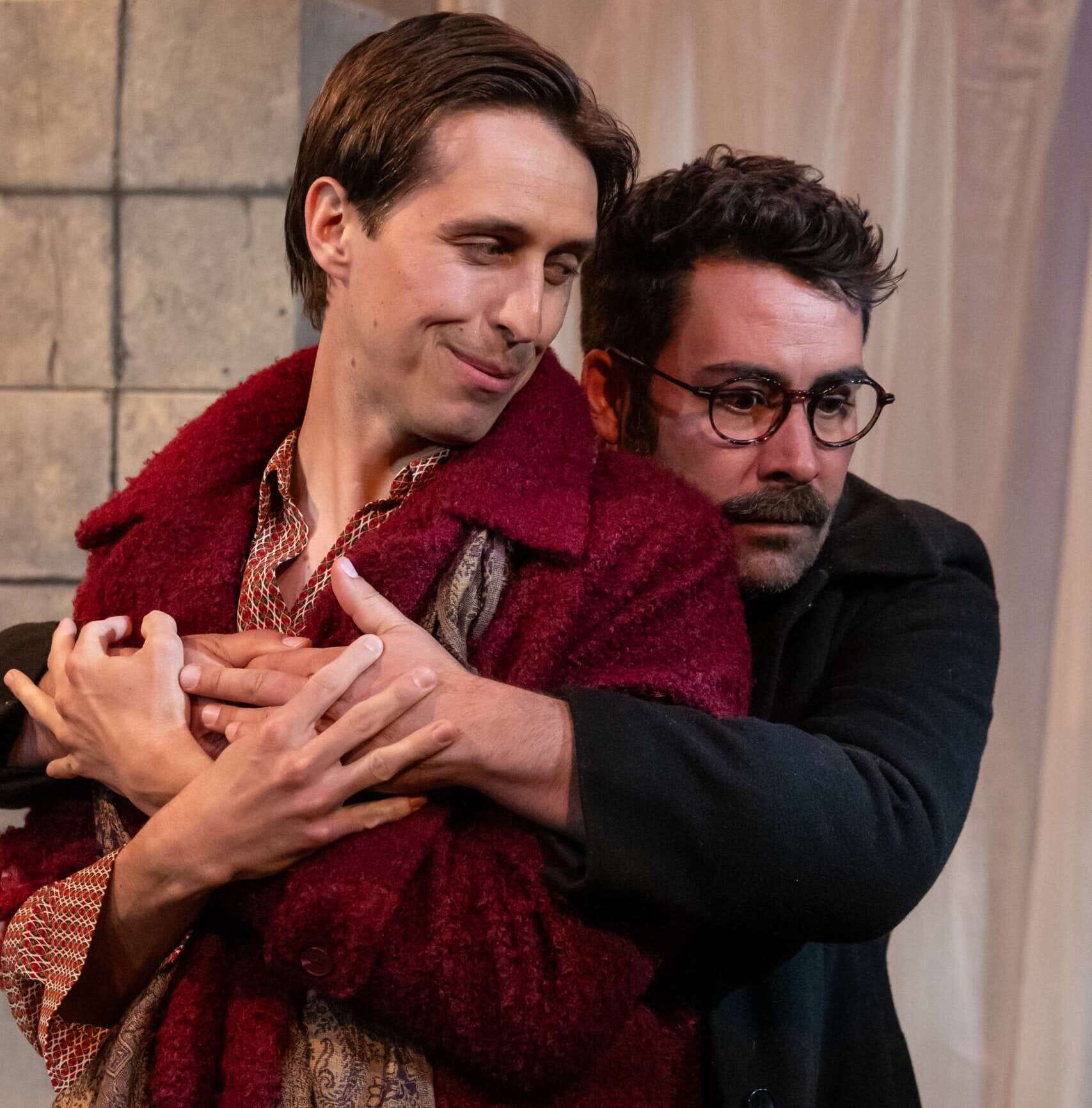
Casey Board as Prior Walter and Dakota Hill as Louis Ironson. | Photo: RDG Photography
Hill’s Louis, meanwhile, embodies a man paralyzed by his own conscience. Unable to face Prior’s illness, he abandons the relationship while simultaneously delivering long-winded lectures about politics and morality. Hill plays the contradictions effectively, revealing both Louis’ intellectual arrogance and his profound emotional cowardice.
As for the other couple, Hewitt conveys Joe’s internal conflict with restraint. Much of his work happens beneath the surface as the character struggles to suppress desires he barely understands himself. That repression finally erupts in a wrenching phone call to his mother, Hannah Pitt (Haley Johnson), when Joe drunkenly confesses he is gay. Johnson’s reaction unfolds with devasting precision, moving from stunned silence to anger and denial before revealing a deeper maternal worry she cannot quite articulate.
Kaiser’s Harper offers a different portrait of distress. Isolated and reliant on Valium, she drifts through elaborate hallucinations that blur reality and imagination. Kaiser plays on Harper’s emotional fragility, including a surreal scene in which she imagines herself wandering Antarctica. The character’s loneliness and disappointment with the life she is stuck in are crystal clear.
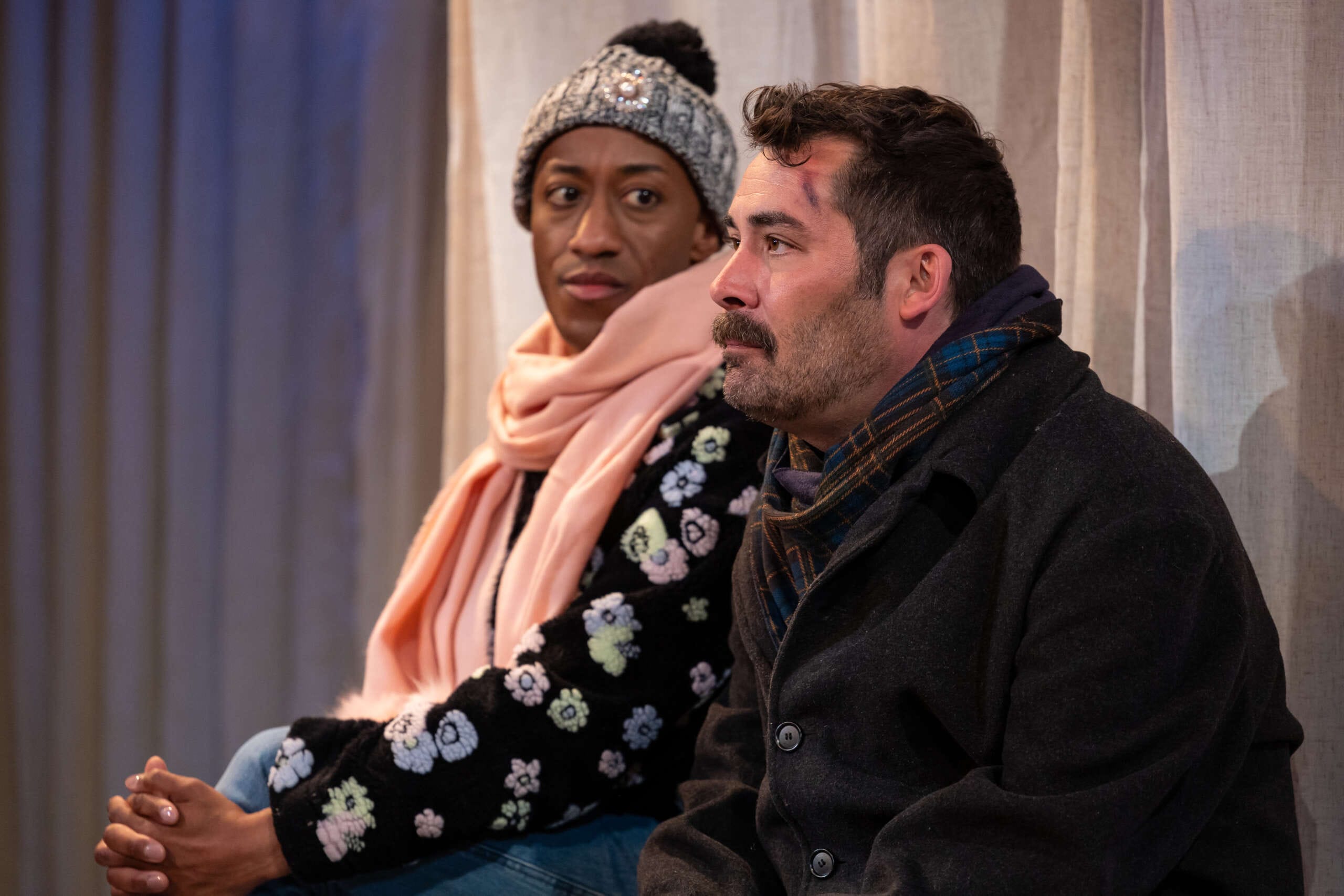
Johnathan Underwood as Belize and Dakota Hill as Louis Ironson. | Photo: RDG Photography
Jonathan Underwood adds a memorable presence in Harper’s visions as Mr. Lies, a mysterious travel agent whose deep, resonant voice gives the character a hypnotic quality. Underwood also appears as Belize, Prior’s friend and former drag queen, who confronts Louis in one of the play’s most satisfying scenes. After patiently enduring Louis’ moralizing speeches, Belize dismantles them with cutting clarity.
Andrew Uhlenhopp’s performance as Roy Cohn is the one that sticks with you the longest. Uhlenhopp dominates every scene in which he appears as Roy Cohn, the infamous real-life lawyer and conservative political fixer for leaders including Richard Nixon and Ronald Reagan. His Cohn is aggressive, fast-talking and terrifyingly persuasive, a man who weaponizes loyalty while denying the reality of his own AIDS diagnosis.
In an early office scene, Uhlenhopp seamlessly transitions between intimidation, manipulation and casual conversation as Cohn manages multiple phone calls while conversing with his protégé, Joe. Later, when Uhlenhopp discovers he has AIDS and attempts to persuade his doctor (trenchantly played by Johnson) to deny what he has witnessed, he is forced to accept the limits of his reality distortion. It’s a commanding performance that fully embraces the character’s ruthless charisma and growing desperation as he fights to keep power as the legal campaign against him intensifies and he begins to die of AIDS.
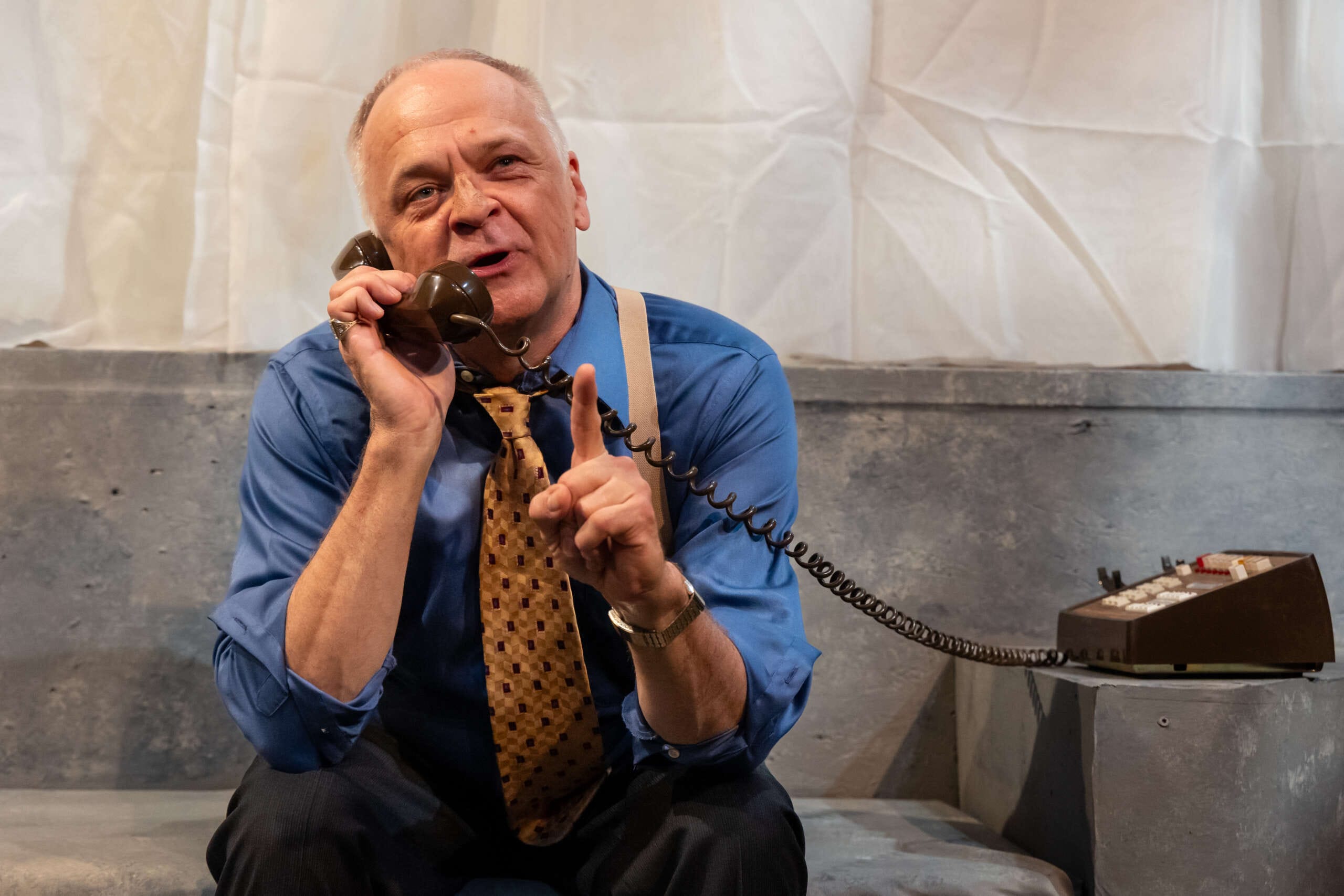
Andrew Uhlenhopp as Roy Cohn | Photo: RDG Photography
Epic ideas in a tiny space
Kushner’s script famously demands theatrical magic: ghosts, prophetic visions and a literal angel crashing through the ceiling. In larger productions, those moments can feel spectacular. Given the Bond-Trimble Theatre’s small footprint, Cardell and scenic designer Brendan T. Cochran wisely opt for a more minimalist approach.
Cochran creates a flexible environment built around two gray pillars, a rotable set piece on the right side of the stage and flowing white fabric that hangs upstage to suggest shifting locations rather than replicating them. Painted clouds along the walls and swirling patterns across the floor evoke Kushner’s spiritual imagery without attempting literal realism, while Emily Maddox’s lighting and Luke Rahmsdorff-Terry’s sound design help signal Kushner’s frequent shifts between reality and the more supernatural elements.
Still, some technical limitations are unavoidable. In comparison to larger productions, the Angel’s climactic appearance, played by Kelly Uhlenhopp, is necessarily more modest. Rather than using elaborate stage mechanics, Uhlenhopp enters the space by pulling aside the flowing fabric and appears with small, crafty-looking wings to greet Prior and announce, “The Great Work begins: The Messenger has arrived.” Yet the moment still lands because the actors have already built the emotional groundwork that makes Prior’s encounter feel inevitable.
Not every element lands as smoothly. A rotating set piece requires visible adjustments by a stagehand, interrupting the otherwise fluid pacing. Opening night also introduced a logistical distraction: sound from Vintage’s neighboring production of 9 to 5: The Musical drifted through the walls, with bursts of singing and applause punctuating quieter scenes. Fortunately, the overlap will only affect the first weekend of performances, as 9 to 5 closes this weekend, but it was noticeable.
The evening also ran warm. With the air conditioning apparently off, many audience members — myself included — resorted to fanning themselves with programs throughout the performance. I’d recommend bringing a fan or calling the box office to ensure that the air conditioning is turned on, as the heat was the only thing that made the runtime somewhat uncomfortable.
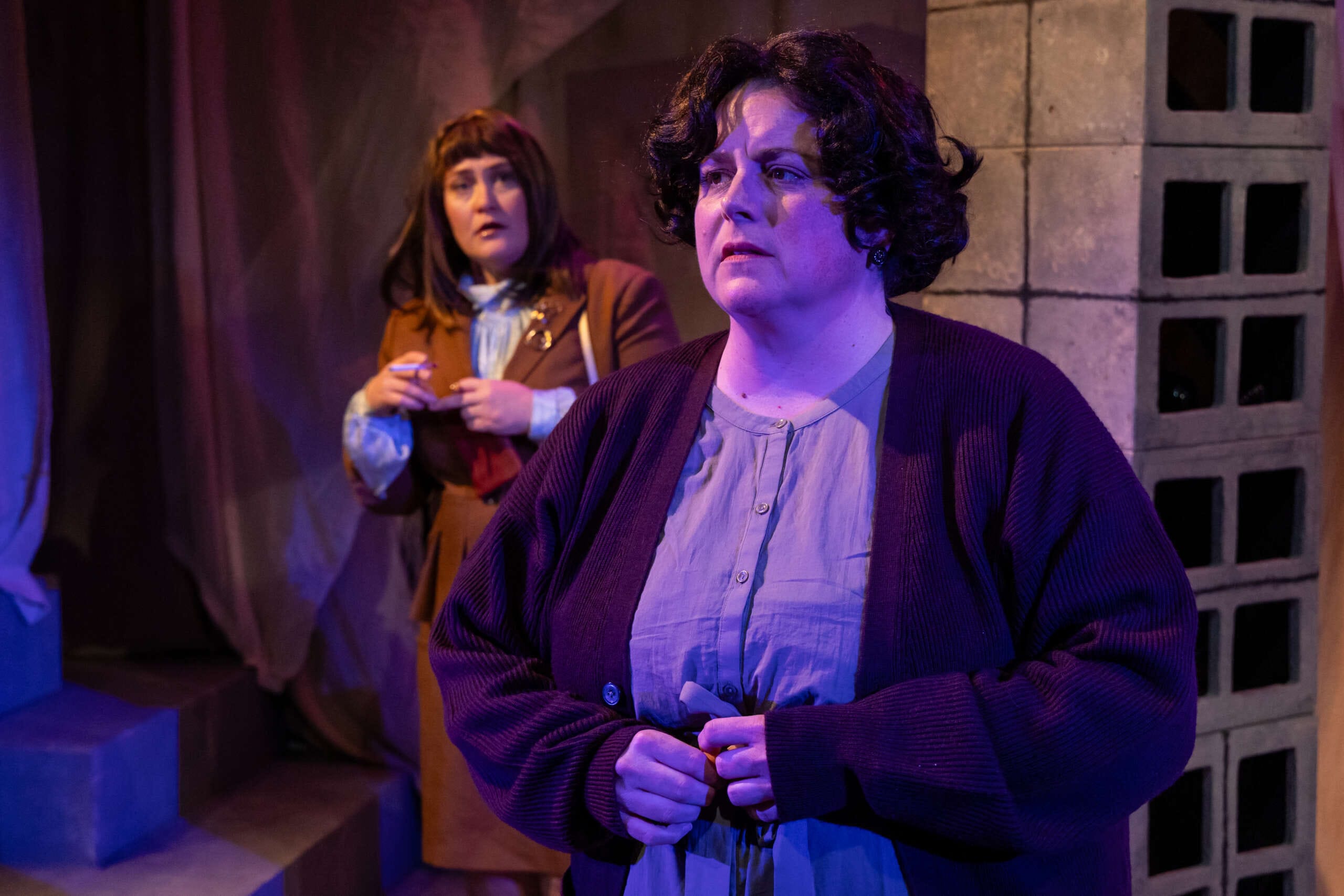
Kelly Uhlenhopp as Sister Ella Chapter and Haley Johnson as Hannah Pitt. | Photo: RDG Photography
Then and now
When Kushner premiered Angels in America in the early 1990s, the play confronted a moment when the AIDS epidemic was devastating communities while the federal government largely ignored the crisis. The story also captures the ideological confidence of the Reagan era, when conservative political power appeared firmly entrenched.
Watching the play today, in the midst of the second Trump administration, invites comparisons. Kushner’s characters navigate a world shaped by fear, indifference and political hostility toward queer communities. Institutions fail them, leaders look away and individuals struggle to reconcile personal responsibility with collective action. Those anxieties echo uncomfortably in the present moment, as debates around LGBTQ rights once again dominate political discourse.
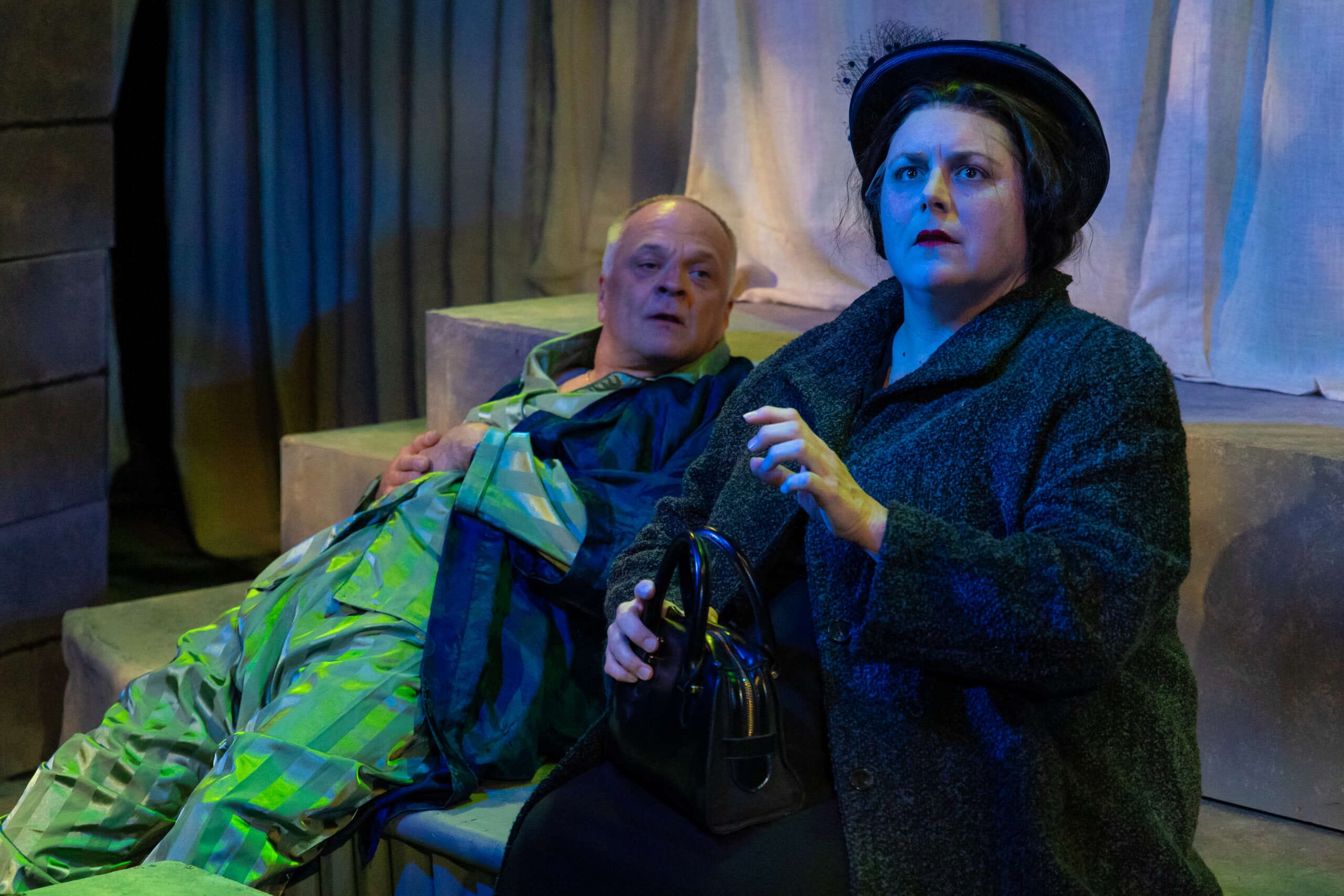
Andrew Uhlenhopp as Roy Cohn with Haley Johnson. | Photo: RDG Photography
The play never offers easy moral answers. Kushner’s characters — queer and straight alike — often make selfish, painful choices. Yet the work insists on empathy, asking audiences to confront both personal responsibility and collective compassion.
With Angels in America Part Two: Perestroika opening April 4 under director Troy Lakey, Vintage’s return to Kushner’s masterpiece is only beginning. Vintage Theatre’s revival may operate on a smaller physical scale than some productions of this modern classic, but Cardell’s focused direction and the cast’s emotionally open performances ensure that the play’s core power remains intact.

An award-winning Colorado arts and culture reporter originally from Mineola, Texas. Tresca is the chief theatre critic for OnStage Colorado and managing editor of OnScreen Colorado. He’s the editor of Bucket List Community News, a contributor to Denver Westword and Estes Valley Voice, a resident storyteller for the Bonfils-Stanton Foundation and the co-host of the OnStage Colorado Podcast.

Leave A Comment