
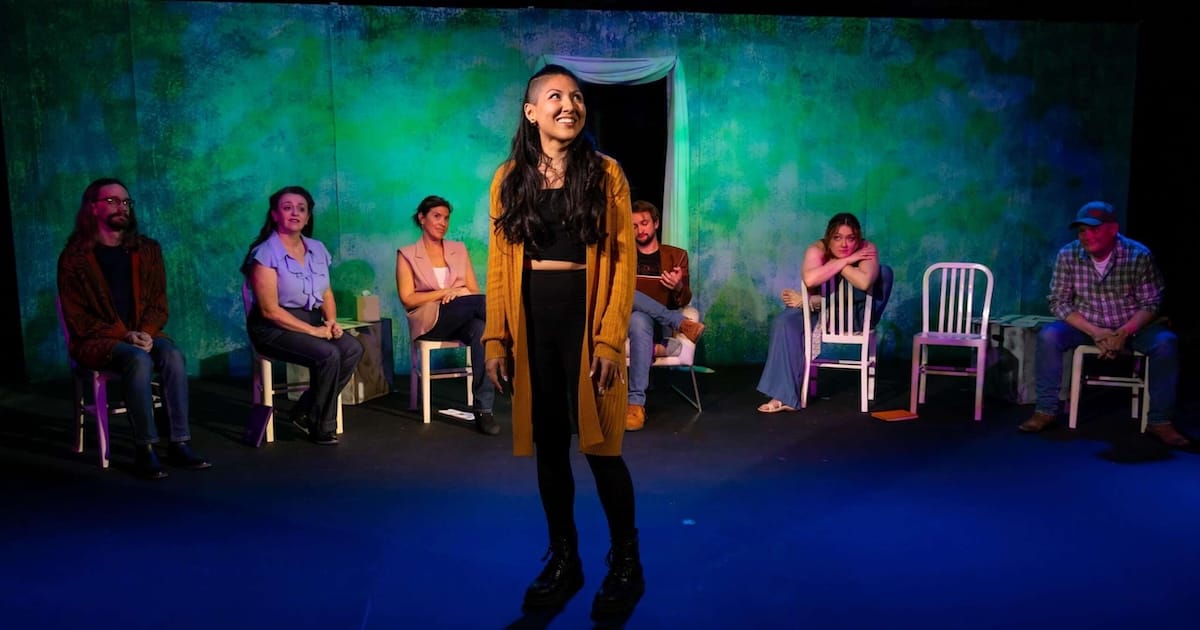
Veritas Productions stages Mia Burnett’s ambitious world premiere about souls in limbo.
Therapy has become one of the dominant languages of modern life. We talk about boundaries, triggers, processing and healing with the same casual fluency that previous generations reserved for the weather or sports.
Mia Burnett’s new play, Divine Bull Transformation, now receiving its world premiere from Veritas Productions at the Mizel Arts and Culture Center, takes that vocabulary and imagines an afterlife built entirely around it. Set in a limbo-like purgatory where souls attend mandatory group therapy before moving on, Burnett’s play uses its cosmic premise as a pointed satire of the modern mental health industry.
The play centers on six dead people gathered in a sparse waiting room overseen by Rafael (Matthew Combs), an angelic facilitator. When not in group therapy, the dead are free to visit Earth between sessions to see loved ones or simply observe what is going on in places like Paris, France.
At its best, Divine Bull Transformation mines that premise for sharp humor and insight. Burnett has created a complex collection of characters with varying relationships to grief — and several performances land with real force — but the script sometimes circles ideas more effectively than it dramatizes them.

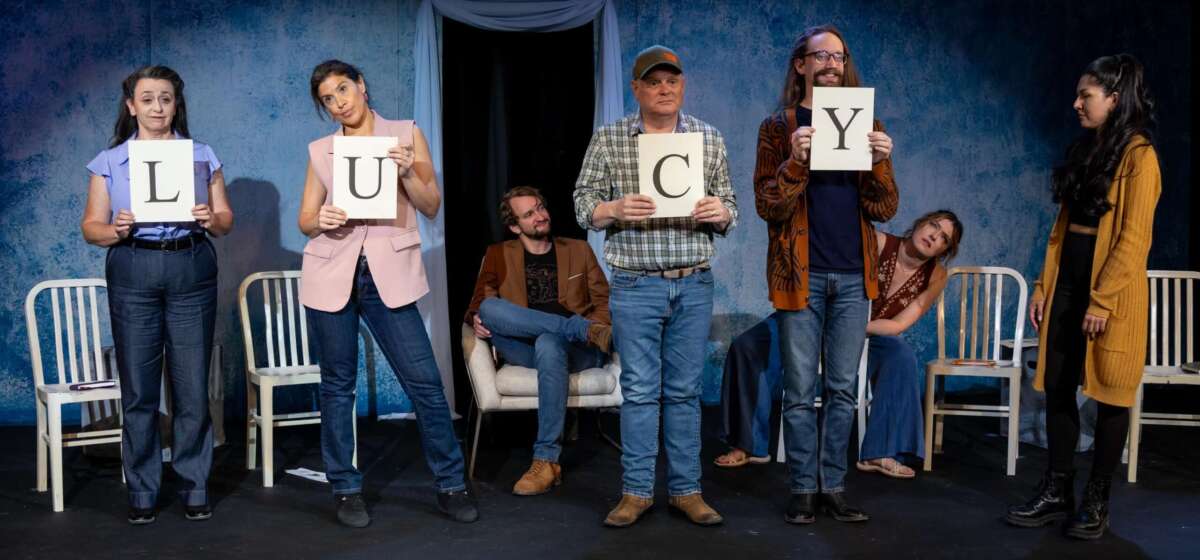
One of the group therapy scenes in Divine Bull Transformation. | Photo: RDGPhotography
Healing in the afterlife
Director Nancy Evans Begley stages the production with an intentionally minimal aesthetic in the intimate PLUSS Theatre. As you enter the space, six white chairs sit beneath a white flat with an entrance cut in the middle, illuminated by bluish abstract lighting that resembles visual static behind closed eyelids. A single cushioned therapist’s chair anchors the room like a throne. The overall vibe is sterile but slightly off-kilter.
The production works well when Burnett allows individual characters’ grief to emerge organically through conversation. Ali Chung delivers the evening’s most moving performance as Joanna, a woman mourning the family she left behind. Chung understands that devastation does not always arrive loudly. Her performance builds carefully, with her emotions leaking out in small fractures before finally breaking open in a shattering scene.
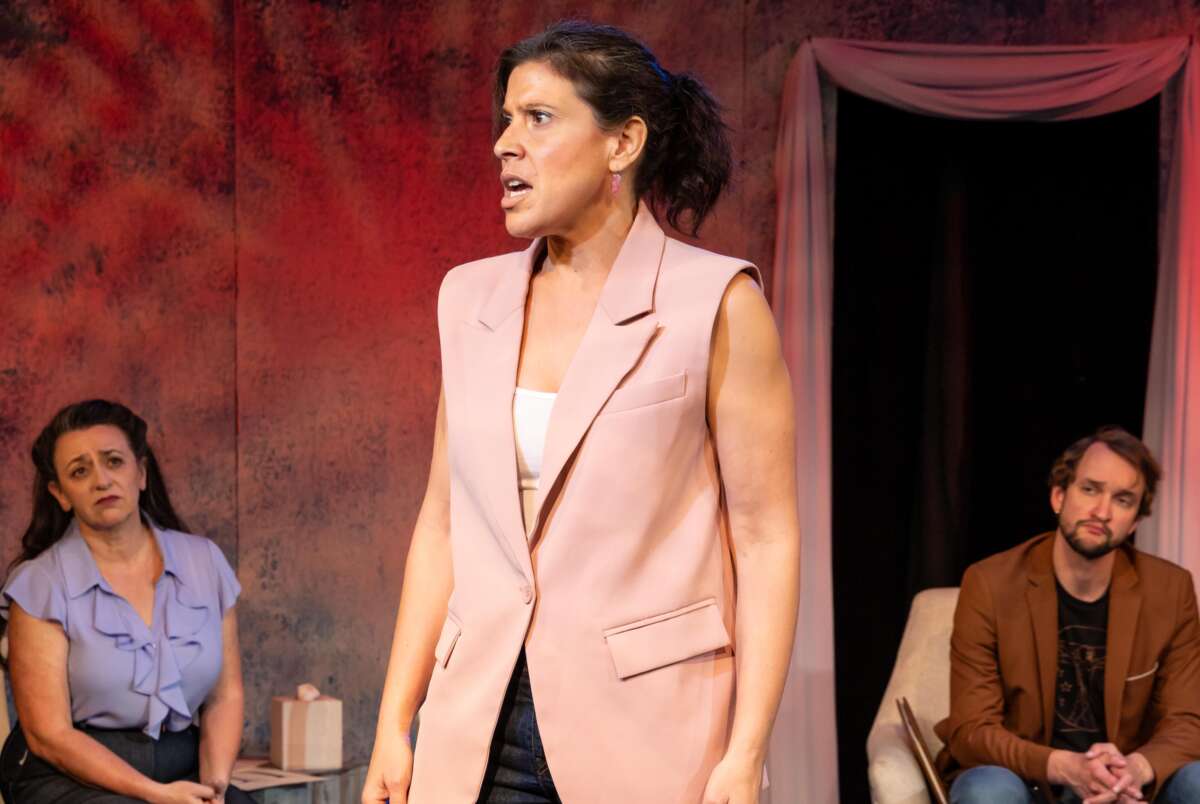
Ali Chung as Joanna in Divine Bull Transformation. | Photo: RDGPhotography
Jennifer Burnett also brings warmth and compassion to Laverne, a soul who died by suicide but remains more invested in helping others than confronting her own suffering. Eddie Schumacher provides welcome levity as Tim, an affable older man struggling with the uncomfortable reality that his widow has begun dating again. Schumacher gives the play some of its most grounded humor, and his scenes offer necessary relief from the script’s heavier philosophical discussions.
Grey Dumois plays Chris as a tightly wound rule follower desperate to get out of limbo as quickly as possible. Dumois gives the character an anxious eagerness that effectively captures the play’s critique of self-improvement culture as another system people try to win their way through.
Iliana Lucero Barron serves effectively as the audience surrogate through Alex, the newest arrival to limbo, whose fractured memory starts to reveal itself over the course of the evening. And Matthew Combs fully leans into Rafael’s smug self-assurance without making him so cartoonish that the satire becomes cartoonish.
Stuck in limbo
Not every character thread lands as cleanly. Abigail Kochevar’s Julia, a woman who died in the ancient fires of Pompeii and who has remained trapped in limbo longer than anyone else, is positioned as one of the play’s emotional centers. Yet her sudden attachment to Alex never fully clicks, making the eventual resolution surrounding her “graduation” feel more conceptually symbolic than emotionally satisfying. Kochevar attacks the role with undeniable intensity and is understandably angsty throughout, but her climactic outburst in Act Two is so forceful that it overwhelms the intimacy of the small theatre.
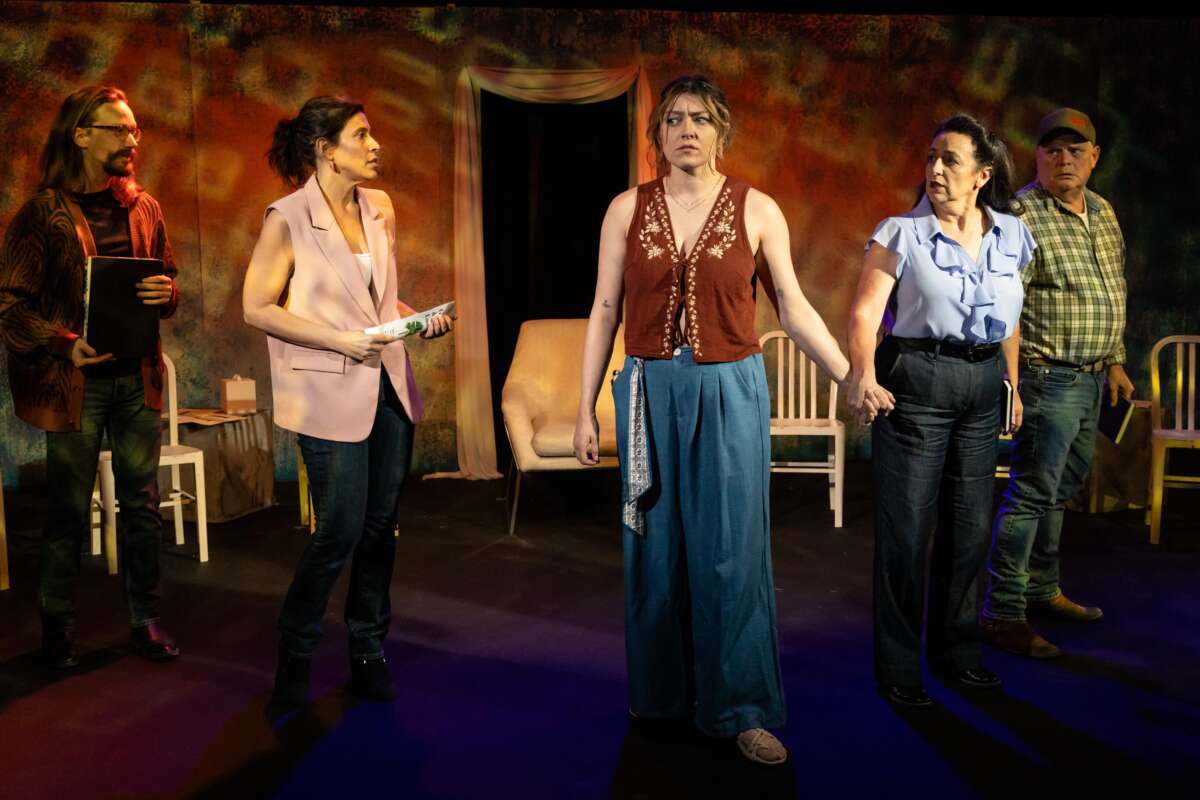
Divine Bull Transformation at the Mizel Arts and Culture Center. | Photo: RDGPhotography
Burnett clearly has an ear for emotionally intelligent dialogue and complicated feelings, but Divine Bull Transformation sometimes struggles to turn those conversations into compelling dramatic action. Much of the play consists of characters sitting in a circle discussing the past. While those conversations are often insightful individually, the cumulative rhythm becomes static. Scenes begin to blur together because the stakes rarely shift in meaningful ways.
Begley attempts to offset that stasis through stylized movement transitions between scenes, with actors drifting through the space in ghostlike choreography under Brett Maughan’s moody lighting design. The sequences create atmosphere, but they also unintentionally emphasize how little external momentum the script generates on its own.
The intermission particularly hurts the pacing. A late first-act development involving Alex disappearing from the limbo space creates genuine narrative urgency, only for the production to halt immediately afterward. The second act then resumes almost exactly where the first ended, and the situation resolves so quickly that the break feels unnecessary.
There are also moments where the world-building feels thin. The script explains that the afterlife updates itself to reflect contemporary Earth culture, which is why souls from vastly different eras all dress alike and communicate through modern therapeutic language. The explanation technically works, but visually it flattens some of the characters together in ways that weaken their individuality. Someone from Pompeii sharing nearly the same aesthetic vocabulary as a modern suburban parent feels like a missed design opportunity.
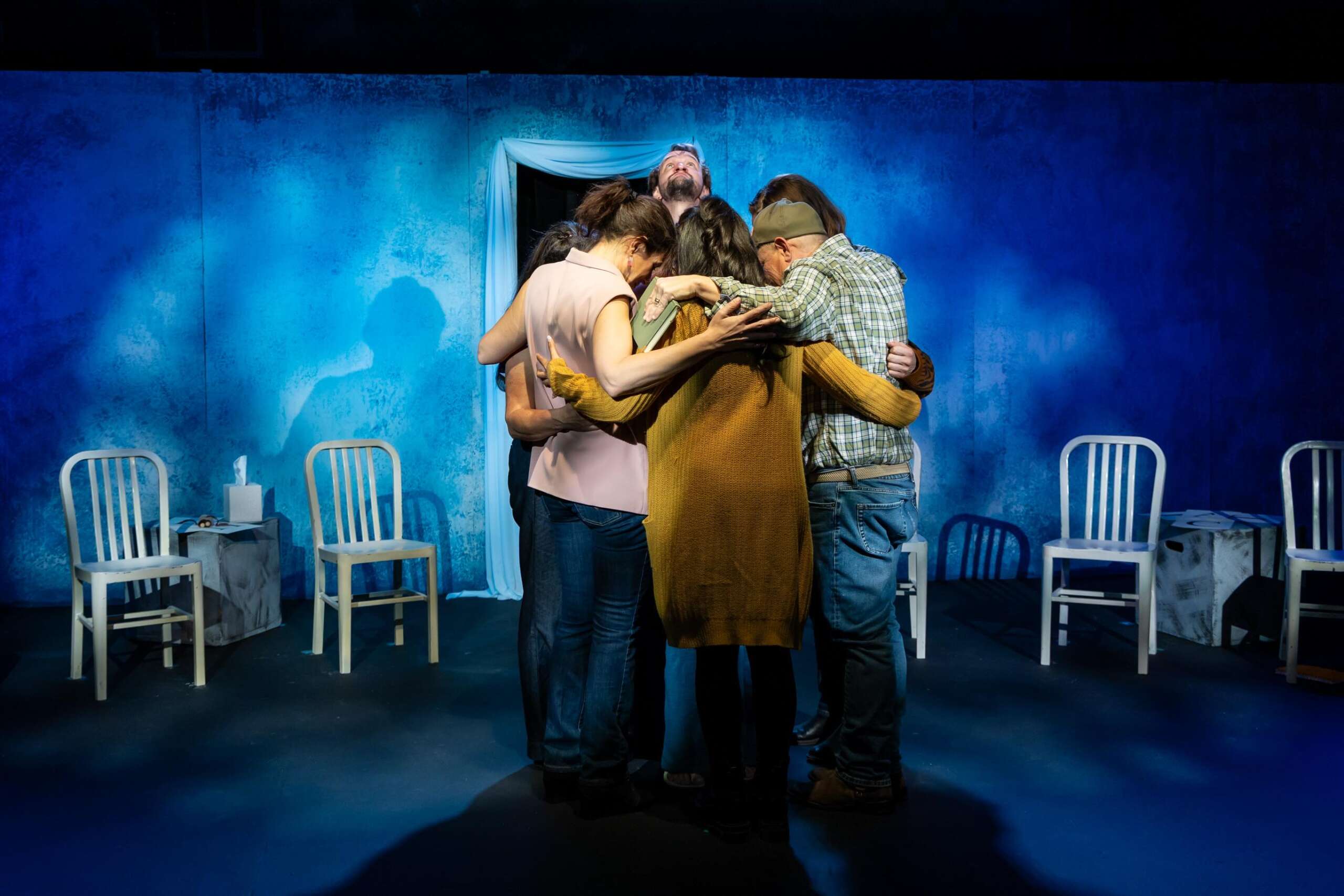
The world premiere staging of Divine Bull Transformation. | Photo: RDGPhotography
Divine Bull Transformation does not entirely solve the challenge of translating its ideas into consistently compelling theatre. The pacing drifts, some character arcs feel underdeveloped and the therapy-circle structure occasionally traps the play in the same emotional stasis it critiques.
Nonetheless, Burnett’s voice remains thoughtful throughout and provides enough provocative ideas about modern mental health to keep the production engaging. Its questions about grief, healing and the limits of self-improvement continue to linger afterward, making this an intriguing world premiere worth engaging with, particularly for audiences interested in new work.

An award-winning Colorado arts and culture reporter originally from Mineola, Texas. Tresca is the chief theatre critic for OnStage Colorado and managing editor of OnScreen Colorado. He’s the editor of Bucket List Community News, a contributor to Denver Westword and Estes Valley Voice, a resident storyteller for the Bonfils-Stanton Foundation and the co-host of the OnStage Colorado Podcast.

Hello! Thank you for the thoughtful review and sincere engagement. I will point out there are a number of factual inaccuracies. First of all, there are 6 dead people in the show, not 7. Secondly, run time is actually 2 hours and 5 minutes with intermission, not 1:45. Accuracy of length is important so that audiences know what to expect in terms of their evening plans :)
Hi Mia. It’s great to hear from you. I just updated the sentence in my review about “dead people.” Thank you for pointing out that I mixed up the number of dead people in the play with how many people are in the entire cast.
As for runtime, I went on Saturday, May 16, and the play started around 7:40 p.m. after Nancy’s preshow announcement, included a roughly 20-minute intermission and I was out of the venue by 9:50 p.m., which is why I listed the play’s runtime as approximately 1:45 w/ int. OSC typically does not include the time before a show or the intermission in the runtime, but I understand why this is confusing and have updated the runtime accordingly.