
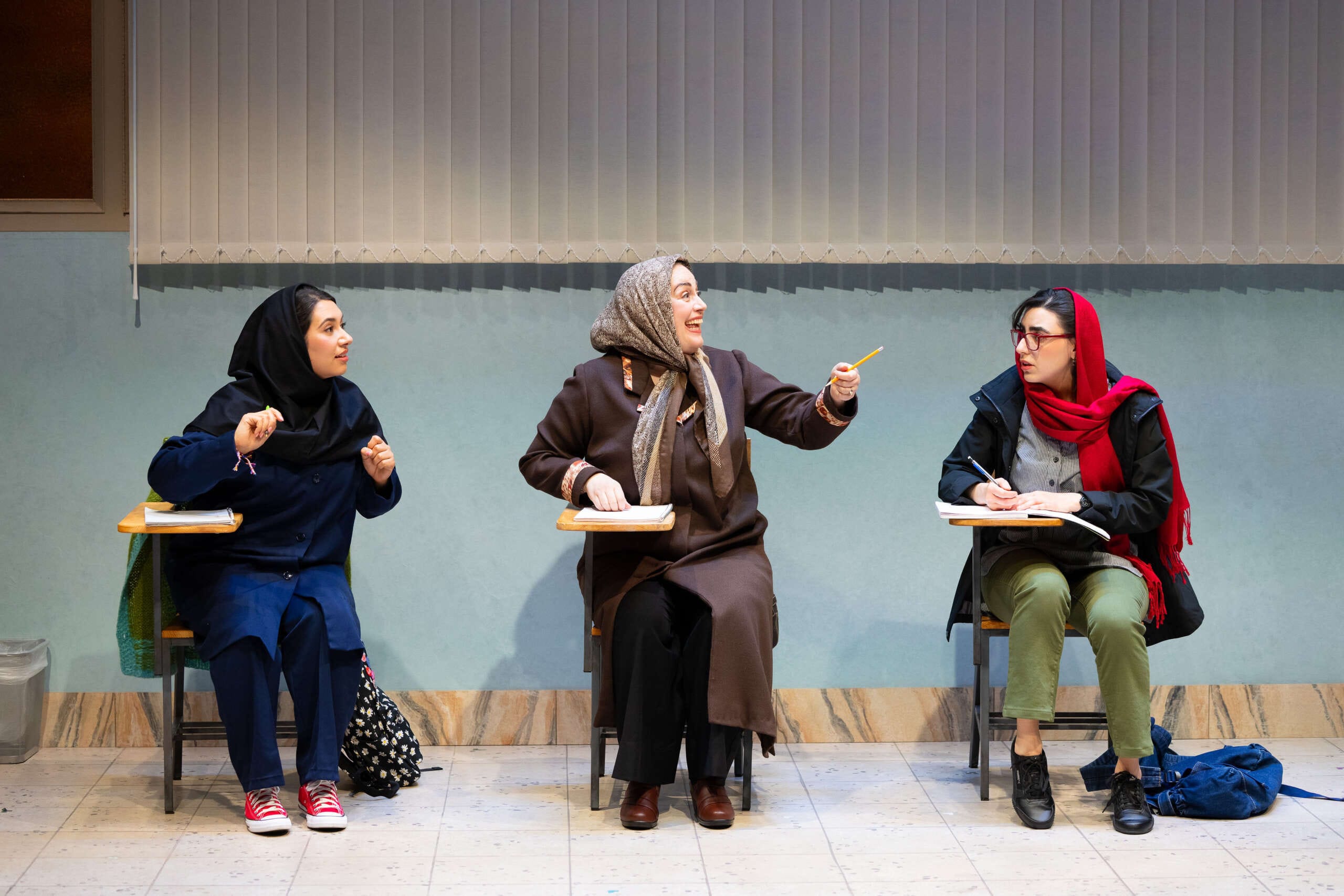
DCPA Theatre Company’s English offers a sharp, human portrait of language and identity.
When English was selected for the DCPA Theatre Company season in April 2025, it wasn’t meant to speak to a war. But as the 2026 conflict between Iran, the United States and Israel dominates global attention, Sanaz Toossi’s Pulitzer Prize-winning play arrives in Denver with an unexpected charge.
Set in a 2008 classroom in Karaj, the play isn’t a response to the ongoing conflict, but it lands in the middle of it, inviting audiences to sit with Iranian lives outside the current news cycle. Inside an English-language course governed by a strict “English only” rule, five adults wrestle with fluency, identity and the cost of being understood in someone else’s tongue.
Under the confident direction of Hamid Dehghani, English resists the pull of spectacle or overt political framing. Instead, the production remains grounded in the rhythms of a classroom, where the stakes are deeply personal, even if the setting appears modest.
Over 100 minutes with no intermission, the play unfolds in short, episodic scenes that track the students’ progress and setbacks over the course of a semester. Dehghani’s staging is clean, allowing the stakes to emerge through casual conversation in a deeply felt chamber piece where language is used to explore who these characters are and who they’re trying to become.
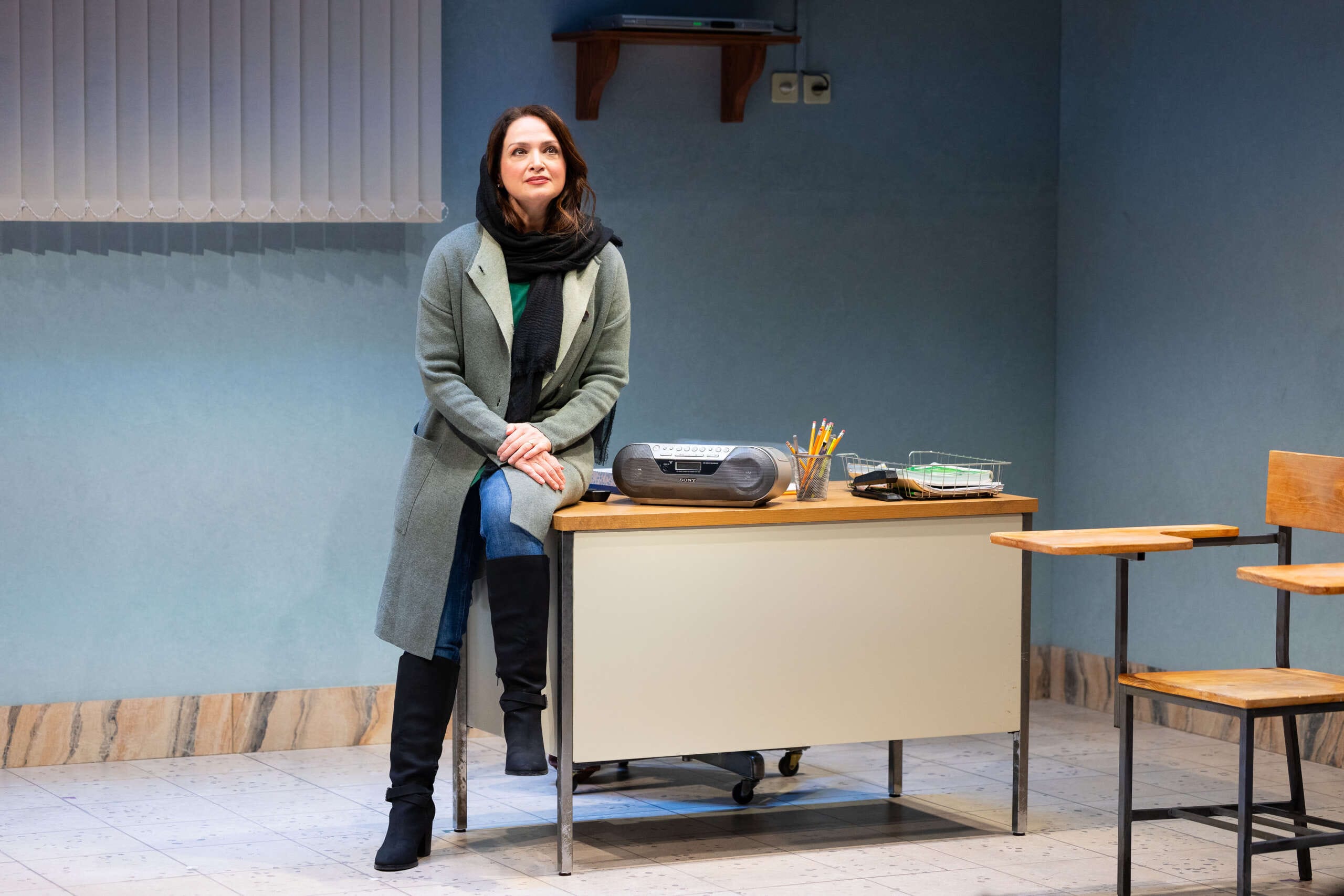
Roxanna Hope Radja as Marjan in English. | Photo: Jamie Kraus Photography
Five students, five relationships to language
The play’s premise is straightforward: Marjan (Roxanna Hope Radja) teaches an English-language course governed by one rule—no Farsi allowed. Her students each arrive with a reason for being there, and those motivations shape how they engage with the language.
Crucially, the production makes a clear, effective stylistic choice: when characters speak English, they use varying degrees of Persian accent, and when they speak Farsi, the accents are removed. It allows the audience to track not just what language is being spoken but also how comfortable each character is within it.
Elham (Vaneh Assadourian), a standout in this production, meticulously embodies that distinction. A top medical student who has repeatedly failed the English exam required to study abroad in Australia, her English is halting and heavily accented. In Farsi, she is sharp, articulate and fully in command. Assadourian builds the performance around that divide, capturing the disorienting experience of knowing exactly what you want to say but not having the tools to say it. When Elham passes her exam without smoothing out her accent, it serves as a rejection of the notion that fluency necessitates the erasure of identity.
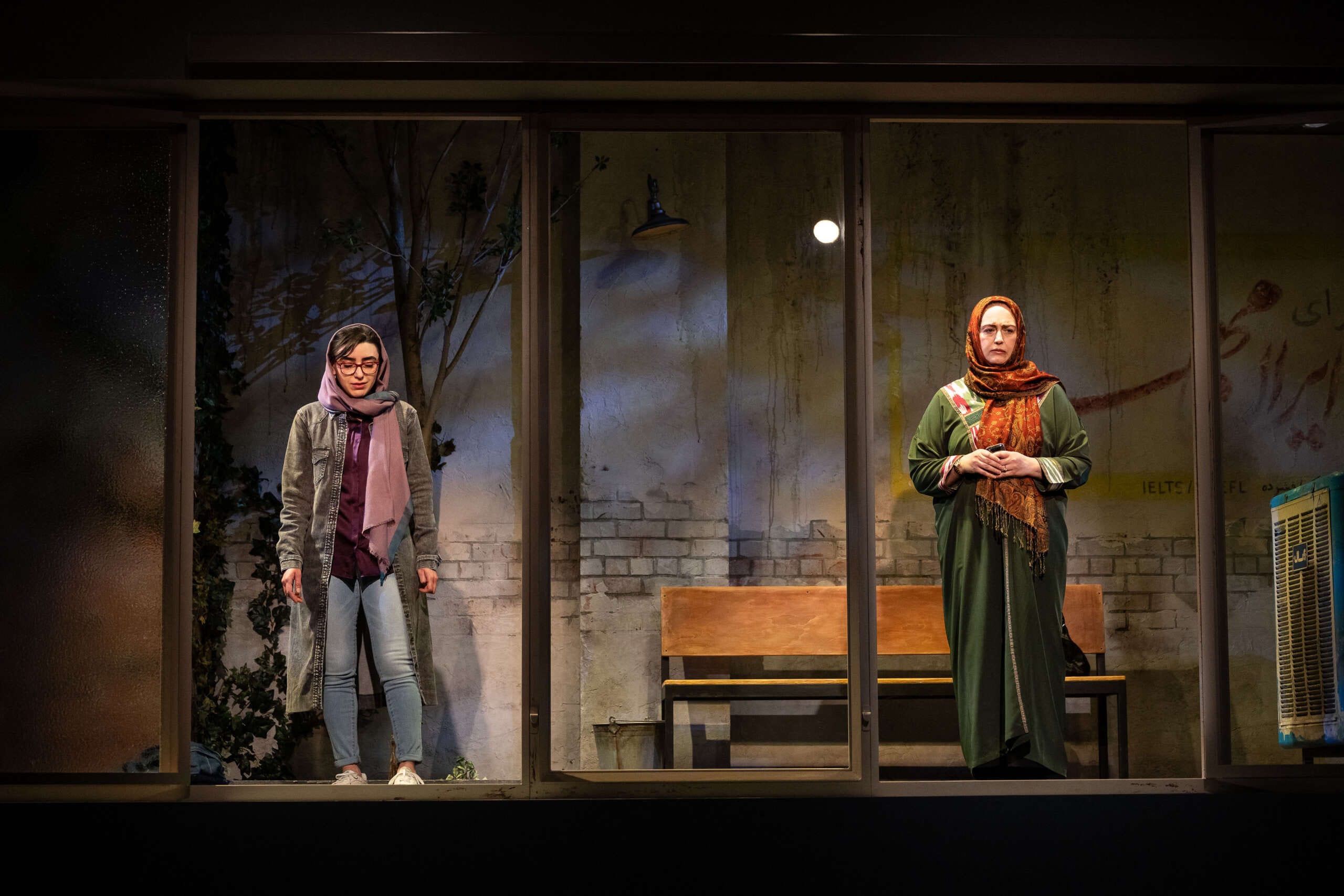
Vaneh Assadourian and Lanna Joffrey in English. | Photo: Jamie Kraus Photography
Roya (Lanna Joffrey) is in the classroom for a more personal reason: she wants to speak with her English-speaking granddaughter in Canada after her son has assimilated so fully that even his name has changed. Her English carries a pronounced accent, and in it, her thoughts feel simplified. In Farsi, she is expansive, emotionally precise and deeply expressive. Joffrey makes that shift immediate and unmistakable, reinforcing the play’s central idea that language reshapes thought rather than simply translating it.
Goli (Shadee Vossoughi) sits in a different position that ultimately feels less defined. She is eager, friendly and often very funny, particularly in moments where her uncertainty in English leads to unexpected or offbeat responses. Vossoughi has strong comic instincts and uses her accent work effectively to land those beats. But compared to her classmates, Goli’s reason for learning English never fully comes into focus. In a play where each character’s relationship to language is so clearly drawn, that absence stands out.
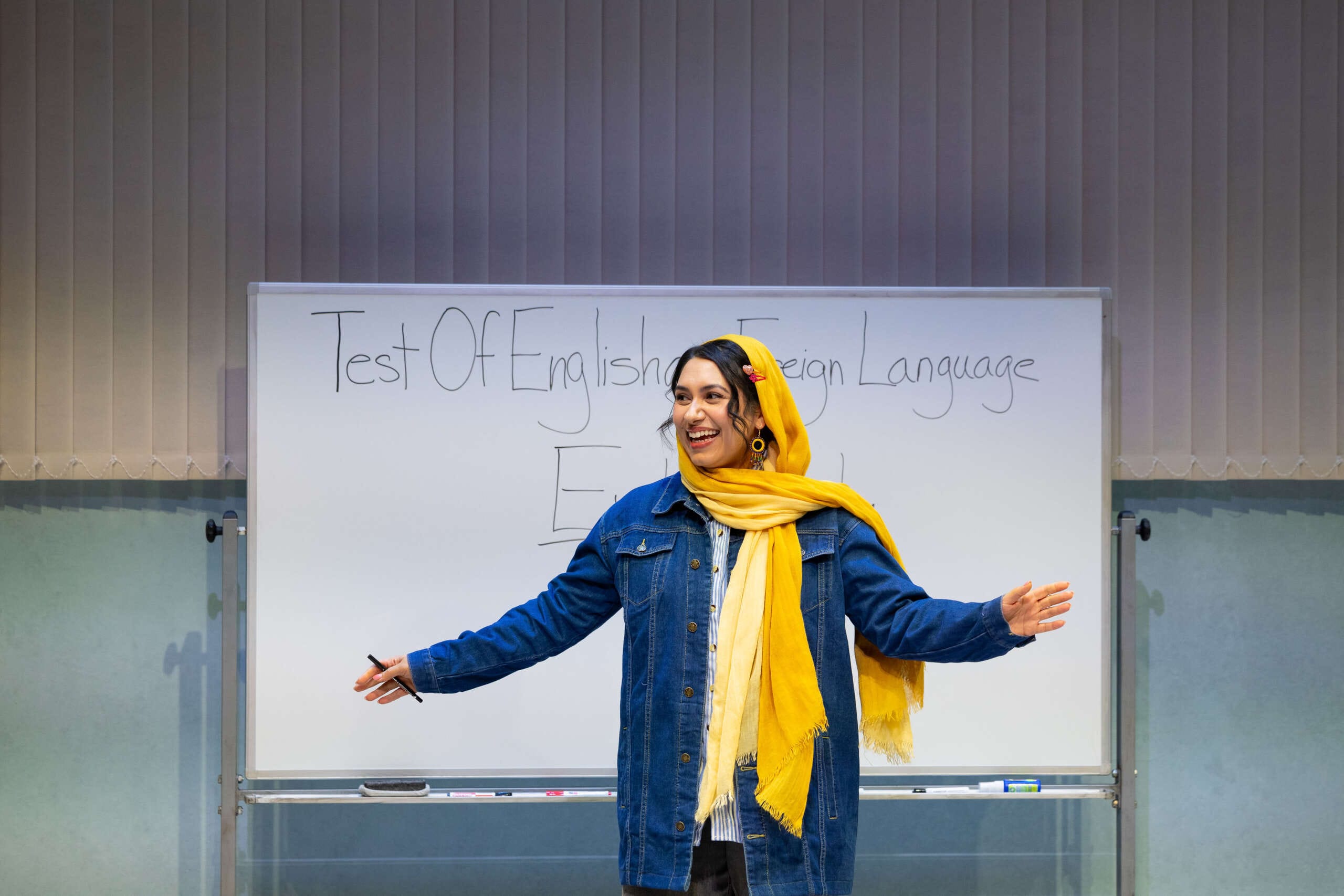
Shadee Vossoughi as Goli in English. | Photo: Jamie Kraus Photography
Omid (Nima Rakhshanifar), by contrast, speaks English with only the faintest trace of an accent. That subtle difference matters. It signals his proximity to American culture before the script confirms it, and it quietly separates him from the rest of the class. Rakhshanifar uses that ease to his advantage early on, then lets it fracture as his backstory comes into focus and his place in the room becomes less certain.
Marjan, who is at the center of the classroom, has a complex relationship with English. Having lived abroad, she prides herself on her fluency. Her English is precise but slightly rigid, her Farsi similarly controlled. That stiffness feels deliberate, as she is a woman who has trained herself to speak in a manner that meets external expectations. As the play progresses, small cracks begin to show, particularly in her interactions with Omid, where her authority gives way to something more vulnerable. Radja captures that tension without overplaying it, allowing Marjan’s internal conflict to surface in brief but telling moments.
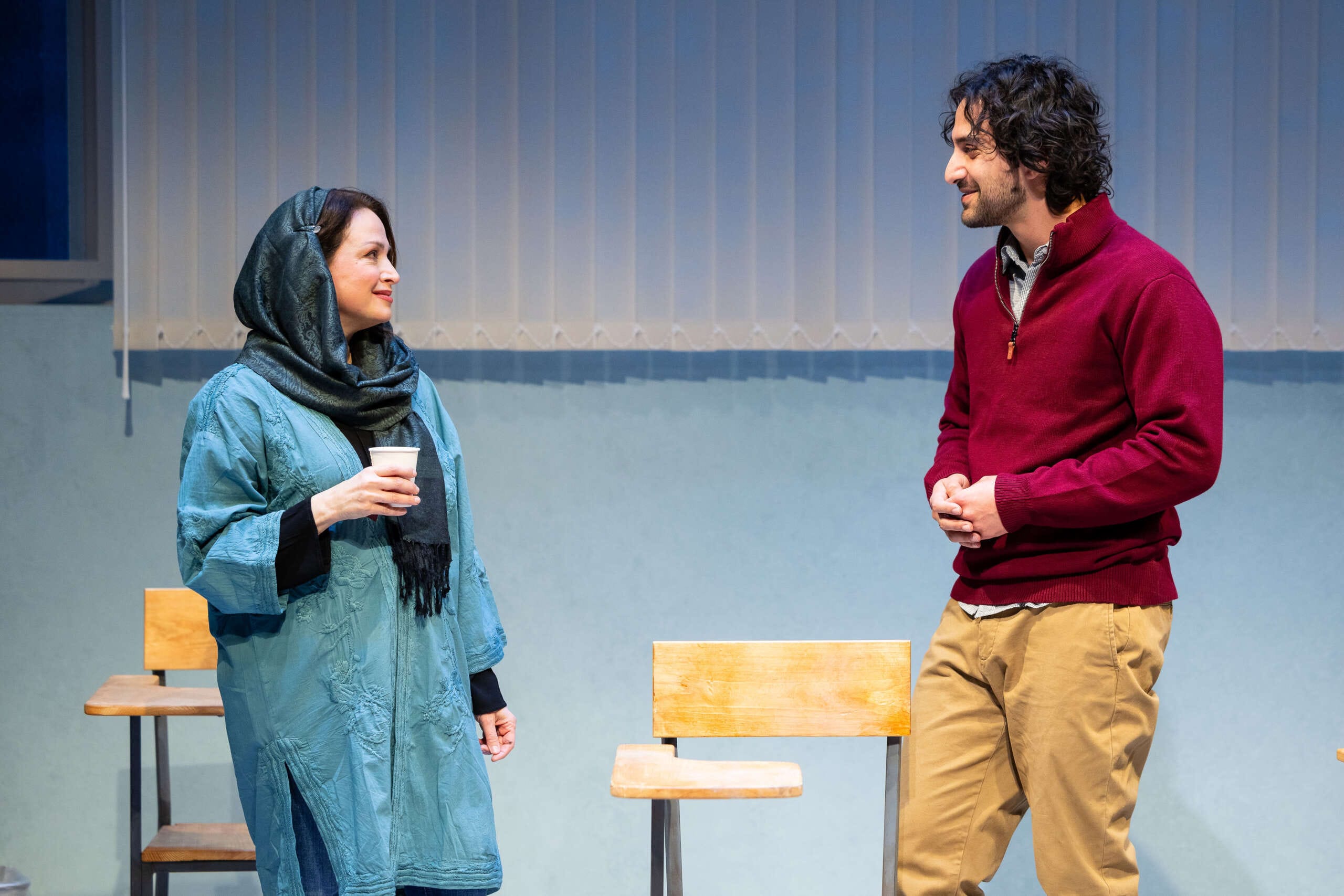
Roxanna Hope Radja and Nima Rakhshanifar in English. | Photo: Jamie Kraus Photography
Together, these performances make the play’s central question unavoidable: if language shapes how you are perceived, how much of yourself are you willing to change to be understood?
A world crafted with restraint
Dehghani’s direction keeps the focus squarely on the actors. Omid Akbari’s scenic design situates the action in a clean, recognizable classroom: student desks, a whiteboard, a television and a bookshelf, but the space subtly expands over time. A window at the back, initially closed off, opens to reveal a more vibrant exterior environment, suggesting a world just beyond reach. Entrances and exits through a glass door and stairwell give the room a lived-in geography, allowing characters to arrive and depart with a sense of purpose.
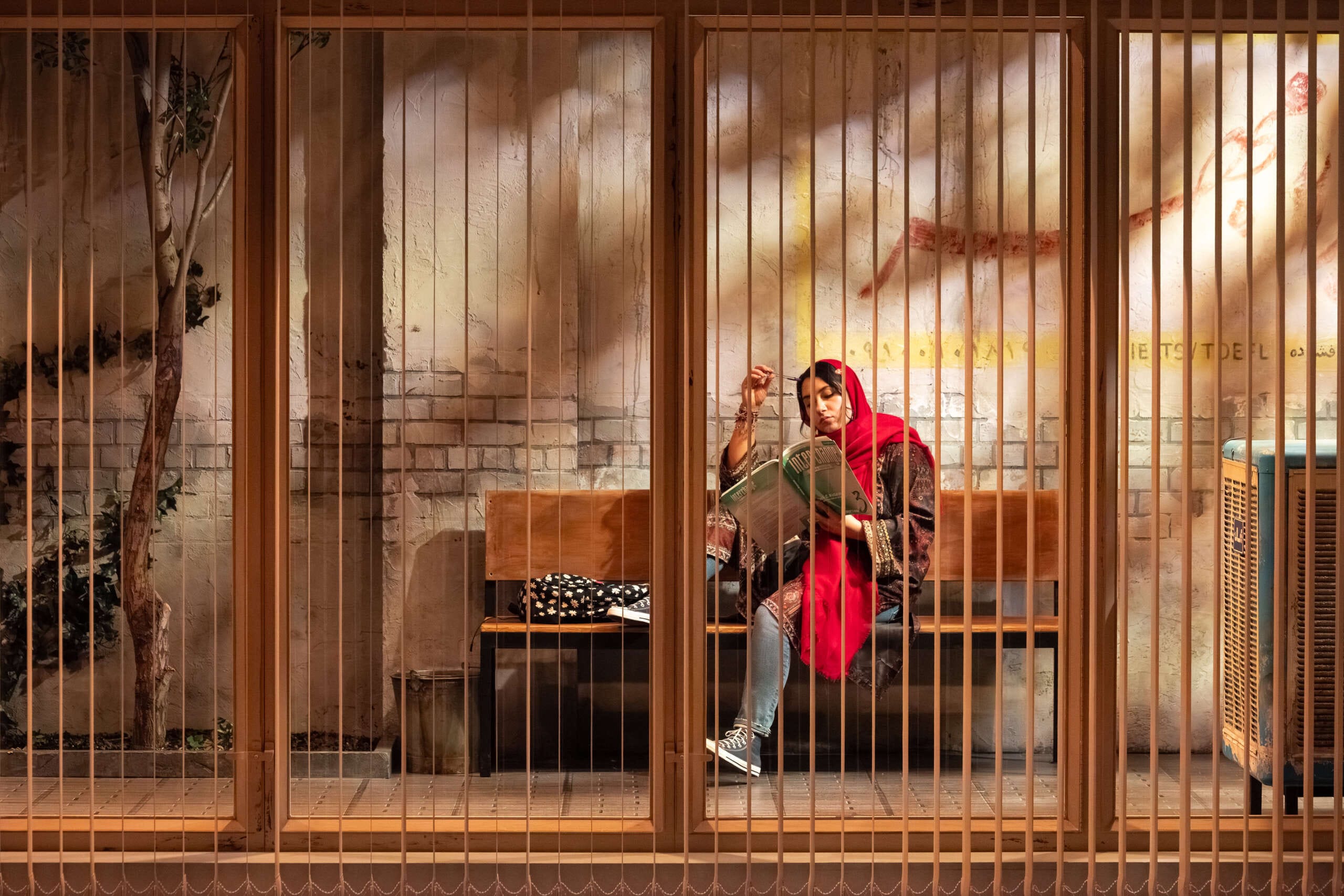
Shadee Vossoughi as Goli in English. | Photo: Jamie Kraus Photography
The transitions between scenes are quick and unobtrusive. Lights shift, desks move slightly and the play continues without pause. That fluidity keeps the focus on the actors and the language they’re navigating rather than on mechanics. Charles R. MacLeod’s lighting and Melanie Chen Cole’s sound design work subtly support the storytelling, while Afsaneh Aayani’s costumes ground each character in a distinct sense of self without pulling focus.
Nothing in the production draws attention, and that’s precisely the point. The technical elements create a stable container for a play that lives or dies on the specificity of its performances and ideas. Here, they hold that container firmly in place.
What remains when the lesson ends
By the time English reaches its final moments, the classroom has shifted. The lessons are the same, but the understanding of what’s at stake has deepened. Language no longer reads as a neutral skill. It becomes a choice about how to be seen, how to be heard and how much of yourself to adjust in the process.
Earlier in the play, Marjan recounts how, while living abroad, she began calling herself “Mary” to make things easier for others. At first, it’s framed as a practical way to move through a world that struggled to pronounce her name. But as her students begin to question that choice, the story takes on a different weight. What initially sounded like adaptation starts to feel closer to surrender.
That tension returns in the final scene, when Marjan is teaching a new class and writes “My name is” on the board. It’s a simple prompt, but it lands differently now. After everything these characters have navigated, the act of introducing yourself is no longer automatic. It carries the question of what you’re willing to keep and what you’re willing to change.
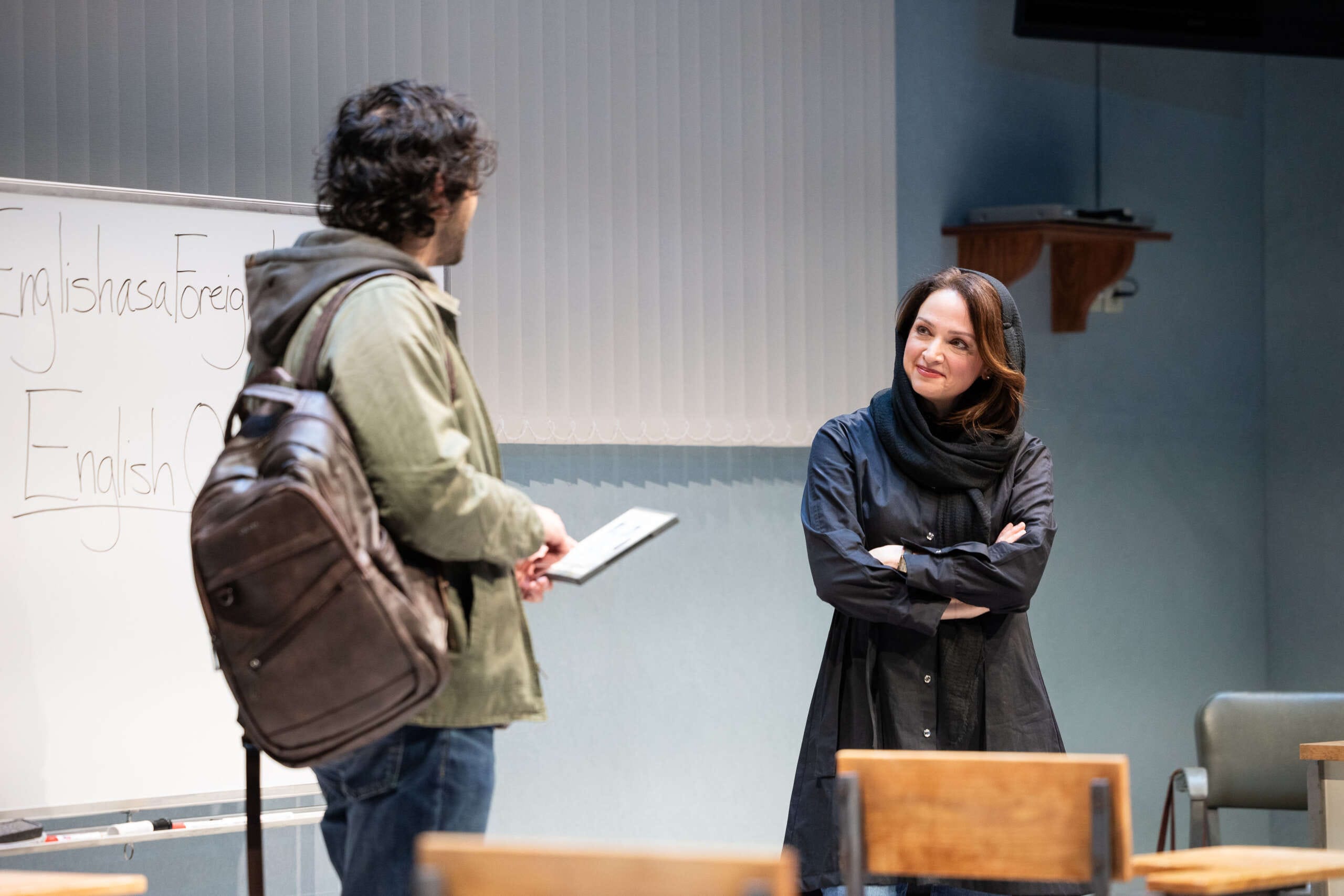
Nima Rakhshanifar and Roxanna Hope Radja in English. | Photo: Jamie Kraus Photography
Elham claims space without softening her accent. Roya refuses to let English flatten the way she thinks and feels. And Marjan, standing at the front of the room once again, seems poised to reconsider the version of herself she once offered so freely.
That lands differently right now. English wasn’t programmed to respond to the current war, and it doesn’t try to explain it. What it does offer is a way of seeing Iranian lives outside of crisis. It focuses on people defined not by conflict but by their relationships, ambitions and choices. In a moment when those perspectives are often flattened or overlooked, that focus feels necessary.
In a moment when Iran is often reduced to sensational headlines and geopolitical shorthand, English insists on something else: attention to the people who live there, the choices they make and the identities they hold onto. DCPA Theatre Company’s production doesn’t try to explain the world outside the classroom, and it doesn’t need to. What it offers instead is focus and that, right now, feels like the more powerful gesture.

An award-winning Colorado arts and culture reporter originally from Mineola, Texas. Tresca is the chief theatre critic for OnStage Colorado and managing editor of OnScreen Colorado. He’s the editor of Bucket List Community News, a contributor to Denver Westword and Estes Valley Voice, a resident storyteller for the Bonfils-Stanton Foundation and the co-host of the OnStage Colorado Podcast.

Leave A Comment