
Brian Colonna talks lesser-known Guinness glory, a 25th season of new and revisited classics and the campaign to buy the company’s longtime home.
For a quarter century, Denver’s Buntport Theater has been turning quirky source material into singular, character-driven comedy — and the company’s latest, This Is the Day ’91, is no exception. The show follows a group of adults trying to re-create a Guinness World Record they broke as teenagers in 1991: catching small stuffed animals thrown in the air while blindfolded.
Ahead of the production’s opening, I caught up with Buntport’s Brian Colonna to talk about how the show came together, what makes it unmistakably Buntport, the company’s upcoming 25th season and the ongoing campaign to purchase the building the troupe has long called home. The conversation has been edited for length and clarity.
This show is billed as a comedy with a little bit of nostalgia, your daily dose of carrageenan and a horse named Markham — but it’s really about a group of adults trying to re-create a Guinness World Record they broke as teenagers in 1991, catching small stuffed animals thrown in the air while blindfolded. Is that right?
That’s correct. One of the lesser-known Guinness records.
How did you come across this idea?

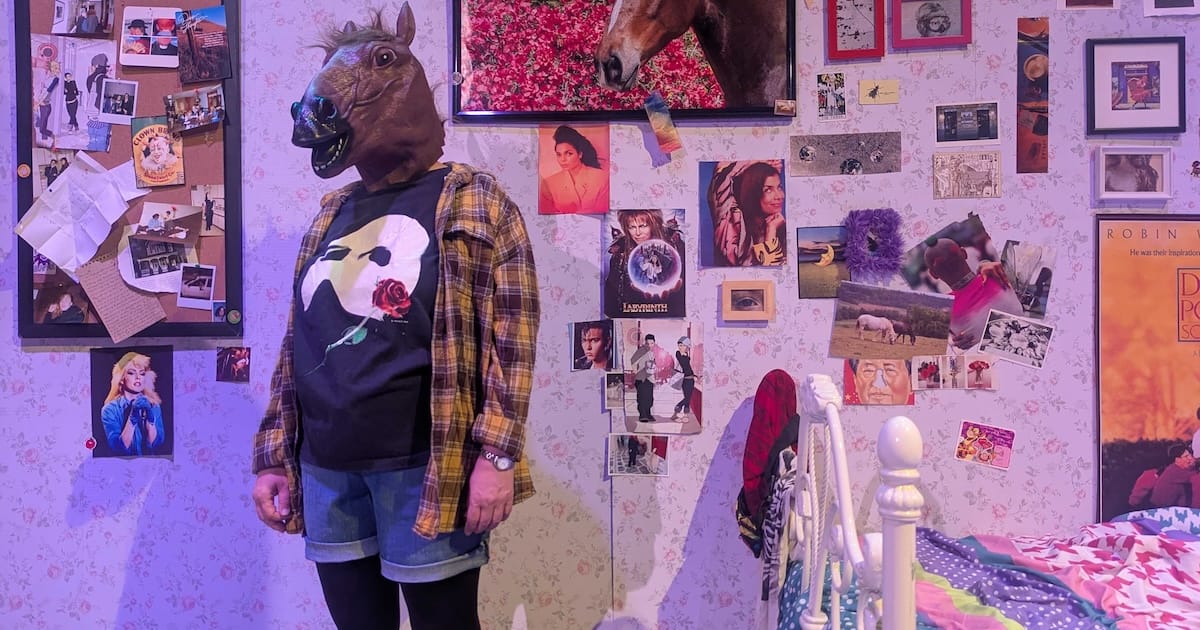
We build shows a lot of different ways. This one started in the brainstorming process, actually from a photograph of a couple of young, teenage, junior high-age girls in a bedroom from a magazine somewhere unrelated to anything. We liked the look of the two characters and the idea of this childhood bedroom. That was a starting point, and then we joked about this Guinness record. It was a random process of just looking up world records, but we thought it might be funny if these characters actually had the ability to break a record onstage. When we were looking at things that Buntport actors would be capable of, we got down the list to catching stuffed animals blindfolded. Spoiler alert: it turns out that’s a difficult record to break.
So there’s a chance you could actually be a contender for hitting this record yourselves onstage. What would that mean to the gang?
We practice it every time we rehearse, so I think it’s possible that in some iteration — maybe not of the actual show, maybe we’ll have to do a fundraiser where we actually try to break it afterward. But while you’re acting and it’s happening in the show, it’s pretty hard to catch more than 26 stuffed animals blindfolded in under a minute. The actual record involves specific measurements — the stuffed animals can’t be longer than a certain length, the distance between the thrower and catcher has to be exact, and you have to have evidence of all of these things. There’s a pretty official and somewhat complicated process to submit record attempts. We’re using an old VHS camera — a big shoulder camera — and I’m not sure Guinness accepts VHS submissions any longer.
The twist is, you have to hold everything that you catch. If it falls out of your hands, it does not count. That’s a major wrinkle. And there’s an even faster record — how many caught in 30 seconds — probably set by two grown men who spend some time practicing and breaking a lot of Guinness records. So we’re up against professionals.
Can you give me a rundown of who plays which characters?
It’s just three Buntportians onstage this time, which happens sometimes. We started with those characters in the bedroom and spun the story out of there. One of the characters in the photograph looks pretty anxious and serious, and her friend is a little more casual, so we built from there with the two friends — Misty and Kalyn — who Erin Rollman and Hannah Duggan play. We added a third character, my character, Elliot, who was the friend who came over the day they tried to break the record and was filming it for them. He’s roped into this second attempt.
For Kalyn, it’s really about something that, when she did it as a teenager — even though it was silly — felt really important to her. Now that the record’s gone, she’s having one of those moments where she has to re-examine what she’s accomplished at middle age. She mentions having put the world record on her dating profile. It’s a moment where they’re all questioning where they’ve ended up, solidly in middle age.
Erik (Edborg) is not in this production, so it’s just the three of us. He had other things he was working on — not theatre — and I think he’s happy to get a little break. We’ve done it that way before.
And SamAnTha Schmitz, as always, is the offstage member who does everything. She runs every show technically; this one has a couple of technical elements, nothing major, but Sam runs lights and sound. She’s also part of the brainstorming process from beginning to end. There are a couple of things in this show where, as we’re writing, it becomes a question of whether we’ll be technically able to achieve them, and Sam’s always helping with that. On the business side, Sam takes care of all the books and box office. She probably doesn’t love doing that, but you know.

The Buntportians, from left: SamAnTha Schmitz, Brian Colonna, Hannah Duggan, Erik Edborg and Erin Rollman. | Photo: From The Hip Photo
Why and how is this a Buntport show?
There’s often a piece — like this strange Guinness World Record — that’s an access point for Buntport, something quirky or weird that’s our in to creating a piece. This falls into that category. And then it’s, I hope, character driven. Buntport usually ends up writing some funny characters that hopefully you like enough to laugh at. It’s not exactly a sitcom episode, but it has that kind of character-driven silliness an old comedic sitcom from the ’90s might have, when they were king. The quirky entry point, and hopefully the comedy, is what people who come to Buntport a lot probably expect. Even when it’s a comedy, it sometimes casts itself out into the world in a way that makes connections with current events — we write every piece now, so we’re influenced by everything going on in the world, and that sneaks into the writing as well.
I hope this show is a fun, silly romp that gives people a bit of escape through comedy, a one-act for a night out at the theatre.
This is the last show of the season, with your 25th season starting July 1. What can you say about what’s coming up?
We haven’t made an official show announcement, but we’ve decided the ones we’re revisiting. There will be two remounts of classic Buntport shows, and then we’ll make a new one as well — a kind of celebratory way to thank people for being along for this ride for so long.
We’re going to revisit Kafka on Ice, which was popular at the time — that’s the ice-capade kind of musical. And then one based on the myth of Elektra, called Electra Onion Eater, done in kind of a ’70s style. The new one is going to be about some local Colorado history — there’s a cemetery in Lafayette where a vampire is thought to be buried from the turn of the century, and we’re hoping to work with the Lafayette Historical Society to weave a tale about this grave. That’ll be the new one, around October.
Did you have any idea this experiment would last a quarter century?
No, not thinking anything like that. Having gone to college together and made a show together coming out of college — we were different grades; I was a little younger than Eric and Aaron, and Hannah, and Sam and I were a year later. We toured that first show around, did the Fringe Festival in Philadelphia and in Winnipeg in Canada, went a couple other places with it. We thought we’d give it a go. There was no sense that we’d be around that long, but it seemed like the time to do it when you were young and didn’t have the same responsibilities you find yourself stuck with later. It’s harder to start a theatre company when you’re smart enough to know it’s too hard to start a theatre company. So we did it before we knew what we were doing, and that was very helpful.
How has Buntport evolved in that time?
I mentioned the sitcom — that was a kind of accidental workshop for us. In addition to the mainstage shows, the sitcom ran every other week, and we’d get a suggestion from the audience and write a new episode. That quick-turnover work in comedy helped us understand what’s possible to stage off the page. You can have all sorts of ideas, but you’re limited by budget, by what you can pull off, what kind of personnel you have. We’ve gotten good over the years at taking a better guess at that at the start.
As a writer, over all these years, I feel like our voices have coalesced. Each of us brings something a little different, but it’s become more of one voice than in some of the earlier shows, because we’ve worked together so long. We’re at over 50 shows together now. Our comedic sensibility is alike — we find similar things funny, and for collaboration especially, that’s a hard thing to dial in. The best collaborators, regardless of their credentials, are the people you like to joke around and sit in a room with. We’re lucky that way, because even 26 years later we’re in a pitch meeting laughing about really silly things and on the same page.
Can you give an update on your quest to purchase the building you’ve been in?
We’re having pretty great success, especially considering we’re at the beginning of things. We’re still in the first year of a planned five-year campaign, and we’re at 55% of our total goal, which feels really good. The Buntport regulars and foundations that have supported us already have done so generously in this first year. These next four years will be a different kind of push — reminding people in different ways, but also relationship building with new donors, both personal and foundational. It’s the long haul.
For some folks who’ve come to Buntport a few times but aren’t regular supporters, this new chapter with the rehearsal space — being able to help and support other companies — might be the kind of thing they’re interested in. This money now goes beyond just one little theatre ensemble. With a rehearsal space and a place for other companies to store things and borrow props, you can help more than just Buntport by supporting this campaign. Our intention is to keep prices very accessible for rehearsing. In this part of town — central Denver — there’s not a lot of space to do that affordably. BETC’s been using the rehearsal space quite a bit, actually.
We ended up getting an angel investor who helped us get a loan to pay for the sale, and now we’re paying off that loan with the capital campaign. We have the building, but we haven’t completely paid for it yet. The campaign is scheduled for five years, but if we finish before that, we save money on interest. We’d definitely like to do it sooner.


Alex Miller is editor and publisher of OnStage Colorado. He has a long background in journalism, including stints as the top editor at the Vail Daily, Summit Daily News, Summit County Journal, Vail Trail and others. He’s also been an actor, director, playwright, artistic director and theatre board member and has been covering theatre in Colorado since 1995.

Leave A Comment