
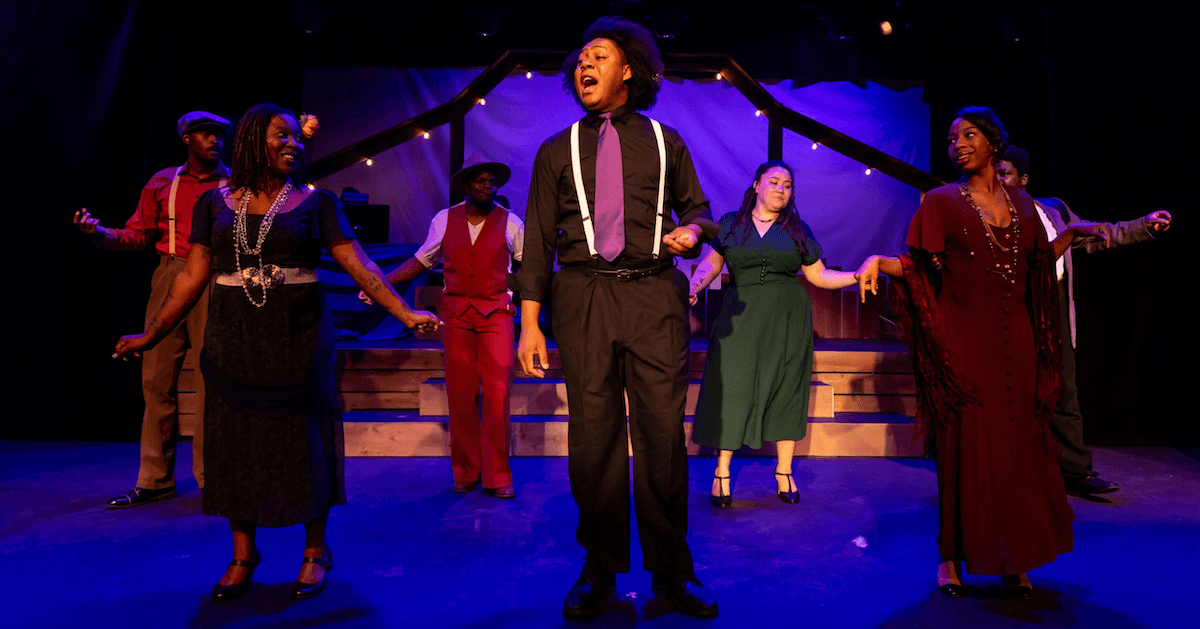
This blues revue is an effective pivot, aided by an excellent ensemble.
There is no way to talk about Vintage Theatre’s It Ain’t Nothin’ But The Blues without first talking about the show that is not onstage.
The musical revue, now playing in the Nickelson Auditorium through June 21, was not originally supposed to occupy this slot in the company’s 25th season. Vintage had announced Michael R. Jackson’s Pulitzer Prize- and Tony Award-winning A Strange Loop, the blisteringly self-aware musical about Usher, a Black queer writer writing a musical about a Black queer writer like himself.
Then, on March 22, the company announced it was shifting gears “due to a few unexpected hurdles.” In place of A Strange Loop came this Tony-nominated revue, with music, lyrics and book by Charles Bevel, Lita Gaithers, Randal Myler, Ron Taylor and Dan Wheetman.
For audiences excited by the prospect of seeing A Strange Loop in Aurora, the swap was understandably disappointing. It Ain’t Nothin’ But The Blues is a far less formally daring piece of theater. It does not have the same self-interrogating bite or structural invention.
What it does have, under the direction and choreography of Johnathan Underwood, is a clear sense of what it wants to be: a swift, sincere, musically satisfying tour through the evolution of the blues.
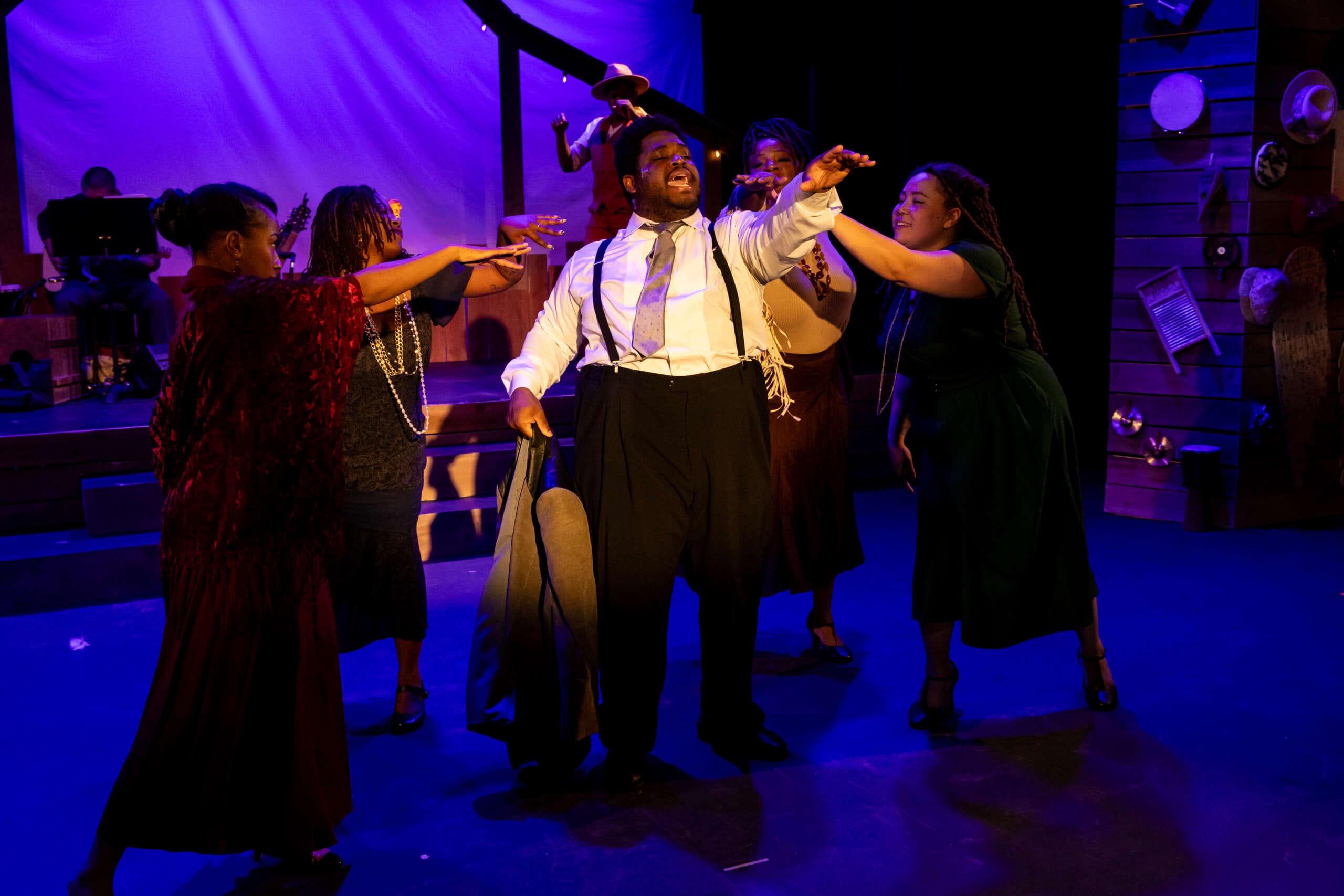
Chrisnel Akele in It Ain’t Nothin’ But The Blues. | Photo: RDGPhotography
Intimate blues lounge across time
The revue uses a loose “time traveler’s lounge” conceit to move through songs, styles and figures connected to the blues. There is little plot and not much dialogue. The show is closer to a guided listening session than a conventional musical, though even “guided” may overstate how much explanation the audience receives.
That is not a flaw. Anyone looking for a thorough academic account of the blues would be better served by heading to the library.
This production is more interested in atmosphere. It wants to make the audience feel as though it has wandered into a communal space where songs can summon churches, fields, juke joints, street corners and late-night parlors with only a shift in lighting or a change in rhythm.
Jeff Jesmer and Megan Davis’ set design helps create that intimacy. Wooden panels line the space, decorated with records, instruments, washboards and other pieces of blues iconography. A raised platform at center stage holds the musicians, while a back scrim gives Kevin Taylor’s lighting room to move between smoky warmth, bright theatricality and more sacred tones.
The two-person band remains visible throughout, which is exactly right for this kind of piece. Jerimiah Otto’s music direction is one of the production’s major strengths, especially in the way the evening glides through spirituals, comic numbers, torch songs and full-cast eruptions without losing momentum.
At roughly 75 minutes with an intermission, the show does not overstay its welcome. In fact, the production might play better as one uninterrupted rush, especially since the first act ran about 37 minutes and the second about 35 on the night I attended. Still, the pacing is crisp enough that the interruption does not derail the evening.
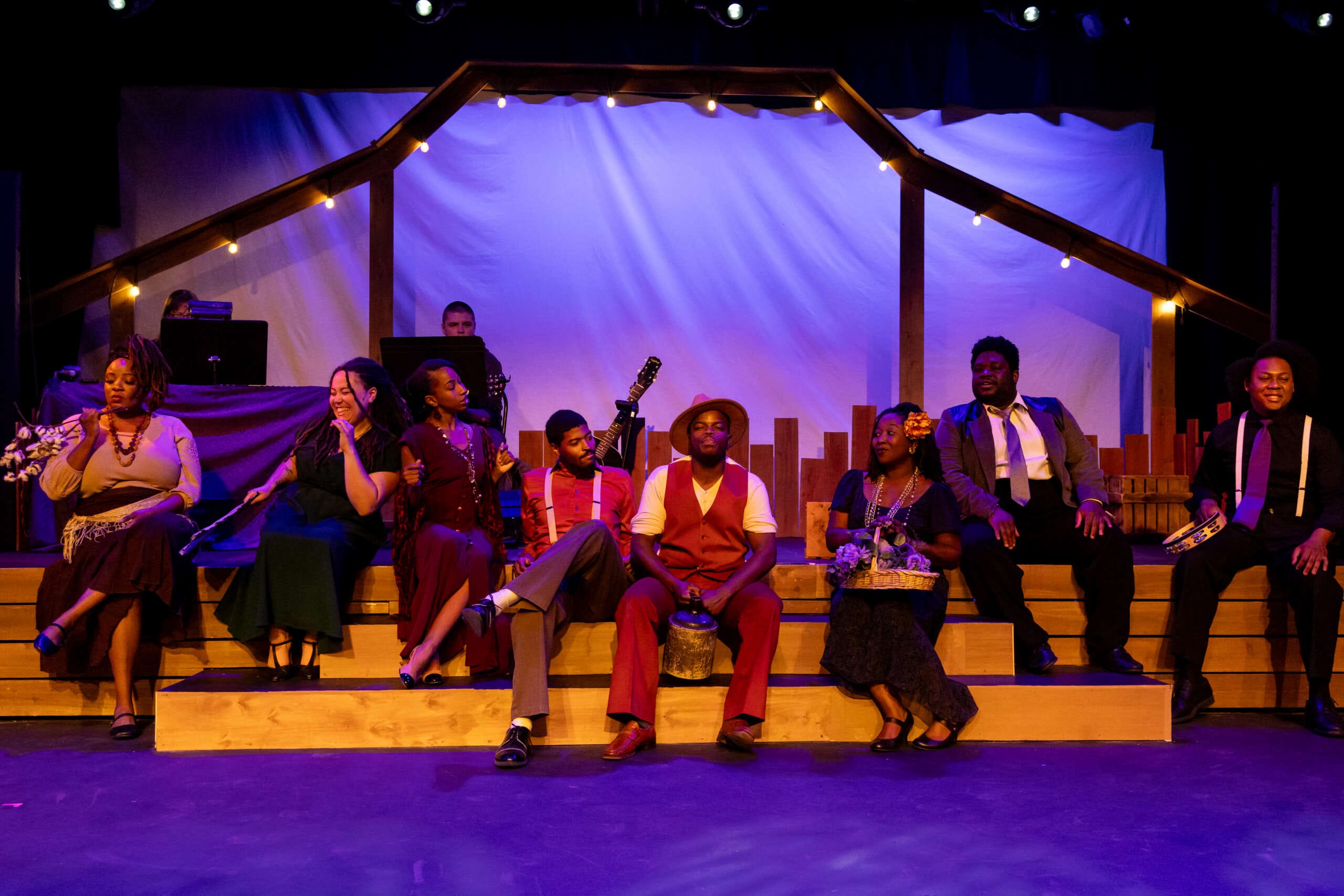
It Ain’t Nothin’ But The Blues at Vintage Theatre. | Photo: RDGPhotography
Cast lights up the room
The opening sequence places the full cast in a more ceremonial mode, gesturing toward the spiritual and communal roots of the genre. By the time Kenya Mahogany Fashaw finishes “I’m Gonna Do What the Spirit Says Do,” the production has established its essential vocabulary. The blues here are not treated as museum pieces. They are alive, flexible and ready to move.
That movement depends on an eight-person ensemble with serious vocal firepower. Chrisnel Akele, Atlas Drake, Fashaw, Daja McLeod, Jozeph Mykaels, Liyah Patrick, CJ Swain and Myles Wright each get moments to step forward, and the production is at its best when it lets their individual textures reshape the room.
Patrick makes a strong impression on “My Man Rocks Me,” especially as the show turns toward the women who helped define and carry the blues tradition. Mykaels gives “Walking Blues” a grounded charge in the first act. Swain’s “Cross Road Blues” helps lead the production into one of its strongest sections, as the ensemble folds him into a religiously charged sequence about repentance.
That stretch gives the first act its clearest build. “Wade in the Water” becomes a full-cast invocation, shaped by deliberate group movement and rich harmonies. “I Know I’ve Been Changed,” featuring Drake, adds group stomping that gives the number a welcome physical force. “Children, Your Line Is Dragging,” with Wright featured, brings playful choreography with fans before “Catch on Fire” ends the act on an exuberant high.
The second act opens with similar ease. Wright has fun with “Let the Good Times Roll,” especially in a running gag that keeps faking out the ending before returning for another blast. Fashaw makes a meal of “Someone Else Is Steppin’ In,” leaning into the song’s comic bite as the stage fills up with her suitors. “I’m Your Hoochie Coochie Man,” performed by Wright and Akele, lands with strong harmonies and a cheeky physical finish.
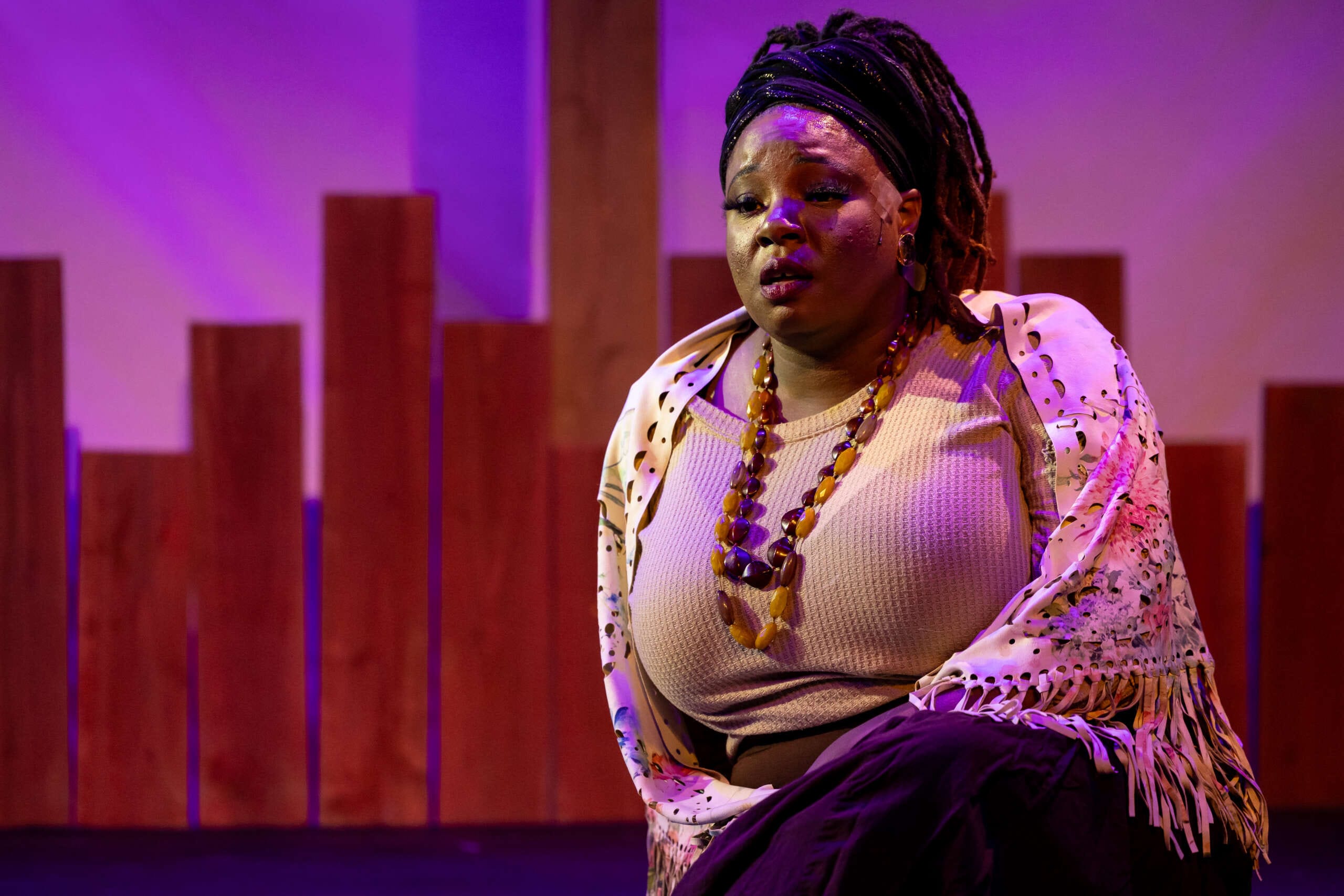
Kenya Mahogany Fashaw in It Ain’t Nothin’ But The Blues. | Photo: RDGPhotography
Akele’s falsetto on “Walkin’ After Midnight” gives him a softer, more emotionally open moment. Fashaw’s “Strange Fruit” brings necessary gravity, shifting the temperature of the room. “A Change Is Gonna Come,” sung by Wright and Patrick, is another vocal standout, while “Candyman” finds room for a goofy prop gag that keeps the evening from becoming too reverent.
Underwood’s choreography is straightforward. Compared with Vintage’s Sophisticated Ladies, another musical revue that used Duke Ellington’s music as the basis for a more ambitious dance-driven evening, this production is more modest in scale. The movement frames the performers, builds a sense of community and lets the songs remain central. That restraint mostly works, though it would be interesting to see this performed with a more developed dance component.
It Ain’t Nothin’ But The Blues may not be the show some Vintage audiences were expecting this spring, but Underwood and his team turn the pivot into a pleasurable night at the theater. The production is compact and polished, with performers who know how to sell a song.
Given the circumstances, this is an effective change of course. Sometimes all it needs is a tight band, a well-designed room and singers who know how to let the music do the heavy lifting.

An award-winning Colorado arts and culture reporter originally from Mineola, Texas. Tresca is the chief theatre critic for OnStage Colorado and managing editor of OnScreen Colorado. He’s the editor of Bucket List Community News, a contributor to Denver Westword and Estes Valley Voice, a resident storyteller for the Bonfils-Stanton Foundation and the co-host of the OnStage Colorado Podcast.

Leave A Comment