
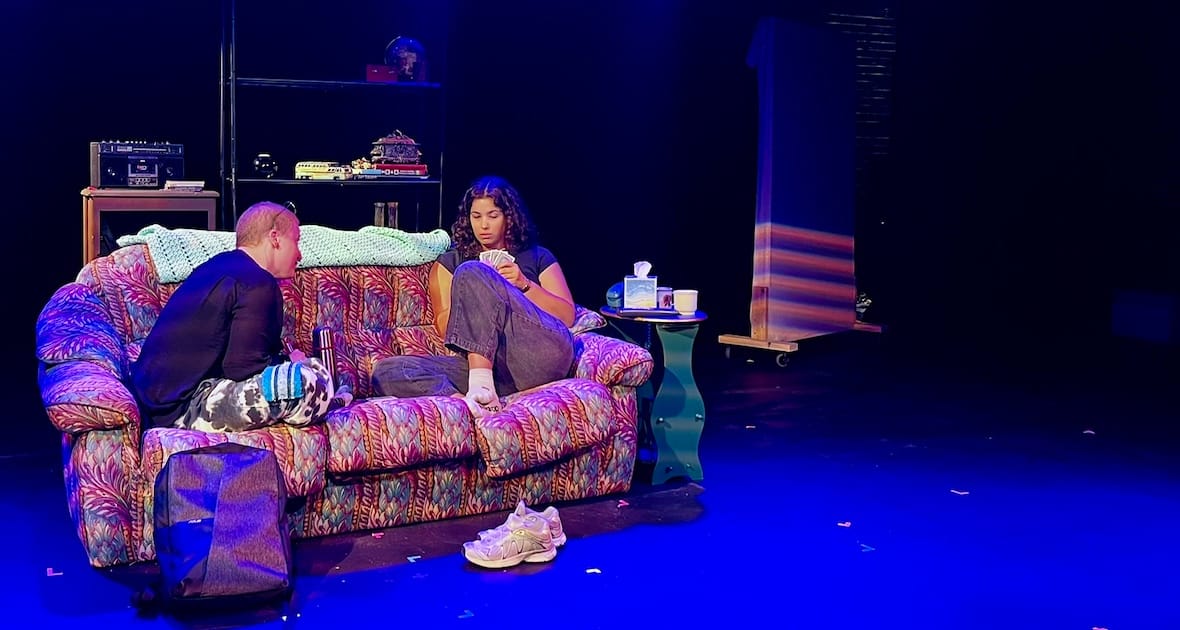
Ratt Walsh and Emma Moonfield launch a new theatre company with Diana Son’s drama.
First came the play. Then came the venue. Only after that did Colorado actors Ratt Walsh and Emma Moonfield realize they had accidentally started a theatre company.
“All of a sudden, we had the bones of something that was real,” Moonfield said. “The government needs to know about us. We need to get a tax ID. We need a bank account, which is absolutely the backwards way to approach a company, and I feel really grateful that despite building around the idea instead of building toward the idea, we have had more success than I could have hoped.”
That company, ER Productions, makes its debut Aug. 21-29 with Diana Son’s Stop Kiss at The Storyteller Theater, a new venue at 9905 E. Colfax Ave. in Aurora.
“I just decided, because I trust my friend Ratt, let’s do it — let’s start a theatre company,” Moonfield said.
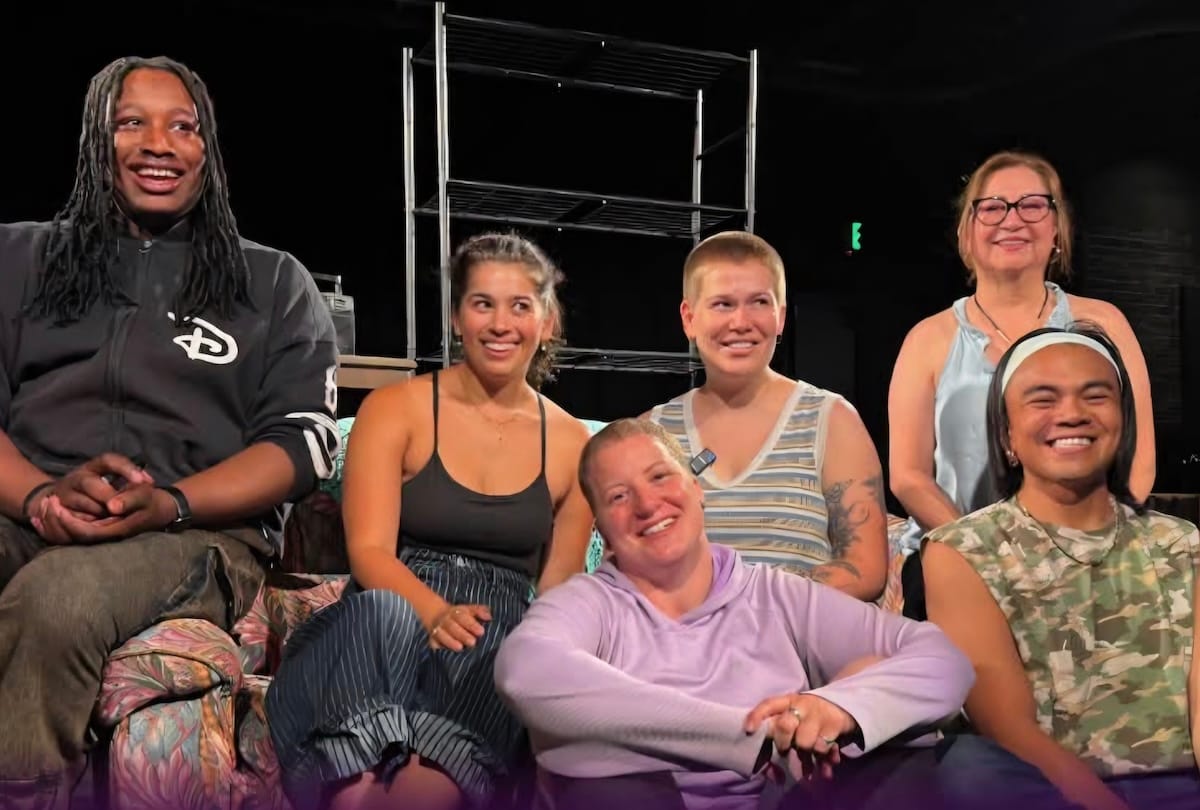
A group photo of the company of ER Productions’ Stop Kiss. | Photo: Jesús Sánchez Meleán
How Stop Kiss started something bigger
Walsh and Moonfield met performing in Phamaly Theatre Company’s A Midsummer Night’s Dream, with Moonfield as Puck and Walsh as Bottom.
“I was immediately drawn to Ratt,” Moonfield said. “I was like, oh, this is the dopest person I’ve ever met.”
Moonfield had also been carrying Stop Kiss with her since seeing Fearless Theatre’s 2019 production. At the time, she had recently experienced a traumatic injury and was not yet out, and Son’s play — about Callie and Sara, two women who are attacked on the street following their first kiss — stayed with her.
Last fall, she handed Walsh the script.
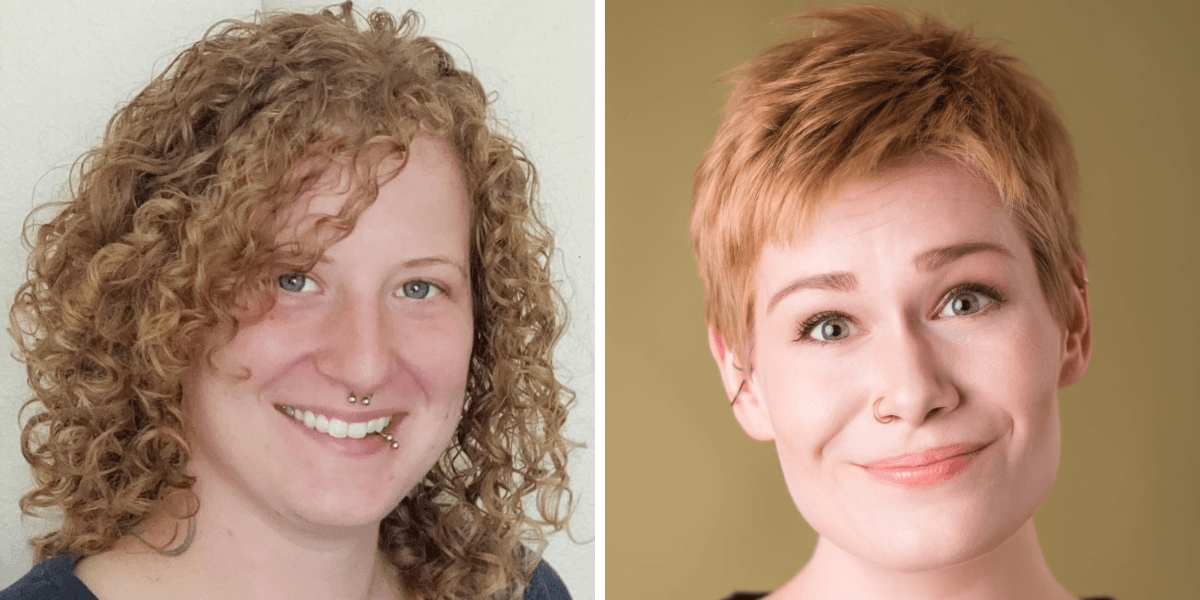
Ratt Walsh, left, and Emma Moonfield, co-founders of ER Productions.
“I picked it up, and I couldn’t put the script down,” Walsh said. “I was like, yeah, she’s right. We gotta do this.”
Moonfield initially envisioned a low-budget staged reading with herself as Callie and Walsh as Sara. Then they began talking with venues, including The Storyteller and its founder, Lexie Lazear. Moonfield moved into the director’s chair, Walsh stayed on as Sara and the project kept growing.
“The thing that Ratt adds is this sense of if we jump, it’ll work,” Moonfield said. “That does not come naturally to me. I’m like, but we don’t have any money. No one knows about us. We don’t have a company.”
Eventually, she decided to jump anyway.
“One thing led to another, the plan shifted around, and all of a sudden, we were working with The Storyteller, we had dates, we had secured the rights, I was directing it, and we had a full cast,” Moonfield said. “I am not surprised, but I am grateful that Ratt was right.”
Taking the show beyond the stage
ER Productions — named partly for Emma and Ratt and partly for their shared love of hospital dramas — was built around the idea that its work should extend beyond performance.
“I don’t want the conversation to stop when the cast bows and leaves the stage,” Moonfield said. “I want the people in the chairs to have some kind of integration tools available to them to continue this conversation into their lives.”
For Stop Kiss, Walsh contacted organizations including the Brain Injury Alliance of Colorado, Atlantis Community, The Center on Colfax, East Colfax Community Collective and Harm Reduction Action Center to provide resources in the lobby. Post-show talkbacks are planned for Aug. 23 and 28.
“This isn’t just to entertain you,” Walsh said. “This is to help encourage you to be curious. Ask questions. Do you need help? Here are resources.”
That thinking carries into accessibility. Tickets are pay-what-you-can beginning at $18, with $5 “safety net” seats available by emailing the company and donated tickets available for people unable to pay. The Storyteller Theater also offers step-free accommodations, ground-level seating, a quiet room, large-print scripts and fidget tools.
“The whole point of art is for everyone,” Walsh said. “It’s not just for the elite. It’s not just for those who pay.”
The finances have been similarly community-driven. ER Productions received $2,500 from the Bonfils-Stanton Foundation through its fiscal sponsorship with Fractured Atlas, while crowdfunding brought in roughly another $500.
“The financial structure of our company is proof that good community makes good art,” Moonfield said.
Onstage, Moonfield is taking a minimalist approach to a play that jumps between timelines before and after the attack. Rather than making large scenic shifts, everything needed to tell the story begins visible, with movement, light and sound changing the space. The production also resists treating the 1998 script as a period piece, following Son’s instruction that its time is simply “now.”
“It is shockingly relevant,” Moonfield said. “It feels very important, it feels very human, it feels very grounded.”
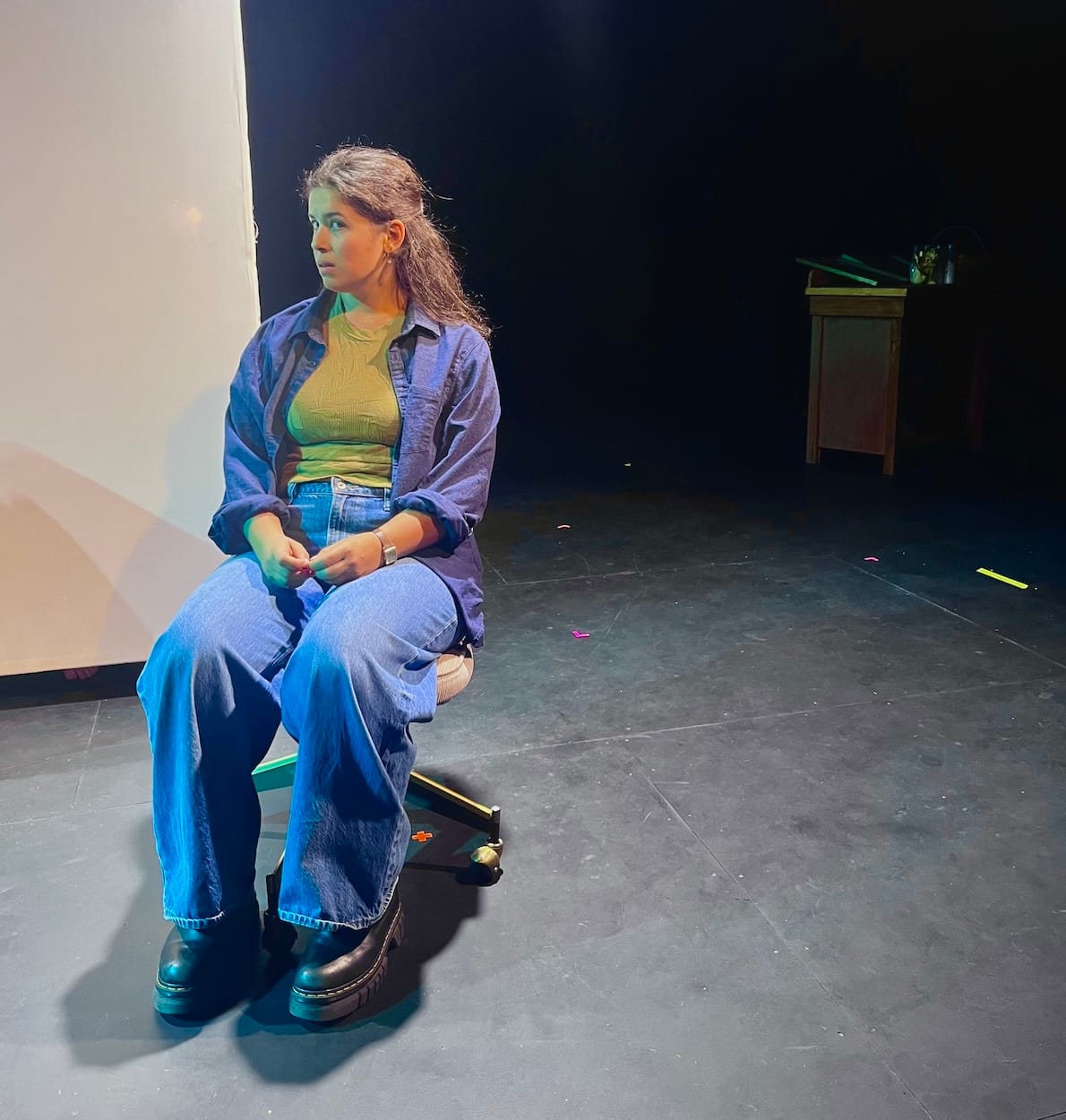
Helen Driesen rehearses for ER Productions’ Stop Kiss. | Photo: Emma Moonfield
That combination of focus and restraint may also become ER Productions’ long-term model.
Moonfield said she believes “a lot of the struggle that is occurring in the Denver theatre scene right now is that theatres, and specifically venues, are not operating with sustainability as a core tenant.”
ER Productions’ answer, at least for now, is not to build a packed season.
“What feels unanimously sustainable is we’re gonna do one thing a year,” Moonfield said. “We’re gonna do it so well, and then we’re gonna do the next thing.”
The founders plan to conduct a postmortem after Stop Kiss before deciding whether to pursue nonprofit status or formally announce another production. Artistically, though, Moonfield is already exploring possibilities: a trans-forward edit of Hamlet, Bertolt Brecht’s The Resistible Rise of Arturo Ui and public-domain works by writers such as Molière that rarely receive productions.
The goal, she said, is to “either produce work that has been done in a new, exciting way, or produce work that never gets produced for some reason.”
ER Productions came together at a sprint, with Walsh and Moonfield building a company around a production already in motion. Its next steps are the opposite: slowing down, choosing carefully and giving each project their undivided focus.
“There’s that Ron Swanson quote, ‘Never half-ass two things. Whole-ass one thing,’ you know?” Moonfield said. “That’s how I feel about theatre. There are a few titles being kicked around, but we’ve not landed on one. We love partnering with Lexie at The Storyteller. We’ve not talked to her about next year, but we would love to work with her once more because she’s amazing, has been so hospitable and the venue is beautiful. I can’t wait for people to get in there.”

An award-winning Colorado arts and culture reporter originally from Mineola, Texas. Tresca is the chief theatre critic for OnStage Colorado and managing editor of OnScreen Colorado. He’s the editor of Bucket List Community News, a contributor to Denver Westword and Estes Valley Voice, a resident storyteller for the Bonfils-Stanton Foundation and the co-host of the OnStage Colorado Podcast.

Leave A Comment