
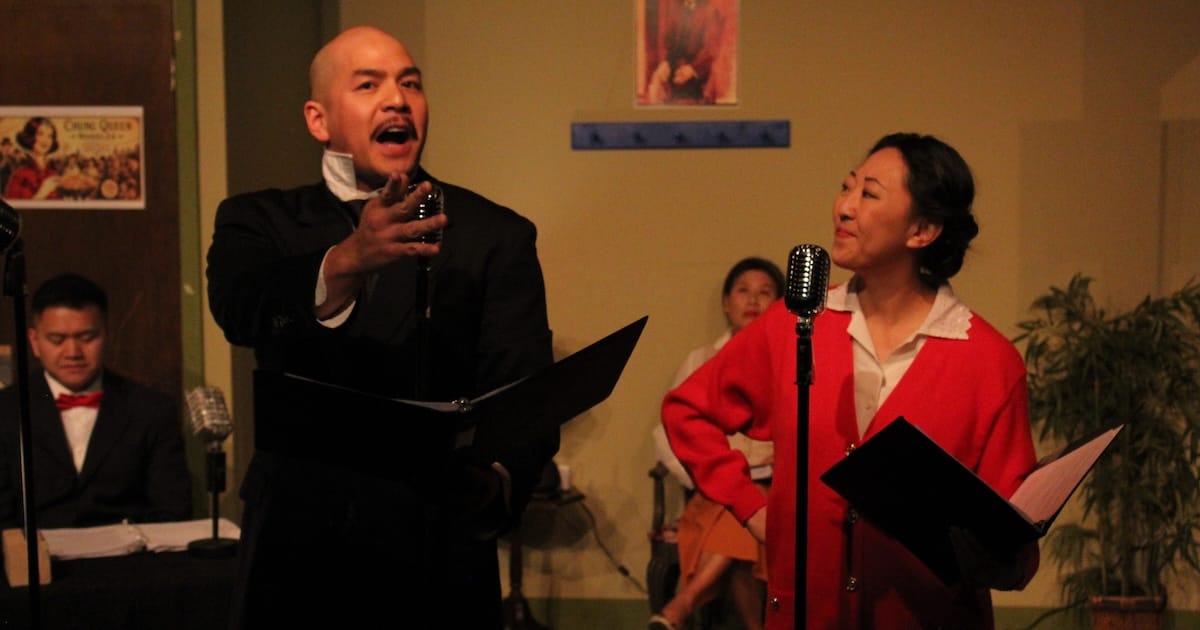
Insight Colab Theatre’s inventive radio-play format brings a real family cold case to life, even if the ending never surprises.
Shadows & Secrets by Nancy Wang isn’t a traditional staged murder mystery. It’s inspired by the real story of her grandfather, Chin Fan Foin, who fell to his death down an elevator shaft in his restaurant in 1924. Through archival documents and memories, Wang investigates whether his death was an accident or he was pushed.
In the production, the fictional Mystery Radio Playhouse puts on a radio play to solve the cold case. The story follows the night of Foin’s death at his restaurant in the Mandarin Inn during a rainstorm. His granddaughter (Caroline Kim) narrates her findings years later as police investigate suspects and their motives in real time, ultimately discovering the killer.
Insight Colab Theatre presented the production at the Bond-Trimble Theatre at Vintage Theatre in Aurora on Aug. 28 for the first performance of a three-night run.
Robust set design in a tight space
Audience members file into an intimate theatre with 60 seats. While the space is small, the visuals by Robert Kikuchi-Yngojo and Mique Hwang develop a whole world within mob-era Chicago and present day.
To the left sits a carpeted recording studio for W.A.N.G. Radio. An advertisement for Chung Queen Noodles hangs on an old door, signifying the radio play’s sponsor. Actors later break out into a silly dance for the commercial that the radio host (Tim Inthavong) invites audience members to join in on.

The granddaughter’s home is set to the side of the studio, where an image of her grandfather hangs above a coat rack. Past a doorway, there’s a small circular table with teacups and a sign for the Mandarin Inn Cafe, Foin’s restaurant.
Still farther to the right, there’s a small lifted stage where a screen showcases graphics like a dramatic image of Foin falling to his death and reaching out in horror. The screen also displays presumably archival images of people portrayed in the show, with their names and affiliations listed as the characters enter the story to limit confusion — most actors are double, triple or quadruple cast.
There’s also a table with a tiny door that actors use to mimic the sounds of shop doors opening and closing with a little bell. They also create clomping noises when the police walk into another room to regroup.
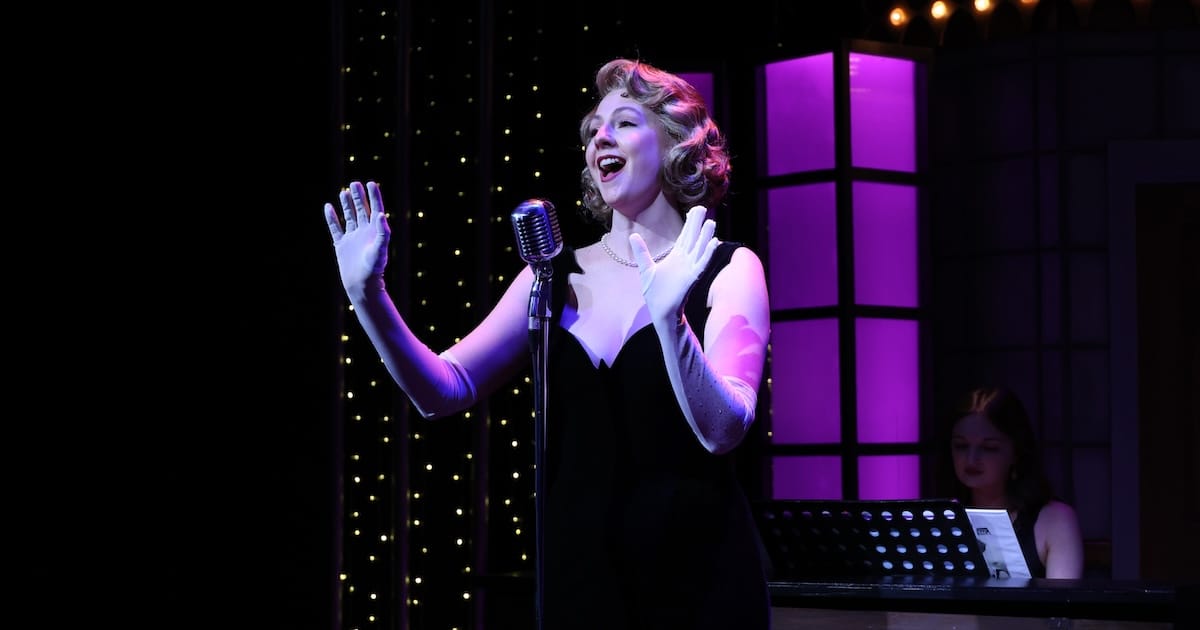
Hwang’s lighting design is simple but effective. The lights are often warm and bright, with an added purple glow for the suspect interrogation.
Susan Rahmsdorff-Terry’s costuming effectively conveys the time period. The men wear dapper black suits and police uniforms while the women wear long skirts, heels, vests, cardigans and blazers. Actors remove one item of clothing, like a jacket, and add a new outer layer to signify a change of character.
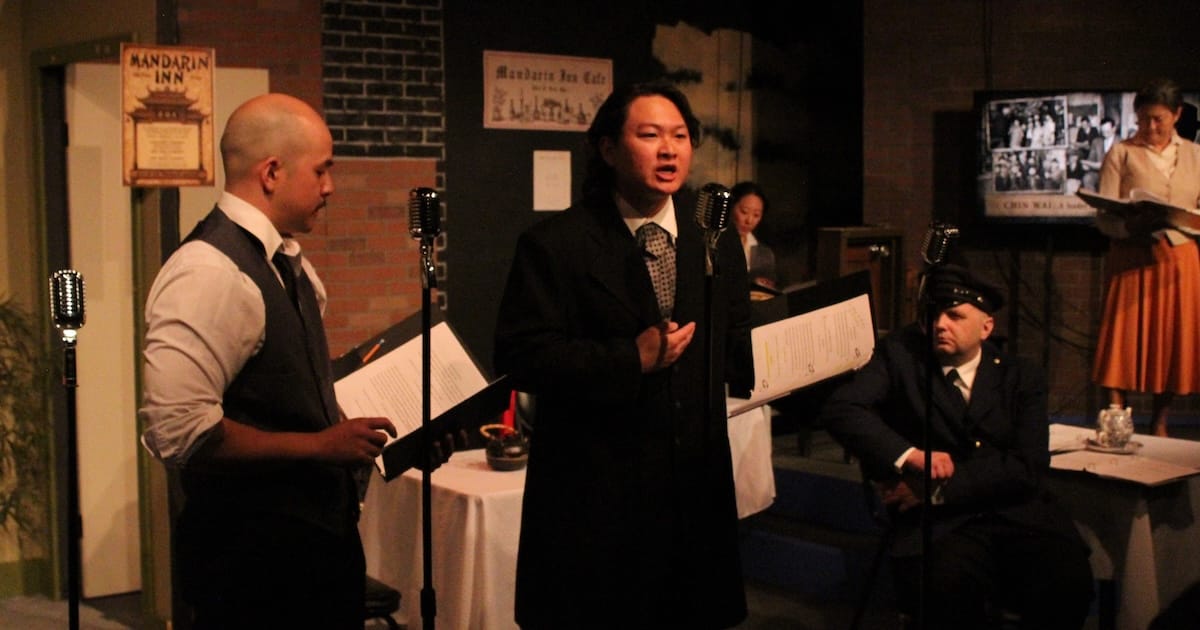
Actors in the Insight CoLab production of ‘Shadows & Secrets.’ Photo: Insight CoLab
In the studio
As the production begins, actors carry scripts like they’re in a recording studio and break the fourth wall as they introduce themselves to the audience. Radio host Inthavong leads audience members through reactions they can express throughout the show, like gasping and laughing. Spooky music plays as Inthavong lays the groundwork for the story.
When actors aren’t in scenes, they stand and sit around the set with their scripts. They approach standing microphones at the front of the stage to perform. For a radio play, it makes sense for the actors to carry scripts since they wouldn’t need to memorize their lines. Since the production is staged, the actors should have their lines closer to memorized and speak while looking out at the audience. Often, actors’ heads are down, reading off their scripts. In lengthy scenes like an interrogation between two police officers and four suspects, they start to lose the audience’s attention.
The production could benefit from more overdramatization. Radio stories rely on only voices to tell the story, so even NPR reporters need to be more expressive than they would when telling a story in everyday life. It would have been beneficial for actors to exaggerate their speech, as if audience members could only gauge the story from their voices, for a more captivating experience.
Kim Egan and Alston Phu excel at connecting with the audience throughout their performances. They showcase the full range of their characters’ emotions, visually and vocally, and look out into the audience as they tell their stories.
Performances
Kim, as the granddaughter, speaks directly to the audience as she discusses her research into her grandfather’s passing. Although her vocal performance is a bit rough, she conveys determination to find out the truth. As Foin, Kevin Chung has a commanding voice but speaks in a mechanical manner.
Egan is a wonderful Molly O’Farrell, Foin’s trusted employee. She speaks in a fairly solid Irish accent and reveals an expressive face throughout her performance.
As Foin’s brother-in-law Wong Way, Phu develops a perfectly bitter persona. His disdain for Foin is palpable and serves as a clear motive for the potential suspect in his murder. Phu’s cold energy serves as a stark contrast to his portrayal of Foin’s nephew Eugene. As the younger boy, Phu reveals Eugene’s panic at being trapped in the restaurant’s basement during the storm. He truly paints the picture without a real basement set through his anxious reactions and a hilarious moment where he gags upon discovering dead rats.
Jeffrey Dallet and Brandon Phelps as Sergeant Murphy and Officer O’Callahan balance each other as an abrasive, prejudiced figure and a softer, more invested officer.
The balanced direction and lack of stakes within the script
Jennifer So’s direction finds a middle ground between the goofiness of a murder mystery and the seriousness of this story being based on a real cold case. Given that the production isn’t actually experienced just through audio, it would have been beneficial for some more scenes to take place within the set instead of just at the microphones, to raise the stakes and make for a more interesting audience experience. As noted earlier, the interrogation scene fell flat as suspects stood stagnant and mostly read from their scripts. The audience couldn’t feel the tension and anxiety of being questioned for hours in a small room.
With a murder mystery, the audience needs to be shocked by the discovery of the killer. It’s more difficult to do this when dealing with real history, but there still needs to be a payoff, and there wasn’t. The reveal was expected. The play could have benefited from more push and pull between the suspects and their motives to make the ending more surprising.
Shadows & Secrets is a deeply personal story and snapshot of an important moment in Asian American history. The production leaves audiences wanting to learn more about the history of Chinese immigrants in the early 20th century, but wishing for a more suspenseful murder mystery ending.

Maddie Browning is a freelance arts and culture reporter who covers music, theatre, visual arts, books, food, and fashion. She has more than five years of culture writing experience, and her byline has appeared in NPR, the Los Angeles Times, Marie Claire, The Boston Globe, Business Insider, Denverite, Westword, Boston.com, WBUR, and Colorado Public Radio, among others. She earned her bachelor’s degree in journalism from Emerson College. On a day off, she enjoys checking out new local coffee shops and thrifting with friends.


Leave A Comment