
Lauren Yee’s Yiddish-tinged fable, in its Colorado premiere, asks what we owe the people we love.
At the start of The Hatmaker’s Wife, a man in a felt hat dances to cheery music while his wife glares at him in disdain. He is unaware of her suffering, as he seems to have been for much of their 60-year marriage.
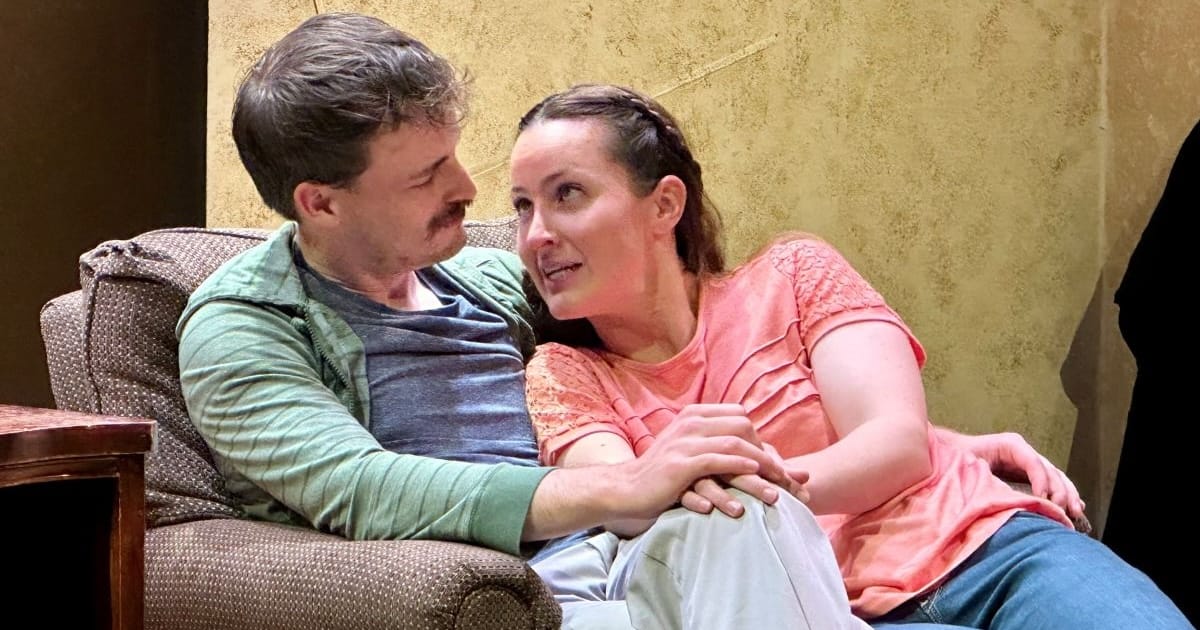
The tableau breaks apart as a woman (Jordann Zbylski) moves into a dingy house with her boyfriend Gabe (Jaylin Wiese). She expects to live a happy, normal life with him until the walls literally start talking to her. Through a vent near the ceiling, the Wall (Corinne Landy) passes her pages of a story about an old hatmaker named Hetchman (Verl Hite) and his wife (Dia Kline) who used to live there.
The tale follows Hetchman’s wife as she journeys to find someone to make her a copy of his hat because her husband refuses. As the days pass, he becomes more concerned about his hat’s departure than his wife’s safety. As she reads the story, the younger woman begins to draw connections between the couple’s experience and her own, learning about the roots of her trauma and how to begin to set herself free.
Running through Oct. 25, Firehouse Theater Company is staging the Colorado premiere of The Hatmaker’s Wife at Denver’s John Hand Theater. The play by Lauren Yee delves into whimsical Yiddish folklore, infused with the real pain of a wife (Kline) who feels invisible in her marriage.

Verl Hite as Hetchman and Dia Kline as Wife in ‘The Hatmaker’s Wife.’ | Photo: Brian Miller
A moving portrait
The Hatmaker’s Wife is also a Colorado directing debut for Colby Bleicher. Working with Yee’s transformational story, the director develops a deeply moving portrayal of an older woman being underappreciated and a younger woman finding her voice in her own life.
Kline beautifully portrays a woman moving through the shadows, tending to her husband’s every need without so much as a thank-you. She doesn’t even have a name at first because she is seen only as an extension of Hetchman.
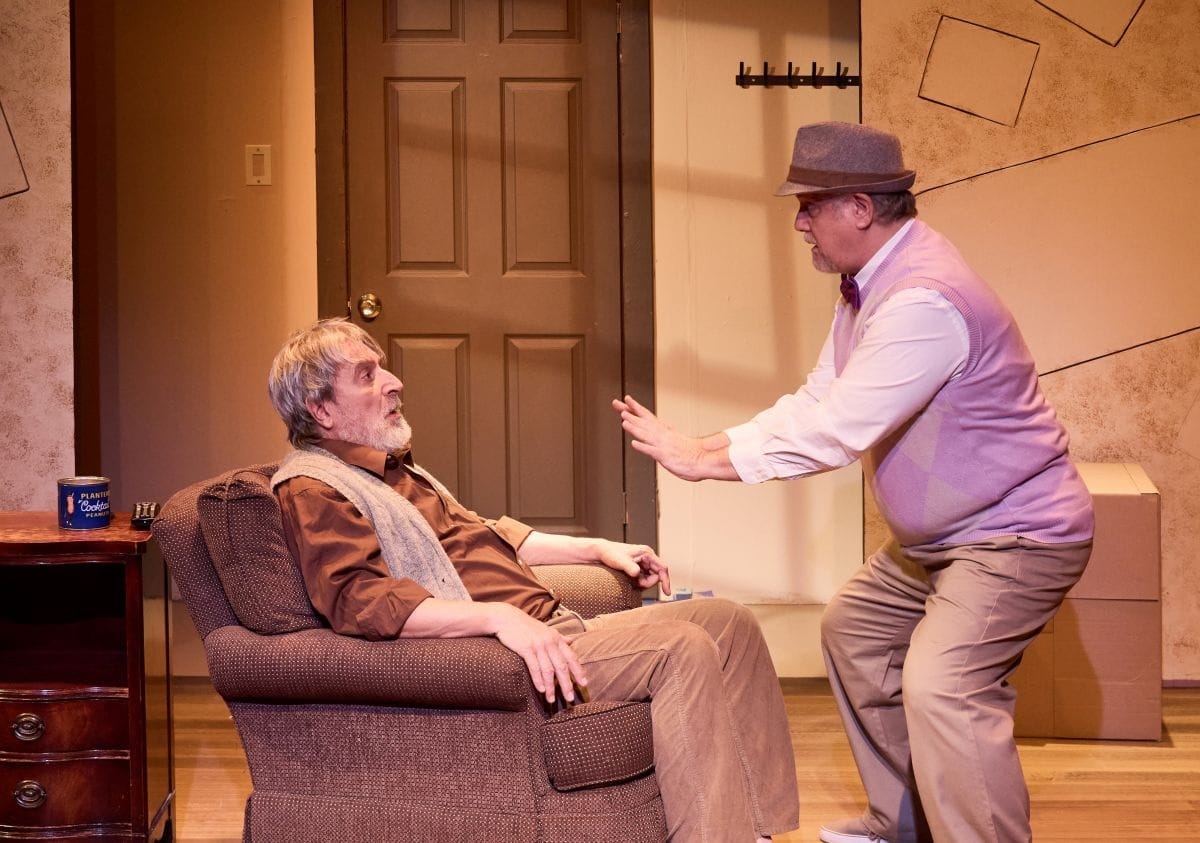
As Hetchman, Hite excels as a disgruntled old man who has lost the meaning of human connection. He moves through each day like it is the last, pinned in an armchair in front of a television. His only friend seems to be his neighbor Meckel (Bruce Laks). Laks develops a likable, neighborly character who wants what is best for both halves of the couple.
Though we never see her face until the final curtain, Landy creates memorable moments as the Wall, whispering and guiding Zbylski through the story. Noted only as the “Voice,” Zbylski explores the confusion of not truly knowing who you are and where you came from. She clings to the Wall’s story with a determination she doesn’t fully understand until the very end. It was lovely to see her transition from disorientation to pain and acceptance. Wiese plays both a steady boyfriend and, as theGolem, an entertaining mythical creature.
Verl Hite as Hetchman and Bruce Laks as Meckel. | Photo: Brian Miller
Immersive staging
With a modest capacity of around 80 people, The John Hand Theater transforms into an impressive set. Jeff Jesmer creates a dingy starter home with a classic armchair and moving boxes scattered across the floor, often used as seats. The wallpaper appears to be peeling and literally explodes off the wall later in the performance.
Cheri Bauman’s innovative lighting casts a window pattern that seems to sit outside the set, shifting as the story moves from day to night.
Costume Designer Rachel Herring-Luna puts Hetchman in the perfect old-man ensemble of a green sweater vest layered over a brown button-up and moccasins. There’s also a hilarious callback to the theater’s origins as a fire station where Hetchman comes out in a fire helmet when he can’t locate his hat.
Hetchman’s wife wears a simple white house dress and a long coat when she embarks on her trip. Gabe dons a simple blue T-shirt and khaki pants, and his girlfriend wears jeans and a peach-colored top. These are easy outfits for moving into a new place.
Madison Kuebler’s sound design adds to the show’s fun with joyful music that plays whenever Hetchman places his hat on his head. The show also includes birds chirping in the early morning and muffled television when Hetchman switches programs.
Throughout the production, a recurring theme is that love keeps people firmly grounded. The characters realize they must consistently show their love for each other to avoid drifting apart. It’s a beautiful lesson for audiences to cherish and carry into their own lives.


Maddie Browning is a freelance arts and culture reporter who covers music, theatre, visual arts, books, food, and fashion. She has more than five years of culture writing experience, and her byline has appeared in NPR, the Los Angeles Times, Marie Claire, The Boston Globe, Business Insider, Denverite, Westword, Boston.com, WBUR, and Colorado Public Radio, among others. She earned her bachelor’s degree in journalism from Emerson College. On a day off, she enjoys checking out new local coffee shops and thrifting with friends.

Leave A Comment