
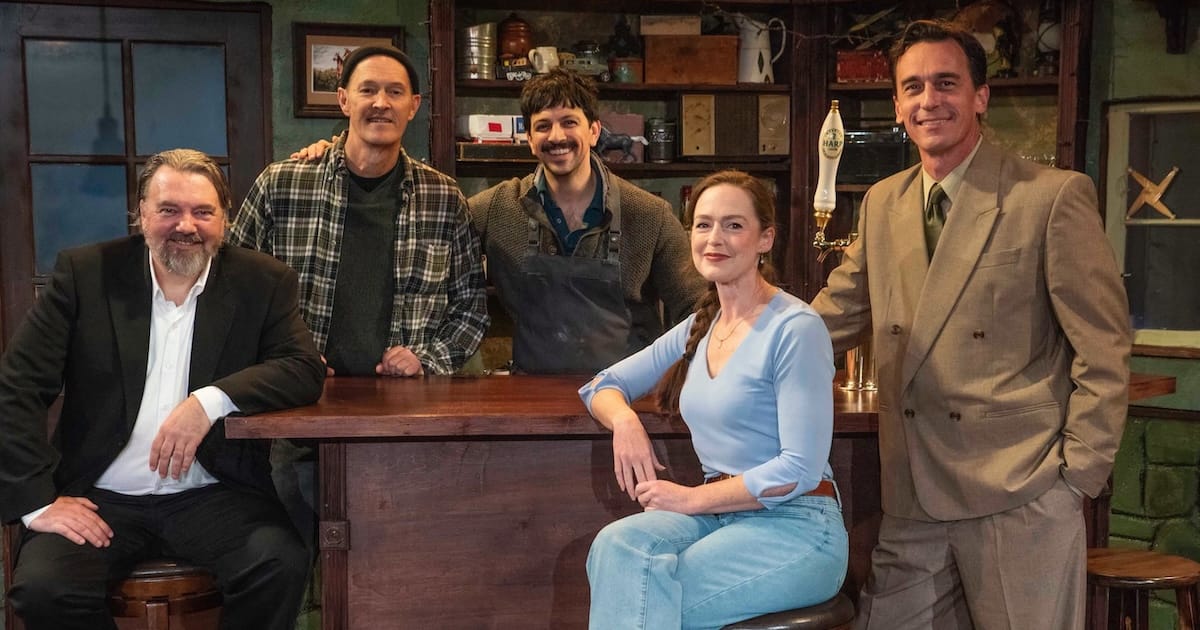
BETC’s 110-minute drama centers grief and companionship in a well-acted evening of haunting stories.
Who doesn’t love a good ghost story around Halloween?
As a horror fan, I certainly do, and Boulder Ensemble Theatre Company proved with last season’s The Thin Place that it can deliver a genuinely spine-chilling theatrical experience. Conor McPherson’s 1997 play The Weir seems like a natural fall follow-up: another intimate, cerebral story in which ordinary people brush against the supernatural.
Yet The Weir is a stranger creature. Director Candace Orrino mounts an exceptionally sophisticated production, and the play contains several gripping passages. McPherson, however, deliberately denies the audience the kind of escalating tension and catharsis its ghost stories seem to promise.
I came to appreciate why, even if the play sometimes left me more intellectually haunted than emotionally shaken.

Pull up a stool
As you enter The Savoy Denver, light Irish folk music plays while Tina Anderson’s homey scenic design creates a convincing country pub, complete with frosted windows, a worn dartboard, beer taps and a fireplace. Sean Mallary’s flickering lights and Rowan Livengood’s low, persistent storm sounds make the room feel cozy and isolated.
Michael Morgan’s Jack is the first to enter the space. Though he isn’t the bartender, he is comfortable enough in the pub to slip behind the bar and try pouring himself a pint. When he discovers the tap is out, he grabs a bottle of Guinness instead and pours it into a glass that barely fills beyond the halfway point. Jack looks genuinely annoyed by the indignity before settling onto a stool.
Then Brendan, the barkeep, played by Ryan Omar Stack, arrives and immediately starts giving him a hard time about drinking bottled Guinness. It is a tiny exchange, but it establishes exactly what Orrino’s production does so well: These people feel as though they have been inhabiting this room and irritating one another in it for years.
Soon Jim (Mark Collins), Finbar (Colin Martin) and Valerie (Colleen Lee) arrive, and the evening settles into the rhythms of a familiar night at the bar. Drinks are poured, old tensions resurface and the men begin subtly competing for Valerie’s attention.
One by one, the men trade eerie stories involving fairies, apparitions and the dead, each tale revealing something about the teller as much as the supernatural. Morgan is particularly captivating, telling Jack’s first story with the ease of someone who has repeated it dozens of times while making every pause feel fresh.
The ghosts we carry
Then Valerie tells a story of her own, and the evening changes.
Her account of devastating personal loss reframes the men’s ghost stories. What initially feels like pub entertainment begins to sound more like the language these people use for things they cannot otherwise explain: grief, regret, loneliness and the past’s refusal to stay buried.
Lee delivers Valerie’s central monologue with considerable emotional force, although I wanted more glimpses of that interior life in the moments surrounding it. Valerie understandably keeps her pain hidden beneath a bubbly, guarded exterior, but the performance seldom lets us sense what is churning underneath until the monologue arrives. That creates some distance between the audience and the grief we eventually discover she carries.
Morgan again provides the evening’s strongest moment when Jack, after most of the pub has emptied, admits his own great regret. His memory of being fed a simple sandwich by strangers after an emotional collapse is life-affirming. McPherson’s point suddenly becomes clearer: Sometimes surviving horror is less about overcoming it than finding somewhere to sit with good company afterward.
That idea is embedded in the title. A weir is a low barrier built across flowing water, raising its level and regulating its movement. These characters cannot stop what has already flowed past them. They can, however, gather together and keep one another from being swept away.
McPherson refuses the conventional payoff those stories seem to promise, allowing the evening to drift back toward ordinary conversation and end almost casually. That initially left me scratching my head, but the more I considered it, the more appropriate the anticlimax seemed.
This is not really a ghost story about spirits lurking in an old house. It is about the haunted histories people carry into otherwise ordinary rooms. BETC makes that room somewhere worth spending an evening, even if the ghosts inside it linger more in the mind than the nerves.


An award-winning Colorado arts and culture reporter originally from Mineola, Texas. Tresca is the chief theatre critic for OnStage Colorado and managing editor of OnScreen Colorado. He’s the editor of Bucket List Community News, a contributor to Denver Westword and Estes Valley Voice, a resident storyteller for the Bonfils-Stanton Foundation and the co-host of the OnStage Colorado Podcast.

Leave A Comment