
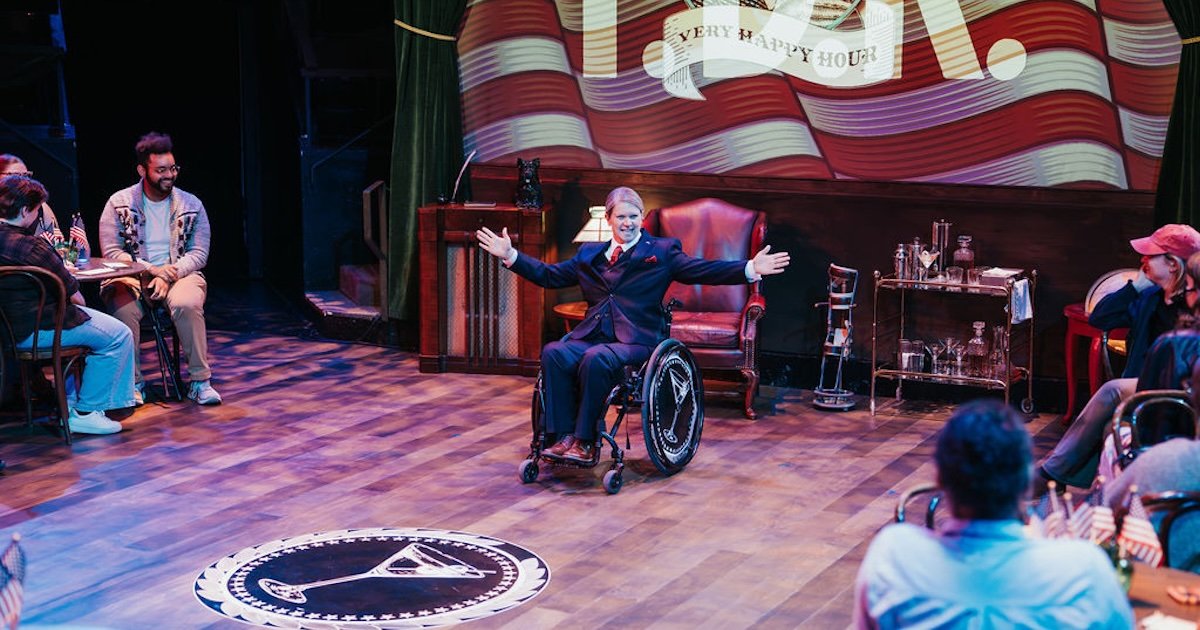
The 32nd U.S. president invites everyone for drinks at the Ellie Caulkins Studio Loft.
Theatre rarely gets to bring a president back from the dead. FDR’s Very Happy Hour does it with a drink in your hand, a stranger at your table and, by the end, a new friend.
The show is an absolute pleasure to experience. President Roosevelt (Regan Linton) appears in bright spirits, full of energy, as if there is no better place on Earth to be. Of course, there are moments that are not so happy, and thanks to those, the joy is even stronger.
At no point does the audience stop to think, “It’s strange that a woman is playing Franklin D. Roosevelt.” Linton researches and immerses herself so thoroughly in his character and history that she wholly becomes FDR onstage. There is never a question about whether the audience is seeing Roosevelt. The willing suspension of disbelief is complete. Everyone in the room is having drinks with the 32nd president of the United States. Linton commands the room and captivates the audience as FDR.
The only way to have a friend …
When Alexandria Wailes joins Linton onstage as President James Madison, the chemistry between the two actors is unmistakable. They are so well matched that the audience assumes they have worked together for years. FDR is known for his maxim, “We have learned the simple truth, as Emerson said, that the only way to have a friend is to be one.” Linton and Wailes come across as close friends in every role Wailes plays throughout the show.
Scenic Designer Efren Delgadillo Jr.’s set is faultless. It is simple, designed to resemble any space where people might feel relaxed having drinks: an office, a home, a cafe or a bar. Without heavy scenery, it can easily travel with a touring production. As it should. The show offers the most accessible theatrical experience I have encountered in more than 40 years in theatre, and that is no small achievement.
The house provides spaces for wheelchairs and scooters at the tables, along with clearly marked chairs for companions. Sign language interpreters are available, including Wailes herself, who signs her lines while also speaking many of them. Additionally, every spoken line appears in captions on large screens. Phones are turned off to encourage genuine human connection unless someone needs a phone for accessibility. Nothing is overlooked when it comes to accessibility.
As a wheelchair user, actor and playwright, Linton has much in common with Roosevelt. She and Director M. Graham Smith tell us more in this OnStage Colorado podcast episode. The show recreates the happy hours FDR held to set aside stress and enjoy the companionship of the people around him.
I find a friend almost immediately and make several more during the evening. That is the true nature and intent of FDR’s Very Happy Hour. This piece is not meant simply to entertain. It reminds audiences of what it looks like when human beings connect with one another. This is Roosevelt’s legacy for the country, and it is Linton’s success on this stage, with some help from her friends.
Forests are the lungs of our land …
Alexandria Wailes’s portrayal of Eleanor Roosevelt is stunning. The interaction between Eleanor and FDR is deeply moving, with vulnerability and strength in the performance. The happy hour includes several very silly moments. Among them is the introduction of Smokey Bear (Wailes). Smokey, created by the U.S. Forest Service, helps FDR discuss current climate events and teaches the audience about important fire safety practices.
Perhaps FDR’s words about the environment are not remembered as often as they should be: “A nation that destroys its soils destroys itself. Forests are the lungs of our land, purifying the air and giving fresh strength to our people.” I get a bear hug from Smokey during this portion of the show, and I am delighted.
This is interactive theatre, but it is neither nerve-racking nor scary. There are opportunities to talk to neighbors or to the president. Trivia, games and questions invite us to think and then answer privately or share our responses with others. FDR conducts a couple of short interviews and tells us to kick off our shoes. He even offers to remove someone’s shoes for them and then does.
Wabi-sabi
There are particularly affecting moments, such as when Roosevelt transfers to an armchair to talk about his leg brace and the deception necessary to maintain the image expected of him as president. Dani Clifford’s lighting design accentuates the moment perfectly. Another comes when Eleanor Roosevelt (Wailes) confronts her husband about his own fear, allowing the crowd to experience FDR’s vulnerability alongside him. Wailes dazzles as Eleanor. This entire scene is powerful and heartbreaking, and it will endure in the memory for years to come.
Watching a legend such as Franklin D. Roosevelt portrayed as a human being who struggles to admit his own shortcomings is a humbling experience. A central theme in FDR’s Very Happy Hour is the Japanese concept of wabi-sabi, which finds value, beauty and tranquility in simplicity, imperfection and transience. It is appropriate for FDR, for the country and for every human being.



Selena A. Naumoff holds a BA in Theatre Arts and two master's degrees. She teaches theatre, stage-manages, directs, writes plays and performs in theatre and film. She is active in all aspects of theatre, including lighting, properties and sound design. She reviews for the Jewish Book Council and has published both nonfiction and young adult fiction under her pen name.

Leave A Comment