
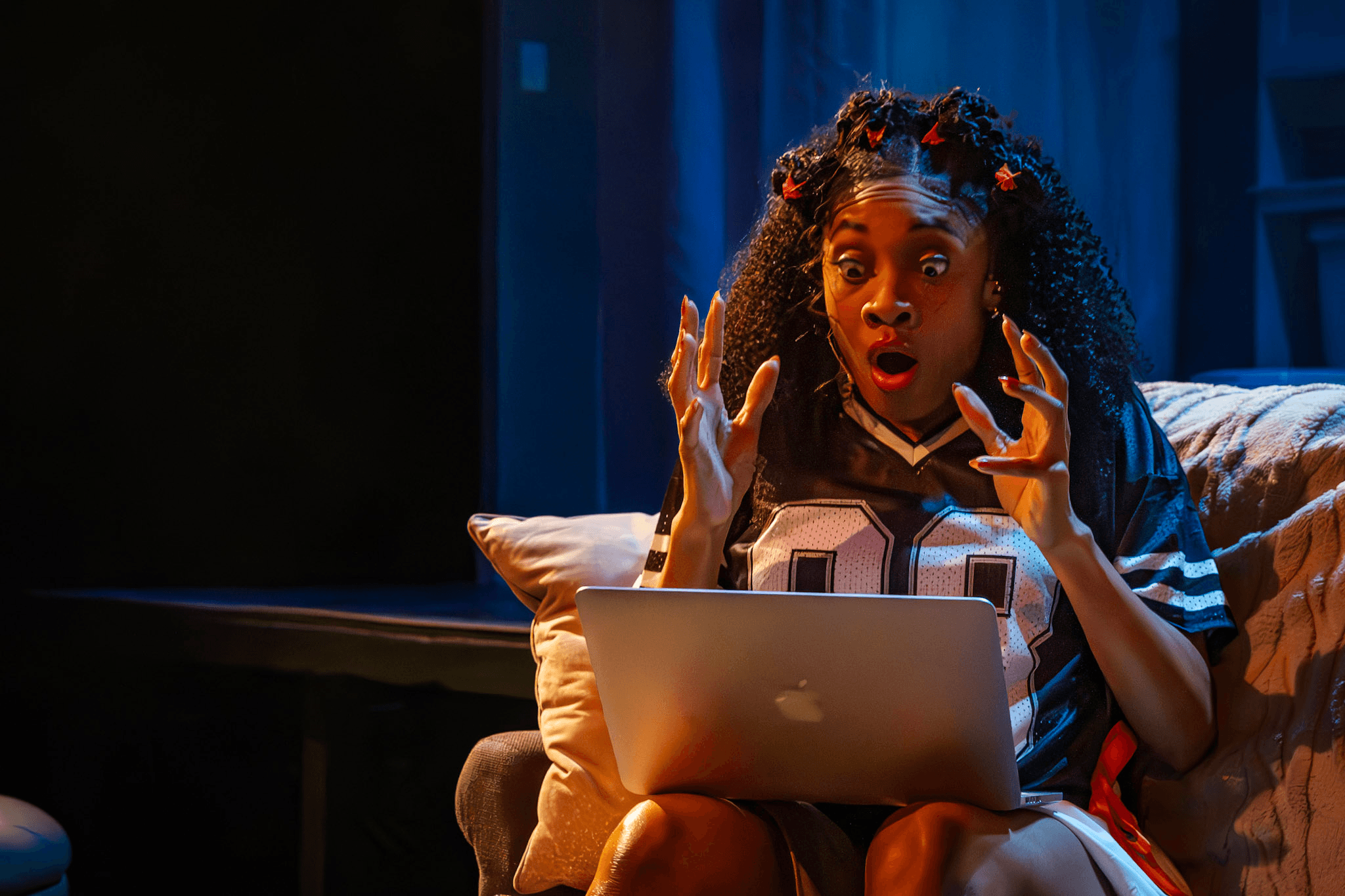
Shifted Lens Theatre Company’s sharp staging elevates this bloody musical teen satire.
Bust out the pom-poms and plaster on the fake smiles because Shifted Lens Theatre Company’s We Are the Tigers is ready to kill.
Preston Max Allen’s cheerleader murder musical, first workshopped in Los Angeles in 2015 before its 2019 Off-Broadway run, makes its Colorado premiere in a slick, bloody and vocally impressive production from one of the metro area’s most interesting young companies. Staged in the Larry D. Carter Theater at the Community College of Aurora, this was supposed to be Shifted Lens’ first production in its new East Colfax home, but as director Lexie Lazear quipped before the performance, “construction is going to construction.”
The temporary venue does not hurt the production. If anything, the clean theatricality of the space works in its favor. Lazear and her team lean into suggestion over realism, creating Riley’s basement through a series of distinct playing areas: a couch in the center with a door and trophy case nearby on the floor, a raised kitchen on one side, a bathroom with a toilet and shower on the other, and the band visible upstage in front of a scrim washed in shifting colors.
That efficient approach suits the material. We Are the Tigers is a tightly wound slasher comedy with limited locations, and the design keeps the emphasis on the performers while providing enough detail to follow the chaos as it escalates.
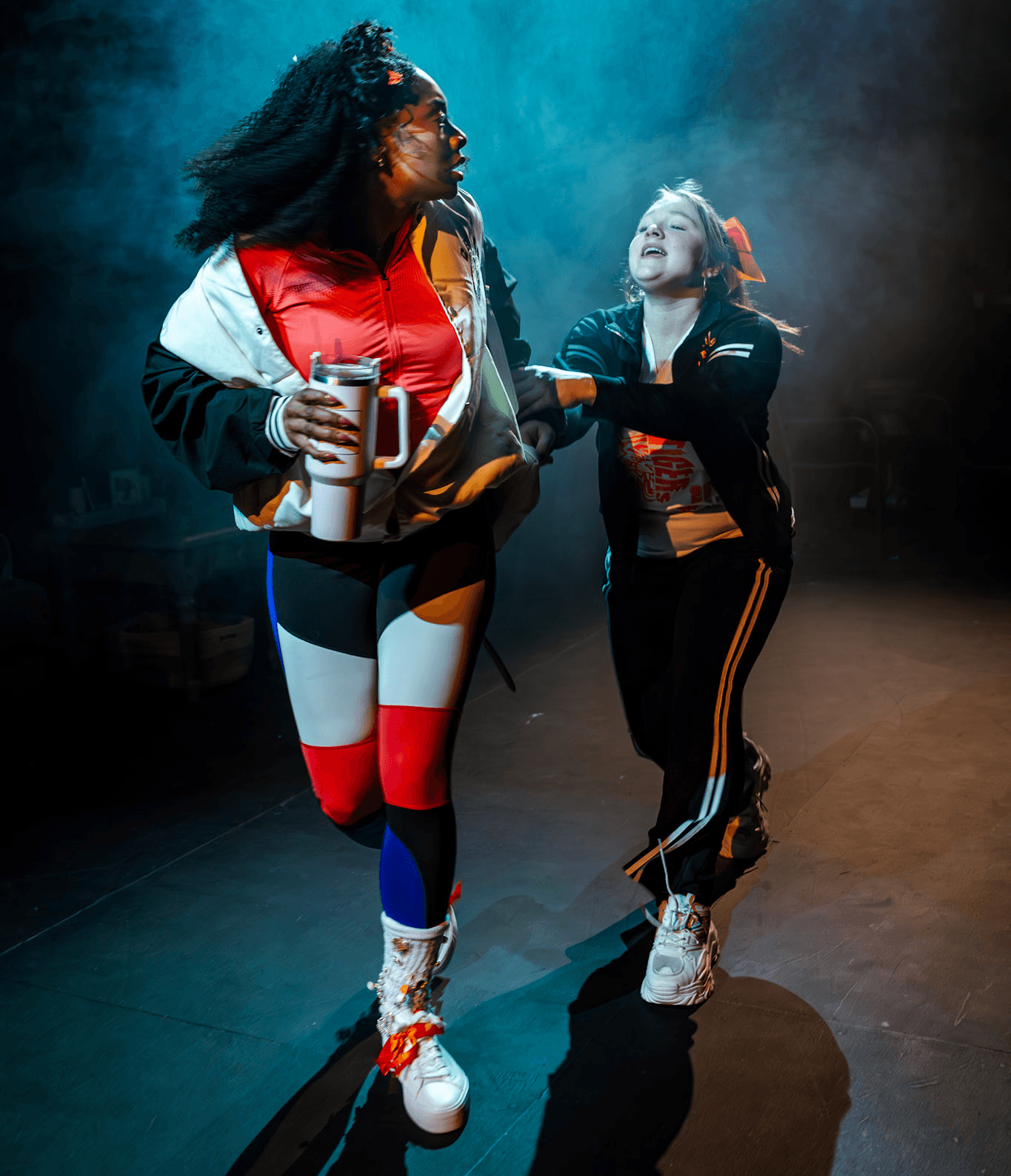
ThurZDay and Kate Hebert in We Are the Tigers. | Photo: Cohagen Wilkinson
Bloody fun amidst tonal whiplash
The setup is simple enough. Riley (Kate Hebert), the Tigers’ new cheer captain, wants to rebuild the team after an embarrassing season in which the squad went viral for all the wrong reasons. What begins as a basement gathering of grudges, rivalries and forced bonding quickly turns into a body count.
The show plays like a Gen Z Heathers with a little Team StarKid-style absurdity in the mix. That sensibility mostly works. The score is pop-punk adjacent, with plenty of opportunities for belting, group harmonies and high-emotion confrontations, even if none of the songs quite burrow into the brain afterward.
Where the material struggles is in its treatment of death. The deaths are grotesque, funny, sad and sincerely destabilizing depending on the scene, and the book does not always manage those shifts cleanly. The murder and grief are performed with real emotional weight, which makes it harder when the same losses become punchlines a few minutes later. That imbalance feels partly intentional, but not always fully resolved.
Viewers comfortable with gallows humor will likely have a good time. Anyone less interested in watching dead teenagers become both emotional rupture and comic engine may want to sit this one out. The production does not soften the show’s bloodier instincts, and that choice is part of what gives it bite.
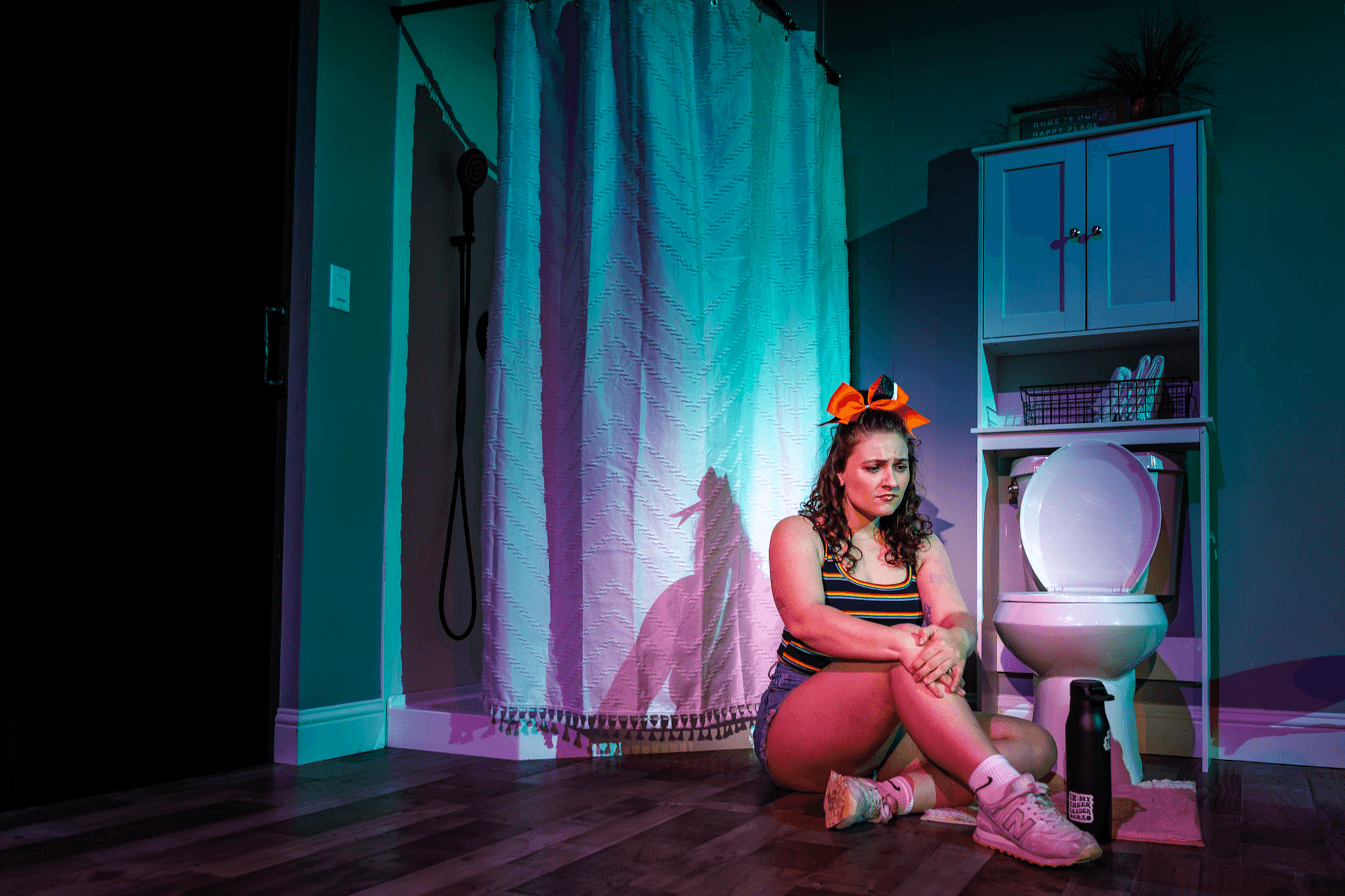
Gabrielle Knoop as Farrah in We Are the Tigers. | Photo: Cohagen Wilkinson
Vocals that make the case
What makes this Tigers worth watching is the musical execution. Under Tanner Kelly’s direction, the cast sounds terrific. Shifted Lens showed similar vocal muscle in Cruel Intentions, and this production confirms that strong musicality is becoming part of the company’s identity. The ensemble harmonies are crisp, the diction is clean and the full-cast numbers have a precision that helps sell the show’s heightened world.
Kate Hebert plays Riley with the right amount of tightly wound desperation. Her Riley is peppy because she has decided she must be, not because leadership comes naturally. That chip on her shoulder gives the performance an anxious charge, especially opposite ThurZDay’s Cairo.
As Cairo, ThurZDay gives the production’s most dynamic performance. She brings confidence, edge and expressive comic timing to a role that could easily become one-note. Her duet with Hebert on “Wallflower” is a standout, turning a friendship fracture into one of the evening’s most vocally and emotionally compelling moments. She is also very funny in smaller beats, especially during a slow-motion fight sequence where Cairo films the chaos with gleefully exaggerated reactions.
Chloe Wheeler gives Kate a guarded, prickly sincerity, particularly in her scenes with Chess. At the performance reviewed, Chess was played by Kayli-Sue Sarbaugh, one of three swings onstage, alongside Sam Evins as Clark and Alyza Alires-Bates as Girl #1/Freshman Squad—all of the substitutions were seamless. Sarbaugh and Wheeler share a believable tenderness that gives Kate’s later grief real weight.
Sabrina Patten is also a vocal standout as Annleigh, the team’s religious firebrand. Patten finds both comedy and sincerity in the character’s confrontational certainty, and her work in “Forever” and “Move On” gives the second act some of its strongest emotional texture. Quinnie Wolfe makes a sharp impression in the smaller role of Mattie, especially during “Mattie’s Lament,” which lands as one of the show’s funniest numbers.
Asheala Tasker brings a clear outsider energy to Reese, the mascot trying to find a place on the team, though their number, “Captain of the Team,” was one of the production’s shakier vocal moments. Gabrielle Knoop has fun with Farrah’s drunken messiness, and Madelynn Guerra brings welcome spark as Eva Sanchez, a rival-team outsider recruited into the Tigers’ increasingly cursed orbit.
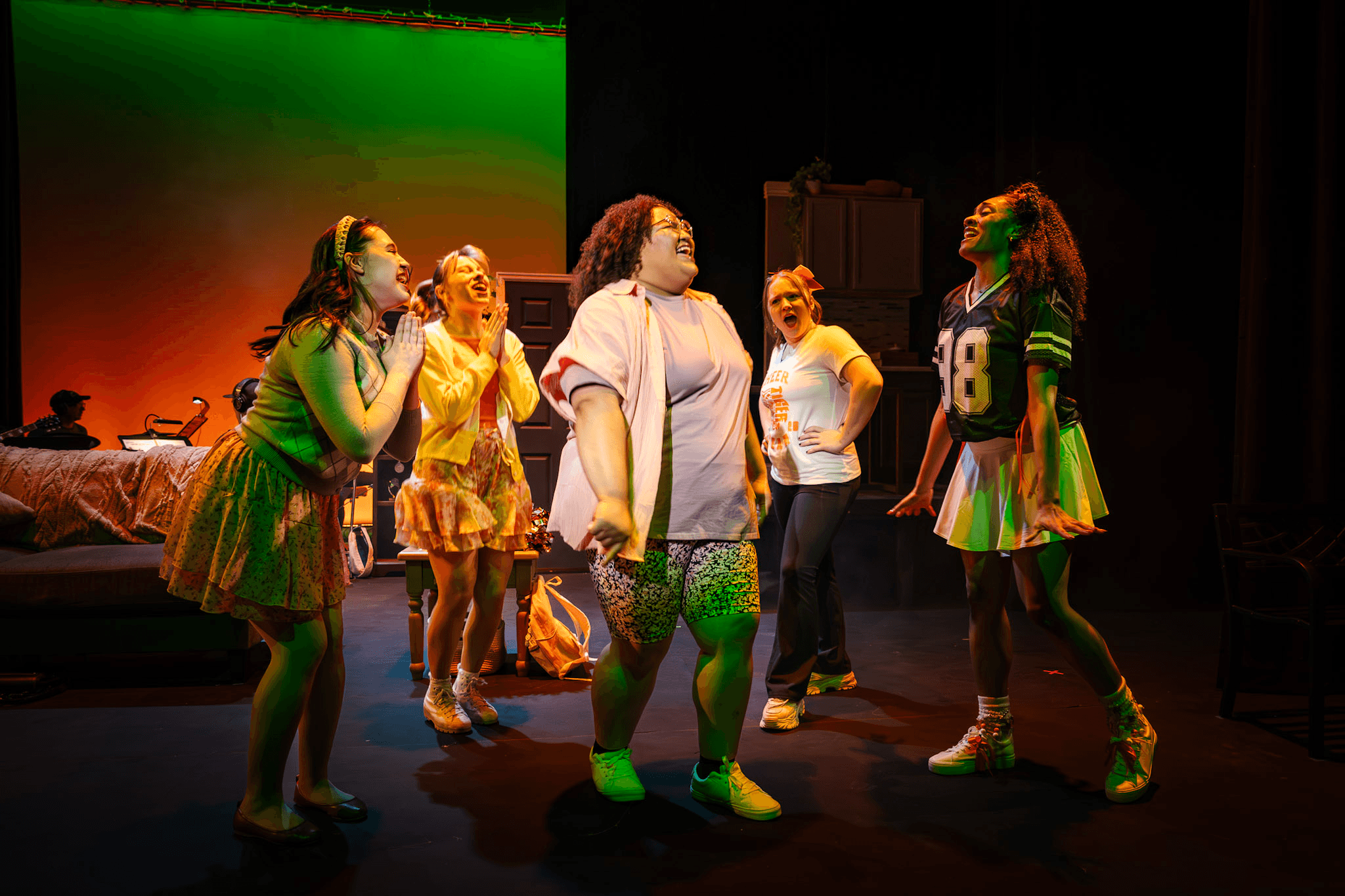
Shifted Lens Theatre Company’s production of We Are the Tigers. | Photo: Cohagen Wilkinson
Shifted Lens knows its lane
Dallas Slankard’s choreography wisely leans into cheer vocabulary without overcomplicating the movement. The dancing is ensemble-driven, which fits a show about team identity, performance and collapse. Mo Schultz’s lighting is one of the production’s strongest technical elements, using haze, shadow and sharp color shifts to push the show toward horror without overwhelming the comedy. The costumes also do smart character work, from Kate’s darker, edgier clothes to Riley’s polished preppy look, before the final cheer uniforms bring the team image into full view.
The live four-person band, led by pianist and conductor Trent Hines with Brian Bohlender on bass, Matt Rich on guitar and Gabe Maldonado on drums, gives the score needed drive without swallowing the singers. For a temporary venue and a young company, the production is impressively smooth.
That polish matters because Shifted Lens is clearly carving out a specific niche: locally premiering shows that appeal to younger audiences and giving them a level of care they do not always receive. The crowd at We Are the Tigers was one of the youngest I have seen at a Colorado theatre performance in recent memory. That is not an accident. Program work that speaks to younger audiences, and they show up.
We Are the Tigers is not a perfect musical. Its tonal swings can be jarring, and its darker ideas sometimes cut deeper than the writing seems prepared to handle. But Shifted Lens gives the Colorado premiere a sharp, funny and musically polished production. As the company prepares to move into its new home on East Colfax, it looks less like an upstart filling gaps in the local scene and more like a company that knows exactly where it wants to pounce.

An award-winning Colorado arts and culture reporter originally from Mineola, Texas. Tresca is the chief theatre critic for OnStage Colorado and managing editor of OnScreen Colorado. He’s the editor of Bucket List Community News, a contributor to Denver Westword and Estes Valley Voice, a resident storyteller for the Bonfils-Stanton Foundation and the co-host of the OnStage Colorado Podcast.

Leave A Comment