
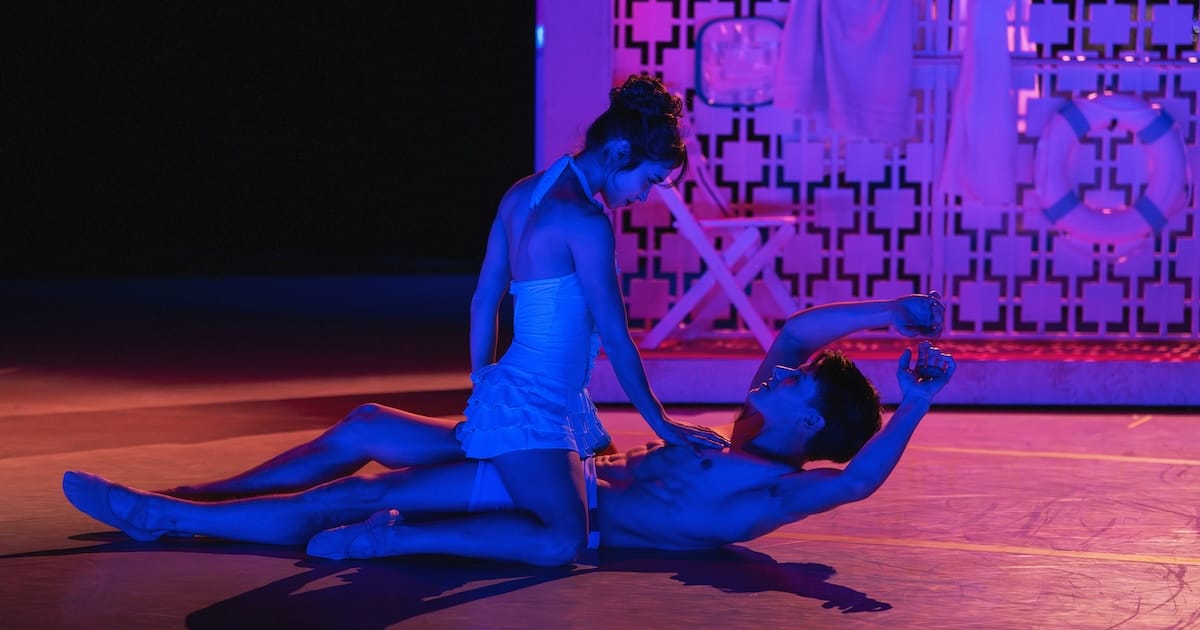
Wonderbound’s ambitious holiday production mixes Elvis Costello and ghosts in a time-bending narrative.
Alex: Today we’re talking about our experience attending Holidays at the Hideaway Hotel earlier this week. This is a Wonderbound production that’s up now. This is one of the ones where they’ve collaborated with live musicians. The music director is Erik Deutsch, who had something to do with the Black Crowes and has also had a solo career.
Toni: Yes, and in addition to being the music director for Hideaway Hotel, Erik also plays the keys and sings with four other live musicians in the rear of the stage.
Alex: This was one of the more ambitious things I’ve seen Wonderbound do in a while. It reminded me a bit of Tom Stoppard’s Arcadia because it is set in two different timelines, 1964 and 1985, and it alternates back and forth between them. There’s also a ghost involved and it’s set in South Florida.
Toni: Yeah, it’s set in this sleazy, motor hotel, the Hideaway, in those two different time periods. We start the show amid this robbery that’s taking place and lots of chaos happening at the hotel. And then we immediately jump back in time to 22 years earlier where we’re watching this young woman played by Rachel Dean and her lover, Nathan Mariano, go to the motel.
Then we cut back to present day where the Hideway staff is getting ready for the holidays and the manager, played by Ezra Schenck, sees Dean in ghost form. Schenck chases after her, as if they are connected, and then guest arrive, including a family of three in blue, newlyweds in yellow and the couple who is holding everyone hostage at the start in orange. The story then shifts between these two time periods to tell a multigenerational ghost story.
Alex: So as they always often do, there’s a synopsis in the program. And I was looking over it again and my god, it is a fairly complex plot; you would get gold stars if you were able to keep track of it while you were watching the whole thing. I know you’re much more of a “I’m gonna try and figure out whodunnit while I’m watching” person. You were a little more on top of it than I was for sure. How clear do you think that plot was to the average person watching this show?
Toni: I can definitely see how it is confusing because Wonderbound, in order to tell this story, is using the entire area of the stage. It is a massive endeavor. Garrett Ammon is staging scenes that take place simultaneously across the entire Wonderbound stage, which is very deep. There are often scenes that take place in both time periods in different parts of the stage, so if you’re looking on one side and just trying to follow the storyline, say in 1985, like in this group dance scene in the cocktail lounge, it’s revealed that Dean is actually the mother of the hotel’s current manager. It’s very surreal, and if you don’t pay close attention to every part of the stage at all times and keep looking back and forth, you’ll miss some of the action.
Alex: I was really distracted by the fact that it’s set to the music of Elvis Costello, specifically to his 1982 album, Imperial Bedroom. The way they performed these songs bore very little resemblance to the way they were recorded on the album. Since it’s an album I know so well, I was constantly trying to parse what I knew that song to be in my head with what I was seeing on stage. It really was distracting for me, but that wouldn’t necessarily be the case for a lot of people.
The lyrics are very much all about really heavy emotions, broken marriages, troubled relationships. It reflects the darker side of human emotion. So, while the songs did not necessarily relate directly to the action, they did in theme because much of the action was quite intense. There was a kidnapping, some gunshots, people died, and all of this occurred against the backdrop of these songs, which were performed exceptionally well but unusually by the band.
Toni: As somebody who has no familiarity with Elvis Costello, I thought it was really compelling how the band used the music to reflect the time period that we were in. When the story was set in the 1980s, the band used a more rock/alternative sound to reflect the era, and when we returned to the 1960s, they played music in a more lounge jazz style. The use of various musical styles to help tell the story and immerse us in the changing time periods was extremely effective. And without that music to help cue me into the shifting times, I would have been really lost. Overall, I thought the band did a nice job supporting the dance, and I personally love a live vibraphone, which they had in the back, played by Greg Harris.
Alex: The one quibble I did have was I thought that the woman on drums, Michelle Pietrafitta, who was doing some of the vocals was not a strong singer at all. I didn’t think she was very much on key to my ear.

Photo: Martha Wirth
Striking set design
Toni: Let’s talk a little bit about the scenic design, by Garrett Ammon, which I thought was one of the most impressive works that I’ve seen from Wonderbound to date. It’s this fascinating set that creates the signage for the Hideaway Hotel, complete with the pool sign and the Exotica Lounge sign, but all of those different pieces move, roll, and turn around.
For example, when you look at the pool sign straight on, it is this neon thing that says “pool.” However, when turned sideways, it creates the poolside seating area. Same thing with this hotel sign — it also breaks away and when you turn it around, it becomes the beds that they use, and those beds also double as benches. It’s an extremely tactile, intricate moving set. I just wanted to point that out because I thought the design and execution of it, especially how they had the actual sign lit up in neon and changing to reflect the different time periods, was a really impressive technical feat.
Alex: Yes, and they always do this where they have these moving set pieces that are mostly handled by the dancers themselves. This is the first one I’ve ever seen where the pieces were lit like this and it was really effective. It had that kind of ’60s vibe to it. The set is an integral part of the choreography, and I am not aware of any other companies doing something similar. Maybe they do, but I’ve never seen it done. It’s really pretty impressive.
Toni: Well, it can’t be done in the theatrical world because there are union rules that say if you’re a union actor, you can’t touch the set piece. That’s why, in live theater, actors rarely move the set, so when it’s done well in a ballet piece, it stands out.
Alex: Yeah, I should call out Eleanor Moriarty, who’s credited as the production stage manager and scenic charge artist. It was very impactful. A lot of Murphy bed action, the way those beds would kind of fold down out of the piece. And Joseph Naftal’s lighting design really helped establish that piece that looked like the bottom of a pool, where I believe one of the characters drowned, correct?
Toni: Yes, that is how the young woman portrayed by Dean died. Her best friend and motor hotel owner, played by Haily Stinchcomb, invites her over to watch her lover perform music on television. However, Dean sees on television that her lover has a new lady with whom he is friendly, so she commits suicide by drowning herself in the hotel’s pool, leaving her friend with her child, who grows up to be the hotel’s manger.
Alex: So there are all these loops of generations that you have to try and divine as you’re watching this. Props to you if you can keep up with it all. But yeah, it really is neat. And as far as the dancing goes, I felt like I’ve seen enough Wonderbound shows that I expect it to be top quality, top notch. I thought I saw some different things in there but I lack the vocabulary to really articulate what it was. You frequently mention Garrett’s fondness for having the performers run in circles, but I didn’t see nearly as much of that in this show.
Toni: You’re right. Garrett Ammon frequently uses this circling blocking when characters are in distress or need to think. This piece isn’t like that. You are not watching characters think about their actions. All of the characters in this are in extremely flighty situations and must keep moving, which is reflected in the choreography, both in the movement of the set pieces and in the kind of crossing between the various families and time periods.
Alex: Yes, there were a lot of violent stage situations — people tied up, there were guns, there was shooting and kidnappings. It was all very fluid and part of the action. It was just a lot of fun to watch. I have to say, even though they tagged it Holidays at the Hideaway Hotel, it really doesn’t have a strong holiday theme — I mean, even though it ostensibly takes place on Boxing Day and Christmas Day, there’s not much of that in the show. There’s not a single Christmas tree or a Christmas light or anything like that in the show.
Toni: No. Aside from the sign mentioning spending your “holidays at the hotel,” there isn’t much holiday spirit in the piece. Oh, and I suppose the two motel employees, played by Alex Kearnan and Marcelina Lancaster-Gaudini, are also dressed in these pink Santa-esque, vaguely festive costumes. But aside from that, not really. I mean, the lighting design’s colors aren’t even Christmas-themed. They’re experimenting with a lot of pinks, blues, yellows, reds, and purples, often in unexpected ways. Even the red, which is sometimes associated with the Christmas season, is used sparingly and only in the most dramatic moments, not exactly in the festive holiday spirit, or when it lights up the neon sign in those truly creepy moments.
Alex: As someone who has attended the majority of Wonderbound shows over the last few years, I feel like I’ve gotten to know these company members quite well, and I enjoy seeing them in new roles. One of my favorites is Aidan O’Leary, a tall bald guy who commands a lot of attention on stage and does a great job playing the father. It was also great to see Dean as the young woman and ghost and Morgan Sicklick as the kidnapper. It’s really fun to see these performers again and again because we’re also watching young dancers develop their skills right in front of our eyes. They are a part of this incredible company and work under Garrett, an extraordinary choreographer, so it’s always exciting to see them again and again in different roles.

Alexa Kearnan and Marcelina-Lancaster Gaudini | Photo: Martha Wirth
Show is selling out
Toni: Definitely. Unfortunately, if you want to check out Holidays at the Hideaway Hotel this year, you might need a time machine to go back in time and grab tickets. When I was talking to marketing director Kelly Jones at the show, she told me even the performances they added because of demand are selling out. I asked Kelly, “Are there even any shows that I can direct people to in this review?” and she quipped, “Yes, they can come to our next show, Decadent Desires, in February.” There are some seats scattered throughout the run, but your best bet is to call the box office on the day of the show and see if anyone has cancelled.
Alex: Bottom line, if you want to attend a Wonderbound show, you must plan ahead. Don’t bother wondering or thinking about what it is. If you want to see one of their shows, get your tickets right away. Even if you’re not a dance person, I tell people you will really dig this. It’s just a really different kind of experience. To me, it looks like something from New York City, but it’s in Denver. I think it’s a great thing to have in the city because they’re a step above what we’re used to seeing. So, Toni, how did you think this stacked up to other Wonderbound shows we’ve seen in recent years in terms of creativity and complexity?
Toni: Wonderbound produces two types of shows: narrative-driven shows like this one and vignette-based performances such as their last show, Rock Ballets. I prefer when they take a chance on narratives over the vignett shows, which can feel a bit less developed, and I thought Hideaway Hotel was one of their most impressive original works in a while. This is definitely more interesting than Awakening Beauty; I believe you’d have to go back to 2023, when they did Wicked Bayou, to find a show of comparable quality. I liked how challenging the narrative was, and how it really demanded your attention while trying to watch and follow this action that was quickly outpacing these characters.
I thought the scenic design and lighting were excellent, among the best I’d seen from the Wonderbound team. We didn’t even mention a part of the scenic design — under the band riser, they have this really nice forced perspective view of these other rooms at the motor hotel, but they look really small because they’re supposed to be far away from the action that we’re seeing in these much larger rooms that we’re inside of. It was very sophisticated work.
And, while the storyline is certainly challenging, I enjoyed it, whereas my girlfriend did not. During the drive home, she told me that it was quite difficult for her to get her hands on and that she thought it was a little boring. She didn’t read the program, so while she enjoyed the music and the dancing’s atmosphere, she found it difficult to relate to it thematically, and I firmly believe that you should not have to read the program to understand the plot. If you can’t understand what you’re watching, there’s something wrong. How about you? How are you thinking about this performance, Alex?
Alex: Yeah, I mean, I definitely did not grok the whole plot as well as I think Garrett would have hoped. At the same time, the entire piece, including the dancing, music, sets, and all of Dawn Fay and Sloane Crazybear’s costumes, was fantastic as always. Really a fantastic production. Perhaps not as thoroughly enjoyable or fun as some others I’ve seen. This one definitely deals with some heavy themes, but as a work of art, I think it’s really quite exceptional and one of the strongest pieces I’ve seen from Wonderbound.
Toni: Yeah. It’s a more gritty, introspective show than most other companies are putting on this holiday season, but if you enjoy dance and are willing to be challenged, it’s a must-see.

Alex Miller is editor and publisher of OnStage Colorado. He has a long background in journalism, including stints as the top editor at the Vail Daily, Summit Daily News, Summit County Journal, Vail Trail and others. He’s also been an actor, director, playwright, artistic director and theatre board member and has been covering theatre in Colorado since 1995.

A Colorado-based arts reporter originally from Mineola, Texas, who writes about the changing world of theater and culture, with a focus on the financial realities of art production, emerging forms and arts leadership. He’s the Managing Editor of Bucket List Community Cafe, a contributor to Denver Westword and Estes Valley Voice, resident storyteller for the Bonfils-Stanton Foundation and co-host of the OnStage Colorado Podcast. He holds an MBA and an MA in Theatre & Performance Studies from CU Boulder, and his reporting and reviews combine business and artistic expertise.

Leave A Comment