
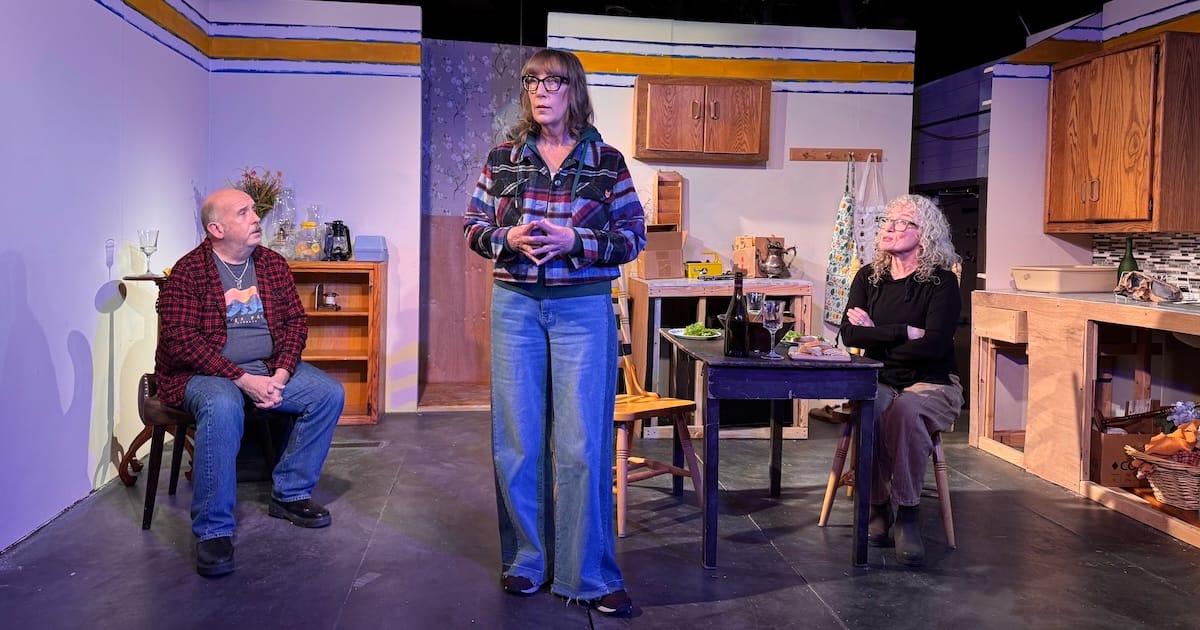
Springs Ensemble Theatre stages Lucy Kirkwood’s post-disaster drama an intimate setting that pulls the audience into every uneasy exchange.
A bottle of alcohol is opened, a salad with bread is placed on the table and three old colleagues converse about the past and what’s next for them. It could be the start of a normal, slightly awkward reunion, except that outside the window, the world has been altered by a radiation disaster, and no one in the room is saying what they truly mean.
That uneasy domestic calm is where The Children begins. Under the direction of Madalyn Rilling, Springs Ensemble Theatre’s intimate staging of Lucy Kirkwood’s three-person drama places the audience so close to the action that the silences feel as loud as the dialogue.
Hazel and Robin, retired nuclear scientists living just outside a contaminated zone, are forced to confront their past when Rose, a colleague they haven’t seen in nearly 40 years, appears at their door with a purpose she refuses to explain. What unfolds is less of a traditional post-apocalyptic story and more of a slow unearthing of guilt, resentment and questioning of their responsibility to each other and the next generation who will bear the consequences of their actions.
That creeping reveal of Rose’s true intentions are the engine of the play, and SET proves an ideal home for its slow-burn tension.
Performed in the Fifty-Niner Speakeasy, a tucked-away venue behind a hidden door in a downtown Colorado Springs game shop, the space naturally favors intimate, small-cast storytelling. Here, that closeness becomes a dramatic asset. Rather than simply observing this reunion from a distance, you feel as if you’ve been seated at the kitchen table, listening in as old wounds resurface.
With strong performances, thoughtful design and an intimate setting that heightens every glance, SET’s ‘The Children’ is a dark, funny and unsettling evening of theatre.
Three people, multiple agendas
What makes this production hum is how clearly each actor understands that their character is always playing more than one thing at a time.
When Amaya Egusquiza’s arrives to the house as Rose at the start of the play, she is careful and cagey. Rose smiles and indulges Hazel’s small talk, but you can feel her steering the conversation toward a goal she refuses to name. Egusquiza plays her as someone constantly calculating, revealing just enough warmth to be disarming while clearly holding something back.
When Robin enters, Stephen Alan Carver brings an easygoing charm that quickly complicates the atmosphere. He cracks open alcohol, jokes, reminisces and slowly reveals himself to be far less forthcoming with his wife than his affable demeanor suggests. Carver’s performance balances humor and frustration, making Robin charming even as his evasions pile up.
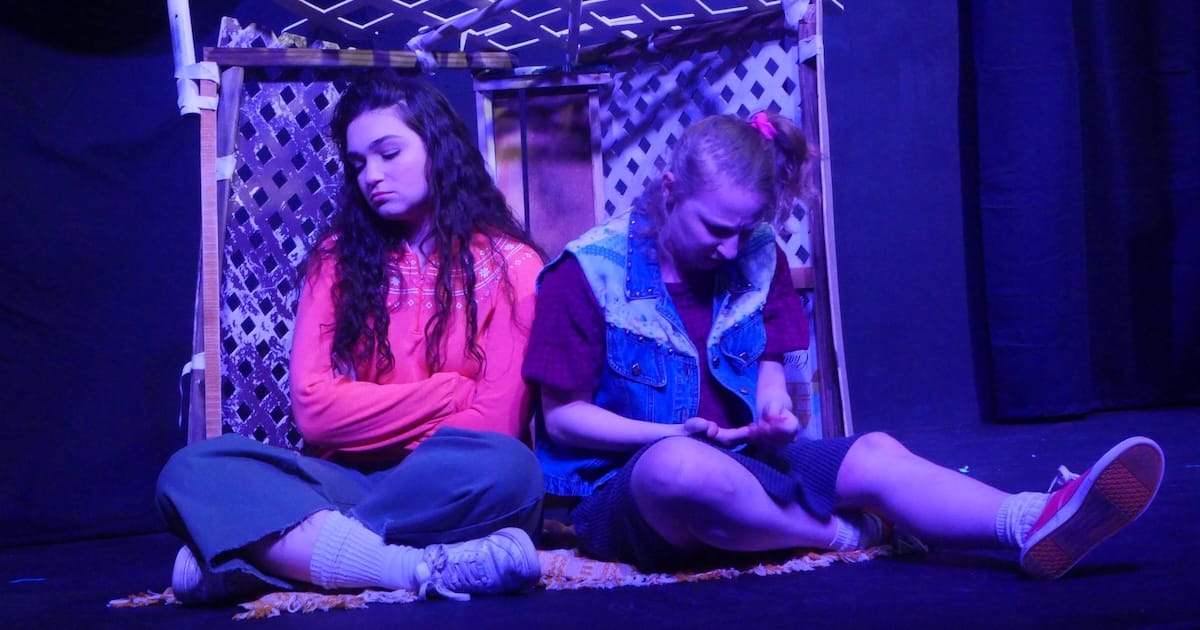
Dinah Mann’s Hazel is the most fascinating presence onstage. As written, Mann is rarely allowed to say exactly what Hazel is really thinking. Instead, she communicates through physical choices: where she sits, how she moves through her yoga routine, the moment she pointedly occupies Robin’s lap as Rose presses in closer. Hazel is sharp, independent and deeply insecure all at once, and Mann allows those layers to flicker constantly beneath the surface.
There’s also more comedy here than you might expect in a post-apocalyptic drama. Much of it comes from the trio’s long familiarity with one another and their ability to press each other’s buttons with surgical precision. The laughter from the audience often lands uneasily, underscoring how quickly this reunion can turn cutting.
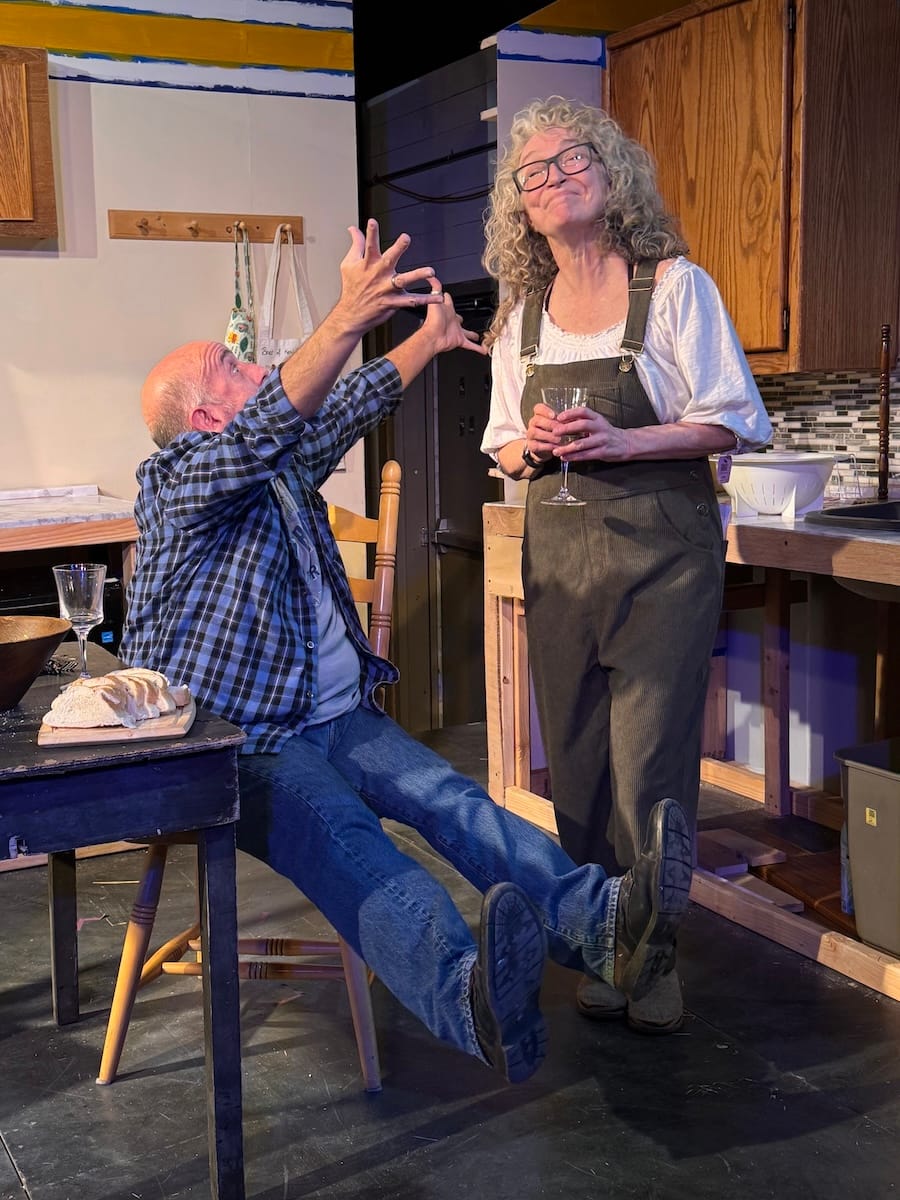
Photo: SET
A cozy cottage at the end of the world
Erik Mattson’s scenic design creates a cottage that feels convincingly lived in, complete with a sink, a window suggesting the dangerous world beyond and multiple doorways that allow for fluid movement. The props work by Rain Gray and Jade Mattson also stands out. The simple meal of salad and bread, the steady appearance of wine glasses and plates all make the space feel actively inhabited rather than staged.
Lighting by Rose Mitchell and Samuel Phaneuf remains mostly naturalistic until late in the play, when subtle shifts signal a tonal change as Hazel and Rose do yoga together in the show’s final moments. Ethan Everhart’s sound design is used sparingly but effectively to underscore transitions and create a faint sense of unease.
The one notable misstep is the decision to split the play into two acts with an intermission. Kirkwood wrote The Children as a tight, uninterrupted 90-minute piece. Here, the break lands awkwardly in the middle of a scene. The break undercuts the mounting tension and contributes to a second half that feels slower than it should. Some early pauses between Hazel and Rose also tip the play’s hand slightly, signaling that something ominous is coming rather than letting it emerge organically.
The pacing never derails the production, but you can feel that the script’s original rhythm has been slightly stretched.
A finale that’s hard to shake
When Rose finally reveals why she’s come, the play pivots from personal drama to something much larger. She’s assembling a group of aging scientists willing to return to the disaster site on what is essentially a suicide mission, believing their generation should clean up the mess they helped create rather than leaving it to their children.
It’s a chilling proposition and Rilling allows it to land without melodrama. The audience is left to wrestle with the same question facing Hazel and Robin: if you helped build something that harmed the world, what do you owe the next generation? That question lingers long after the lights come up.
With strong performances, thoughtful design and an intimate setting that heightens every glance, SET’s The Children is a dark, funny and unsettling evening of theatre. Tighten the pacing slightly and it would be exceptional. As it stands, it’s a compelling fit for a company known for edgy, in-your-face work that asks audiences to sit with discomfort.

A Colorado-based arts reporter originally from Mineola, Texas, who writes about the changing world of theater and culture, with a focus on the financial realities of art production, emerging forms and arts leadership. He’s the Managing Editor of Bucket List Community Cafe, a contributor to Denver Westword and Estes Valley Voice, resident storyteller for the Bonfils-Stanton Foundation and co-host of the OnStage Colorado Podcast. He holds an MBA and an MA in Theatre & Performance Studies from CU Boulder, and his reporting and reviews combine business and artistic expertise.

Leave A Comment