
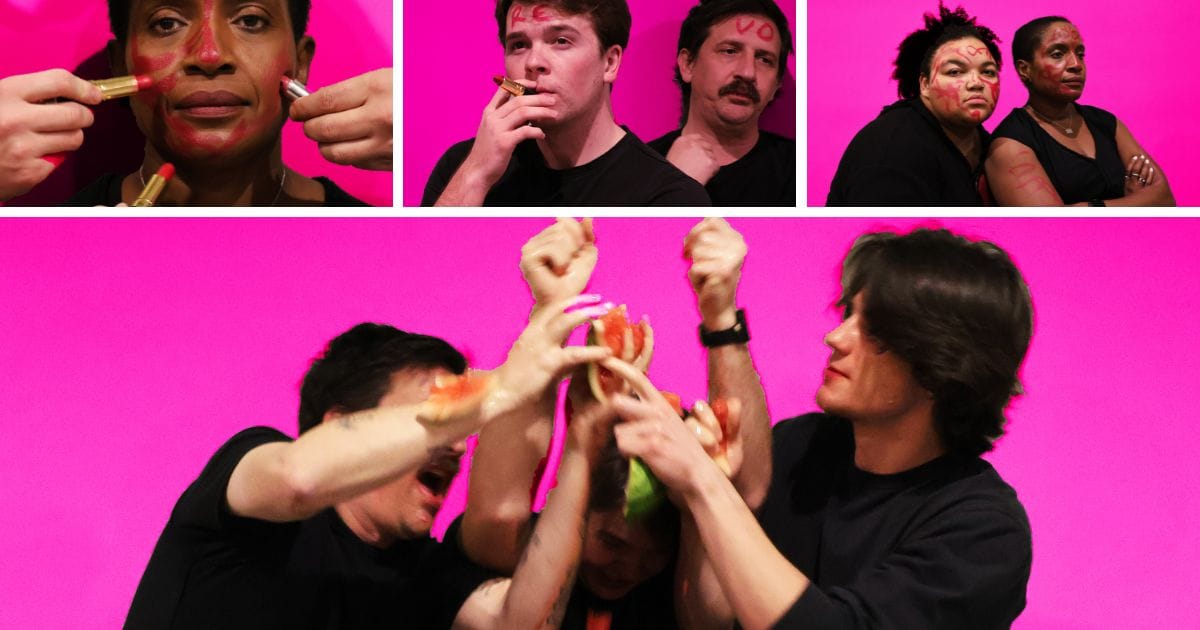
The Moot Point Project’s Revolt. She Said. Revolt Again. is a confrontational, experimental provocation that challenges audiences to rethink power, patriarchy and performance.
Revolt. She Said. Revolt Again., produced by The Moot Point Project at Su Teatro Cultural and Performing Arts Center, is unlike almost anything else you’re likely to see on a Denver stage this year, and that distinction is very much the point.
An emerging company founded by recent University of Northern Colorado graduates, The Moot Point Project has made no secret of its ambition to push past the bounds of traditional theatre. Their name doubles as a manifesto — “the limits of traditional theatre are a moot point,” its website argues — and Alice Birch’s edgy, formally unruly play proves an ideal vehicle for that mission.
In a city with a strong but largely conventional theatre ecosystem, Revolt. She Said. Revolt Again. arrives as a deliberate disruption. Directed with fearless urgency by True Smith, the production opens The Moot Point Project’s third-ever show and first official season with a work that is designed to provoke attendees and force us to reconsider our relationship to performance.
In under 90 minutes, the play unfolds across four acts that reject linear narrative in favor of a series of vignettes, disruptions and direct confrontations with the audience. The result is an audacious experience that is intentionally abrasive, frequently funny and persistently unsettling.
From observation to implication
Audiences entering Su Teatro are not directed toward the company’s familiar mainstage but instead ushered into the smaller Frank Trujillo Salon. The space is modest: a slightly raised platform, a projection screen with “ACT ONE” projected on it with a VHS-like static and rows of chairs arranged in a conventional, forward-facing formation that suggests (falsely, as it turns out) a traditional evening of theatre.
At the door, you’re handed a pink, fold-out program that resembles a zine. Packed with a director’s note and a lengthy list of content warnings, including “strong language, sexual content, depictions of blood and vomit, descriptions of violence and abuse, and depictions of nudity,” the program requires physical effort to unfold, rotate and refold. That friction is not accidental. Like the play itself, it asks the audience to work, to engage actively rather than passively.
The first act initially lulls the audience into recognizable territory. Presented as a series of discrete vignettes, the scenes pair one woman and one man in situations that feel uncomfortably ordinary: a couple renegotiating sex, a conversation about marriage that exposes unequal expectations and an employee requesting time off from a boss who demands more.
As the women, Asheala Tasker, OD Duhu and Evy DiPasquantonio ground these moments with specificity and emotional clarity, navigating Birch’s stylized dialogue with an awareness of how closely it mirrors real-world dynamics. Opposite them, Jacob David Smith, Kent Lullo and Carson Coffey lean into exaggeration with purpose, portraying men whose authority is both ridiculous and deeply entrenched. The humor lands, but it’s edged with menace.
Structurally, Act One is the most conventional the play will ever be. The audience remains seated. The scenes, though disconnected narratively, are legible in intent. And yet even here, Birch and director Smith are laying groundwork, sketching a pattern of contradictions and expectations that will soon spiral beyond containment.
Rearranging the room and the rules
That spiral begins in Act Two, when the production quite literally disrupts the audience’s position. Chairs are rearranged into a horseshoe, as the actors pull a table into the center of the room and perform on the same level as the crowd. Projections flicker behind them, announcing scene titles that accumulate into an overwhelming litany of commands: Revolutionize the world. Revolutionize the work. Revolutionize the language.
The effect is cumulative and destabilizing. Scenes blur into one another as a harrowing dinner-table confrontation unfolds between three generations of women that escalates into grotesque, symbolic violence. Blood appears. Tongues are ripped out. Any illusion of polite observation dissolves as the audience is placed inside the action and forced to sit with the imagery rather than process it from a safe distance.
By the third act of the play, the audience has been moved into a “meatball” formation, in which actors surround the audience, overlap dialogue and remove layers of costume while marking their bodies with lipstick. Individual words become indistinguishable, so meaning here is conveyed more through sensation than through language. What remains is pressure, urgency and the feeling of being implicated.
That sense of controlled chaos is reinforced by the production’s spare but precise design. Harrison Rosenberg’s scenic approach is minimal, relying on chairs, a table and projected text to constantly redefine the space. Feliz Martinez outfits the performers in everyday clothing that is gradually removed, repurposed or weaponized, mirroring the play’s systematic stripping away of social norms.
Lighting designer Brevin Bazurto does the heaviest atmospheric lifting, using a limited rig to flash between stark illumination and moody, saturated color. The shifts track the emotional temperature of the room, amplifying moments of humor, horror and revolt with striking precision.
A deliberate discomfort
By its final moments — a brief, chilling exchange in which the women discuss the necessity of eradicating men as a precaution — Revolt. She Said. Revolt Again. makes no attempt to soften its provocation. This is a play designed to unsettle, frustrate and linger long after the lights come up.
That won’t be for everyone. But in a city where experimental theatre remains scarce, The Moot Point Project’s commitment to risk feels both bracing and necessary. Revolt. She Said. Revolt Again. is not an easy watch, nor is it meant to be. It is, however, a bold declaration that Denver’s theatre ecosystem has room (and need) for work that refuses comfort and demands engagement.

A Colorado-based arts reporter originally from Mineola, Texas, who writes about the changing world of theater and culture, with a focus on the financial realities of art production, emerging forms and arts leadership. He’s the Managing Editor of Bucket List Community Cafe, a contributor to Denver Westword and Estes Valley Voice, resident storyteller for the Bonfils-Stanton Foundation and co-host of the OnStage Colorado Podcast. He holds an MBA and an MA in Theatre & Performance Studies from CU Boulder, and his reporting and reviews combine business and artistic expertise.

Leave A Comment