
Caryl Churchill’s award-winning play given an admirable production under Director Brett Landis.
Caryl Churchill’s Top Girls is a challenging play – both to perform and for audiences. As presented by Theater Company of Lafayette, it also is one of the angriest plays I’ve ever seen. Every character is silently and occasionally vocally screaming at how women are trapped by societal constructs. They yearn to break free, but is that freedom worth the cost? Top Girls does not, because it cannot, answer that question. As directed by Brett Landis, this production is admirable, even if not all the challenges are met.
Non-linear but connected
Top Girls is a non-linear play. The first act raises so many questions: Where? When? What is this about? I found the questions I had about what I was watching intriguing but not aggravating.
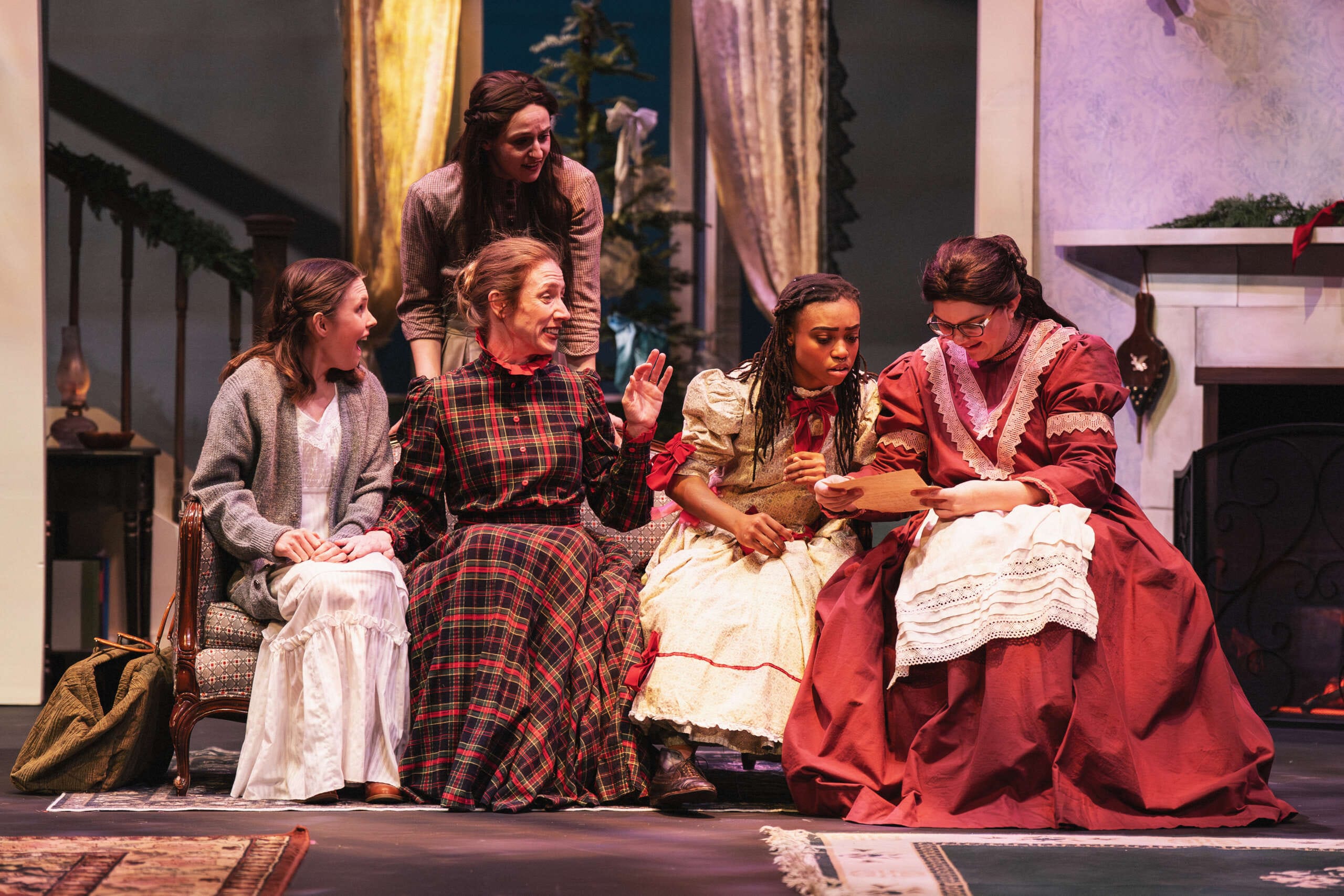
In the first act, Marlene (Jo Niederhoff), smartly and professionally dressed, is hosting a meal at a restaurant. Various women arrive, but why are they in costume? Why is one in a kimono talking about being a concubine to a Japanese Emperor (Cami Libouban-Gunderson)? Is one the Pope (Elizabeth Kappes)? One talks about being a world traveler (Jaccie Serbus). And there’s one who appears to be from the 1100s (Daphne Moore). They are joined late by a woman in warrior garb who grunts (Shelby Repaci).
Better-educated British audiences may have recognized each of these women who are based on actual historical women or from paintings and stories. While I knew the character types, I didn’t have the instant connection which would have made the play more accessible from the start. That’s on me, though.
Each of the women have stories to tell, often doing so in overlapping dialog and simultaneous conversations. The common thread for many of the discussions is children – birthing and losing them to the whims of men. But they are also gathered to congratulate Marlene on her promotion at Top Girls Employment Agency. The act ends with the warrior, Gert, who has been quietly mocking the attendees and engaging in all manner of small humorous physical bits, rising and telling the tale of leading women, tired of their children dying in conflicts, to raid Hell to end evil.
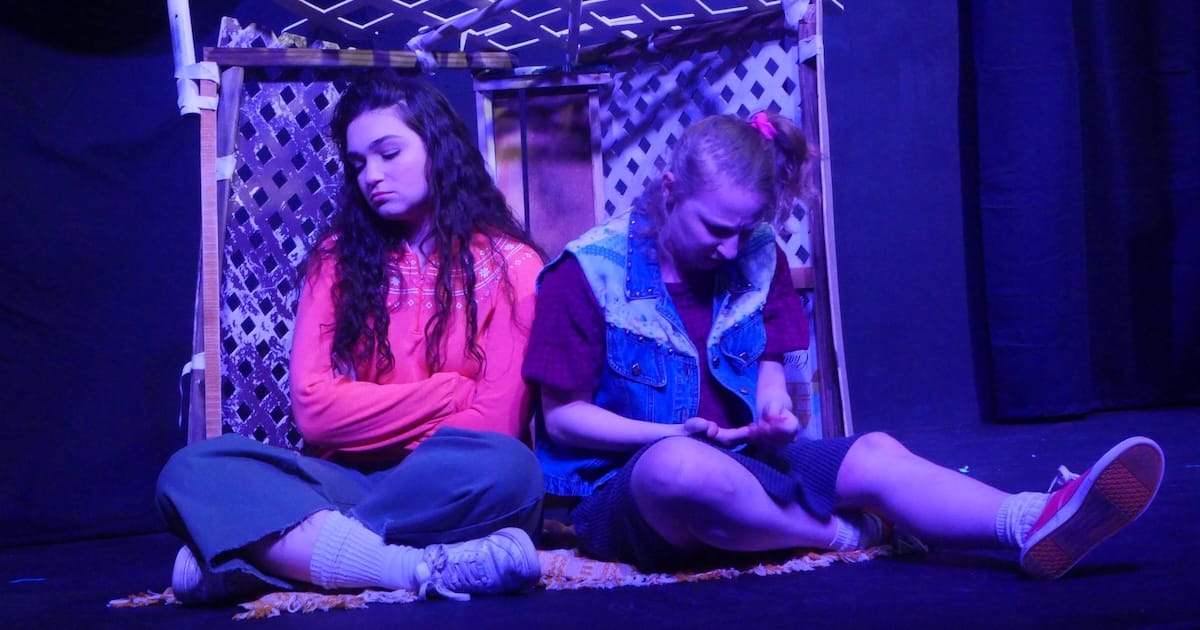
Dramatic shifts in place and time happen twice in Act Two. We meet Angie (Repaci) a teen girl hiding and playing with a younger girl (Moore) in a backyard. Angie is not happy with her life or her mother. But, what is the connection to Act One? And then we are in London at the Top Girls Employment Agency watching Marlene and Win (Libouban-Gunderson) interview a series of women in various stages of life who are looking for a change or an opportunity.
Marlene is confronted by the wife of the man who did not receive the promotion (Moore) who challenges Marlene for accepting a job that a man should have. The doubling of actors from Act One into these various characters smartly begins to draw Churchill’s themes out. And, into this mix, Angie shows up having travelled to London to be with her Auntie Marlene.
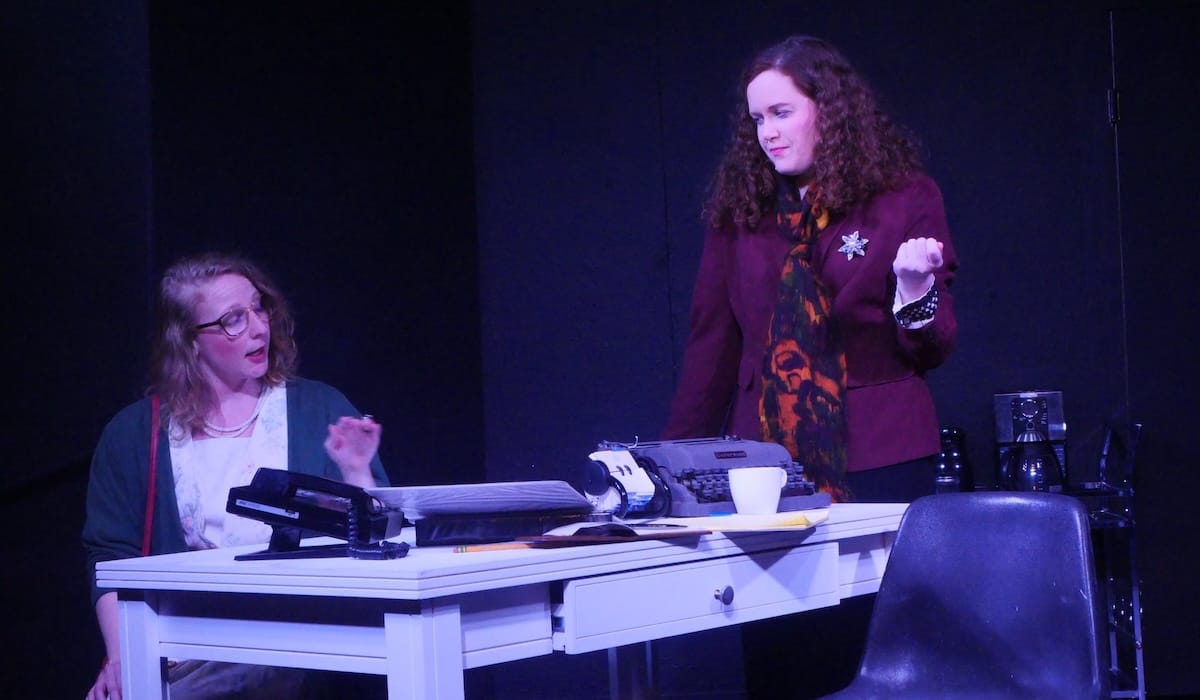
Photo: TCL
Stick around for Act Three
Before the show began, Director Landis implored the audience to stick around for Act Three where everything would make sense, promising a reward and purpose for any confusion in the first two acts. Yet, Act Three takes place a year before Act Two in Angie’s house where Marlene has come to visit for the first time in several years. Marlene and her sister, Joyce (Serbus), do not get along. They heatedly discuss their differing lives and struggles each has faced. Serbus is phenomenal here.
So, there are a lot of seemingly disconnected pieces. It was only when I left the theatre and could think and discuss the play that it all did fit together. At least, I made connections and had my own understanding of the play. I had a deep conversation with my spouse on the drive home. That too, filled in the play’s themes for me as a male. It’s not that men are the villains, per se, in Top Girls – but male dominated societies are the villains and the men who are part of them don’t necessarily see the effects on women.
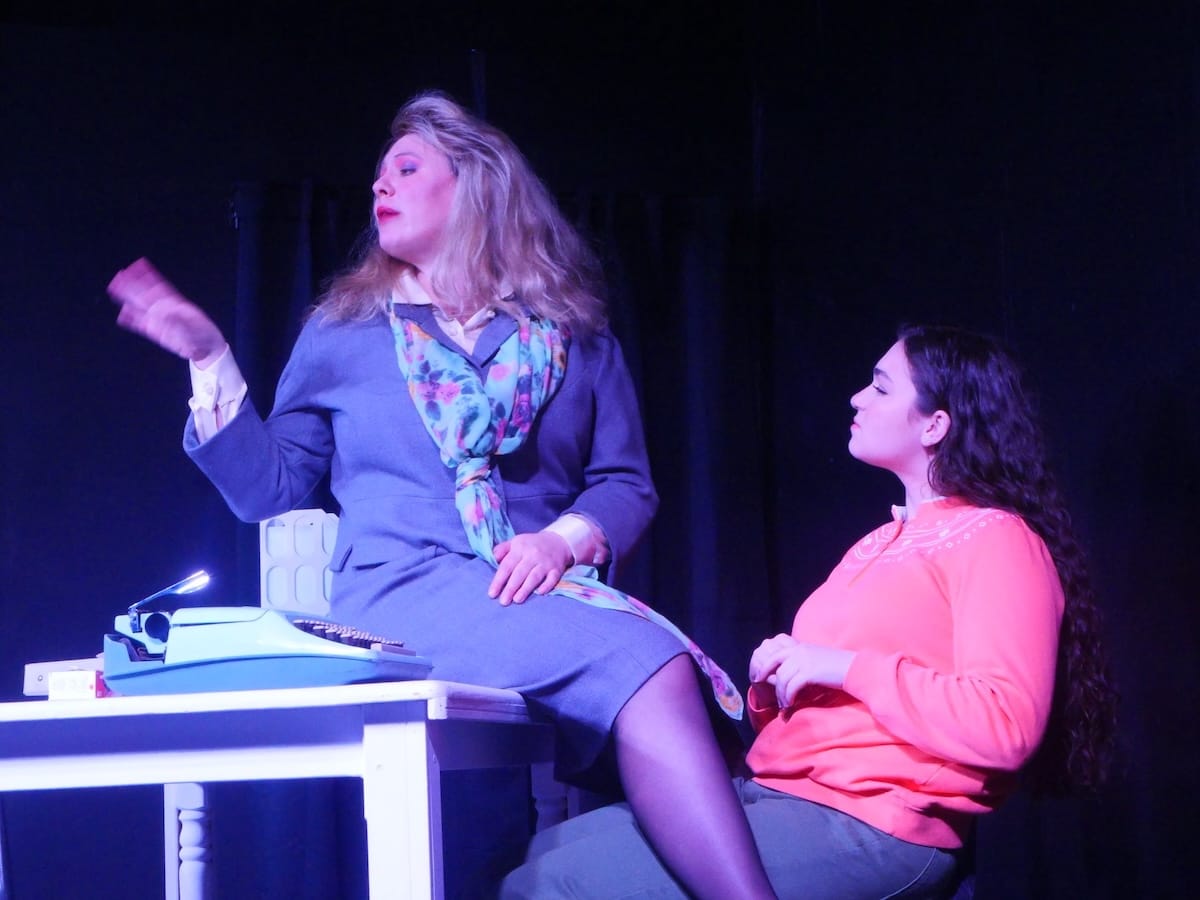
Photo: TCL
Tricky dialog
Top Girls has many sequences of overlapping dialog. That is not simple to stage for a director nor for actors who have to focus on their own words while several others are speaking. There is so much for these characters to talk about that they can’t wait and react. They have to be heard now. But, the challenge for the director and cast is that the words must be intelligible because there are stories and important concepts being spoken that inform and develop the play’s themes.
Most of the cast handles this well in Act One, although at times, it didn’t always feel natural and alive. Rather, for some, you could almost hear them pause and count in their head listening for the cue word for an overlapping sequence to begin. The focus was on getting the words right rather than having them flow with emotion. In contrast, in Act Three, when Niederoff and Serbus have their confrontation, they talk over each other, but in a way that felt real and raw.
Niederhoff’s Marlene is the throughline for the show. She starts off so confident and in charge that I took an instant liking to her as she struggled to keep order in Act One. But as her character is challenged by others for seeking and actually escaping from a societal trap, her self-armor dissipates. Niederhoff ends the show communicating her character’s uncertainty, even though Marlene has been seeking certainty and justification.
Serbus is a standout in her various roles – effortlessly shifting and instantly defining her characters. Repaci excellently creates a humorous and silent Gret and then enraptures the audience with her uninterrupted monologue. As Angie, she becomes the opposite – an insecure teen who lacks an understanding of why she is treated the way she is and yearns for something more.
Kappes is a delight as Pope Joan and has one of the funniest lines in the play (even if I was one of only a few who laughed at it). Moore inhabits the young Kit in Act Two, but her other roles didn’t have quite the same sense of authenticity. Libouban-Gunderson plays both her characters with whimsy. While I’m not sure that whimsy fits those roles, she solidly commits to that presentation. Her and Moore’s Act One characters come across as flippant and unperturbed by the horrors that underlay their stories, which, upon reflection, is a character choice that addresses Marlene’s choices.
Due to the small stage, the sets by Frank Landis were kept simple, functional, suggestive and easily mobile. Two 10-minute intermissions between the acts were smartly used to change the scenery and props led by Stage Manager Liz Ferrante — who also appears as a waiter in Act One.
Madison Flewelling somehow found many props for the 1970s/1980s scenes and also successfully produced large amounts of liquid that did look to be wine and alcohol. Kudos to the cast for meeting the challenge of consuming copious amounts of liquid on stage. The lighting design by Niederhoff was basic but just right to set apart the sequences, especially in Act Two.
If you’re looking for a light direct comedy, Top Girls is not for you. If you’re looking for a simple drama with an easy resolution, Top Girls is not for you. But if you’re looking for a play that challenges you to think and evaluate your own life and the lives around you, and maybe even scream at how little things have changed, then you should make your way to Lafayette for this one.


Garth Gersten is an attorney and lifelong theatre lover. In Champaign, Illinois, he directed shows with Champaign-Urbana Theatre Company, Rantoul Theatre Company, Bright Lights Theatre Company and Twin City Theatre Company, which he founded. He now lives in Boulder with his wife who is a professor at CU.

Leave A Comment