
Powerful performances and evocative design elevate production of this absurdist play about waiting.
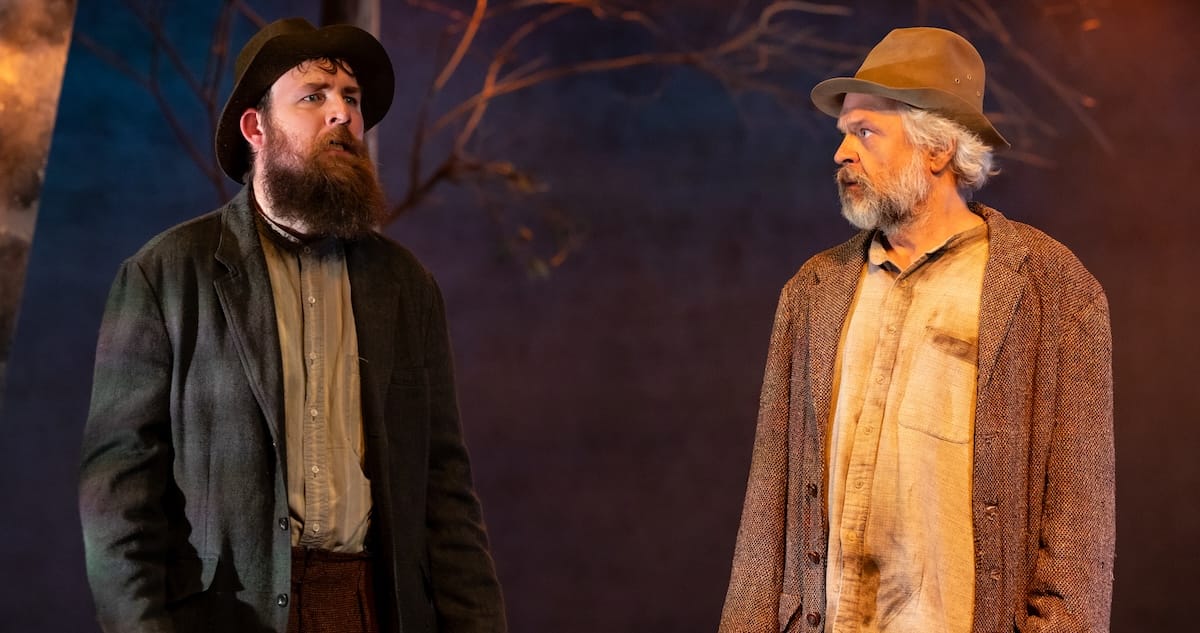
There are no gimmicks in director Rodney Lizcano’s staging of Waiting for Godot. No contemporary reframe. No flashy conceptual overlay. Just a tree, a wasteland, two men and the unbearable passage of time.
It’s a choice that pays off, allowing the language, performances and design to do the heavy lifting in a patient and precise production on the Aurora Fox Arts Center’s mainstage.
First performed in 1953, the absurdist landmark follows two wandering men, Vladimir and Estragon, who linger beside a lonely tree waiting for a man named Godot. They’re convinced he will arrive and change their lives. He never does. That’s the plot. Or rather, the lack of one.
Instead, the pair pass the time talking, bickering, joking, contemplating suicide and trying to remember why they’re there at all. Along the way, they encounter a domineering traveler and his abused companion, as well as a young messenger who repeatedly delivers the same message: Godot will not come today, but surely tomorrow.
In a moment when many of us feel like we’re waiting for some kind of political relief or social change to help return us to a sense of normalcy, the sight of two men clinging to the belief that tomorrow will be different hits with surprising force.
Lizcano’s production leans fully into the strange, mournful, darkly comic rhythms of Beckett’s text, trusting that strong performances, smart pacing and slick design are enough to carry audiences through one of the most famously confounding plays in the Western canon.
The result is a faithful, sharply tuned rendition that finds both the humor and the ache in watching two people wait for something that will never come. And for those willing to sit in that discomfort, it’s deeply rewarding.
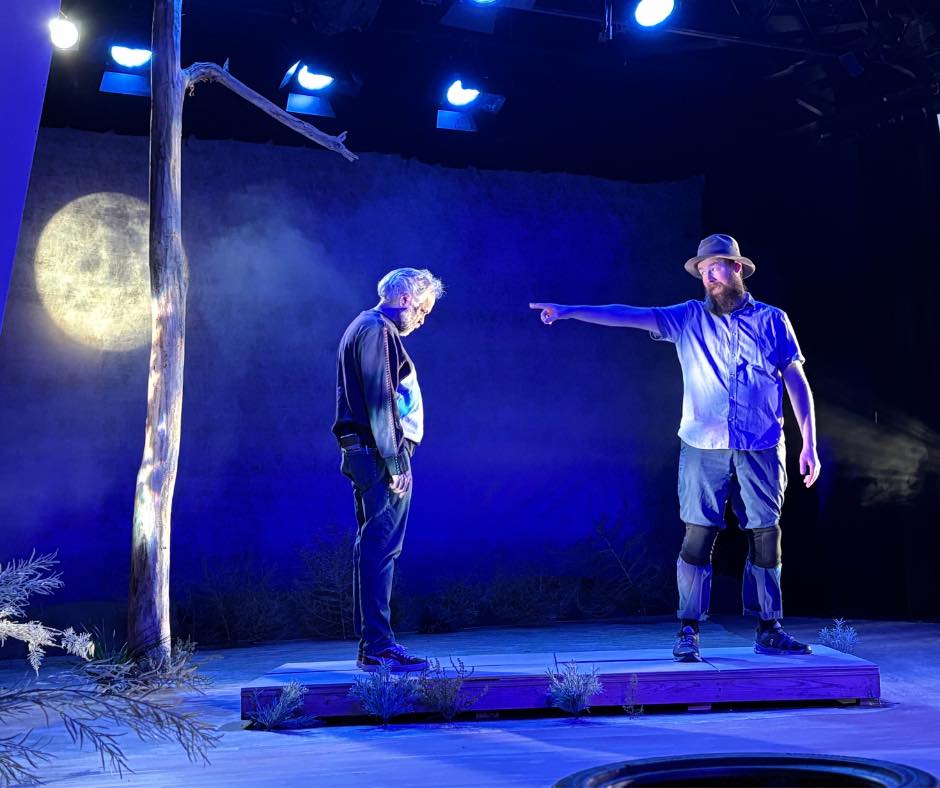
Andrew Uhlenhopp, left, and Matthew Murry in ‘Waiting for Godot’ at the Aurora Fox. | Photo: RDGPhotography
A wasteland of existential dread
Scenic designer Nicholas Renaud creates a barren, vaguely Western landscape that feels untethered from any specific time. Rocks, a tire, scraggly plants and a spindly tree sit against painted cloud panels that fade into nothing. Upstage, a projection of the horizon shifts seamlessly from day to night, the moon appearing in an instant.
The set never changes, but it never feels static. The design does exactly what Beckett requires: It gives the actors a liminal nowhere to exist in.
Lighting by Brett Maughan and sound by John Hauser subtly reinforce the sense that time is slippery here. Day becomes night with eerie immediacy. Shifts are occasionally punctuated by a knowing “ping” sound effect, but often, silence stretches. When music does play, it feels out of place and difficult to identify.
Costume designer Linda Morken differentiates the characters with precision: Vladimir and Estragon in worn, muted attire; Pozzo in a showy, almost ringmaster-like look; Lucky ghostly and stained; and the Boy crisp and formal as a messenger from elsewhere. Every design element works together to create a cohesive, otherworldly playground for existential dread and clownish comedy.
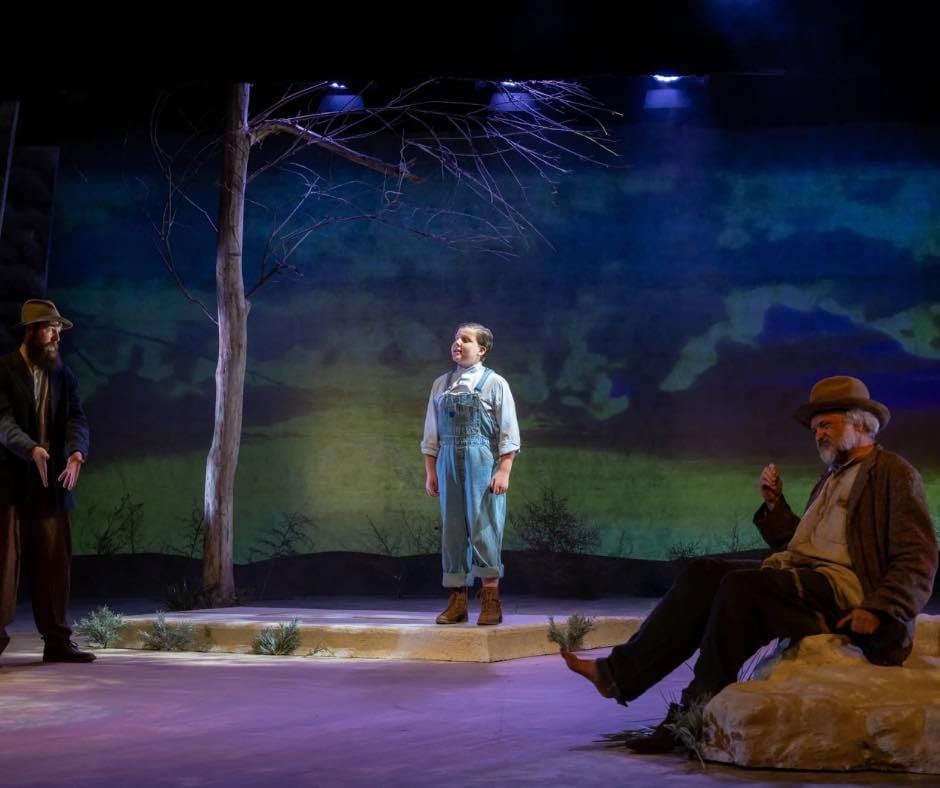
From left, Matthew Murry, Max Rynerson and Andrew Uhlenhopp. | Photo: RDGPhotography
Actors help make the wait compelling
At the center of production are two of the metro area’s most familiar and reliable performers: Matthew Murry as Vladimir and Andrew Uhlenhopp as Estragon.
Murry’s Vladimir is restless, probing and desperate to understand why they’re here and whether Godot is truly coming. Uhlenhopp’s Estragon is weary, cranky and inclined to avoid thinking too hard about their predicament. Their chemistry is immediately convincing. The duo’s back-and-forth is fast, clear and intentional, with every verbal volley landing with purpose.
Much of the evening is simply these two actors goofing around in the void, and it’s a genuine pleasure to watch seasoned Colorado talent sink their teeth into this material. Lizcano keeps them in constant, subtle motion across the stage, preventing the talk-heavy script from ever feeling inert. And when the famous hat-swapping routine arrives in Act Two, it explodes into pure vaudeville and reminds us that Beckett’s absurdism is as much comedy as philosophy.
The arrival of Pozzo and Lucky disrupts the rhythm in welcome ways. Antonio Minino’s Pozzo is commanding and theatrically broad, his circus-master attire popping against the muted landscape. David Stallings’ Lucky is grotesque and tragic, delivering his famously chaotic monologue with frantic intensity before snapping back into servitude.
Max Rynerson’s Boy, appearing at the end of each act, brings a quiet heartbreak as he repeatedly informs Vladimir that Godot will not come and insists he has no memory of meeting him before. These interruptions give the play jolts of energy while reinforcing its central loop of confusion, repetition and fading memory.
Waiting, hoping and recognizing ourselves
Lizcano does not try to make Godot more accessible. He stages it cleanly, clearly and as written, and that will be a hurdle for some audience members. You could hear it at intermission: “Only about an hour more,” one patron muttered on opening night. Others sit with open-mouthed uncertainty, unsure how to process what they’re seeing.
But that friction is part of the experience. If you’re willing to meet the play halfway, this is a rare chance to see absurdist theater done exceptionally well by a top-tier local cast. If you’re not in the mood for existential contemplation wrapped in clownish comedy, it may feel long, strange and opaque.
Either way, Aurora Fox is offering something you don’t often get to see in the metro area: a confident, expertly acted dive into Beckett’s bleak, hilarious meditation on hope, memory and the human tendency to wait for a better tomorrow.
And, in a moment when many of us feel like we’re waiting for some kind of political relief or social change to help return us to a sense of normalcy, the sight of two men clinging to the belief that tomorrow will be different hits with surprising force. Their hope is persistent. Their disappointment is constant.
Watching Vladimir and Estragon wait is less an abstract theatrical exercise and more of a mirror. We recognize the impulse to believe that relief is just around the corner, even when experience tells us otherwise.
Aurora Fox’s production doesn’t offer answers, and Beckett never intended it to. But through sharp direction, poignant design and committed performances, it makes the act of waiting feel profoundly human and tragically relatable.
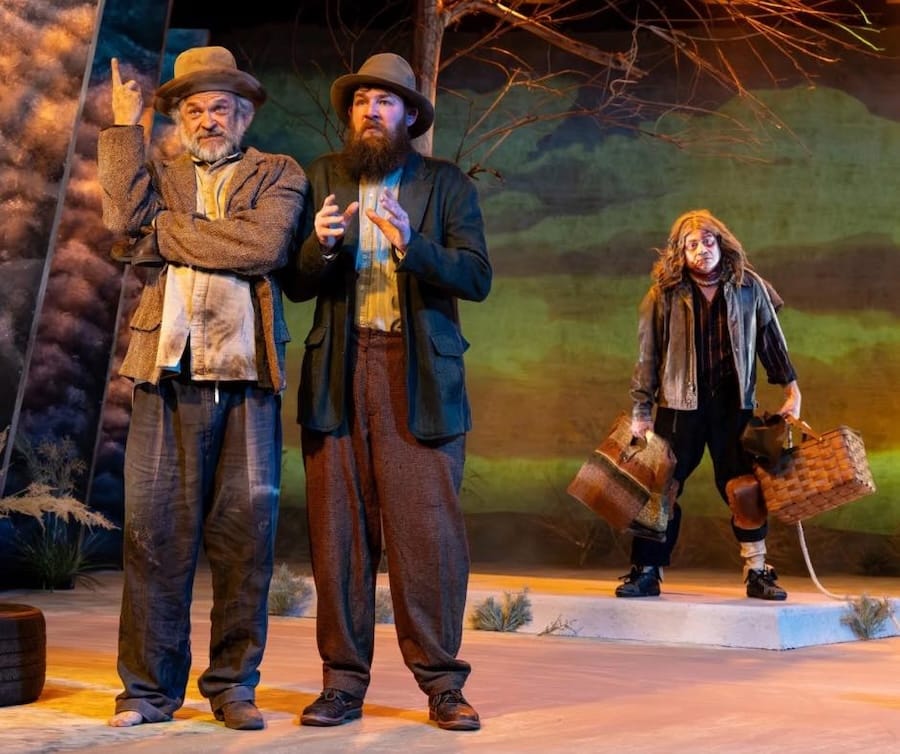
Uhlenhopp, Murry and David Stallings as Lucky. | Photo: RDGPhotography

A Colorado-based arts reporter originally from Mineola, Texas, who writes about the changing world of theater and culture, with a focus on the financial realities of art production, emerging forms and arts leadership. He’s the Managing Editor of Bucket List Community Cafe, a contributor to Denver Westword and Estes Valley Voice, resident storyteller for the Bonfils-Stanton Foundation and co-host of the OnStage Colorado Podcast. He holds an MBA and an MA in Theatre & Performance Studies from CU Boulder, and his reporting and reviews combine business and artistic expertise.

Leave A Comment