
At the Denver Center’s Buell Theatre, the national tour turns a bestselling novel into a muscular, moving stage spectacle.
Contemporary musicals adapted from existing IP don’t always justify their existence onstage. But the non-equity national tour of Water for Elephants, now playing at the Buell Theatre at the Denver Center, makes a compelling case for itself with a thrilling fusion of circus artistry and surprisingly grounded storytelling.
Many audience members likely first encountered this story through the 2011 film adaptation starring Robert Pattinson and Reese Witherspoon, which introduced Sara Gruen’s Depression-era circus tale to a wider audience beyond readers of the 2006 novel. That cinematic adaptation leaned heavily into sweeping melodrama. The stage musical retains the central love triangle but cleverly reshapes the material into something more tactical and suitable for live performance.
The story follows Jacob Jankowski (Zachary Keller), a veterinary student who loses his parents in a sudden accident and impulsively hops aboard a moving train belonging to the Benzini Brothers Circus. Hired by the magnetic but mercurial ringmaster August (Connor Sullivan) to tend the animals, Jacob soon develops feelings for the circus’s star equestrian performer Marlena (Helen Krushinski) — who also happens to be August’s wife.
Rather than a straightforward narrative, the musical frames the action as a memory play. An elderly Jacob (Robert Tully), having fled his assisted-living facility, wanders into a present-day circus and begins recounting the wild chapter of his youth. Under tour director Ryan Emmons’ staging (building on Jessica Stone’s original Broadway direction), Tully’s older Jacob weaves in and out of scenes, at times observing silently and at others assisting with puppetry.
This structure will sound familiar to frequent Buell showgoers, as it is the same basic time-bending storytelling device used in the recent touring productions of The Notebook and Life of Pi. In those adaptations, the stage versions frequently struggled to articulate why their narratives needed to exist in theatrical form at all.
In Water for Elephants, the theatrical framing device feels organically tied to the medium. A circus, which is already a performance space defined by risk, illusion and physical labor, translates naturally into a form where audiences can see the effort behind the magic.
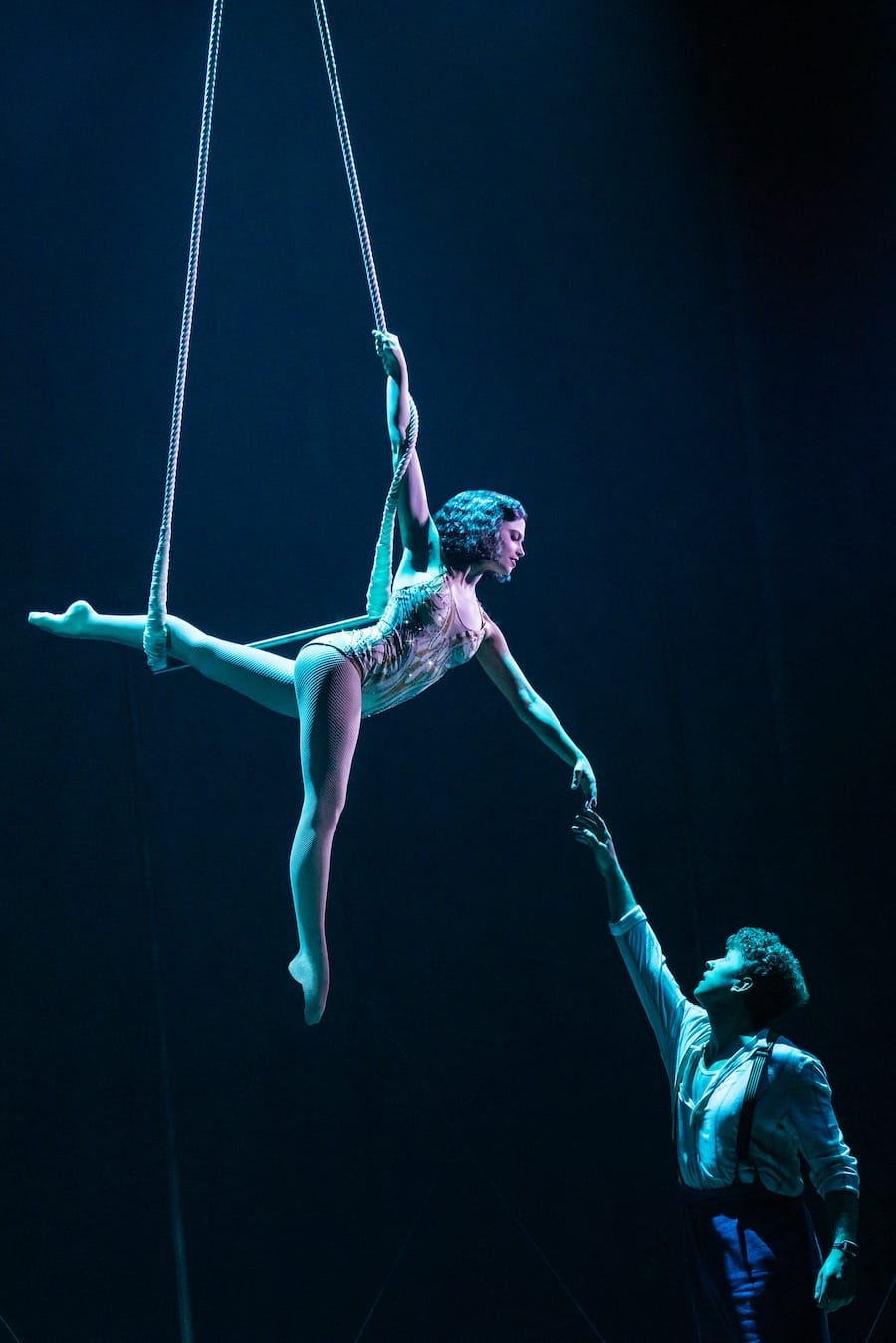
Helen Krushinski and Zachary Keller in ‘Water for Elephants. | Photo by Matthew Murphy for MurphyMade
Building the big top in plain sight
From its brassy overture onward, Water for Elephants wastes little time plunging audiences into circus life. Much like Jacob himself, we are immediately thrown headlong into its rhythms and hierarchies. Takeshi Kata’s representational scenic design favors visible theatricality over illusionistic realism; audiences can see the wires, the rolling scaffold pieces and the flown drops. Instead of detracting, this constructed quality reinforces the show’s themes of performance and not believing everything you see at first glance.
During the ensemble number “Anywhere/Another Train,” performers climb and shift vertical frames to create the sensation of riding the rails, not just through illusionistic scenery, but also through coordinated movement. Later, in the rousing “The Road Don’t Make You Young,” the company physically constructs the circus tent via a choreographed hammer-and-rope dance. At one point, a performer ascends a vertical pole with their body held rigid like a flag — a striking visual that underscores the physical toll of assembling this transient world night after night.
Choreography by Jesse Robb and Shana Carroll is a major asset throughout, seamlessly integrating dance with circus technique so that even transitional sequences feel alive with purpose. That physical storytelling becomes especially striking in Act Two, which features not one but two wordless, dream ballet-style sequences.
The first, performed by five circus artists shortly after two of Jacob’s friends are murdered, is a brief balancing sequence. Later, during “Go Home,” a much longer carnivalesque sequence breaks out after Wade strikes Jacob, evoking a surreal parade of distorted memories and anxieties. Performers tumble, contort and loom over him in a nightmarish recreation of Jacob’s circus life gone wrong. It’s an inventive use of movement to externalize trauma and a welcome reminder that the dream ballet hasn’t entirely vanished from the Broadway vocabulary.
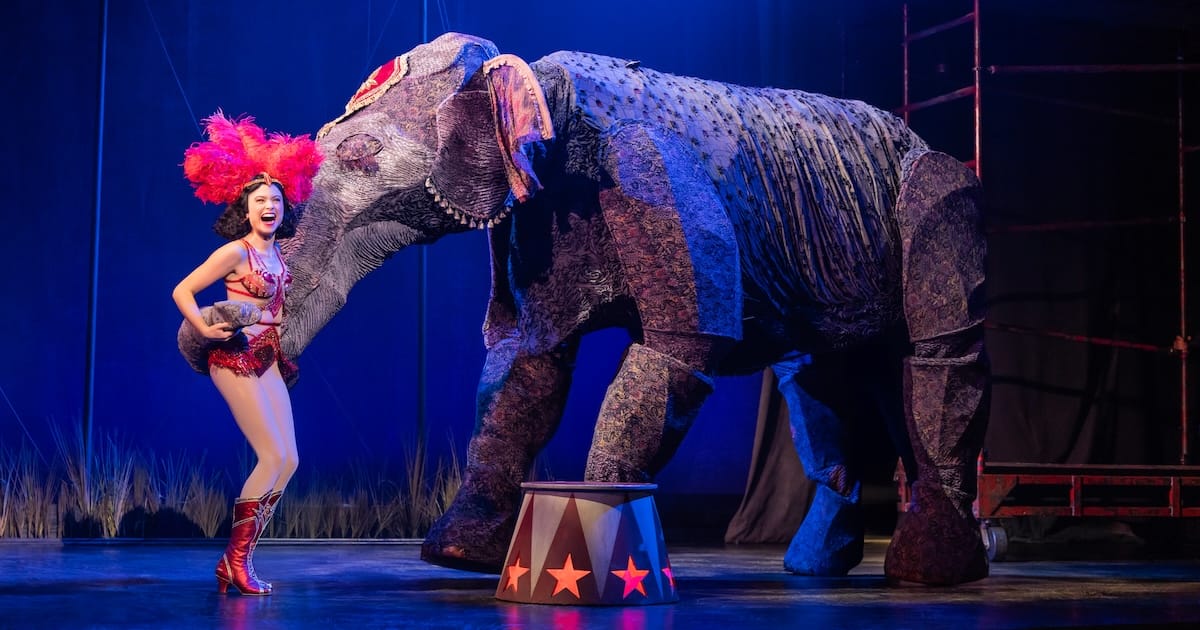
The production’s circus elements are not decorative add-ons but essential storytelling tools. Multi-operator puppets bring animals like Rosie the elephant to life with surprising nuance, while aerialists and acrobats move through the space on silks, hoops and trapeze. The Act One finale, “The Grand Spec,” goes all out with roller skating, juggling, ball balancing and a full reveal of Rosie that elicited cheers from the audience on opening night.
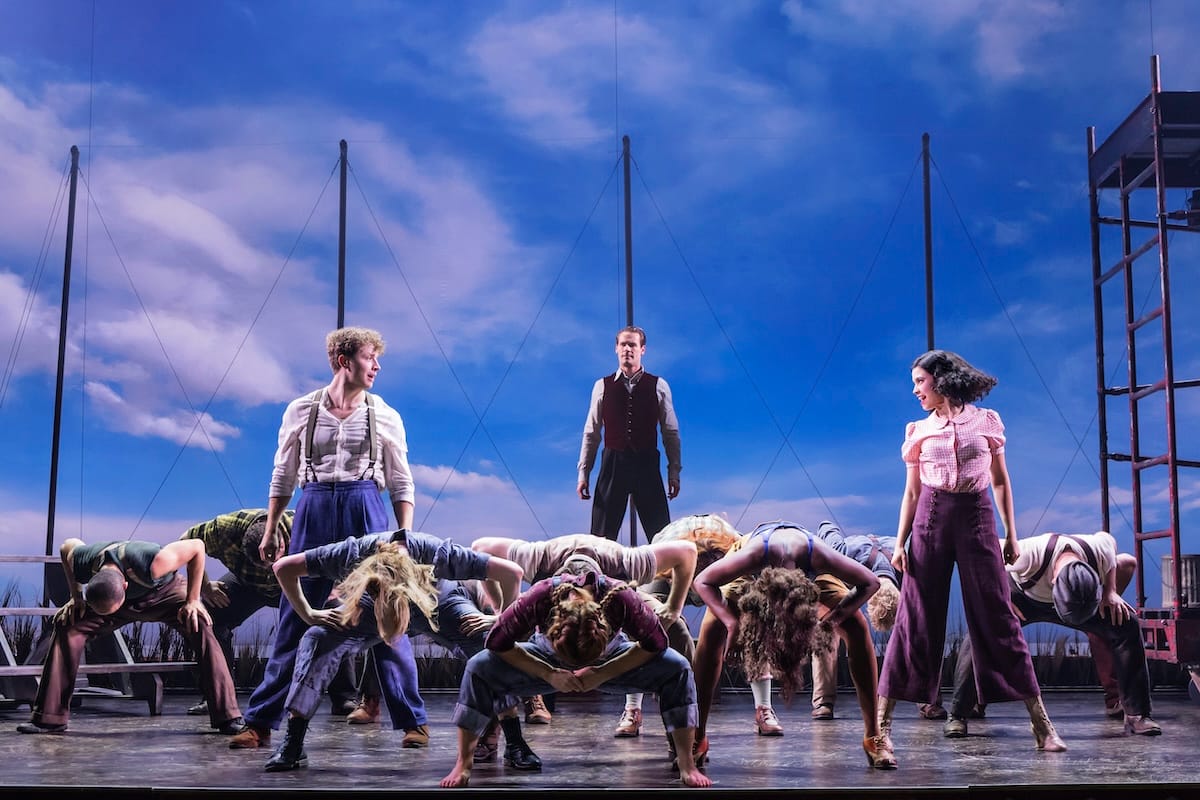
Zachary Keller, Connor Sullivan, Helen Krushinski and the cast of ‘Water For Elephants.” | Photo by Matthew Murphy for MurphyMade
Performances that ground the spectacle
For all its visual invention, Water for Elephants ultimately hinges on whether its central love triangle feels believable enough to justify the risks Jacob takes and whether August’s volatility reads as seductive before it turns dangerous. Fortunately, the touring cast delivers across the board.
Zachary Keller’s Jacob avoids the trap of wide-eyed ingénue earnestness, instead presenting a young man who is compassionate but stubbornly principled. His refusal to be pushed around gives the character a quiet backbone that makes his attraction to Marlena feel warranted. Early on, he plays the “new guy” as someone taking rapid stock of the circus’s power dynamics. That choice makes Jacob’s moral line feel earned: when he finally stands his ground, it reads less like sudden heroism than like a guy realizing he’s already too far in to stay passive.
Helen Krushinski’s Marlena has a dynamic voice, but she is most captivating when she allows the audience to see the calculations beneath the glamour. She does not play Marlena as purely trapped or purely smitten; rather, she portrays her as someone who has learned to manage danger by managing the room. In early scenes with August, Krushinski’s body subtly tightens, even as her face stays trained on performance-ready charm. That physical storytelling pays off when Marlena and Jacob begin to connect: Krushinski doesn’t flip a romantic switch so much as allow moments of ease to sneak in.
Together, Keller and Krushinski make the romance feel less like escapism and more like a risky, human bid for a different life, which is exactly what this show needs beneath all the aerial wonder.
Connor Sullivan’s August walks the line between charm and menace successfully, projecting the kind of larger-than-life charisma that might plausibly draw people into his orbit before revealing the volatility beneath. Tyler West’s Walter, meanwhile, provides a consistent source of comic relief as the circus’ clown, particularly during his extended routine with August involving a knife and cabbage near the end of Act One.
Throughout, the ensemble serves admirably as both circus performers performing physically demanding feats and a cohesive company of itinerant laborers whose survival is dependent on maintaining the illusion of wonder for paying audiences.
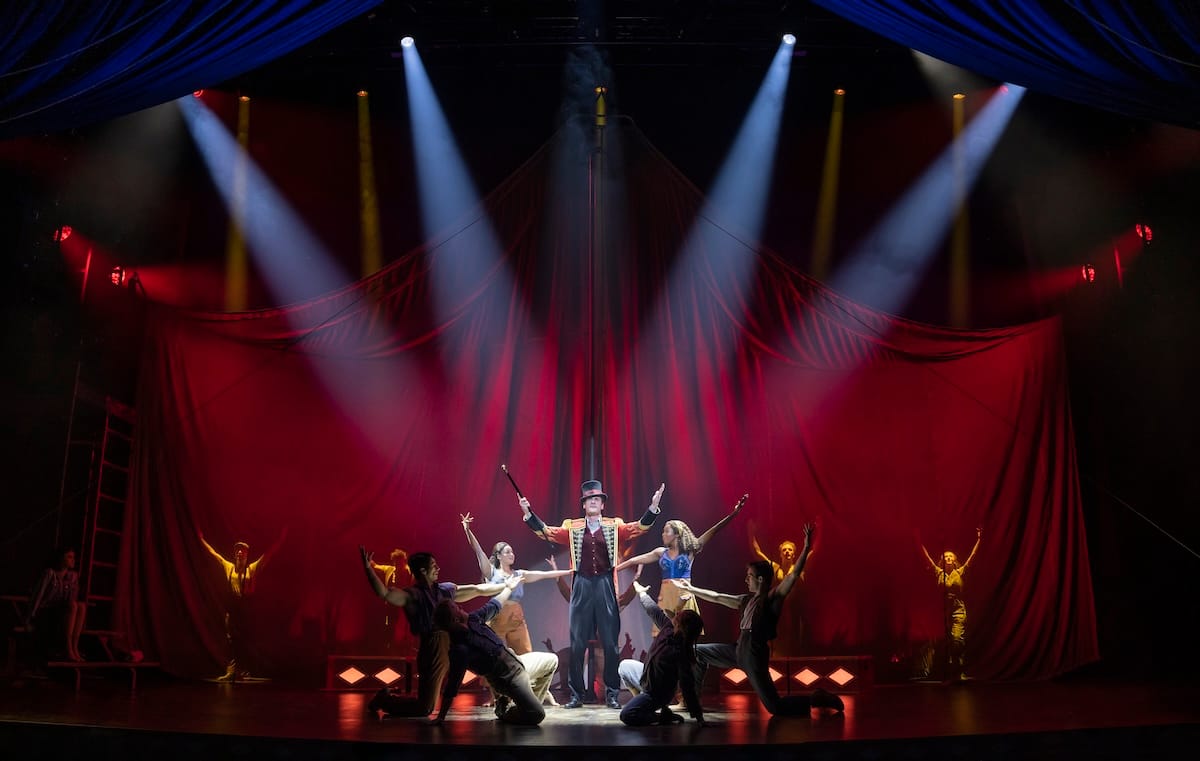
Photo by Matthew Murphy for MurphyMade
Strong staging, uneven sound
Opening night wasn’t without its technical hiccups. Walter Trarbach’s sound design struggled to maintain clarity early in Act One, with the orchestra occasionally overpowering vocal lines to the point where lyrics became difficult to discern. The balance improved after intermission, but the muddiness initially undercut several character-establishing songs.
PigPen Theatre Co.’s score is otherwise a strength, blending folk textures with brassy big-top stylings to create a musical vocabulary distinct from standard Broadway pastiche. A few numbers, however, are less effective, most notably Marlena’s ballad “Easy” about her horse Silver Star, which is staged with an aerial silk routine that visually impresses but leaves the audience emotionally unsatisfied.
By the time the show builds toward its infamous circus disaster and climactic stampede (a kinetically staged sequence that sends animals and performers surging across the stage), Water for Elephants has earned its emotional stakes. This may be a love story born of an affair, but it ultimately lands as a meditation on survival, reinvention and the strange families we assemble when our pasts leave us nowhere else to go.
Even with its occasional rough edges, Water for Elephants captures something that many larger Broadway imports miss: the visceral thrill of watching something real and risky happen right in front of you. You can see the wires. You can see the people operating the puppets. But in this case, the transparency is part of the appeal. At the Buell, Water for Elephants proves that when an adaptation understands its medium, spectacle and storytelling can coexist in the same show.

A Colorado-based arts reporter originally from Mineola, Texas, who writes about the changing world of theater and culture, with a focus on the financial realities of art production, emerging forms and arts leadership. He’s the Managing Editor of Bucket List Community Cafe, a contributor to Denver Westword and Estes Valley Voice, resident storyteller for the Bonfils-Stanton Foundation and co-host of the OnStage Colorado Podcast. He holds an MBA and an MA in Theatre & Performance Studies from CU Boulder, and his reporting and reviews combine business and artistic expertise.

Leave A Comment