
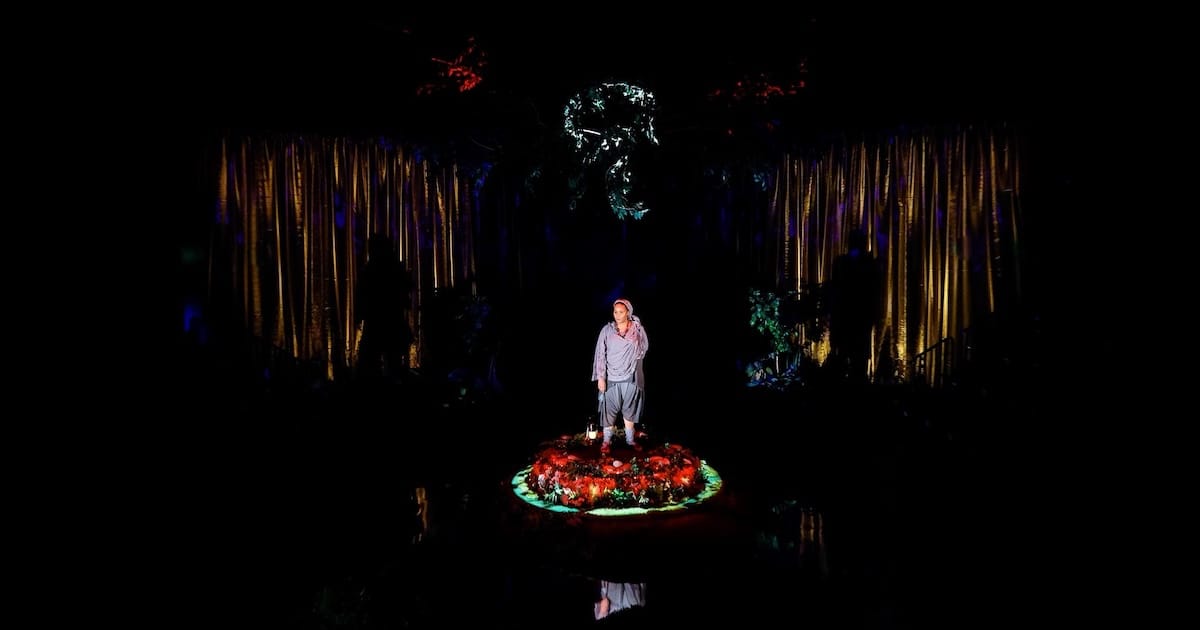
Colorado debut of Donnetta Lavinia Grays’ one-person play features impressive design but struggles to deliver a clear, compelling story.
The stage at Theatreworks’ Where We Stand looks like the perfect place to hear a story. Sand, grass and shallow pools of water surround a glowing green mound at center stage, while tree-like shapes hang overhead and a rough brown curtain evokes bark and earth.
Director Marisa D. Hébert describes the piece in her director’s note as a return to “our storytelling origins,” invoking the feeling of stories told around a campfire. Unfortunately, this is one campfire story that struggles to hold attention.
The story’s action revolves around a man’s deal with a stranger dressed in gold. He receives miraculous seed, tools and the opportunity to transform a dying town into a lush paradise, while also gaining long-denied respect from his community. The price is simple: Everything must be done in the stranger’s name. When the town begins celebrating the man instead, the bargain collapses, leading to a public trial in which the audience votes on his fate.
The Colorado premiere of Donnetta Lavinia Grays’ play boasts a haunting physical world, but for all its visual ambition and technical polish, the storytelling itself proves far less engaging and often difficult to follow.
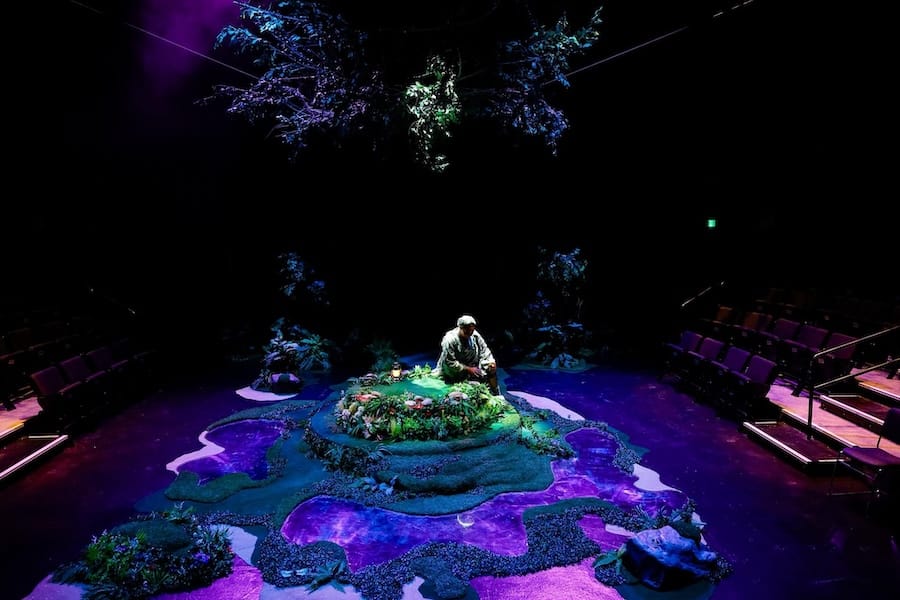
The scene design by Yvonne Miranda is a standout for the show. | Photo: Theatreworks
A richly imagined world
The production’s greatest strength is its design. Scenographer Yvonne Miranda crafts a tactile, organic environment inside the Ent Center’s Dusty Loo Bon Vivant Theater — a flexible black box arranged in a thrust configuration with audience members seated on three sides.
Sand blends into patches of vivid green grass. Shallow pools of water catch the light. A glowing, mossy mound sits at center stage, lit from beneath, where the performer frequently stands like a storyteller at the center of a circle. Tree-like elements hang from the rafters, and a textured brown curtain upstage evokes bark or earth, giving the space the feel of a living, breathing environment.
Lighting designer Josh Hemmo adds striking visual punctuation, particularly in moments involving the shadowy man in gold. Backlighting throws enlarged silhouettes across the curtain, creating images that feel mythic and ominous. Sound designer Jeremiah Walter underscores the action with subtle atmospheric shifts.
These technical elements repeatedly hint at a more gripping theatrical experience than the one that unfolds.
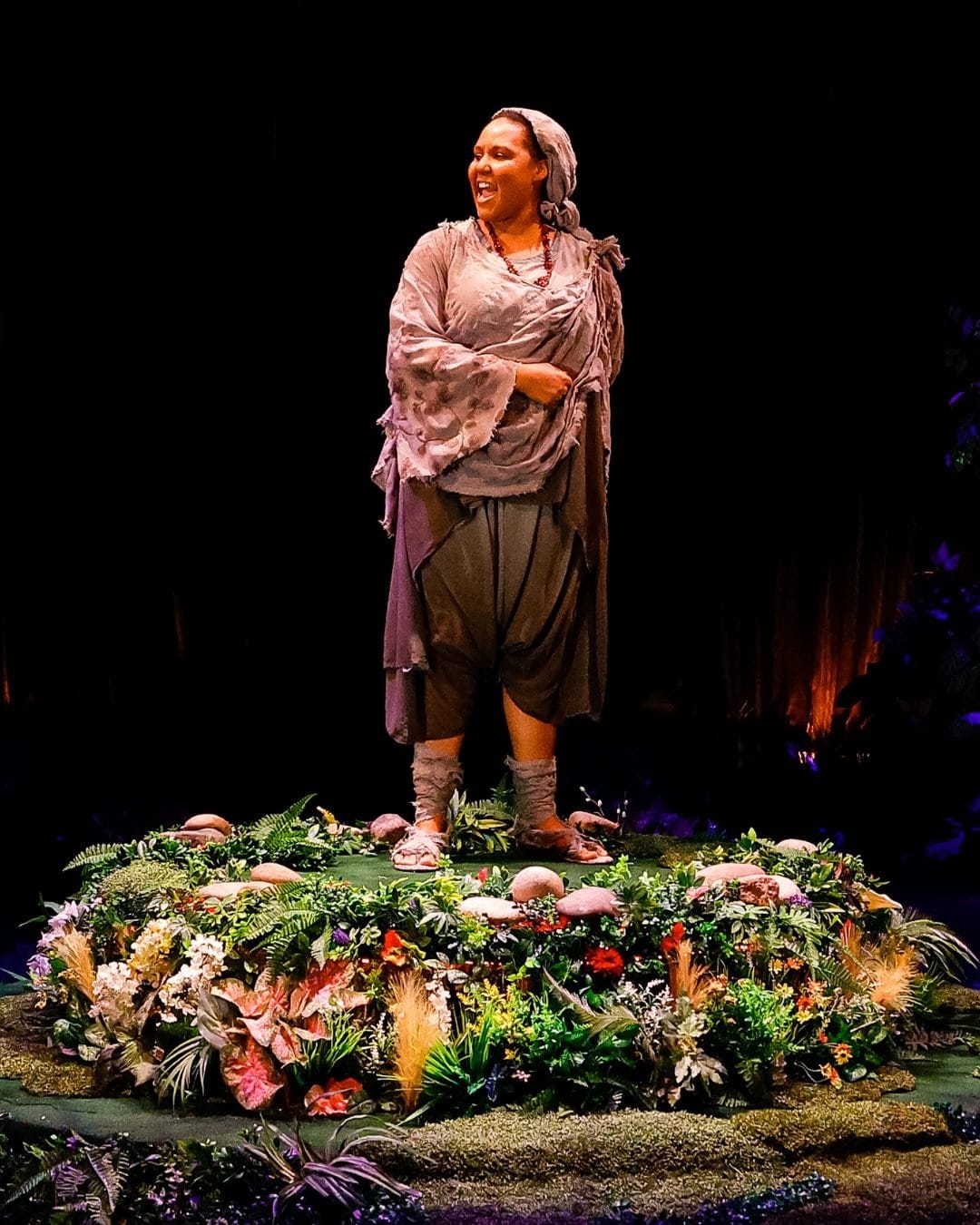
Alex Campbell in ‘Where We Stand.’ | Photo: Theatreworks
A performance that muddies the narrative
At the center is Alex Campbell as The Man, who is tasked with portraying not only the protagonist but also the townspeople and the devilish stranger as Campbell recounts how the deal went wrong. Director Hébert keeps Campbell in near-constant motion through the thrust space, circling the audience, changing positions, ascending the steps where the crowd is seated and frequently addressing spectators directly as if they are part of the town.
But a one-person show hinges on crisp, distinct character transitions, and here those shifts are often blurry. Early attempts to differentiate the man in gold with a darker vocal tone and stylized posture fade as the performance continues. The townspeople’s testimonials, meant to feel like a chorus of distinct voices, instead blur together into a single register.
More critically, key plot points become difficult to track. The central transgression that the town stopped honoring the stranger in gold is never articulated with enough clarity to ground the story. By the time the play reaches what should be its climactic vote, several audience members could be heard asking aloud what The Man had actually done wrong and “why are we voting?” That confusion undercuts the moral weight the play is trying to build.
To be clear, this is an extraordinarily demanding role. Campbell is onstage for the full 75 minutes, navigating dense text, frequent shifts into song and constant physical movement through the space while attempting to conjure an entire community alone. There is visible effort and commitment in the performance, and moments where Campbell’s focus sharpens and the story briefly snaps into place. But sustaining that clarity proves difficult. Lines occasionally blur together, transitions lose definition and the pacing slackens, causing the narrative momentum to ebb just when it most needs to build.
Audience interaction that drains the energy
The production leans heavily into audience interaction. Campbell gestures to viewers as townspeople, asks them to hum, sing portions of a song, shout lines of dialogue, read from cue cards passed through the crowd. And the show culminates in a live vote.
In theory, this communal engagement should be the show’s most electrifying element, as it is a literal representation of shared storytelling around the fire. In practice, it has the opposite effect.
Campbell repeatedly has to coax responses from an audience that seems unsure how or why to participate. A microphone passed around for audience members to read from cue cards fails to carry voices. Requests to hum or shout lines land in hesitant murmurs. Instead of creating intimacy, these moments stretch into awkward pauses that sap the room’s energy.
Grays’ script aims for something lyrical and allegorical, but in this staging, the pacing turns lethargic. Long stretches of narration, unclear shifts into song and extended pauses create a sense of drift.
There are flashes of what the piece could be: the haunting shadow imagery, the tactile landscape underfoot and the idea of giving people the choice between justice or forgiveness. But the production never fully unites these elements into a cohesive, emotionally engaging whole.
Where We Stand is admirable in its ambition and often beautiful to look at. Yet as a theatrical experience, it feels confusing, slow and dramatically underpowered. Perhaps with a more engaged crowd, the piece might find the spark it seeks, but at this performance, it never caught fire.

A Colorado-based arts reporter originally from Mineola, Texas, who writes about the changing world of theater and culture, with a focus on the financial realities of art production, emerging forms and arts leadership. He’s the Managing Editor of Bucket List Community Cafe, a contributor to Denver Westword and Estes Valley Voice, resident storyteller for the Bonfils-Stanton Foundation and co-host of the OnStage Colorado Podcast. He holds an MBA and an MA in Theatre & Performance Studies from CU Boulder, and his reporting and reviews combine business and artistic expertise.

Leave A Comment