
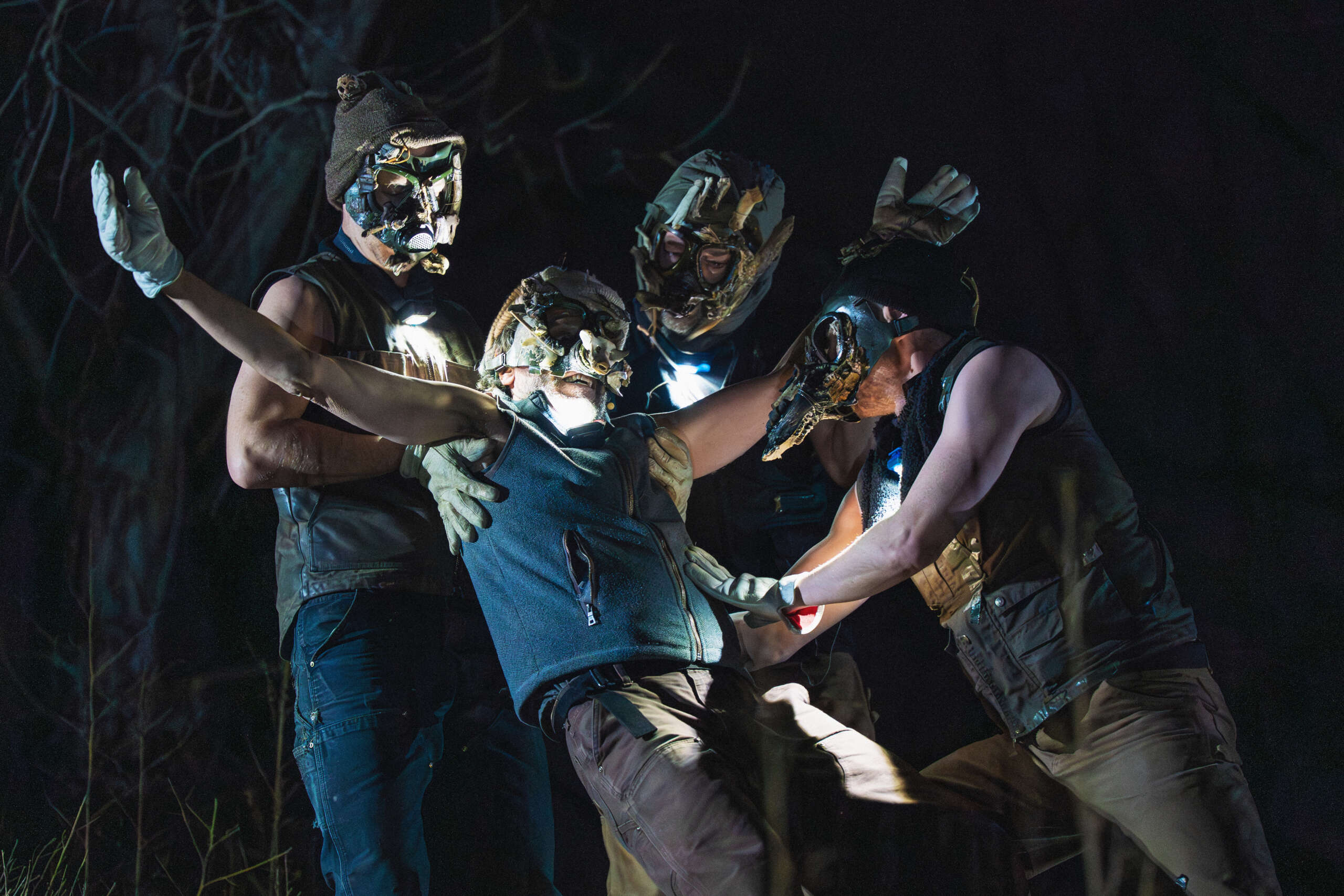
Control Group’s off-kilter Red Willow combines dance, mythology and a walk through South Platte Park.
E
xperientially, immersive performance has long been part of Control Group Productions’ creative DNA, and their newest work, Red Willow, continues that exploration. Running through April 4 at South Platte Park in Littleton, the site-specific piece invites audiences to walk 2½ miles through wooded trails at dusk in “a ritual of preparation for resistance.”
The premise is provocative. Drawing on mythology, philosophy and contemporary political anxieties, Red Willow asks how individuals and communities prepare themselves to confront rising authoritarianism, ecological crisis and social violence. Presented by an all-male ensemble — Nicholas Caputo, Michael Gunst, David Ortolano, Adam Geluda Gildar and Patrick Mueller — the piece also attempts to interrogate masculinity, inherited power and the responsibility of white men to move beyond passive benefit and toward solidarity.
Those are substantial questions, and Red Willow deserves credit for taking them on in such an offbeat form. But while the production offers vivid imagery, committed performances and a memorable sense of place, it only partially succeeds in turning its many references and symbolic gestures into a cohesive theatrical experience.

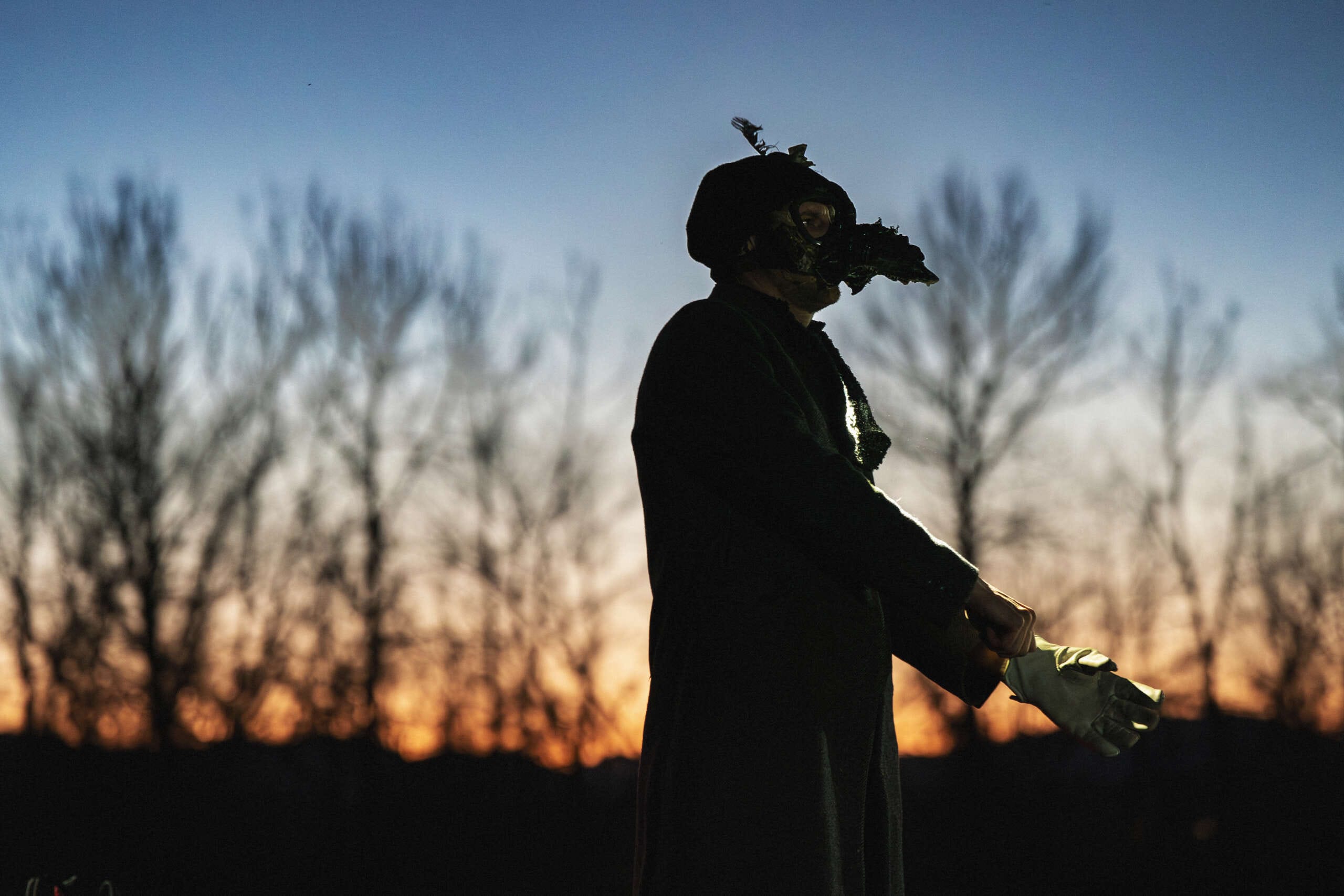
A scene from Red Willow. | Photo: Amanda Tipton Photography
Ritual starts in the parking lot
The evening begins in an RTD parking lot across from a 7-Eleven, where audience members are encouraged to park before walking across the street to the 7-11, where Control Group has set up a white trailer. Outside the 7-11, attendees check in and receive a fanny pack containing a program-map, flashlight and a walking stick topped with a small flag. Each participant is assigned to a group — Raven, Goat, Bear or Boar — and asked to choose between a flatter route or one that ventures a bit more off trail.
It is a strong opening frame that feels like both an orientation and initiation. Control Group is good at making even the logistics of gathering feel like part of the event, and Red Willow quickly establishes that the audience is not simply watching a performance but entering into a temporary structure of ritual and belonging.
The performance I attended on March 26 unfolded under unusual circumstances. Because of smoke conditions earlier in the day, attendance was small, with only four audience members (including myself) present. Control Group acknowledged the situation and adjusted on the fly, but the piece is clearly designed for larger crowds moving through the park in multiple groups. That reduced scale may have softened some of the show’s intended sense of collective energy.
After brief introductions, the first scene of the play, performed by Gunst and Mueller, begins with a philosophical prologue delivered near the roadside before the group crosses into the park. Drawing on the myth of Parsifal and the Fisher King while critiquing the political philosophy of Thomas Hobbes, the opening monologue situates the work within a broader conversation about responsibility, violence and resisting authoritarianism.
It’s an ambitious start, but the outdoor setting, which includes ambient noise from passing traffic, reversing trucks and customers chatting in the 7-11 parking lot, occasionally dilutes the atmosphere before the audience gets to the trails.
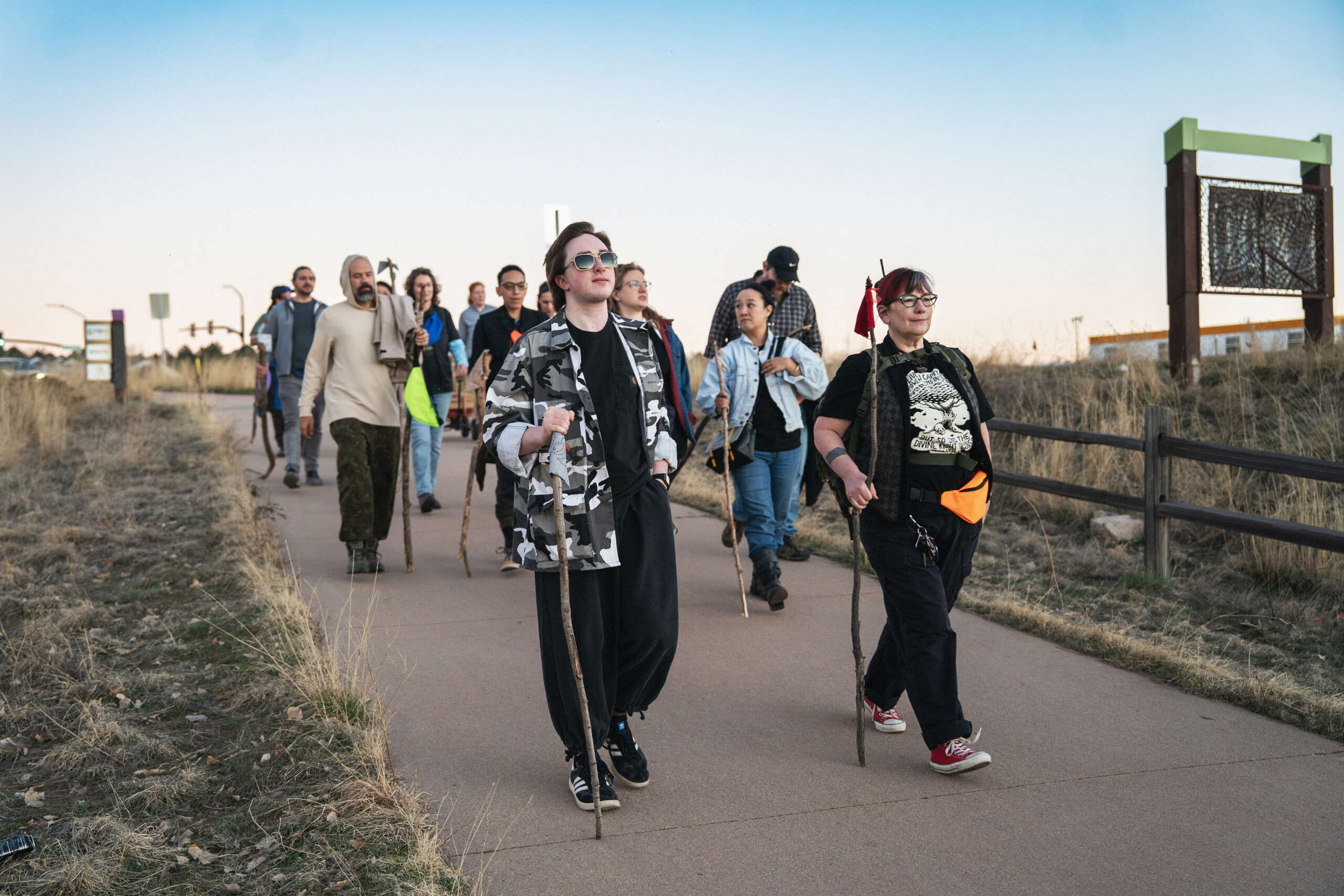
Audience member enters South Platte Park during Red Willow. | Photo: Amanda Tipton Photography
Strong atmosphere with memorable moments
Once inside the park, Red Willow becomes more visually and physically engaging. The performers lead audiences along winding paths while Caputo’s live trumpet and electronic soundscape echo through the natural environment. The actors dance, run ahead on trails and stage ritualized encounters that unfold along the route.
Several sequences create striking theatrical images. Early on, the audience arrives at an area identified on the map as “the portal,” a space beneath the bridge near the water where the performers engage in a masked galvanizing ritual that carries an eerie intensity. Because it occurs while there is still light in the sky, the power of the moment comes less from darkness than from the contrast between the everyday park setting and the performers’ sudden shift into masked, heightened action.
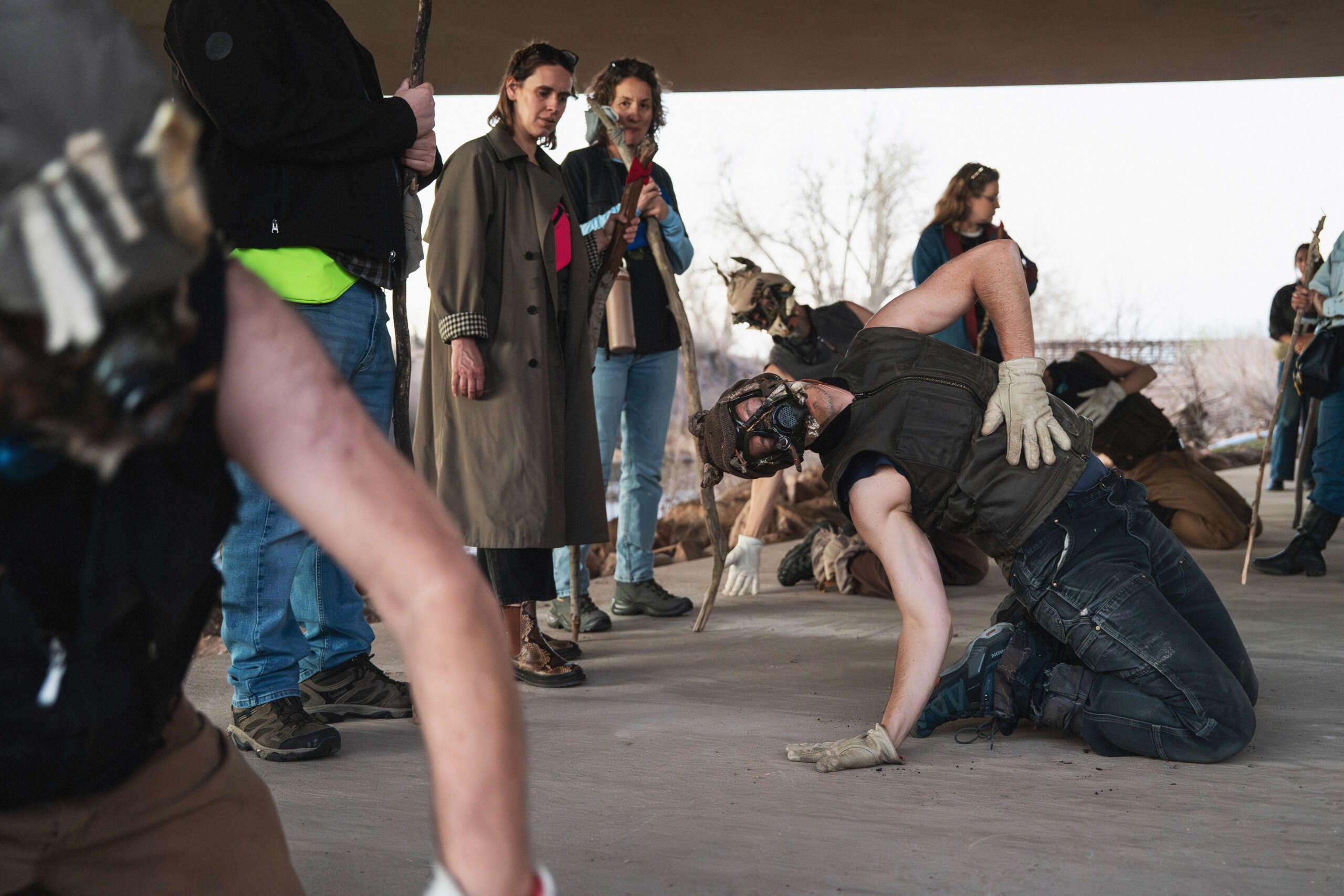
The galvanizing ritual in Red Willow. | Photo: Amanda Tipton Photography
Later scenes benefit more fully from the onset of night. A fight sequence staged inside a ring of sticks creates arresting shadows and silhouettes as the performers strike, circle and collapse. A later section involving wounded bodies scattered across the landscape, as well as the vulnerability ritual performed on a hill, makes good use of lighting and terrain.
Irene Joyce’s visual design is central to those moments. Rather than overwhelming the site, it works with the contours of the park, helping carve out pockets of theatrical intensity in the dark.
The performers themselves are fully committed to the material. Their choreography and physical storytelling carry an almost shamanistic intensity, suggesting warriors, wanderers and wounded survivors moving through a dystopian landscape. The performers throw themselves into the physical vocabulary and the ritual frame with complete seriousness, which helps sustain the piece even when the writing itself becomes murky.
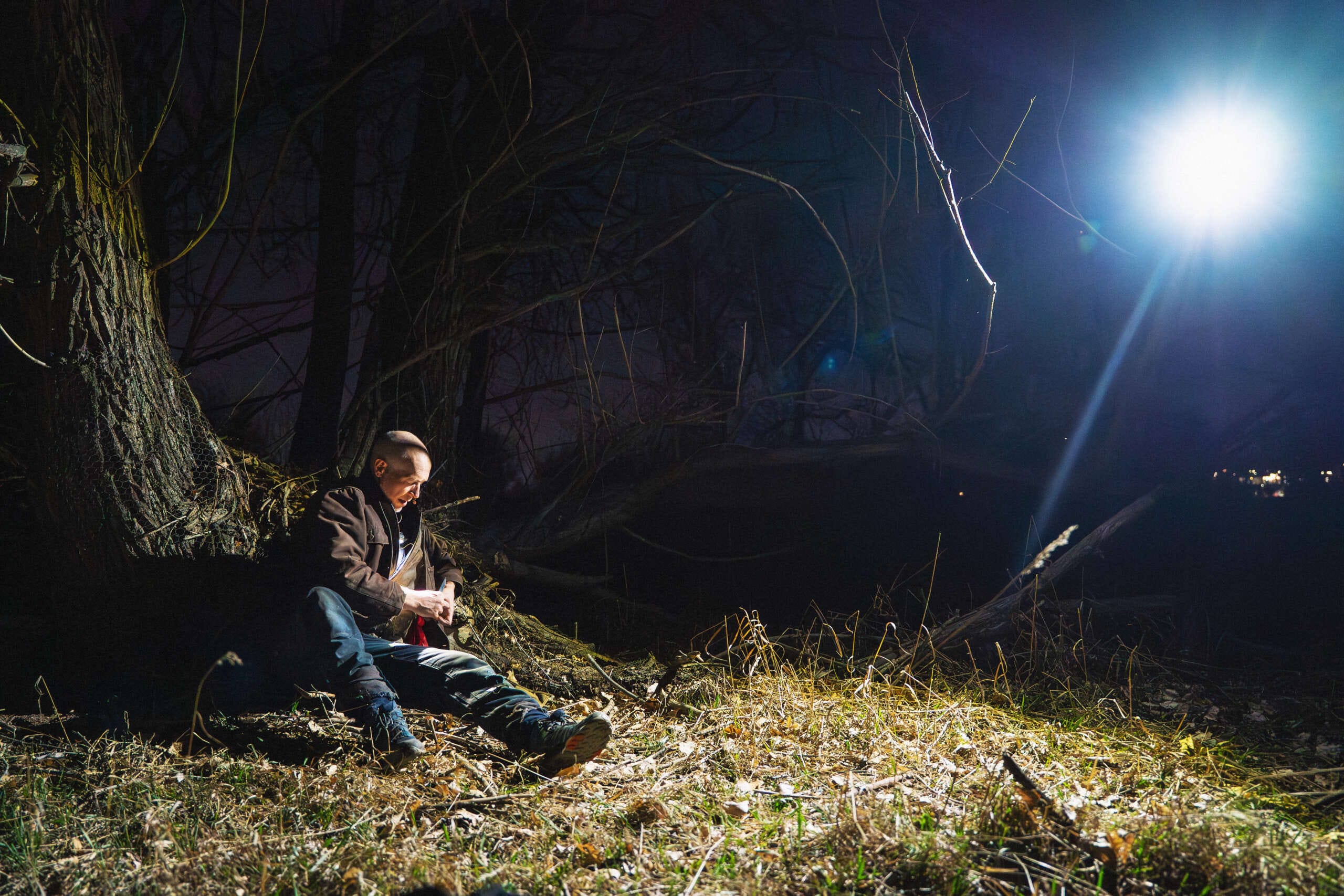
Patrick Mueller in Red Willow. | Photo: Amanda Tipton Photography
Big questions, partial answers
The central inquiry of Red Willow is timely: what responsibility do individuals, particularly white men, bear in resisting injustice and mobilizing their privilege toward collective action?
The show acknowledges inherited power and the need for accountability, but it rarely becomes specific enough to make those ideas feel productively uncomfortable. For a piece that explicitly calls attention to whiteness and male embodiment, the script does not probe very far into what those identities mean in relation to the histories and resistance traditions it invokes.
That becomes especially noticeable when Red Willow draws on Indigenous resistance, warrior cultures and land-based ritual. The production is clearly trying to think in solidarity and reverence rather than appropriation, but it does not always sufficiently complicate the fact that the men at the center of this inquiry are also positioned within histories of colonial violence. That omission leaves part of the show’s political framework feeling thinner than it needs to be.
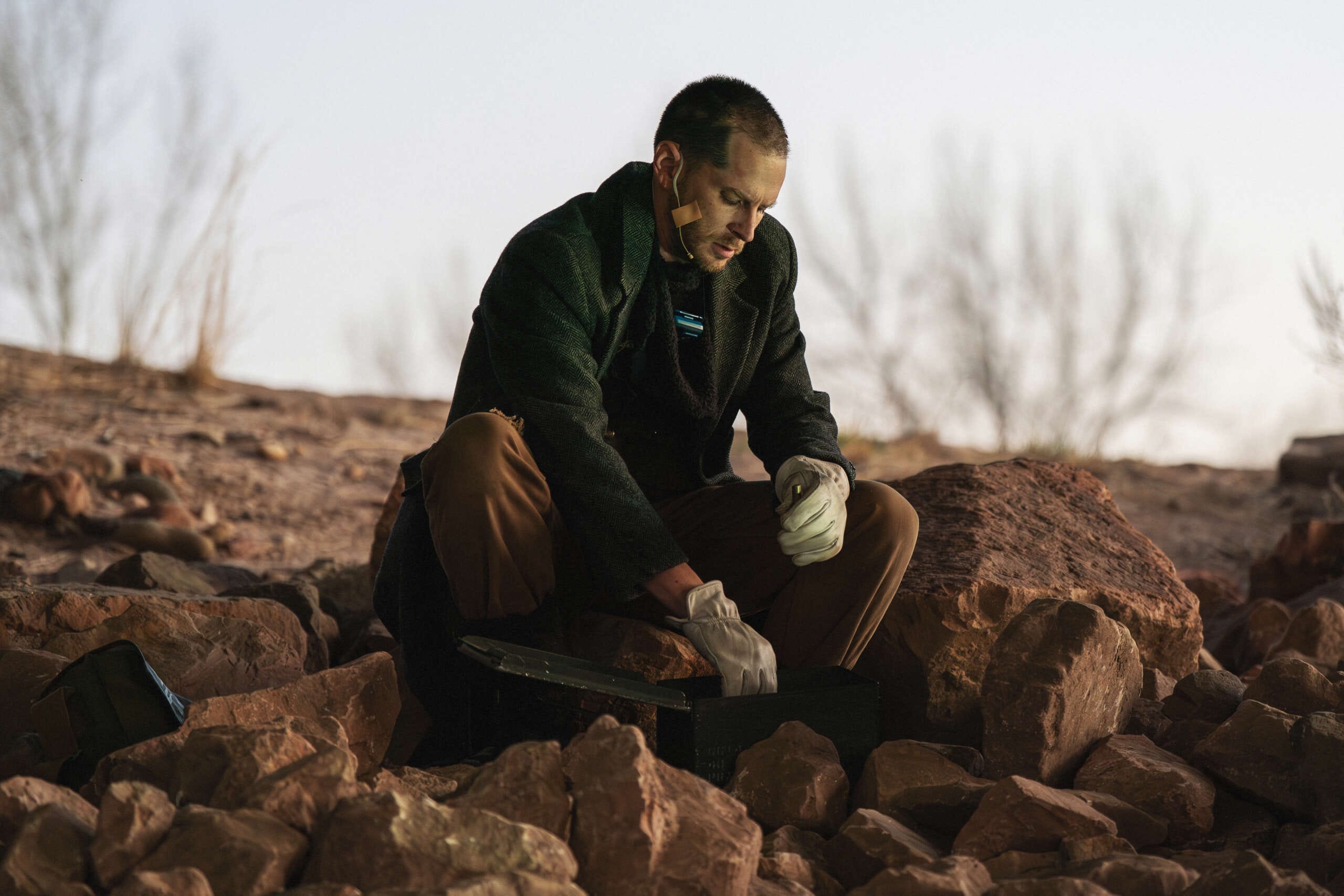
Adam Geluda Gildar in Red Willow. | Photo: Amanda Tipton Photography
The work also struggles with world-building. Audience members are sorted into symbolic groups, given flags and briefly ushered into what feels like a tribal or clan-based structure. But those divisions do not ultimately acquire enough meaning to make the audience’s participation feel dramatically necessary. The production hints at a more immersive logic than it finally delivers.
That tension runs throughout the piece. At times Red Willow feels like it wants to be a rigorous political meditation. At others, it leans toward mythic LARP, with audiences walking through the woods as men with sticks battle, mourn and perform ritual acts of transformation. Either approach could work. The problem is that the show never fully commits to one mode or fuses them into something more legible.
As a result, there are moments when attention wanders, and the performance feels more like a collection of evocative fragments than a cohesive dramatic journey.
A show for adventurous audiences
Control Group Productions has built a reputation for experimental, nature-based immersive work through its Treeline series, which includes earlier projects like After the Follow, Canopy and Bitter Moon. Red Willow continues that lineage, offering audiences a chance to encounter performance outside conventional theatrical spaces.
For viewers intrigued by unconventional storytelling, immersive ritual and site-specific dance, the experience holds undeniable appeal. The production’s willingness to experiment and to invite audiences physically into the journey remains one of its most compelling qualities.
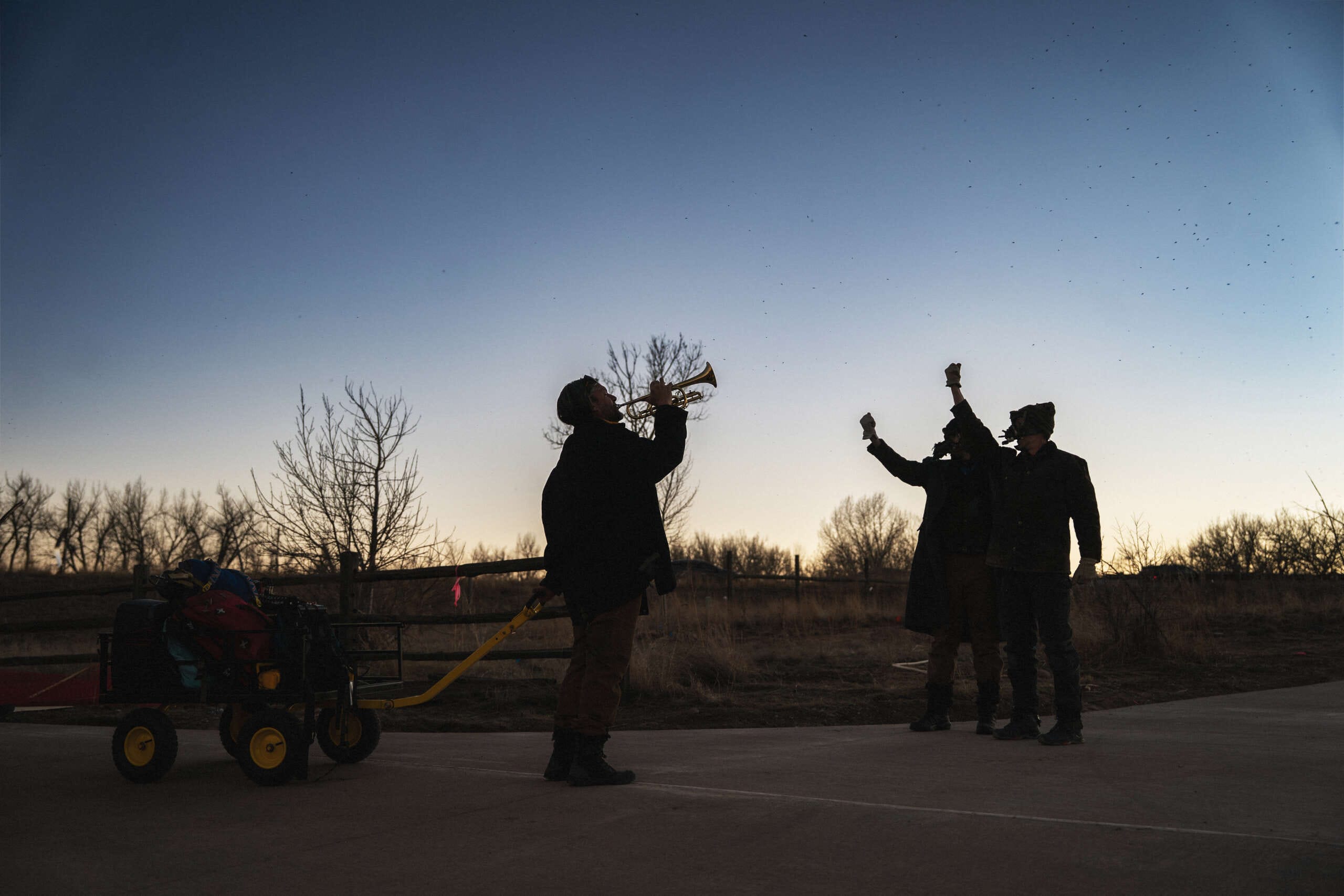
A scene from Red Willow. | Photo: Amanda Tipton Photography
However, compared with some of the company’s previous projects, Red Willow feels less emotionally immediate. Its heavy thematic ambitions sometimes outpace the clarity of its storytelling, leaving the audience with intriguing ideas rather than a fully realized dramatic arc.
Still, Red Willow contains enough striking moments to demonstrate why Control Group continues to do this type of work, as the journey through the park is frequently eerie, beautiful and unexpectedly communal. If you’re looking for a surreal adventure, Red Willow may be worth the trek, even if the journey is more interesting than the destination.

An award-winning Colorado arts and culture reporter originally from Mineola, Texas. Tresca is the chief theatre critic for OnStage Colorado and managing editor of OnScreen Colorado. He’s the editor of Bucket List Community News, a contributor to Denver Westword and Estes Valley Voice, a resident storyteller for the Bonfils-Stanton Foundation and the co-host of the OnStage Colorado Podcast.

Leave A Comment