
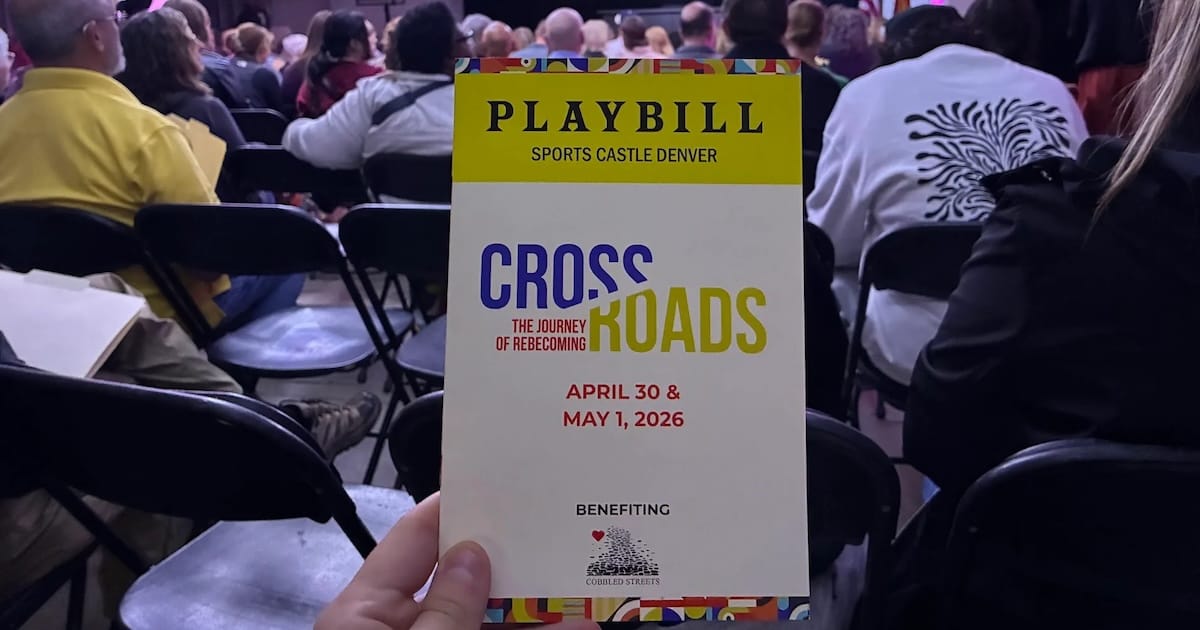
Interactive performance at Sports Castle in Denver delivers an eye-opening look at a broken system.
What if you were a child placed into the foster care system against your will?
That question sits at the center of Crossroads: The Journey of Rebecoming, a two-night immersive work created by Cobbled Streets in collaboration with Emancipation Theater Company and Better Together Productions. Directed by Jeff Campbell and staged inside Sports Castle, the production places audiences inside that scenario.
From the moment you walk in and receive a manila folder, your “case file,” the experience begins stripping away your sense of control. You’re assigned a courtroom section. If you arrive with friends, you’re separated. You’re told where to go, when to move and how to participate.
You feel, almost immediately, how little agency exists in a system that’s supposed to be about care.
Before anything begins, you’re asked to place a personal item into a trash bag. A man who was a foster child tells you at check-in that this is how many children go through foster care. No suitcase, no stability, just whatever fits in a trash bag. It’s blunt, but it lands, and then you’re off.
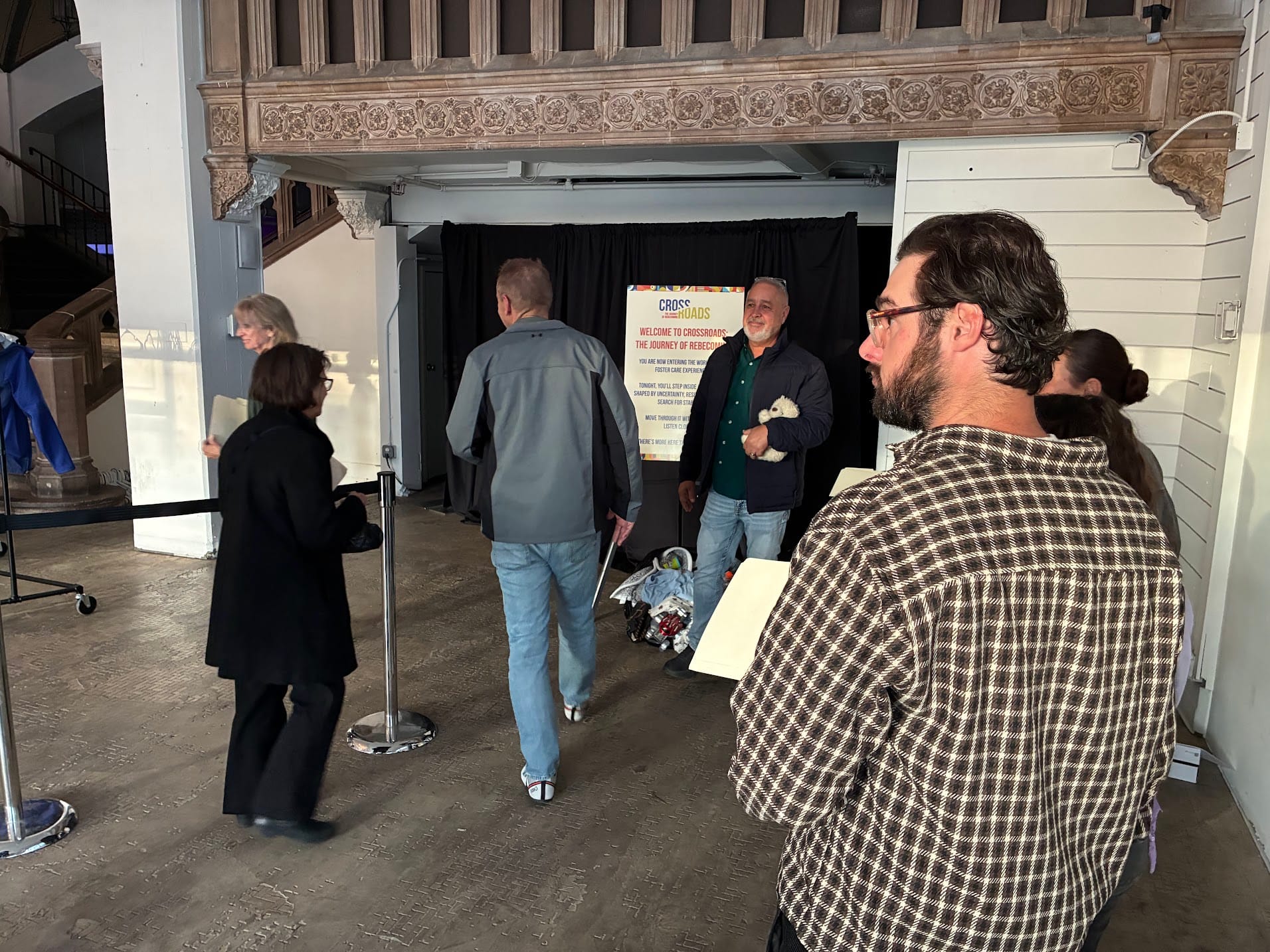
Entrance to Crossroads: The Journey of Rebecoming. | Photo: Toni Tresca
The legal system offers no good answers
The first major sequence drops you into a Colorado courtroom, where Jayden’s future is being decided in real time. The production splits its central character between two performers: Teej Morgan-Arzola as an older Jayden who narrates and occasionally interrupts the action, and Andrew J. Betts as his younger self, a teenager being pulled through a process he didn’t choose.
The stakes are laid out quickly. Jayden can remain with his foster parent Tanya, played by Jamie Lujan, who offers consistency but is stretched thin, or return to his father Deshaun, played by Vincent Clouse, who insists he is sober and ready to parent despite a history of instability and flashes of anger that surface even in the courtroom. Between them is Marcus, the caseworker, played by Mitch Marquez, who tries to advocate for Jayden while juggling the limits of an overburdened system.
Judge Holloway, played by Terry Burnsed, is shockingly candid about how bad the legal process is for kids. Late in his career, he acknowledges that the system he serves rarely produces clean outcomes. At one point, he offers Jayden a voice in the process, not because it will change the result, but because it may be the only moment of agency the boy is given.
Then the production extends that question to the audience. You are asked to decide whether Jayden should: 1) return to foster care, 2) live with his father or 3) allow the system to decide. Hands go up across the room. People justify their reasoning out loud. Some argue that returning to family is essential. Others point out that family can be the source of the deepest harm. Interestingly, no one voted to leave the decision entirely to the system.
The scene works because it refuses to simplify. There is no clear right answer, only a series of compromises that reveal how limited the available options really are.
A birthday party that opens conversation and slows the pace
From there, the experience moves upstairs into a birthday party set on Jayden’s 15th birthday. The shift in environment is immediate. Bright colors, balloons and cupcakes replace the starkness of the courtroom. Audience members are seated at tables and given prompts to discuss their own experiences growing up, what they understand about foster care and what responsibility might look like beyond witnessing the story.
In practice, these conversations become one of the most revealing parts of the evening. At my table, someone admits that they came hoping that the system would not be as bad as they had feared, while another participant with direct experience with the foster care system quietly notes that what is being portrayed is a sanitized version of reality. The structure encourages honesty, and in many cases, people take the invitation seriously.
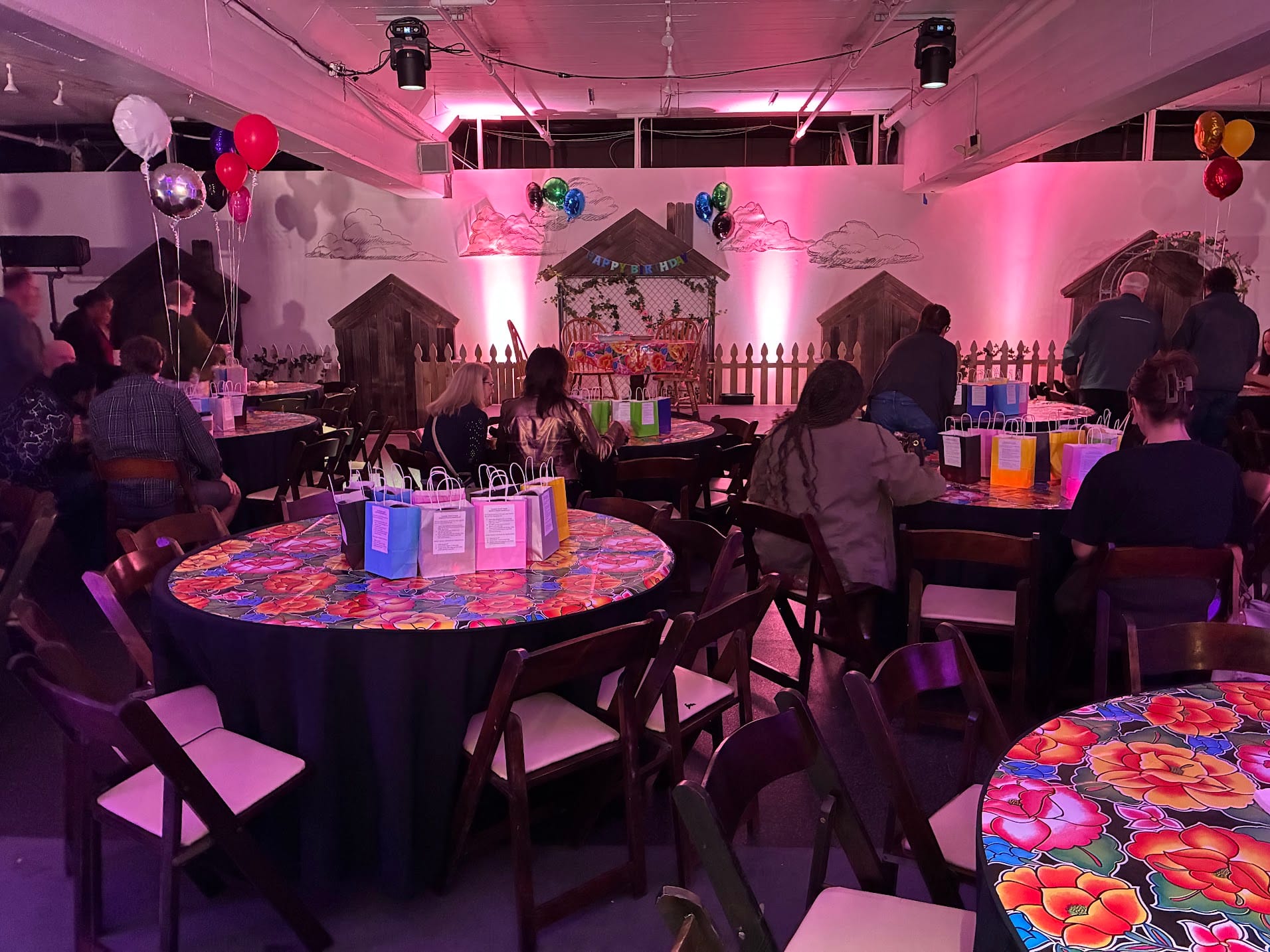
The birthday party scene in Crossroads: The Journey of Rebecoming. | Photo: Toni Tresca
At the same time, the pacing begins to slip. The transition into this section stretches long enough that the urgency built in the courtroom dissipates. The scene itself takes time to restart, and when it does, it has to rebuild tension that had already been earned.
Once the narrative resumes, it centers on a strained attempt to create normalcy. Marcus proposes enrolling Jayden in an arts-based program through Crossroads, which elicits cheers from various parts of the room. When Deshaun arrives, the underlying conflict resurfaces quickly. He accuses the system of keeping his son from him. Tanya pushes back. The conversation escalates into a full argument that leaves Jayden caught in the middle once again.
At that point, Jayden puts on a pair of headphones, and the audience is instructed to do the same. The sound design by akilbeatsdenver takes over, layering a hip-hop beat with fragments of Jayden’s internal thoughts. The effect is disorienting in a way that feels intentional. The noise of the adults fades, replaced by the pressure building in his head. It is one of the clearest moments where the immersive structure aligns fully with the emotional reality of the character.
An art gallery that points forward, and skips ahead
The final section moves to the top floor, where the tone shifts again. The setting is an art gallery showcasing Jayden’s work at a later stage in his life. The older version of the character reflects on how programs like those offered by Cobbled Streets helped him find direction and stability.
The space is populated not just by actors but by real participants in those programs. One stands beside a display referencing a summer camp experience. Another represents a martial arts program. A third highlights a golf initiative. These presences ground the story in lived experience and make the connection between the narrative and the organization’s mission explicit.
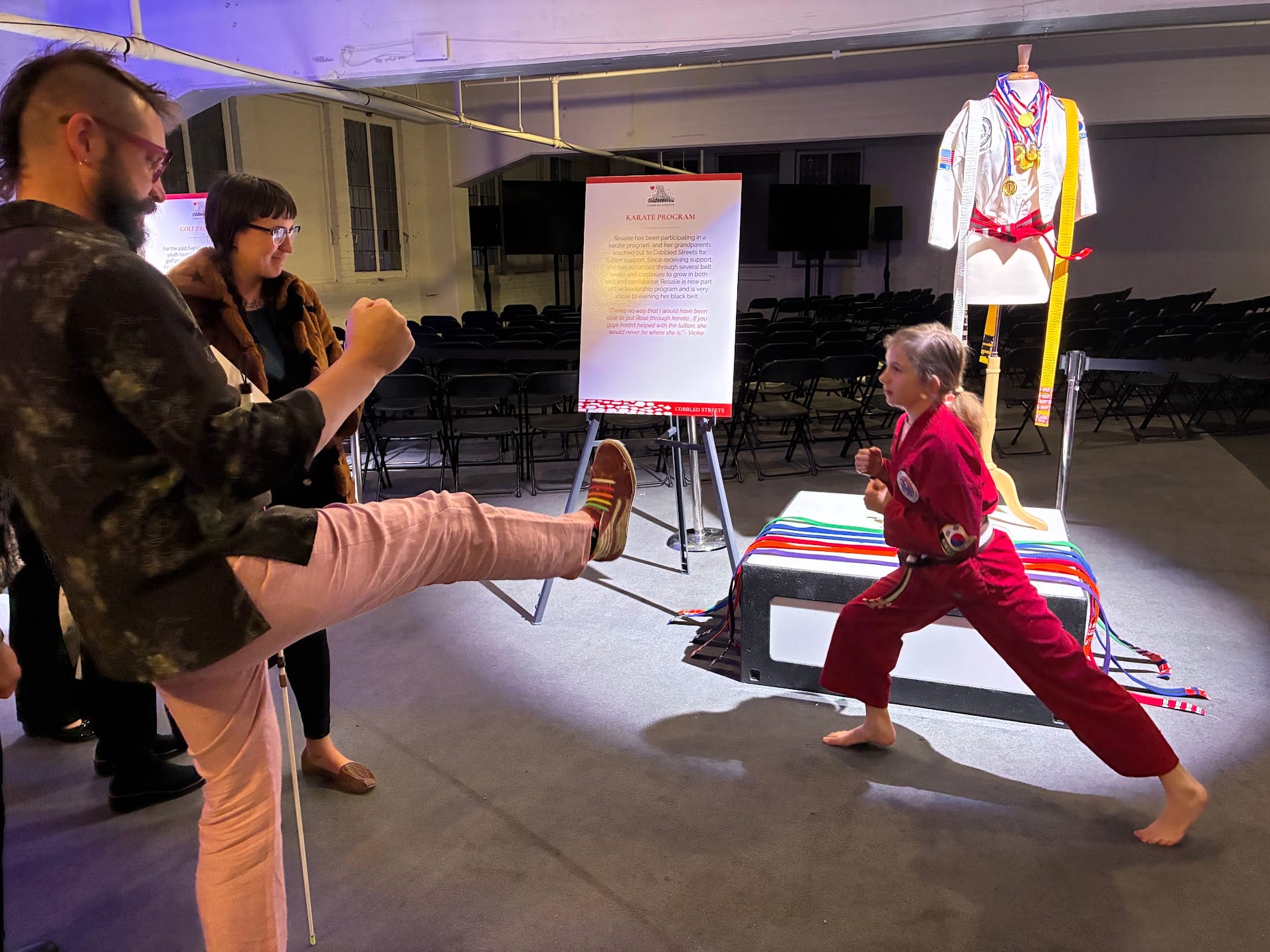
A Cobbled Street kid in front of a sign about its karate program in the last scene of Crossroads: The Journey of Rebecoming. | Photo: Toni Tresca
The sequence is effective in its immediacy, but it also compresses the journey. The distance between the instability of the earlier scenes and the relative calm of this resolution is significant, and most of that ground is covered in summary rather than dramatization. You understand the intention. You see the impact. You do not fully see the work it takes to get there.
That choice shapes how the ending lands. After an evening that emphasizes how difficult and inconsistent the system can be, the final note leans toward resolution. It offers a version of what success can look like when the right support is in place. It also risks smoothing over the reality that, for many, that outcome is far from guaranteed.
Strong foundation
What Crossroads does well is make the foster care system feel immediate and personal. It takes something that can be easy to ignore and puts it directly in front of you, asking you to engage with it in a way that feels active rather than passive. As you are told early on, 1/5 children who are in foster care will end up homeless the second they turn 18. This is not a system designed for success, and that should alarm everyone.
The performances support that goal. Morgan-Arzola provides a steady throughline as the older Jayden, guiding the audience without overplaying the role. Betts captures the confusion and pressure of a teenager navigating adult decisions. Marquez, Lujan and Clouse each bring specificity to roles that could easily become archetypes, and Burnsed leads the courtroom with a quiet sense of fatigue that suggests years of similar cases.
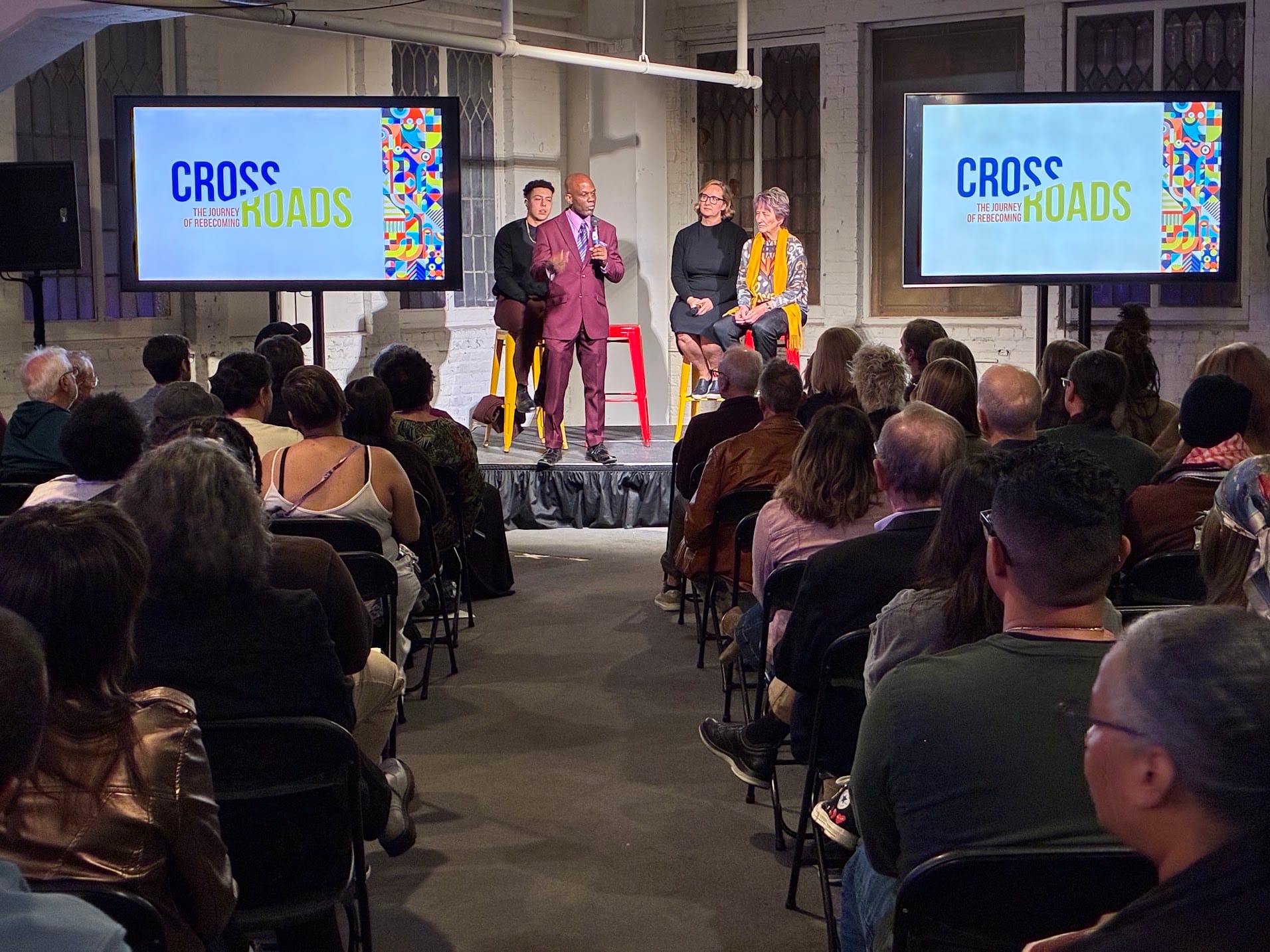
Talkback following Crossroads: The Journey of Rebecoming. | Photo: Toni Tresca
There is room to refine the structure. The extended transitions between sections slow the overall rhythm, and the piece would benefit from either tightening those gaps or using that time to deepen the story. Expanding the middle section or adding additional scenes could help bridge the gap between the crisis presented at the beginning and the resolution at the end.
Even in its current form, the experience lands. It is informative without becoming didactic, leaving you with a clearer sense of how the system operates and how much of it depends on forces outside a child’s control. More than anything, it prompts a question that lingers after you leave the building. If this is the structure we have in place for some of the most vulnerable people in our communities, what responsibility do we carry in changing it?
While the piece itself doesn’t (and couldn’t possibly) answer that question, it does deserve credit for getting over 100 people to come out on a Friday night, confront the devastating realities of the foster care system head-on and begin to consider a better path forward.

An award-winning Colorado arts and culture reporter originally from Mineola, Texas. Tresca is the chief theatre critic for OnStage Colorado and managing editor of OnScreen Colorado. He’s the editor of Bucket List Community News, a contributor to Denver Westword and Estes Valley Voice, a resident storyteller for the Bonfils-Stanton Foundation and the co-host of the OnStage Colorado Podcast.

Leave A Comment