

The Truth About 250-150 is an immersive bus exhibit that examines Colorado’s colonial history.
As Colorado celebrates its 150th anniversary alongside the nation’s 250th, The Truth About 250-150 asks audiences to look directly at the violence those anniversaries can obscure.
The Indigenous-led mobile installation, created by Wakáška Yuza in collaboration with Control Group Productions, reframes the story of Colorado statehood through land theft, forced removal, genocide and survival. Housed inside a renovated school bus, cargo trailer and shade tent, the piece operates somewhere between museum, immersive theatre and community intervention.
It is a “mobile monument” built to travel across Colorado, carrying a history the state has too often buried into the communities still living with its consequences.
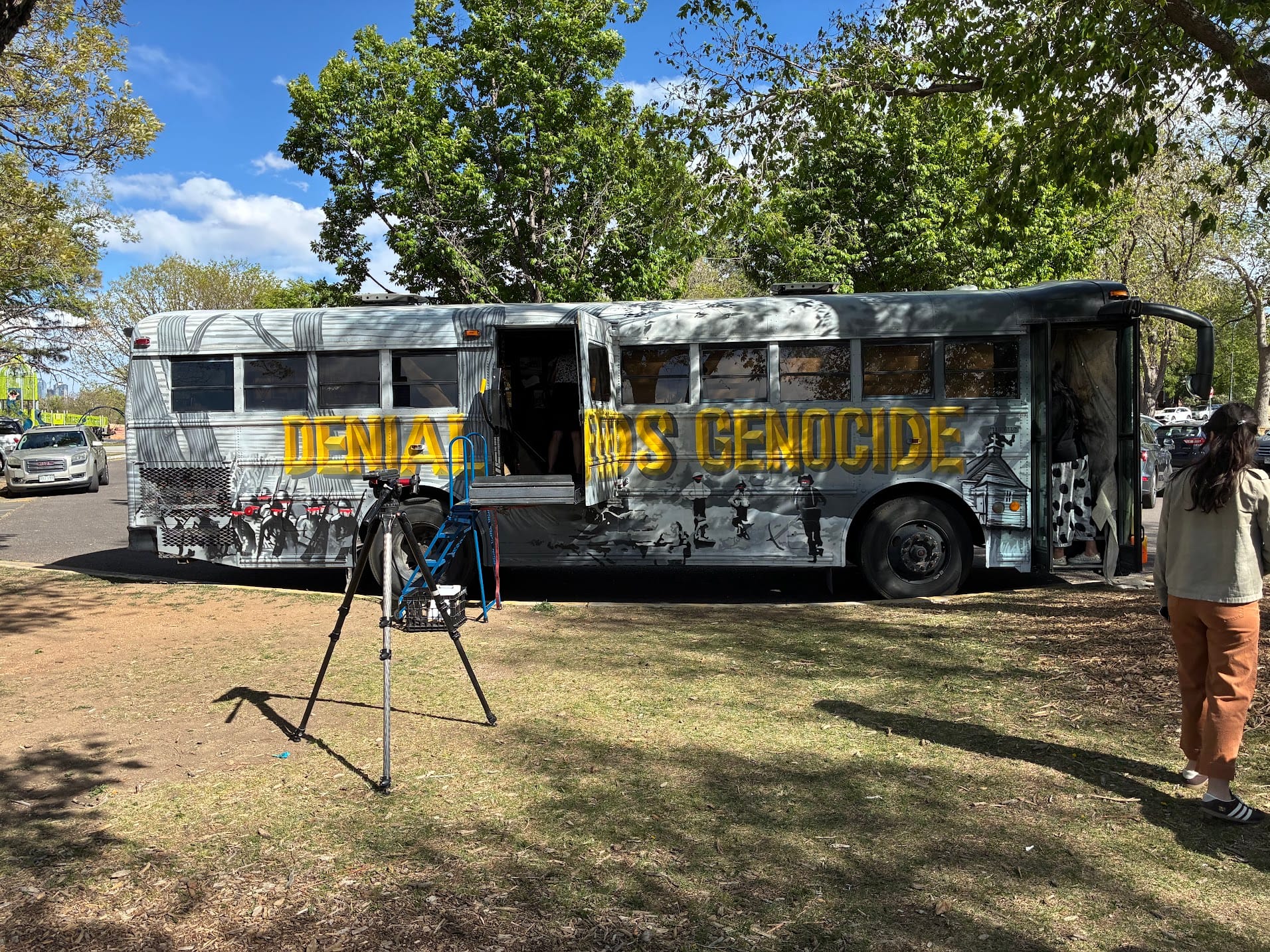
Exterior of Control Group Production’s event bus, which houses The Truth About 250-150. | Photo: Toni Tresca
That mobility is central to the project. Following a May 9 opening at the Sky Ute Casino in Ignacio, the installation will tour communities across the state through September, with stops planned in Montrose, Trinidad, Carbondale, the San Luis Valley and Colorado Springs.
The project builds on several years of work by Control Group’s Breathing Healing initiative, which since 2021 has explored how immersive art and somatic practice can address historical trauma. In 2025, that work was transformed into a touring Breathing Healing Bus.
“We had been working on the bus as a mobile immersive space,” Control Group’s Patrick Mueller said at a preview event in Sloan’s Lake Park on April 24. “And when we started hearing about the 250/150 commission, it became clear this could be a literal vehicle for that story.”
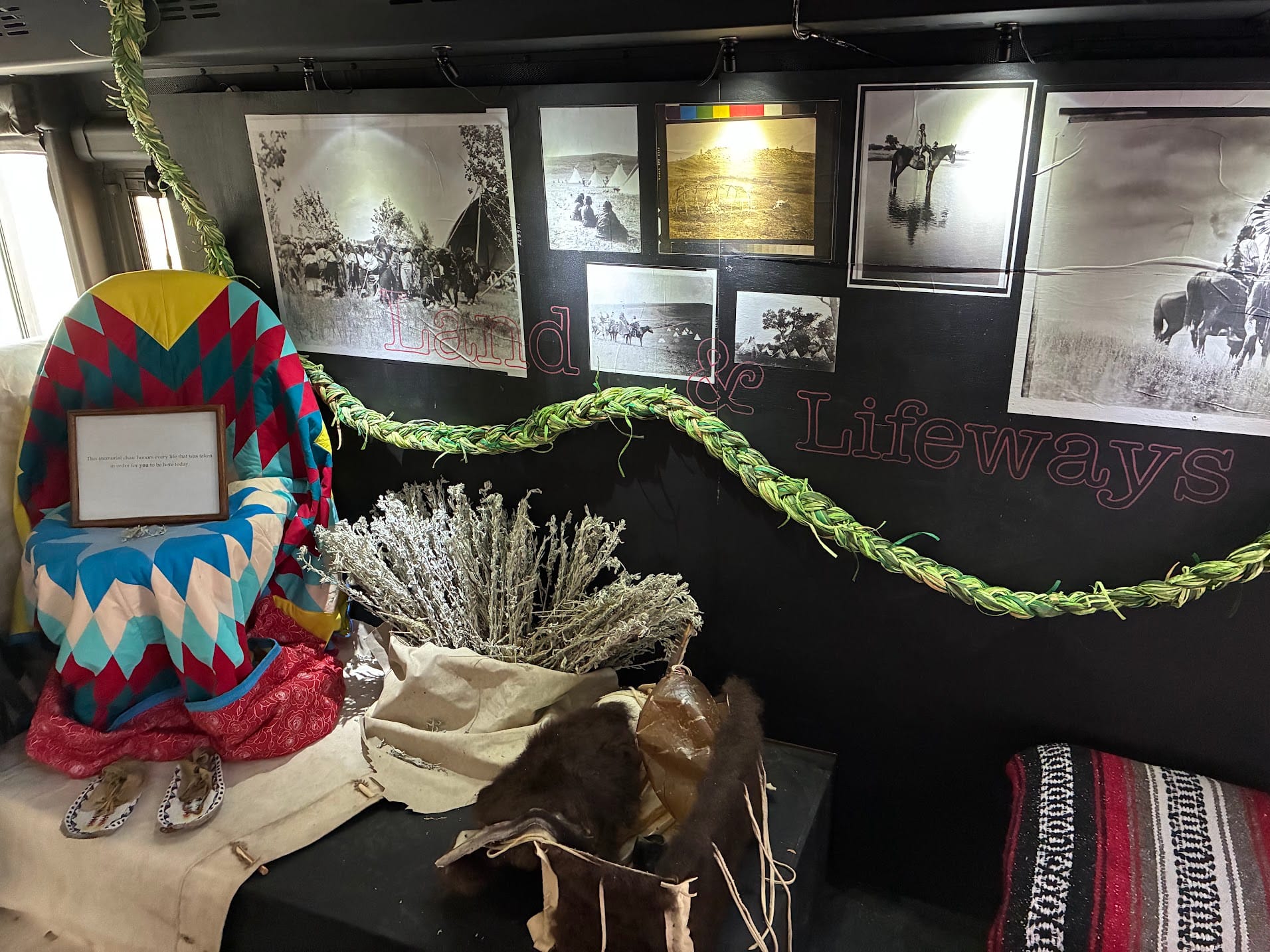
The “Land & Lifeways” section of The Truth About 250-150. | Photo: Toni Tresca
Dr. Terri Bissonette, the lead facilitator with Wakáška Yuza, explained that the project arose from concerns about how Colorado would commemorate its anniversary.
“What I was concerned about, knowing Colorado’s history and how the truth of what happened to tribal nations when Colorado became a state had essentially been buried, was that our history would not be told accurately,” Bissonette said. “Very few people in the state know this history at all.”
That absence becomes the project’s central provocation. If Colorado is going to celebrate 150 years of statehood, The Truth About 250-150 insists that Coloradans must also confront what made that statehood possible.
“Native history is Colorado history, and every Coloradan should know this history,” Bissonette said. “In addition, we also want folks to know that we’re still here and we have vibrant, dynamic communities.”
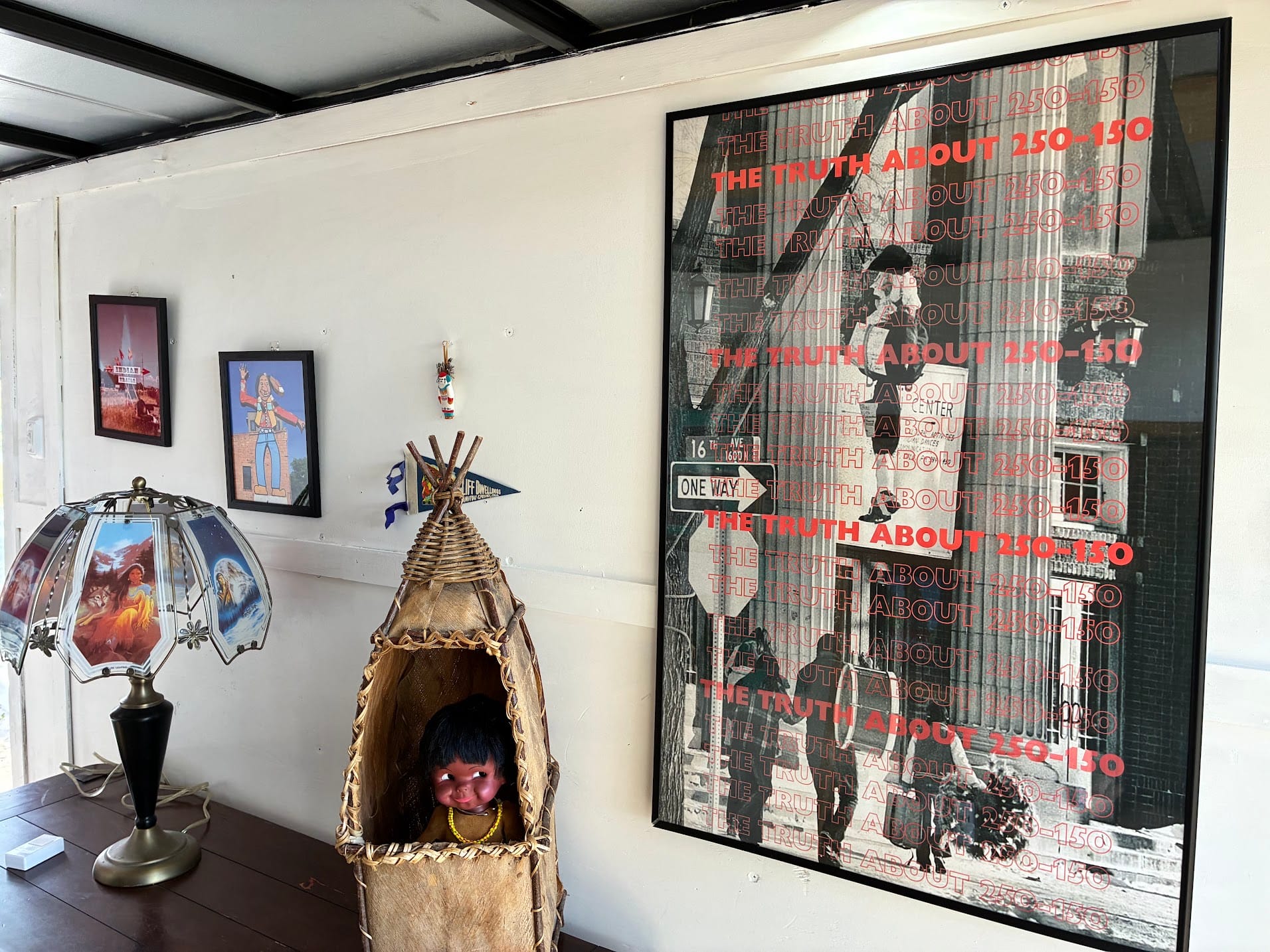
A trailer is set up near Control Group Production’s event bus where The Truth About 250-150 begins. | Photo: Toni Tresca
Immersion without escape
Unlike many immersive works, The Truth About 250-150 does not use theatricality as a form of fantasy. There are no live performers, hidden rooms or puzzle-box theatrics. Instead, the audience member becomes the moving body inside the work, guided by audio, images, video, installation and somatic reflection.
The experience begins in a cargo trailer staged with pop culture artifacts, racist children’s books and distorted representations of Native people. A “LANDBACK” sign cuts through the room’s domestic familiarity, making clear that nostalgia is part of the problem.
From there, visitors choose one of three audio tracks: one for Native visitors, one for white visitors and one for non-Native, non-white visitors. I chose the white track, which runs about 36 minutes and guides listeners through the experience with a tone that is direct, unsettled and intentionally personal.
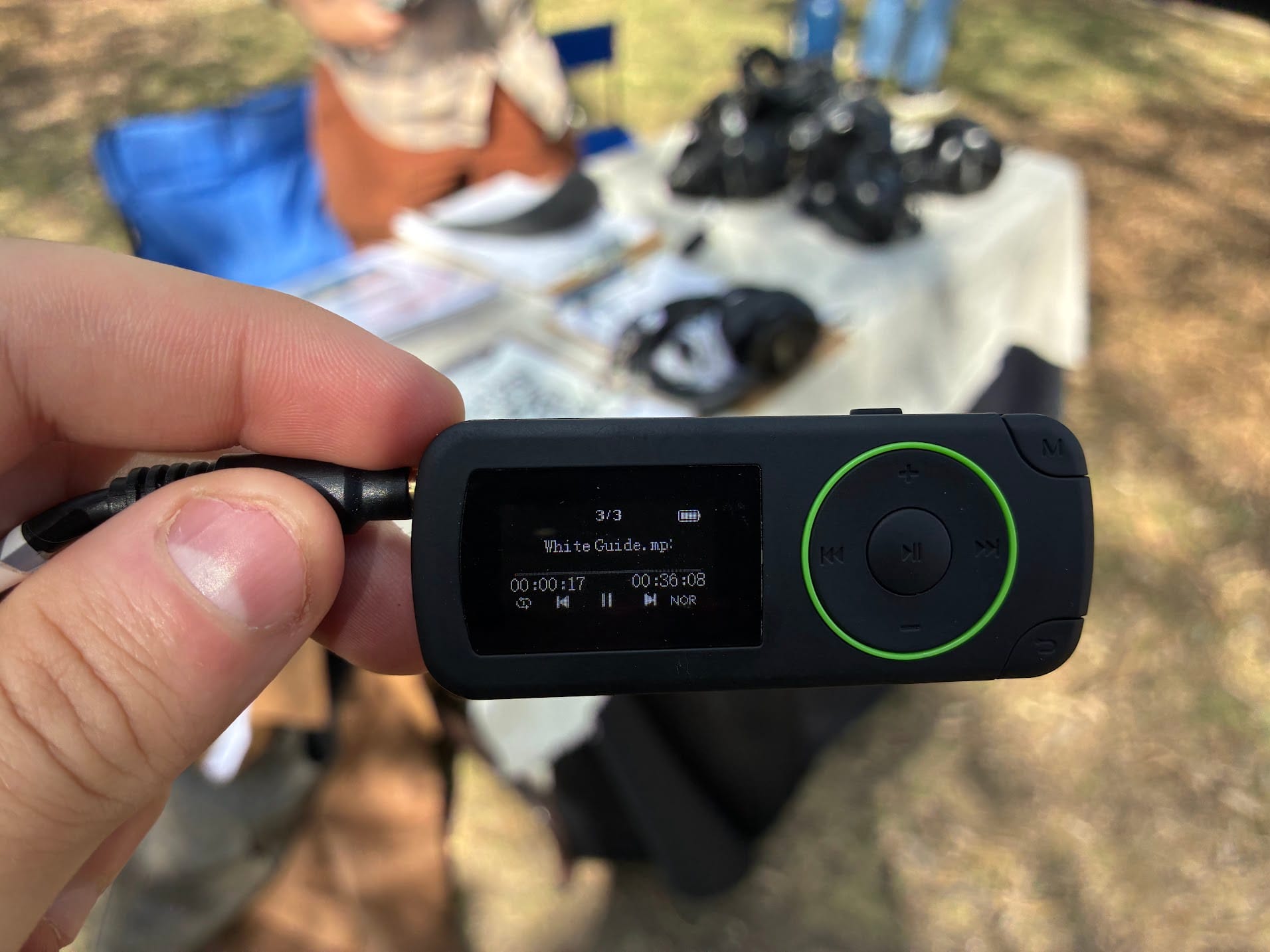
Each guest is given an audio player that provides one of three guided tour options: 1) Native, 2) white or 3) non-Native, non-white. | Photo: Toni Tresca
Mueller notes the three-track structure reflects the understanding that different audiences enter the space with different relationships to the land and its history.
“The healing for each of these three groups is very different,” he said. “The relationship with the ground under your feet, with the history being handled, is quite different for each of those three groups of people.”
That choice gives the installation much of its force. Rather than allowing visitors to observe history from a safe remove, the audio keeps returning them to their own bodies, their own inheritances and the ground beneath them.
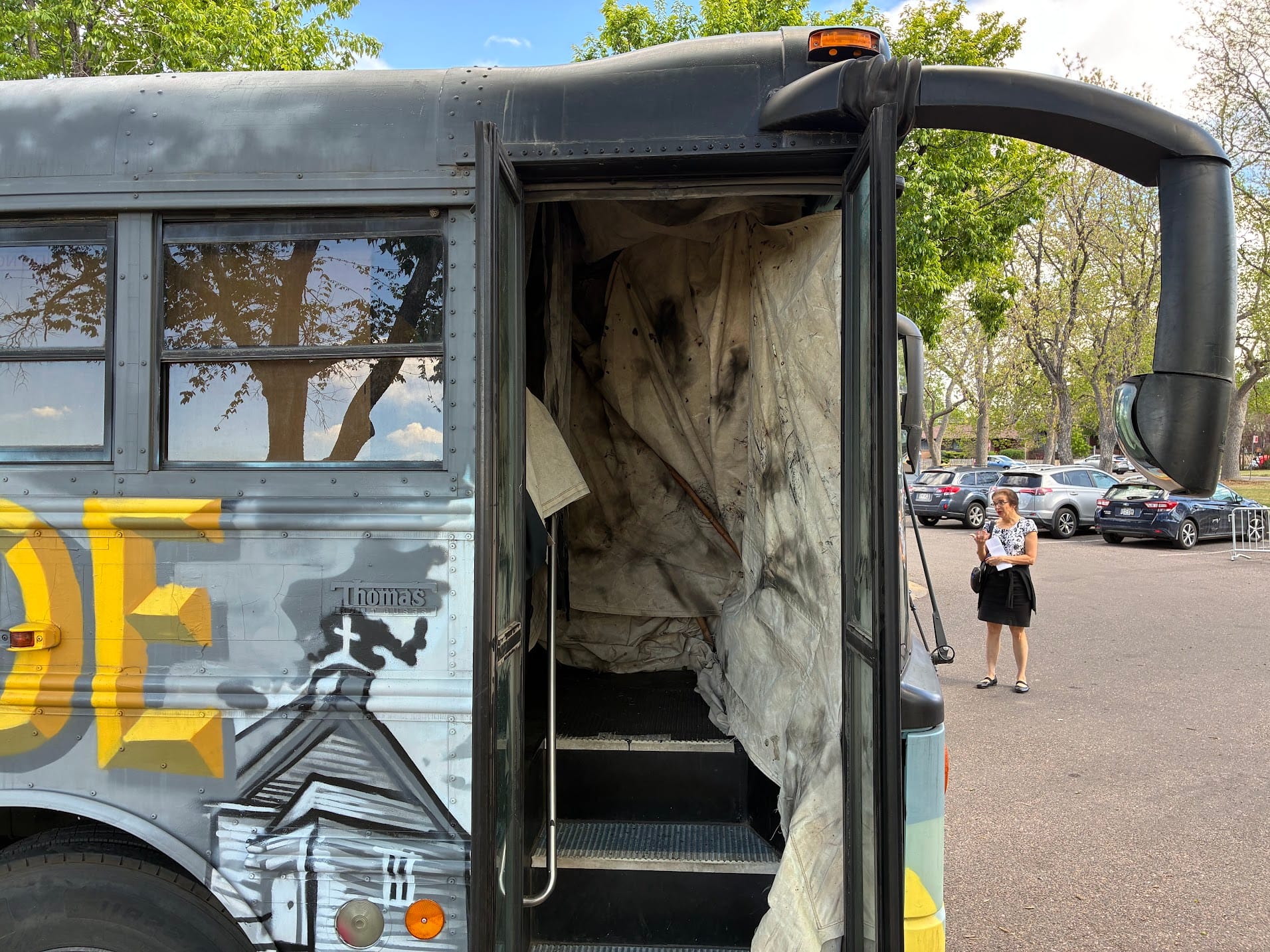
Entrance to The Truth About 250-150. | Photo: Toni Tresca
Boarding the bus
Inside the bus, the installation moves from pre-colonial land and lifeways into invasion, dispossession and the continuing effects of colonial violence. A memorial chair honors “every life that was taken in order for you to be here today.” A wall of imagery traces conquest and removal. A video installation outlines the economic, environmental and cultural destruction inflicted on Native communities.
One of the most unsettling moments asks visitors to physically mirror a photograph of a settler standing atop a pile of buffalo skulls. The prompt is simple, but the gesture lands with force. It makes domination something you briefly inhabit, then asks what that posture reveals.
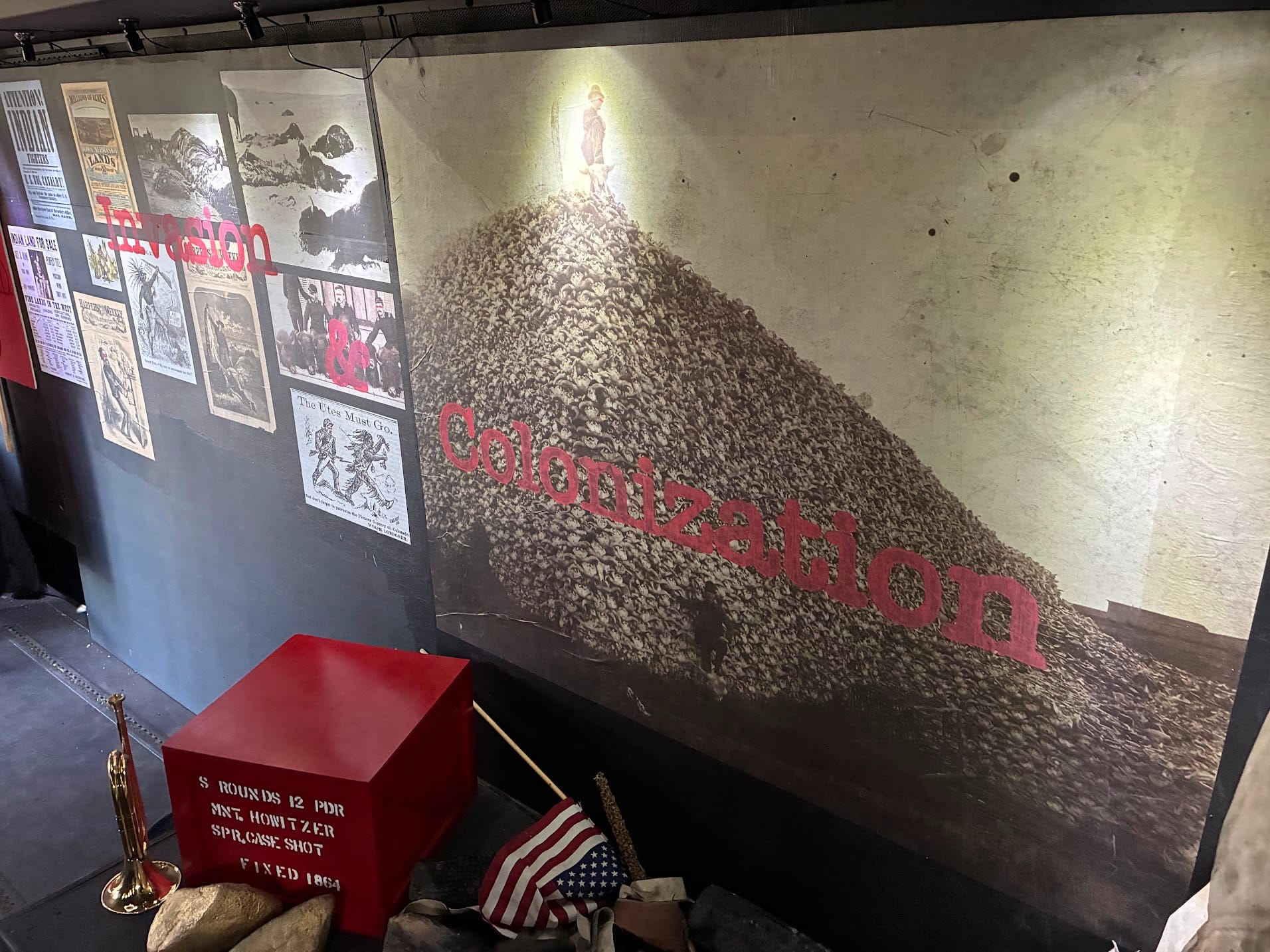
The “Invasion & Colonization” section of The Truth About 250-150. | Photo: Toni Tresca
The installation later expands into the 20th century and present day, addressing boarding schools, Missing and Murdered Indigenous Relatives and the ongoing disparities Native communities face in Colorado. Mueller says new material was added to connect the earlier history of invasion with continued oppression and genocide.
“The bus was mostly talking about the initial invasion of European culture into this land,” Mueller says. “We added content reflecting the continued oppression and genocide through the 20th century with boarding schools and then MMIR.”
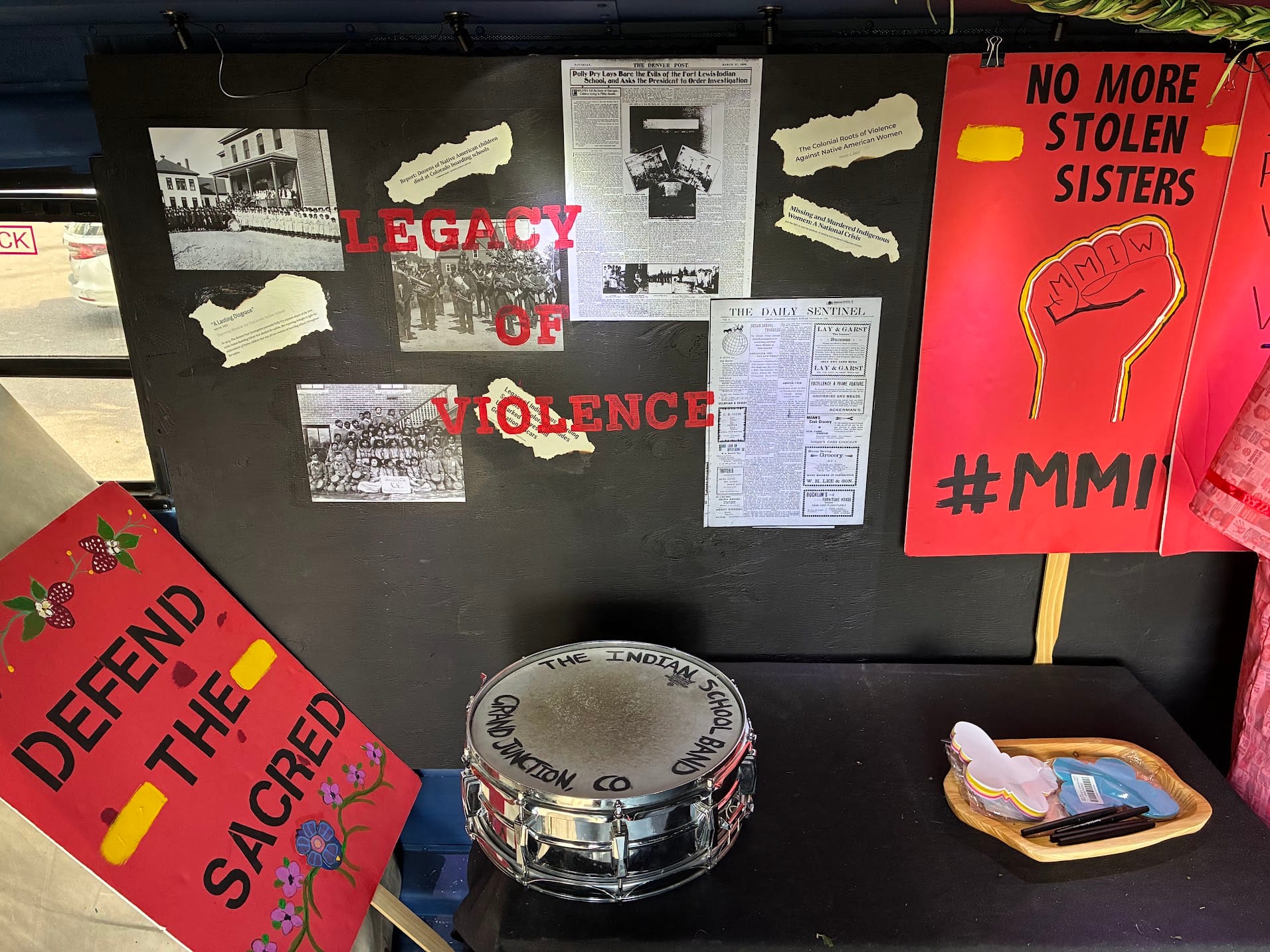
The “Legacy of Violence” section of The Truth About 250-150. | Photo: Toni Tresca
That progression is crucial. The project refuses to let audiences file colonial violence away as a completed chapter. Instead, it shows how unresolved violence mutates into policy, education gaps, erasure and ongoing harm. Bissonette says that emphasis is central to the statewide tour.
“You can’t do that from Denver,” she said. “You have to go physically into these places and share this information.”
Reckoning as practice
The most powerful element of The Truth About 250-150 may be its refusal to offer easy catharsis. Near the end, Cinnamon Kills First leads visitors through a somatic reflection in which they are asked to consider their ancestry and current responsibilities. It does not absolve. It does not soothe the experience into something more comfortable. It asks you to breathe with knowledge that should be difficult to carry.
As theatre, the project is strongest when it trusts the intimacy of that discomfort. The bus’s narrow interior, the solitude of the audio tour and the physical prompts create a kind of embodied history lesson that feels more potent than a wall text or panel discussion could. At times, the density of information threatens to overwhelm the shape of the experience, but the accumulation also mirrors the enormity of what has been omitted from public memory.
Bissonette says the goal is not to leave people trapped in grief but to move them toward responsibility. “We want to do it in a way that ends up inspiring and motivating people to really want to participate in reconciliation and want to participate in just moving forward together,” she said.
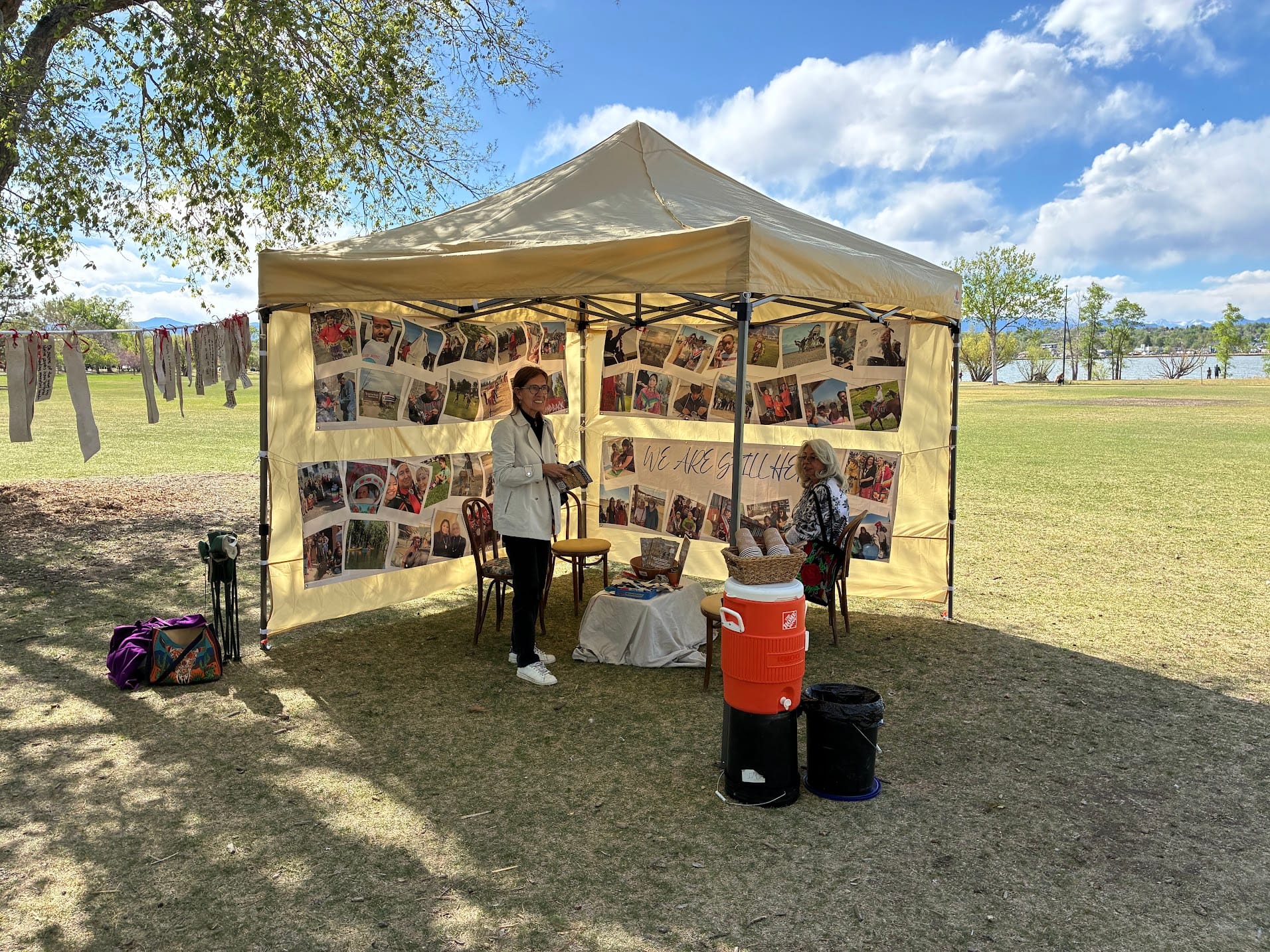
A photo installation outside Control Group Production’s event bus, concluding The Truth About 250-150. | Photo: Toni Tresca
That intent is reflected in the zine that was distributed under the tent with photos taken by Native youth artists with the words “we are still here” on it next to the bus and a link to a petition asking lawmakers to use some of the State Land Board revenue to support statewide Indian education. The project treats awareness as a beginning rather than an endpoint.
By the time visitors step off the bus, The Truth About 250-150 has made celebration feel impossible without accountability. It is a demanding, artful and necessary work that uses immersion not to whisk audiences away from Colorado, but to make them feel the full weight of standing here.

An award-winning Colorado arts and culture reporter originally from Mineola, Texas. Tresca is the chief theatre critic for OnStage Colorado and managing editor of OnScreen Colorado. He’s the editor of Bucket List Community News, a contributor to Denver Westword and Estes Valley Voice, a resident storyteller for the Bonfils-Stanton Foundation and the co-host of the OnStage Colorado Podcast.

Thank you, Toni.