
Atomic Theatre’s original musical struggles to dramatize the legendary gunslinger’s life.

John Henry “Doc” Holliday absolutely has a story worth telling. The dentist-turned-gambler-turned-gunfighter has occupied a strange and enduring place in the mythology of the American West for more than a century.

Popular culture has transformed him into everything from tragic antihero to unstoppable outlaw, often exaggerating both his body count and his legend. He is perhaps best known for his role in the Gunfight at the O.K. Corral in Tombstone, Arizona, alongside Wyatt Earp, but Colorado audiences may know him for another reason: Holliday died in what would later become Glenwood Springs after traveling west in hopes that the mountain air might ease his tuberculosis.

So when Atomic Theatre announced Defiance: Doc Holliday’s Last Stand, an original musical written and composed by Ken Crow and directed by Emily Liddy, the premise immediately sounded promising. Holliday’s life contains betrayal, violence, addiction, friendship, mythmaking and mortality — all rich material for musical drama.
A deathbed reflection framed around the ghosts of his past could have offered an intimate way into that mythology. Unfortunately, Defiance rarely finds a compelling dramatic angle on its subject.

Rather than dramatizing a pivotal chapter of Holliday’s life or interrogating the mythology surrounding him, the musical spends almost its entire 90-minute runtime with Holliday confined to a bed in Glenwood Springs while three women from different periods of his life argue over who understood him best. Ghosts of men he killed occasionally appear to confront him, though those encounters ultimately lead less toward reckoning than reaffirmation.

Again and again, the show circles back to the same conclusion: Doc Holliday may have been reckless, selfish and destructive, but he was also just too charismatic to condemn.
683738409 17873754486600013 7395435505291373587 n

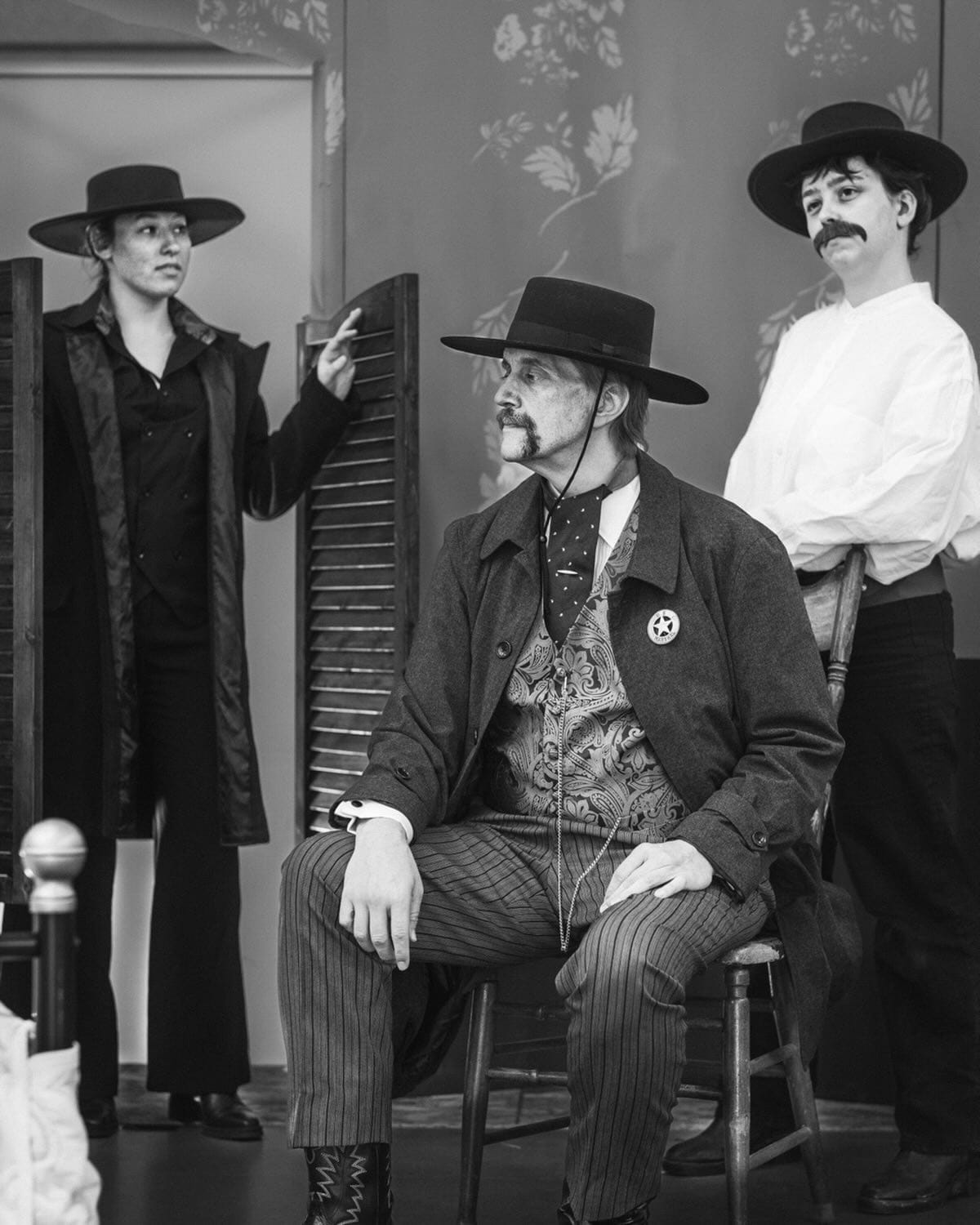
Julietta Rozin, Tobie Bonahoom and Rebecca Juranek in Defiance: Doc Holliday’s Last Stand. | Photo: Paul Adams

That reverence becomes the production’s central problem. Defiance holds Holliday in such high regard that it never seriously interrogates the man beneath the legend. The result is a musical with very little dramatic tension. Since the story begins with Holliday dying of tuberculosis in the 1880s, there is no uncertainty about the outcome, and the script struggles to create meaningful stakes beyond repeated declarations about his freedom-loving spirit.

The women surrounding him are at least conceptually more interesting. Mary Katherine (Tara Hedberg) sees Holliday not as a mythic gunslinger but as the sick, diminished man before her. Big Nose Kate (Deletta Hartkopp) embraces his chaos and excesses, insisting that loving Holliday means accepting all of him. Mattie (Tracy Hoang), meanwhile, represents a more moralizing force, someone who spent her life hoping he might reform.

Those tensions could fuel a compelling chamber musical. Instead, the script reduces most of their interactions to repetitive romantic disputes that never deepen our understanding of either Holliday or the women themselves.

The musical structure does not help. Most songs function as isolated musical interludes rather than integrated storytelling devices. Nearly every number shares the same slow, folksy country rhythm, causing the score to blur together over time. Aside from the playful “Can Can” number, which at least briefly shifts the show’s energy, few songs leave much impression after they end.

More importantly, the songs rarely advance character or plot. Scenes often stop entirely so performers can deliver standalone musical reflections before resuming exactly where they left off. The production frequently feels less like a dramatic musical and more like a concept album interrupted by dialogue scenes.

The show’s strongest musical sequence, “Come Away,” arrives late in the production with Julietta Rozin’s appearance as the Angel of Death. Rozin brings a striking vocal presence, and her scenes with Rebecca Juranek’s Holliday finally introduce the kind of thematic confrontation the show has long needed. Their exchanges briefly hint at a more psychologically complex version of this material, one concerned with memory, regret and legacy rather than simple hero worship.

Juranek, meanwhile, does solid work within the production’s limitations. Confined to a bed for much of the runtime, Juranek still brings folksy charm to Holliday, particularly during “I Am On The Run,” “Come Away” and “Ain’t No Yankee.” Several supporting performers also show flashes of strong character work, especially Hartkopp’s fiery Big Nose Kate.

Still, the production itself often feels under-rehearsed. Vocal performances across the ensemble can be shaky, with uncertain harmonies and inconsistent pitch throughout the evening. Dialogue pacing drags in several scenes, particularly as line stumbles and long pauses sap momentum from already static staging.

Technical issues further complicated opening night. Early in the opening number, “Photographs,” the projections failed, displaying an error screen for about a minute before cutting out completely. Whether additional visual storytelling had originally been planned through those projections is unclear, but their absence left the already exposition-heavy opening feeling even more inert.

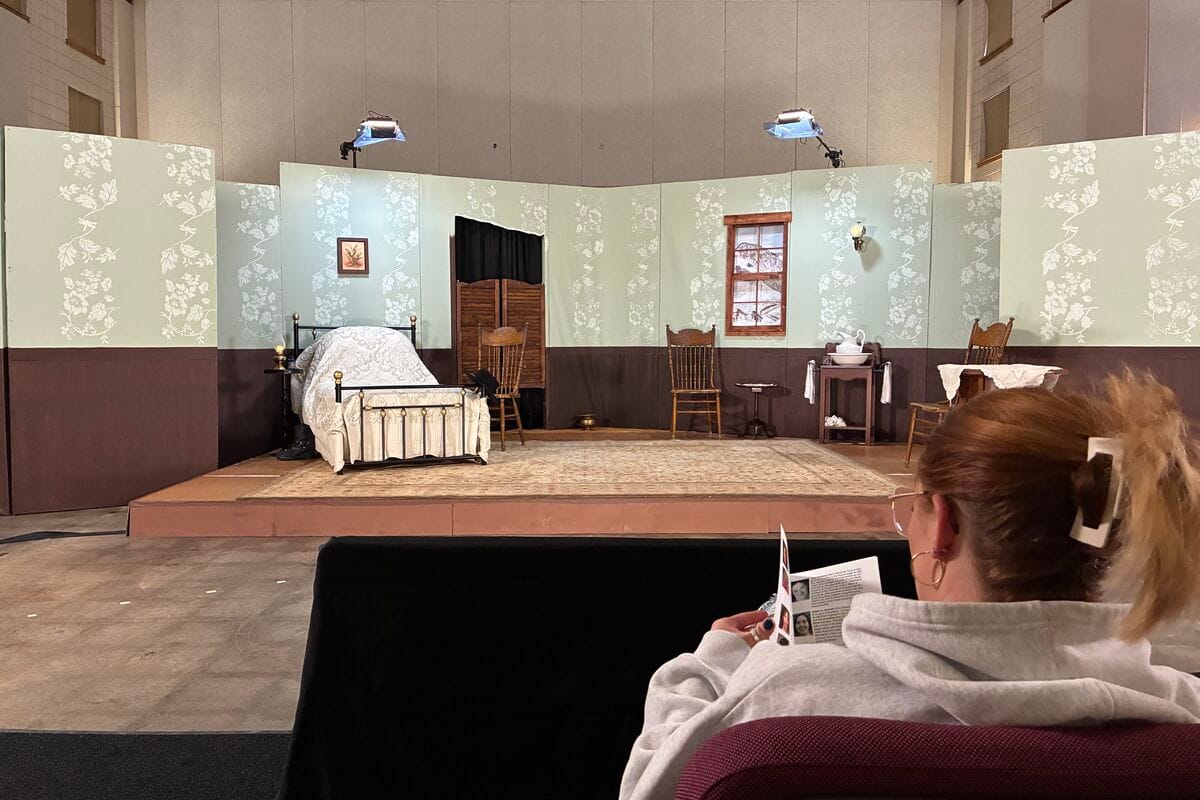
To the production’s credit, the physical staging itself is not the primary issue. Performed at the Wheat Ridge Center for Music and Arts, the set designed by Mary Beth Nelson efficiently transforms the modest church performance space into a sparse frontier sickroom complete with saloon doors, mountain imagery and practical furnishings. The environment serves the material adequately.

The larger problem is that the script gives the actors remarkably little physical action to play. Much of the evening consists of performers standing in place singing or slowly crossing from one side of the stage to the other.

Odd technical rhythms compound that stiffness. Most scenes end in abrupt hard blackouts rather than fluid lighting transitions, creating a choppy stop-and-start rhythm that emphasizes the show’s lack of momentum.

Ironically, Defiance finally stumbles onto a more interesting premise in its closing moments, when Holliday’s fate is determined through a poker game tied to his afterlife. It is one of the few moments where the production embraces theatrical metaphor and dramatic tension simultaneously. One almost wishes the musical had started there.

Because beneath all the repetition and mythologizing is still the outline of a compelling story. Doc Holliday remains a fascinating American figure precisely because he exists somewhere between truth and legend. But Defiance never fully explores either side of that divide. Instead, it spends most of its runtime talking about Holliday’s reputation rather than dramatizing the contradictions that made him enduring in the first place.

The production is all tell and very little show, turning Defiance into a slow deathbed tribute to a man whose life should have made for a compelling musical.

67485b72fa6146f9dd5ebe7d4d8917ec

A Colorado-based arts reporter originally from Mineola, Texas, who writes about the changing world of theater and culture, with a focus on the financial realities of art production, emerging forms and arts leadership. He’s the Managing Editor of Bucket List Community News, a contributor to Denver Westword and Estes Valley Voice, resident storyteller for the Bonfils-Stanton Foundation and co-host of the OnStage Colorado Podcast. A member of the American Association of Theatre Critics, he holds an MBA and an MA in Theatre & Performance Studies from CU Boulder.