
Despite a fantastic setup, this comedy’s best ideas arrive too late to fully land.
There may be no more bizarre and Buntport-ready premise than three former teens reuniting decades later to reclaim a Guinness World Record for catching stuffed animals while blindfolded.
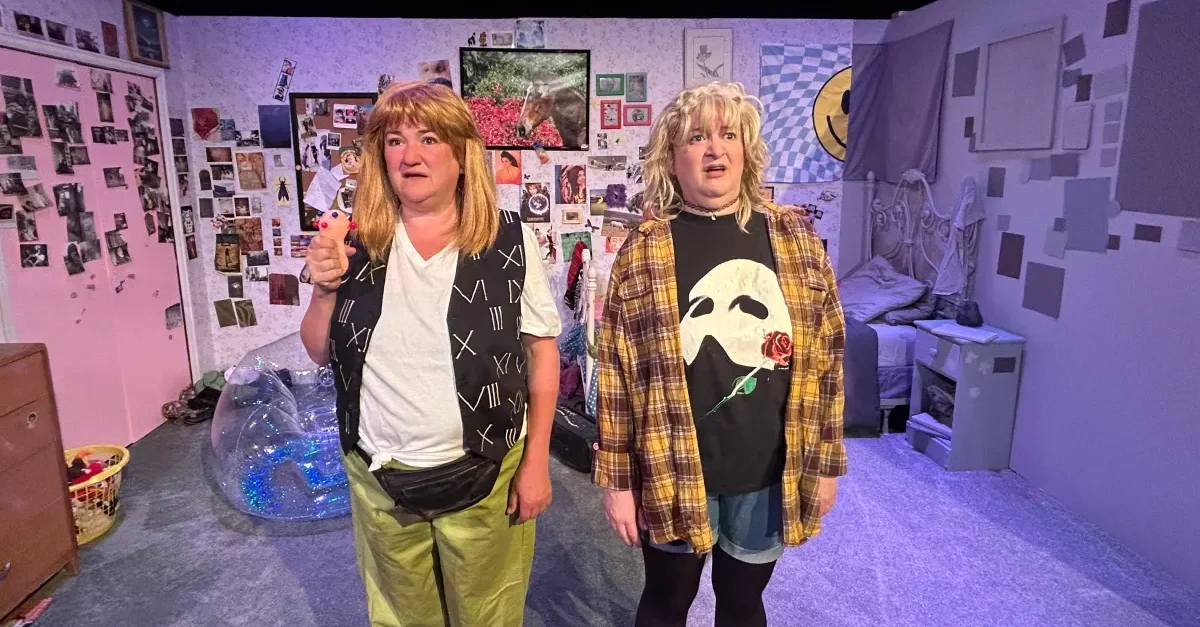
That is the setup for This Is The Day ’91, the latest collaboratively created comedy from Buntport Theater, running through June 14 at the company’s Lipan Street home. The show stars Hannah Duggan as Kaelyn, Erin Rollman as Misty and Brian “Byron” Colonna as Elliott as three adults attempting to recreate the exact conditions of the wacky record they set as teenagers in 1991.
Unfortunately, This Is The Day ’91 does not quite live up to that incredible premise. Although the production is clever and frequently intriguingly self-aware, as a work of comedy, it is strangely hesitant to embrace the physical absurdity at its core.

A childhood room reconstructed
The best thing about the production is its set, which immediately establishes both the world of the play and its central metaphor. Misty’s childhood bedroom has been reconstructed in the middle of the theater, complete with ’90s markers including a lava lamp, an inflatable chair, VHS tapes, pop-culture posters and the kind of adolescent clutter that can make a room feel like a time capsule.
Yet it is not a realistic bedroom. The audience can see the exposed wooden supports holding the walls upright. The missing fourth wall becomes a literal and comic subject in the opening exchange. There are also gaps in the design where memory has failed. Parts of the room remain gray patches and indistinct blobs because the characters couldn’t remember what was there.
That visual idea is genuinely evocative. The room is both a reconstruction and an admission that reconstruction is impossible, foreshadowing much of the show’s later discussion about how close is close enough to warrant a recreation.
The opening minutes promise a sharper, sillier show than the one that follows. As “Love Shack” plays and Kaelyn and Misty address the missing fourth wall with deadpan seriousness, the production starts on a pleasingly ridiculous wavelength. Jokes in this first section strike the perfect balance between high and low comedy, with one particularly amusing example being the characters poking their butts through the missing wall to great comedic effect.
Then Elliott arrives late, wearing a Mickey Mouse shirt and carrying the faint aura of someone with an actual life outside the room. He has kids. He has obligations. He enjoys mowing the lawn. To Kaelyn, this is suspicious evidence of surrender. Has he grown up or sold out? Is finding pleasure in normalcy a betrayal of who they once were?
Those questions give the play some of its most interesting undercurrents, especially at this moment in Buntport’s own history. The company is in a period of major transition as it works to purchase its longtime home and move from renter to owner. For a troupe that has spent decades building an alternative theatrical model, the anxiety around adulthood, property, permanence and compromise feels pointed.
When the characters wonder whether time has changed them, it is hard not to hear the company asking itself a version of the same question.
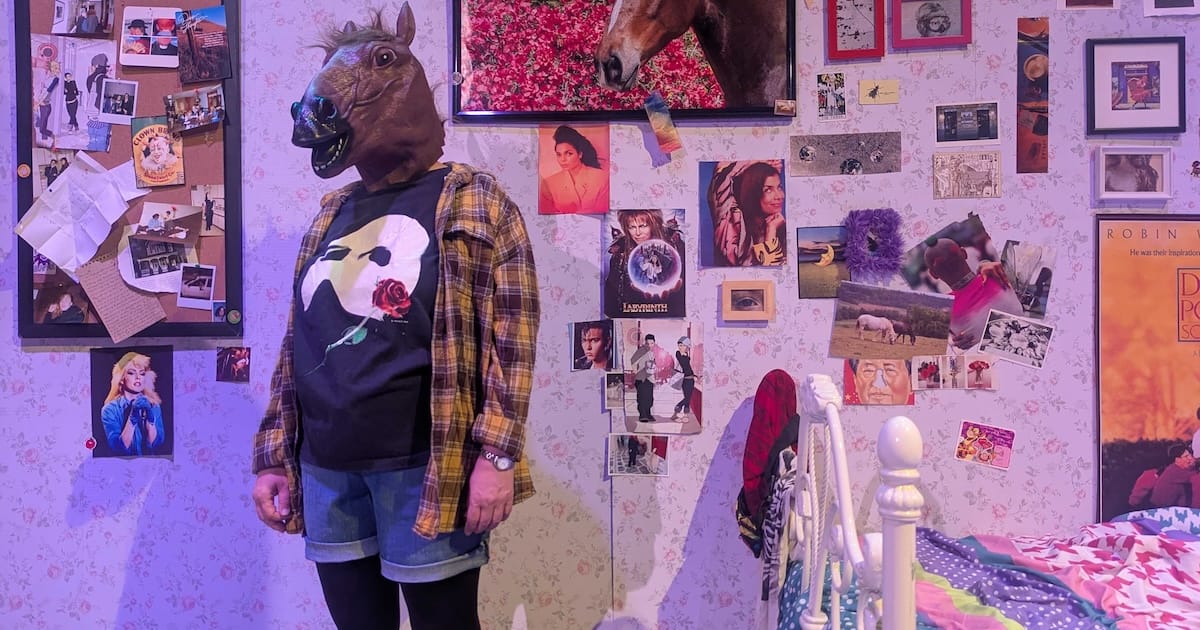
A horse named Markham — one of the character in Buntport’s new show ‘Ths Is the Day ’91.’ | Photo: Buntport Theater
Smart ideas in search of sharper shape
The problem is that the show’s central action remains frustratingly theoretical for too long. The characters have gathered to rebreak their childhood record, yet the play delays clearly explaining what that record is and why they are there.
If you already know the premise, the early business with test throws and preparation makes sense. Without that context, as one member of the group I attended with did not have, you may spend the first 40 minutes scratching your head before the characters explicitly state that they are here to break the Guinness World Record for the most stuffed animals caught in a minute while blindfolded.
Even once the record is fully identified, the play does not shift into the comic machinery that the setup seems to promise. Instead, the characters circle through conversations about memory, physics class, whether a McLean Deluxe can be accurately recreated and what it means to attempt the same act as adults that once defined them as children. These are not bad subjects. In fact, many of them are rich subjects for Buntport, a company whose work often thrives on taking a goofy conceit seriously enough to reveal something tender underneath.
However, the balance feels off. The play keeps gesturing toward the absurd delight of the record without giving the audience enough of the record itself. We hear about the attempt. We watch them prepare for the attempt. We watch them avoid the attempt. But the actual physical event is saved until the very end, and by then, the production has spent so much time delaying its own payoff that the payoff cannot carry all the weight placed on it.
That is especially frustrating because the premise has obvious theatrical potential. A group of adults trying to reclaim a childhood Guinness record by catching small stuffed animals while blindfolded should be a gift to performers as precise and funny as Duggan, Rollman and Colonna. It could build through failed practice runs, shifting rules, escalating desperation and the bodily comedy of people realizing they are no longer teenagers. Instead, much of This Is The Day ’91 keeps its funniest idea off to the side.
The recurring line “This is supposed to be fun” becomes both a character refrain and, unintentionally, a critique of the show. The phrase lands because these characters desperately want the past to produce the same feeling it once did, but it also points to what is missing from the production. While the play is often thoughtful, it is rarely as much fun as its setup suggests it should be.
The final attempt at the record does introduce a more active comic image, particularly as Kaelyn begins breaking down in the middle of the effort. By then, however, the stuffed animals had been grounded for far too long, and the play never quite shows the joy these characters keep insisting they came to recover.
That, more than the absence of a clean triumph, is what makes the ending feel unsatisfying. They do not need to break the record. They do not even need to recreate the past exactly. The play’s own ideas suggest that they cannot. What it needs is a clearer glimpse of what happens after they stop trying to make the moment identical and start finding a new version of pleasure in it.
A near miss from a singular company
Buntport remains one of Colorado’s most distinctive theatre companies, and even a lesser Buntport show contains pleasures few other groups could generate. The visible seams, oddball logic, handmade theatricality and willingness to chase a ridiculous idea toward existential questions are all present in This Is The Day ’91. The production has an evocative design, a strong ensemble and an appealingly weird premise that could only have come from this group.
Having said that, this one just doesn’t quite work. It has the bones of a great Buntport comedy, yet it never fully animates them. The show’s reflections on memory, friendship and artistic aging are thoughtful, but its comic engine sputters. By the time the stuffed animals finally start flying, the audience has spent too much of the evening waiting for the play to catch up with itself.
For longtime fans, This Is The Day ’91 may still hold interest as a witty, meta-theatrical meditation from a company entering a new chapter. But as a comedy, it feels like a terrific premise tossed into the air and not quite caught.

An award-winning Colorado arts and culture reporter originally from Mineola, Texas. Tresca is the chief theatre critic for OnStage Colorado and managing editor of OnScreen Colorado. He’s the editor of Bucket List Community News, a contributor to Denver Westword and Estes Valley Voice, a resident storyteller for the Bonfils-Stanton Foundation and the co-host of the OnStage Colorado Podcast.

Leave A Comment