
Colorado Shakespeare Festival’s new Julius Caesar riff needs to give its peripheral Romans more room to lead.
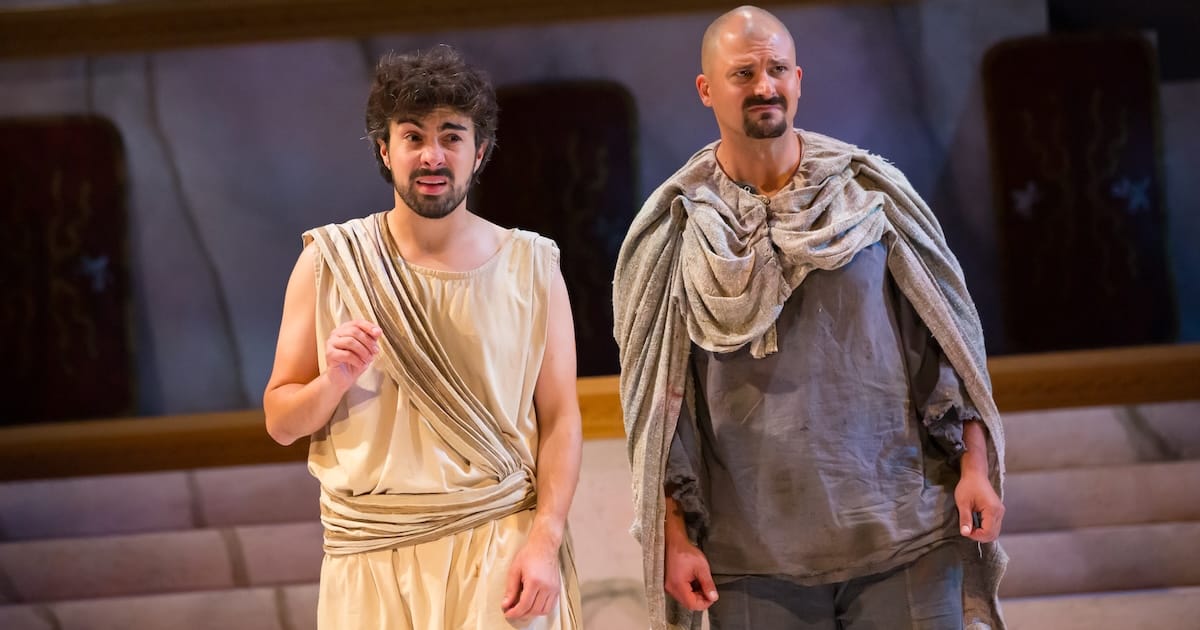
When Alexander Quiñones enters Colorado Shakespeare Festival’s Friends/Romans/Countrymen, monumental columns tower over him, marble stairs climb toward the heavens and heroic music promises the arrival of someone important.
Then Quiñones’ Virgil begins sweeping the street.
The contrast neatly establishes the promise of David Davalos’ world-premiere comedy: retelling Julius Caesar through the eyes of ordinary Romans who clean up after great men who believe history belongs to them. Yet across two and a half hours, Davalos repeatedly surrenders that perspective to Caesar and his circle. Although the peripheral figures may receive top billing, the play’s richest scenes still belong to the emperor.
Searching Shakespeare’s margins
Davalos, whose Wittenberg similarly placed famous figures inside an irreverent historical remix, imagines Shakespeare’s unnamed soothsayer as Virgil, a struggling poet with prophetic visions. Xenarchus, Virgil’s skeptical new sanitation partner based on the Greek philosopher, is also not a character who appears under that name in Julius Caesar. Davalos introduces the characters as coworkers with aspirations beyond their current cleaning jobs.
Caesar enters shortly after they meet on the Roman street, and Virgil warns him about the Ides of March. Virgil subsequently discovers the assassination plot but is forced to swear to Jupiter that he will not inform Caesar. Forced to wrestle with whether prophecy can change the future or merely reveal it, he eventually becomes entangled with Caesar’s heir, Octavius, helping set the Roman Empire in motion.
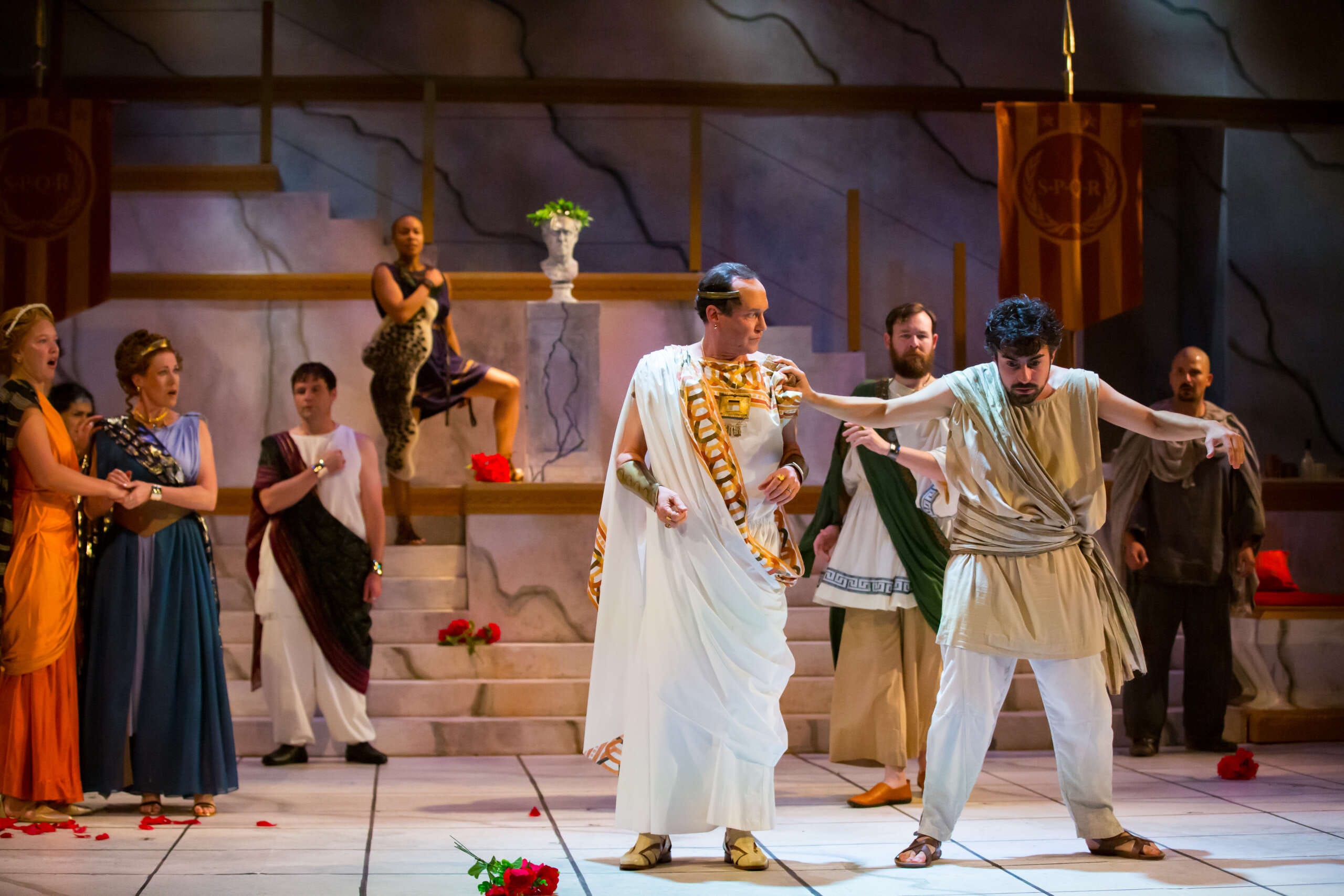
Koral Jackson (Portia), Laurie Keith (Calpurnia), Benjamin Reigel (Cassius), Antoinette Robinson (Antony), Joe Hilsee (Caesar), Matthew Murry (Casca), Alexander Quiñones (Virgil) and Jihad Milhem (Xenarchus) in Friends/Romans/Countrymen. | Photo: Jennifer Koskinen
The play positions Xenarchus (Jihad Milhem) as a rationalist counterweight. In theory, the dreamer and philosopher could debate whether history follows divine design or whether people impose patterns upon random events. In practice, Davalos has written Virgil a journey and Xenarchus a collection of punchlines. Quips such as “When in Rome” and “What the Zeus?” generate little momentum and reveal even less about the man delivering them.
Quiñones gives Virgil an openhearted earnestness that helps his dense verse land clearly. He makes the poet’s faith feel vulnerable rather than foolish, particularly when Virgil realizes that divine knowledge has not granted him the power to prevent catastrophe. Milhem’s drier presence could create productive friction, but director Tim Orr never establishes a sufficiently dynamic bond between the pair. They often appear to occupy separate comic worlds rather than a shared adventure.
That imbalance becomes more apparent whenever they disappear.
Long first-act passages follow Caesar and Calpurnia to dinner with Lepidus and Junia, then descend into a basement where the conspirators rehearse their assassination. These scenes feature lively writing, but they also take Virgil and Xenarchus out of their own play for long stretches before their relationship takes root.
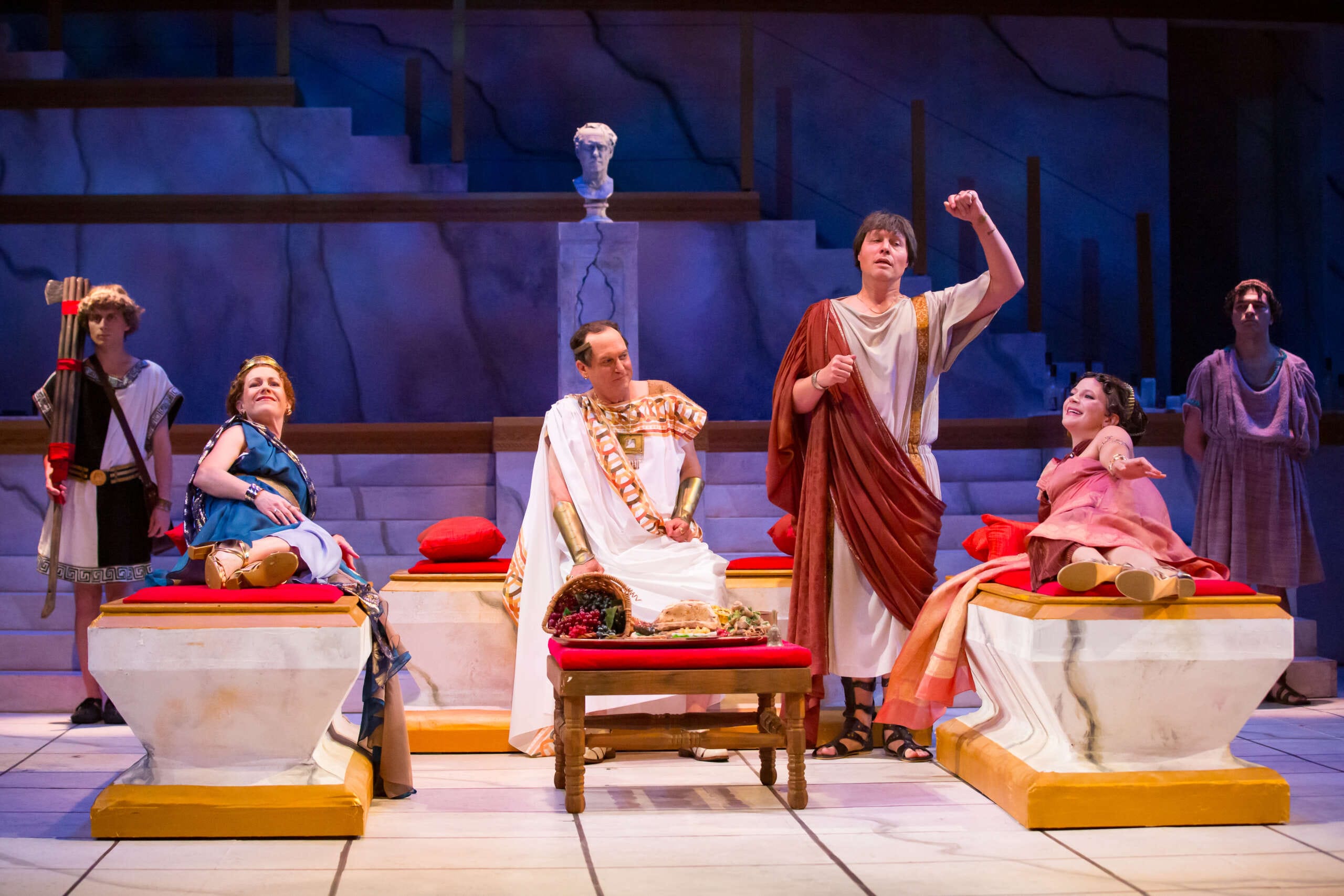
Tyler Cox (Lictor), Laurie Keith (Calpurnia), Joe Hilsee (Caesar), Adam Schroeder (Lepidus), Madison Taylor (Junia) and Kai Symons (Camio) in Friends/Romans/Countrymen. | Photo: Jennifer Koskinen
Caesar reclaims the spotlight
Joe Hilsee’s Caesar benefits most from the detours. Hilsee finds a marvelous mixture of imperial certainty, bruised vanity and weary self-awareness. His Caesar expects the world to accommodate him yet seems exhausted by the ceremonies required to maintain that authority. A second-act appearance as Caesar’s ghost is the production’s comic high point. He looks at his murder with surprising satisfaction: after surviving armies across the known world, only Romans he helped train were capable of killing him.
Tyler Cox likewise gives Octavius a compellingly alert intelligence. Where Caesar dismisses warnings, Cox’s watchful successor recognizes that signs can become instruments of power. That distinction clarifies Davalos’ strongest idea: everyone claims to serve Rome, but “Rome” means peace to Virgil, republican liberty to the conspirators, personal destiny to Caesar and political opportunity to Octavius.
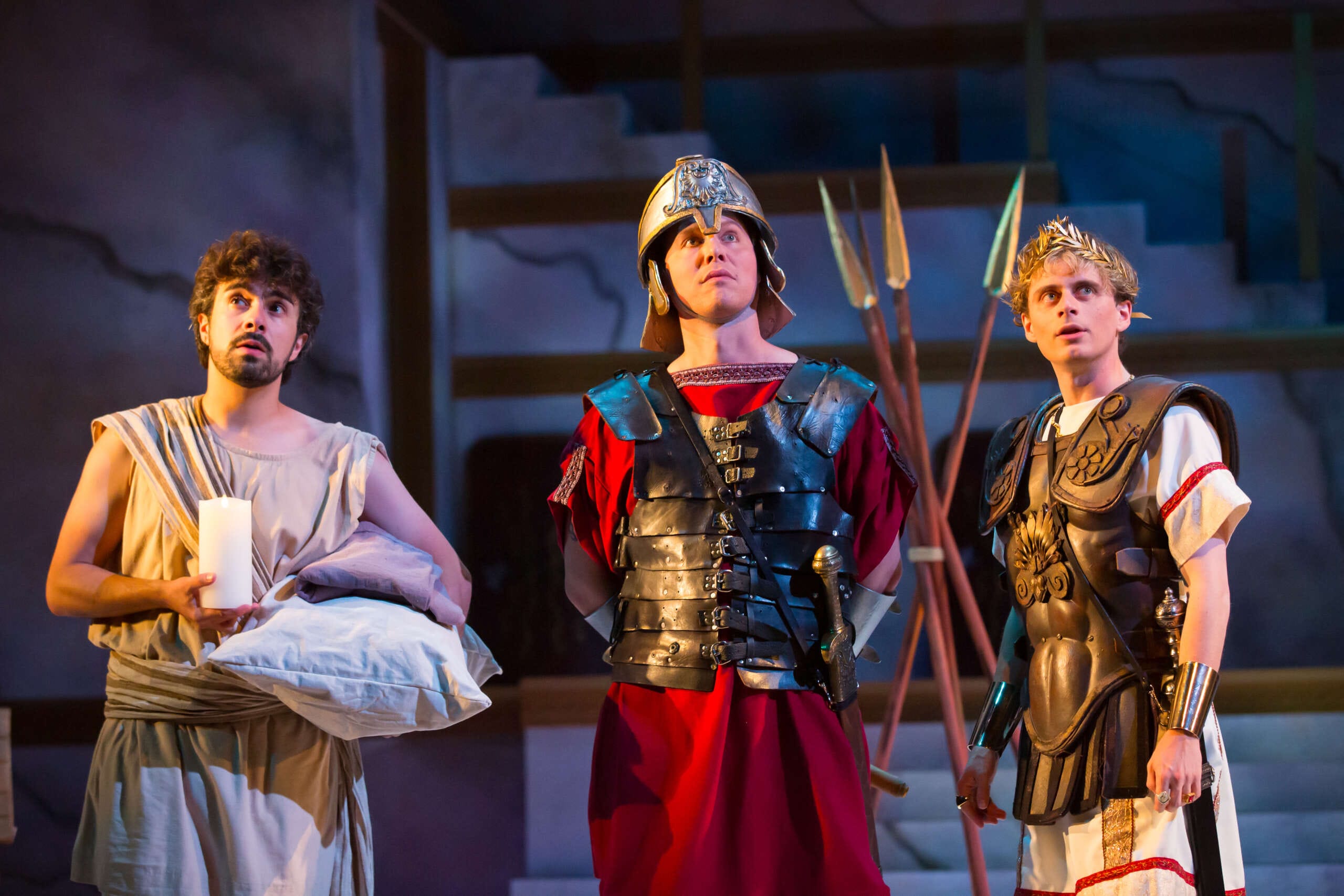
Alexander Quiñones (Virgil), Adam Schroeder (Agrippa) and Tyler Cox (Octavius) in Friends/Romans/Countrymen at the Colorado Shakespeare Festival. | Photo: Jennifer Koskinen
The production looks strongest when those competing visions fill the stage. Kevin Nelson’s imposing set, shared with CSF’s Julius Caesar, dwarfs sanitation workers and senators alike. Its scale physically expresses how small individuals appear beside the history they are trying to redirect.
Benjamin Reigel’s fight choreography turns Caesar’s assassination into an amusingly frantic struggle. As Mark Antony is distracted elsewhere, Hilsee’s Caesar twists, ducks and resists behind him, making the famous murder look less like solemn destiny than a plan barely held together by panic. Orr handles these crowded sequences with confidence, keeping bodies and competing points of attention legible across the vast space.
Still, the production’s energy spikes whenever Caesar returns and drains when the purported protagonists resume debating what his story means. By the time Virgil accepts that his calling is to chronicle rather than change history, Davalos has gestured toward a fascinating origin story: the making of the poet who will transform Rome’s violence into national mythology. The script does not spend enough time showing that transformation.
As a world premiere, Friends/Romans/Countrymen contains the foundation of a sharper play. Davalos has found provocative questions in the margins of Shakespeare: Who gets to interpret history after powerful men spill the blood? What good are warnings when nobody listens or when fate has already decided the outcome? Now he needs to trust the outsiders he placed there.
Virgil and Xenarchus spend the play searching for meaning in signs that Rome’s rulers ignore, exploit or misunderstand. Until Davalos allows them to shape the drama as decisively as Caesar shapes history, Friends/Romans/Countrymen will remain caught in the same contradiction as its heroes: able to recognize its destiny without fully finding the means to reach it.

An award-winning Colorado arts and culture reporter originally from Mineola, Texas. Tresca is the chief theatre critic for OnStage Colorado and managing editor of OnScreen Colorado. He’s the editor of Bucket List Community News, a contributor to Denver Westword and Estes Valley Voice, a resident storyteller for the Bonfils-Stanton Foundation and the co-host of the OnStage Colorado Podcast.

Leave A Comment