
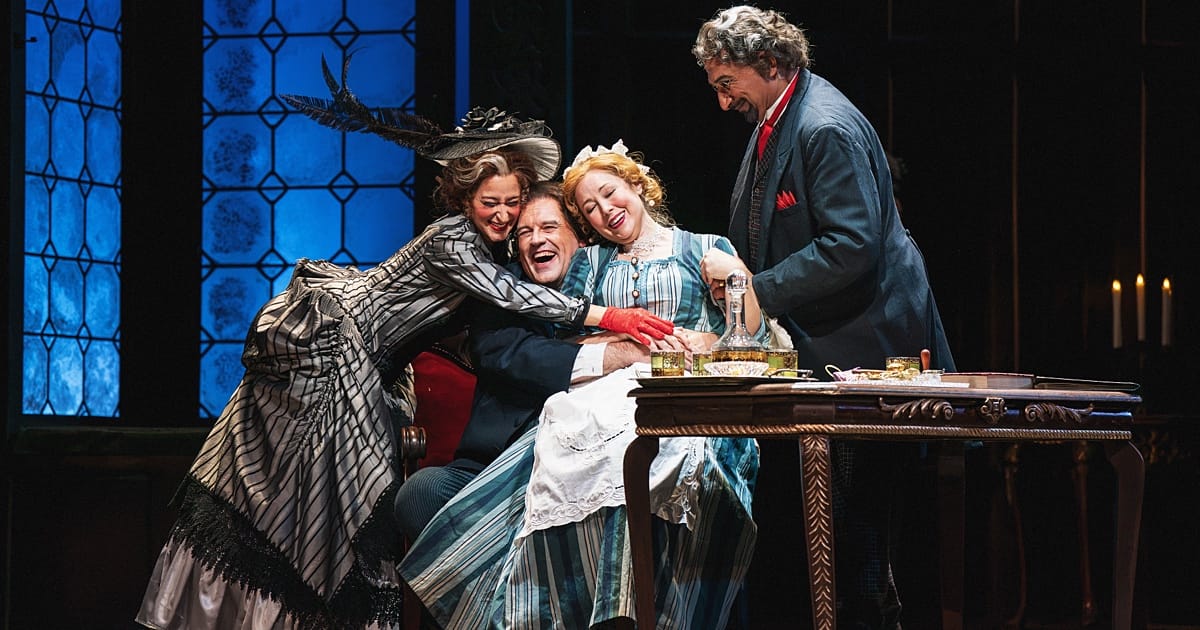
Mozart’s The Marriage of Figaro opens the company’s season as a musical and theatrical triumph.
Last year, Central City Opera offered a delightful production of Rossini’s The Barber of Seville, so it’s appropriate that this year the company opens its current season with Mozart’s The Marriage of Figaro. Figaro is a follow-on of sorts to Barber in that both operas share three main characters: the slightly buffoonish barber Figaro and Count Almaviva and his lover Rosina, now his Countess. Like last year’s Barber, Figaro is a musical and theatrical triumph, another diamond in Central City Opera’s crown of operatic jewels.
Both Barber and Figaro are staples of the opera canon, and with good reason. The music in both, although by different composers, is soaringly beautiful, and both contain enough energy to heat an entire Spanish villa with our laughter. But there is one very big difference. Barber is pure opera buffa, featuring lighthearted comedy with relatable situations, while Figaro is essentially buffa but with tragic elements — in this case the philandering of Count Almaviva and the heartbreak it causes his wife.
Figaro’s story is typically operatic, full of romantic comings and goings, surprise family connections and tests of marital fidelity. The action takes place on the day of Figaro’s wedding to Susanna, the Countess’s maid. But the Count is fixated on Susanna, wishing to exercise his droit de seigneur (the feudal right of a lord to sleep with a vassal’s wife on her wedding night). Meanwhile, the adolescent Cherubino (a trouser role sung by a mezzo-soprano) chases anything in skirts but focuses especially on the Countess. There are several other subplots, but it’s fairly easy to keep track of them in Central City Opera’s production.
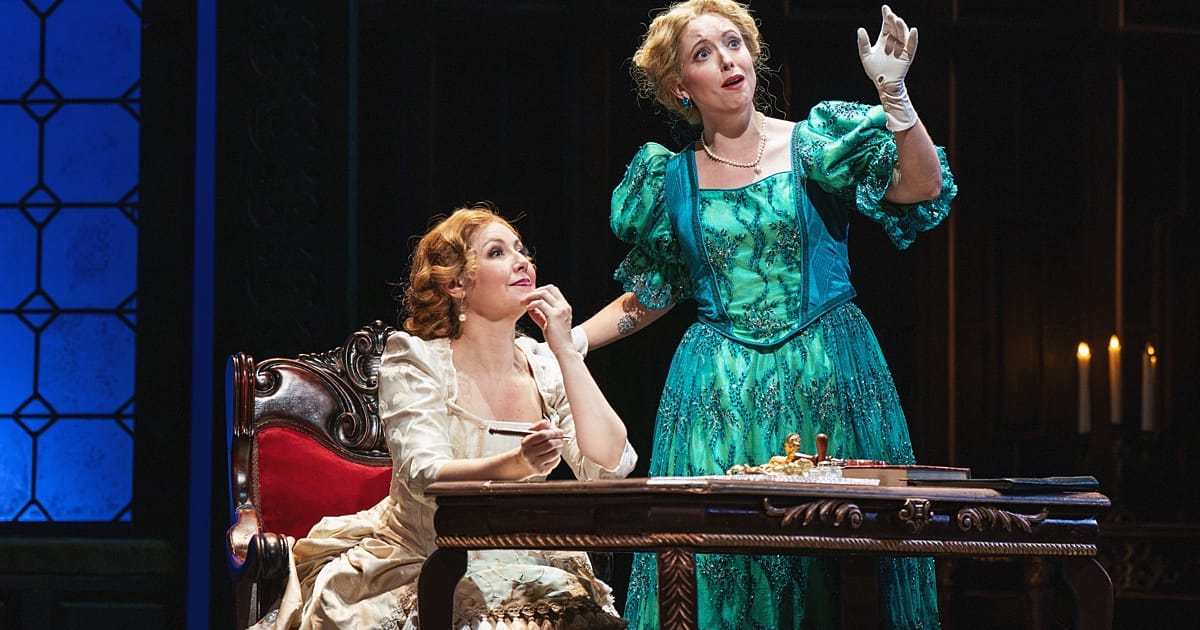
‘The Marriage of Figaro’ plays through Aug. 2 in Central City. | Photo: Amanda Tipton Photography
Challenging material
The juxtaposition of Figaro’s comic and tragic elements poses a major challenge for any director. The situation of the Countess is truly tragic, and Mozart and his librettist Lorenzo Da Ponte give her two opportunities to express the profound pain of her husband’s philandering. In “Dove sono” in particular, Mozart gives her what is, to my mind, the most heartrending aria in opera. Standing alone in the villa’s drawing room, she pours out her heart at the anguish of being rejected by the husband she loves so deeply. The aria is so powerful and haunting — sung with great feeling by Erica Petrocelli here — that on occasion I have actually been brought to tears seeing or listening to it.

The major directing challenge of Figaro is how to keep the raucous humor going while making the tragic elements feel real and connected to the larger narrative. Any production’s success at this depends partly on the characterization of the Count. In most productions I have seen, he is an appropriately regal presence caught up in the hijinks almost despite himself. But here he is essentially a buffoon, and as a result it is hard to take his scheming to seduce Susanna seriously. Only in his famous third-act aria does he radiate the power he exerts over his servants; up to that point, he seems as caught up in the story’s silliness as all the other characters. In all fairness, as the Count, Luke Sutliff’s booming baritone voice breaks through the sight gags whenever he has a chance to let loose vocally — just as it did last year when he sang the lead role in Barber.
Another challenge of Figaro is its length. The original 1786 production had four acts with three intermissions and ran four hours. Today, virtually all opera companies shorten it to three hours or so. There are different ways to do this. At Central City, the company’s changes include faster tempi, hence faster physical action; one intermission, with pauses between Acts 1 and 2 and between Acts 3 and 4; and the deletion of some musical repetitions (Mozart loved repetitions). Having seen a four-hour version years ago and several shorter productions, I think Central City’s version works very well, retaining dramatic charm without giving short shrift to the glorious singing and music.
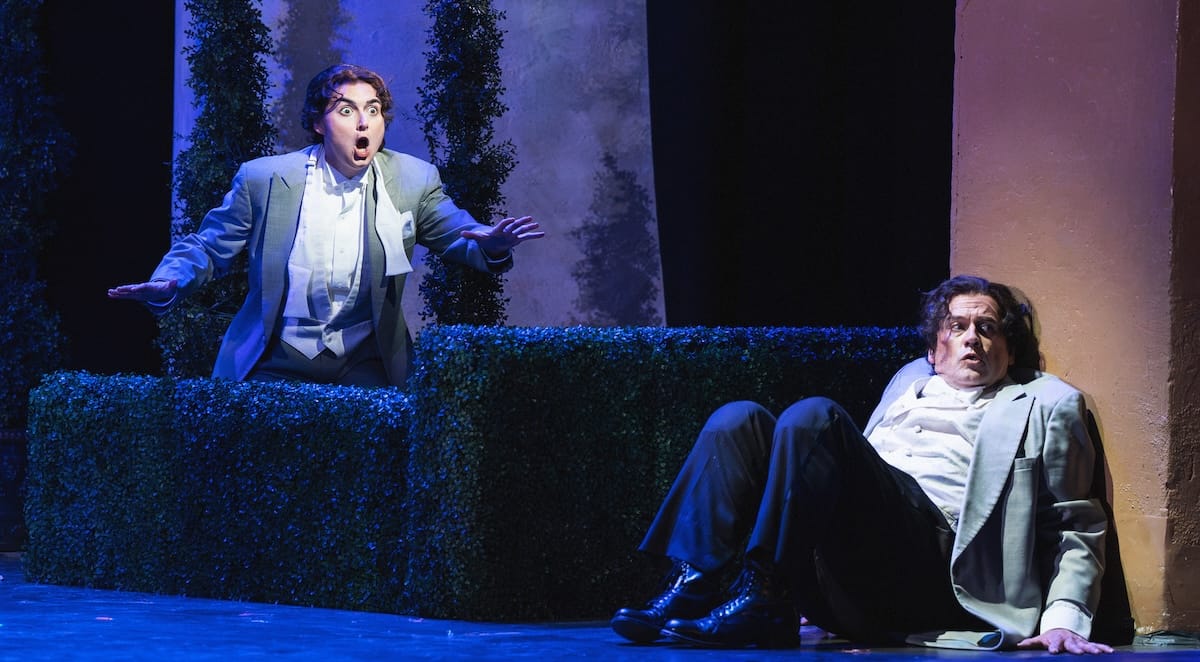
Photo: Amanda Tipton Photography
Top talent
As it always does, Central City Opera continually finds singers, musicians and production teams that together create first-rate operas capable of transporting us to other worlds, other cultures and other experiences. Virtually every singer in this Figaro can act as well as she or he sings; apart from conveying character and emotion, the physical comedy here often requires extreme physical feats. Maureen McKay as Susanna and Andrew Wilkowske as Figaro are to be especially lauded for their ability to roll around on the floor (several times) while singing the crystalline tones of Mozart’s transcendent score.
Like McKay and Wilkowske, everyone else in the cast is pitch-perfect in his or her role, and the voices of the singers blend beautifully in their solos, duets, trios and larger ensembles. For example, McKay and Petrocelli have exactly the right balance in their soprano voices — light versus richer — to make clear the differences in their ages and status. Every other member of the cast deserves kudos as well; with 11 solo roles, this is quite an accomplishment. The company chorus is also excellent; although it doesn’t have a large role, it adds both beautiful sound and heft to the cast.
Under conductor Marcello Cormio, the orchestra easily manages the faster tempi of this production, never losing the ethereal beauty of Mozart’s score. There is always the symmetry, emotional depth and elegance of Mozart’s music, and the feeling it takes for every musician to play it.
In reviving Madeline Boyd’s towering set from the company’s 2014 Figaro, scenic designer Nora Marlow Smith brings the Central City Opera House stage to life as a grand Spanish villa. Through the efforts of all the other members of the production team — and of course the company’s administration — this is a wonderful reminder that great opera can be and is presented every summer in Central City, Colorado.
Alice Kaderlan is a long-time dance and theatre critic and general arts writer. She has written for newspapers and online news sites in Seattle, Washington D.C., Pittsburgh and other cities for more than 40 years. She has also appeared on various public radio stations including WAMU-FM in D.C. and KUOW in Seattle and covered arts for NPR. She currently lives and writes in Denver.


Leave A Comment